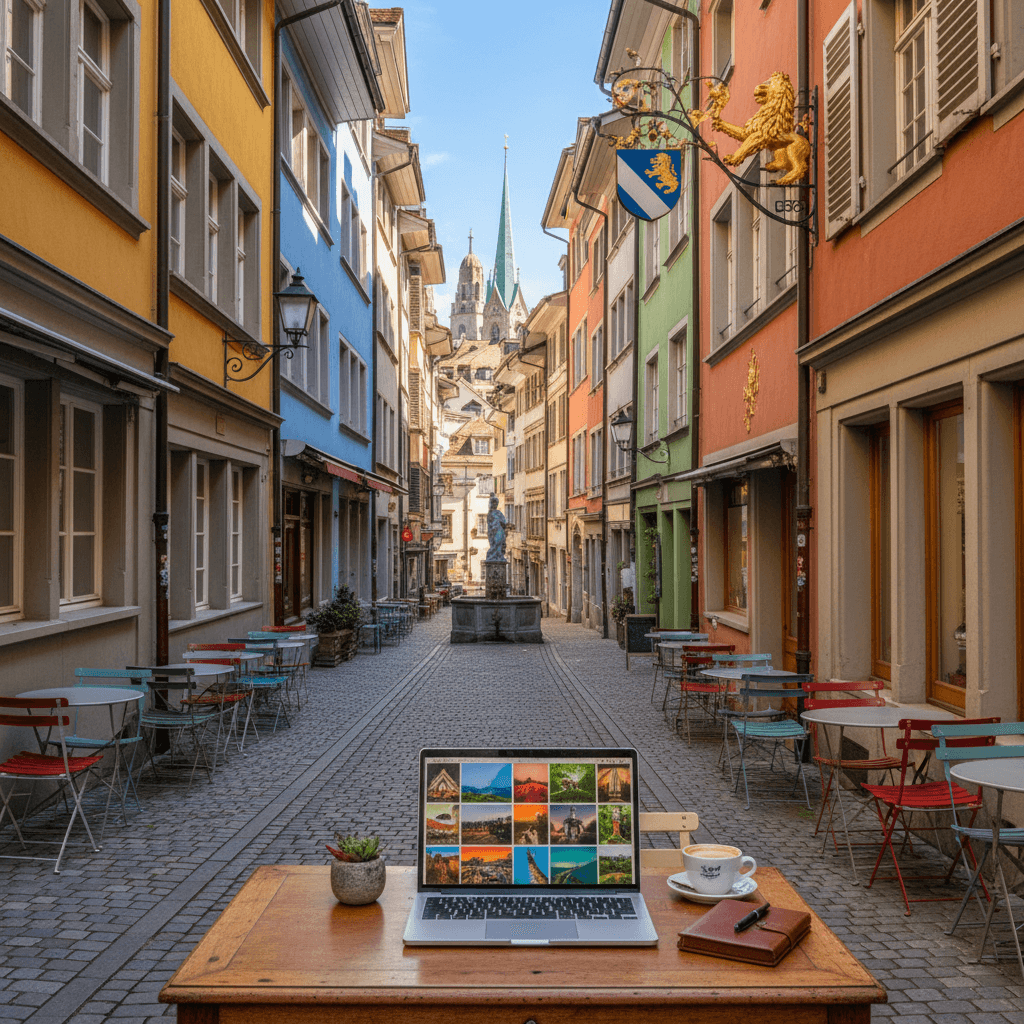
Zurich
🇨🇭 Switzerland
Zurich doesn't ease you in gently. You step off the train at Hauptbahnhof and the city hits you immediately: the smell of fresh pretzels from the station bakeries, cold Alpine air cutting through the concourse and an almost eerie sense of order that takes a few days to stop noticing. Everything runs. The trams are on time, the streets are clean, the WiFi is fast. It's, honestly, a little unsettling if you're coming from somewhere more chaotic.
This is Switzerland's largest city, home to around 430,000 people and it functions as a serious financial capital without feeling like one at street level. Zurich West has gallery spaces and techno clubs sitting next to converted industrial lofts, the Langstrasse gets loud on weekends and the lake on a clear day looks almost implausibly beautiful, the Alps stacked up behind it like a screensaver nobody would believe is real.
What nomads love about Zurich is real: the internet is genuinely fast, public transport covers the whole city with Swiss-clock reliability and English gets you surprisingly far, turns out most locals under 50 are comfortable switching without making you feel bad about it. Safety isn't a concern in any serious way, solo travelers say it's one of the easiest cities they've worked from.
But the cost. That's the conversation every nomad has eventually, usually over a CHF 7 coffee. Budget at least CHF 4,000 a month if you want to live here without constant stress and that's not a lavish lifestyle, that's a modest apartment outside the center, groceries from Migros and the occasional dinner out. Switzerland has no digital nomad visa either, so your legal options are limited unless you're an EU citizen or working through a registered entity.
The city's personality, weirdly, is its biggest draw and its biggest friction point. Zurich is precise, a little reserved and deeply proud of its quality of life and that pride is justified. But it can feel impersonal when you first arrive, the social scene takes longer to crack than in cities where strangers talk to each other freely.
Give it two weeks. Most people who write Zurich off as cold and expensive end up quietly extending their stay.
Zurich is, frankly, one of the most expensive cities on the planet. Not cheap. Not "a bit pricey." We're talking a single person burning through CHF 1,900 to 2,000 a month before rent and rent alone in the city center averages CHF 2,900 for a one-bedroom, CHF 1,800-2,200 outside, which most nomads find genuinely shocking the first time they see a listing.
Budget another three months' rent upfront for the deposit, that's the standard expectation not a negotiation tactic, arguing about it will get you nowhere.
Food & Drink
- Street food or fast food: CHF 16 to 25 per meal
- Mid-range restaurant (two people): CHF 60 to 120 for a three-course meal
- Cappuccino: CHF 5.40, espresso around CHF 3.80
- Monthly groceries: CHF 400 to 600 if you're cooking at home and being sensible about it
Eating out adds up fast, most expats recommend cooking most nights and treating restaurants as an occasional thing rather than a daily habit. The grocery stores, turns out, are your best friend here.
Getting Around
- 24-hour Zurich Card: CHF 27, covers trams, buses, rail, boats and cable cars
- 72-hour Zurich Card: CHF 53
- Bike-sharing (PubliBike): CHF 2.90 for the first 30 minutes
Coworking
- Daily drop-in: CHF 16.20
- Monthly open space: CHF 145 to 225
- Dedicated desk: CHF 225 to 279
- Premium spaces like Spaces Bahnhofplatz: CHF 845 a month
Monthly Budget Reality Check
- Budget (excluding rent): CHF 1,900 to 2,000
- Mid-range (modest rent included): CHF 2,500 to 3,500
- Comfortable (quality apartment, dining out regularly): CHF 4,000 to 5,500
The honest takeaway is that Zurich rewards people who plan carefully and honestly punishes those who don't. If your remote income is under $4,000 a month, this city will stress you out, the math just doesn't work comfortably below that threshold.
Zurich's neighborhoods are, honestly, quite different from each other and picking the wrong one means overpaying for the wrong vibe. Here's where to actually land depending on why you're here.
Digital Nomads
Zurich West (Kreis 5) is the obvious answer. It's where the lofts, galleries and coworking spaces cluster, the streets smell faintly of coffee and spray paint and the crowd skews young, international and laptop-carrying. Eight minutes by train to the main station, so you're not sacrificing access for atmosphere. Rents run cheaper than the center, though "cheaper" in Zurich still means CHF 1,800 or more for a decent studio.
Oerlikon (Kreis 11) is the other strong pick, turns out, especially if you're flying in and out regularly since it sits close to the airport with solid tram connections everywhere. It's more corporate than cool, but the international community is thick here and finding short-term furnished apartments is genuinely easier than in other districts.
Expats
Most expats settle into Wiedikon or Altstetten (Kreis 9) within a few months. Wiedikon has that balanced feel: urban enough to walk to good restaurants, calm enough to actually sleep. Altstetten is the budget-conscious choice, it's practical and improving fast, good public transport, none of the premium you're paying for in Seefeld or Old Town.
Speaking of Seefeld: it's beautiful, the lake is right there, you can hear the water on a quiet morning. It's also expensive in a way that'll make your accountant wince. Skip it unless someone else is paying.
Families
Wiedikon works here too and so does Enge, which has a quieter residential feel without being cut off from the city. Families who want more space often push out to Thalwil or Kilchberg along the lake's western shore, where you get actual gardens and calmer streets, though the commute adds up fast.
Solo Travelers
Stay near Langstrasse or Zurich West. Langstrasse is loud on weekends, the bars don't quiet down until 3am and that's the point. Old Town is walkable and atmospheric but skews touristy, it's fine for a few nights, just don't expect to feel like a local there. Budget travelers should know that even "affordable" neighborhoods in Zurich aren't cheap, there's no way around it.
Zurich's internet is, honestly, some of the best you'll find anywhere in Europe. Coverage is blanket-solid across the city, speeds are fast enough that you'll never think about it and WiFi in cafes and coworking spaces is genuinely reliable rather than the usual coin-flip situation. Mobile data through the main carriers, Swisscom, Sunrise and UPC Cablecom, is equally strong, even underground on the tram.
For a SIM card, pick up a prepaid option at the airport or any carrier store in the city center. Travelers who don't want a physical SIM can grab an eSIM through Yesim or Holafly before they even land, which, surprisingly, tends to be cheaper than buying at the counter. If you need a pocket router for a short stay, ZurichWiFi rents them out.
Coworking Spaces
There are 55-plus coworking spaces in Zurich. That's a lot for a city this size and the quality is generally high across the board. Prices, though, are Zurich prices.
- Drop-in day pass: CHF 16 to 20 ($18 to 23), depending on the space
- Monthly open desk: CHF 145 to 225 ($165 to 256)
- Dedicated desk: CHF 225 to 279 ($256 to 317)
- Spaces Bahnhofplatz: CHF 845 ($960) per month for a dedicated desk, which is on the steeper end even by Zurich standards
- Regus: Multiple city locations with flexible contract terms; good if you need a professional address
Most nomads who stay longer than a week find a monthly open desk membership pays for itself fast, especially compared to buying coffee every few hours to justify a cafe seat.
Working From Cafes
Kraftwerk at Selnaustrasse 25 is the go-to. It's a converted industrial space, there are power outlets at most seats, the WiFi holds up under load and nobody rushes you out after one coffee. The coffee itself will run you CHF 5 to 7, which stings a little every time, you do get used to it eventually. Most other cafes in Zurich West and Kreis 5 are similarly laptop-tolerant, it's not the kind of city where staff hover impatiently.
Skip the cafes around Hauptbahnhof entirely. They're crowded, the WiFi is inconsistent and the atmosphere isn't exactly conducive to getting anything done.
Zurich is, honestly, one of the safest cities you'll ever spend time in. It scores around 76.6-76.7 out of 100 on the Numbeo safety index, which puts it comfortably among the world's safest major cities. Violent crime is rare enough that most long-term expats say they've never witnessed anything remotely threatening.
The main thing to watch for is petty theft. Pickpockets work the train station, Bahnhofstrasse and anywhere tourists cluster with their bags half-open and their eyes on their phones, so stay aware in those spots. It's not a serious problem by global standards, just the standard urban nuisance.
Solo female travelers rate Zurich 4.6 out of 5 for safety and that tracks with what most nomads report on the ground. Walking back from a late dinner or catching a tram after midnight doesn't feel sketchy, it feels like a quiet, well-lit European city going about its business. Public transport at night is safe, clean and punctual.
If something does go wrong, the main 24/7 police station is Urania-Wache, near the city center. Emergency numbers are straightforward:
- Ambulance: 144
- Police: 117
- Fire: 118
Response times average 8 to 12 minutes in urban areas and operators are multilingual, so a language barrier won't slow things down in a crisis.
Healthcare is where things get complicated. The quality is genuinely world-class, Switzerland's hospitals are modern, well-staffed and efficient, but the cost structure will catch you off guard if you're not prepared. Switzerland requires all residents to hold basic health insurance and even short-stay visitors are strongly advised to carry comprehensive travel health coverage before they arrive.
Treatment without insurance is, turns out, eye-wateringly expensive. A standard GP visit can run CHF 150 to 250 out of pocket and a hospital stay will generate a bill that ruins your month. Don't arrive assuming your home country coverage transfers cleanly, it usually doesn't.
Pharmacies are everywhere and well-stocked, pharmacists here are weirdly knowledgeable and will actually help you work through minor issues without pushing you toward a doctor visit. For anything more serious, the University Hospital Zurich (UniversitätsSpital Zürich) handles complex cases and has English-speaking staff throughout.
Bottom line: Zurich won't make you anxious about your physical safety, it'll make you anxious about your insurance paperwork.
Zurich's public transport is, honestly, one of the best-run systems you'll ever use. Trams, buses, trains, boats and even cable cars run on a single integrated network and they're almost never late. The tram is your default mode, it covers most of the city center efficiently and you'll hear that familiar bell every few minutes from pretty much anywhere in Kreis 1 through 5.
The Zurich Card is the cleanest option for short stays: CHF 29 for 24 hours of unlimited travel, CHF 56 for 72 hours. It covers everything on the network, no zone confusion, no ticket machines to figure out. Long-term visitors should look at monthly passes instead, which work out significantly cheaper if you're commuting daily.
Bikes are genuinely useful here. The city's flat enough near the lake that cycling doesn't feel like a punishment and PubliBike handles the rental side: CHF 3 for the first 30 minutes, then CHF 0.10 per minute after that. There are also free city bikes via Züri Rollt with refundable deposit, turns out most tourists don't know about them.
Walking in the center is completely viable. Kreis 1 (Old Town) is compact and pedestrian-friendly, you can cross most of it in 20 minutes on foot. The waterfront along the lake is a genuinely pleasant walk, especially in warmer months.
Taxis exist but aren't worth it for most trips. Rates are steep even by Zurich's standards and the tram will get you there almost as fast. Most expats stop using them after the first week.
For getting out of the city, Zurich Hauptbahnhof (the main train station) connects you to the rest of Switzerland fast. Basel in under an hour, Lucerne in 45 minutes, Bern in about an hour. The Swiss rail system is weirdly satisfying to use, everything connects, everything runs on time.
- 24-hour Zurich Card: CHF 29, covers all transport modes
- 72-hour Zurich Card: CHF 56
- PubliBike rental: CHF 3 for the first 30 minutes
- Free city bikes: Züri Rollt with refundable deposit
- ZVV app: Buy tickets, plan routes, track trams in real time
Download the ZVV app before you arrive, it's the one thing locals and nomads agree on.
German is Zurich's official language, specifically a dialect called Swiss German (Schweizerdeutsch) that's, honestly, almost incomprehensible even to native German speakers from Berlin or Munich. It sounds softer, more melodic, with a rhythm that catches you off guard the first time you hear it echoing through a tram car or across a cafe counter. Standard High German works fine in writing and formal settings, but locals speak Swiss German to each other, always.
The good news: English gets you surprisingly far. Most Zurichers in the city center, especially anyone under 50 working in finance, tech or hospitality, speaks fluent English, you won't feel stranded. Expats frequently report getting through entire weeks without speaking a word of German, which is convenient but can also make you feel oddly invisible after a while.
That said, making zero effort with the local language has a social cost. Zurichers aren't unfriendly, but they're reserved and walking into a neighborhood bakery and immediately speaking English reads as presumptuous to some locals. Learning a handful of Swiss German phrases goes a long way, even phonetically butchered attempts tend to land warmly.
Phrases Worth Knowing
- Grüezi: Standard greeting (formal, used constantly)
- Merci vielmal: Thank you very much (a Swiss-French hybrid that everyone uses)
- Tschüss: Goodbye (casual)
- Entschuldigung: Excuse me or sorry
- Sprechen Sie Englisch?: Do you speak English?
French and Italian are Switzerland's other national languages, they're not widely spoken in Zurich day-to-day but French turns out to be handy in upscale restaurants where menus skew heavily toward French culinary vocabulary. Don't expect it to replace German in any practical sense.
For communication apps, WhatsApp is dominant here, most locals use it over SMS. If you're joining any expat groups, coworking communities or neighborhood chats, that's where they'll be. Telegram has a smaller but active presence in the tech crowd.
One thing that surprises a lot of newcomers: Swiss German has no widely standardized written form, so texts, emails and signage are almost always in High German. You'll hear one language, read another. It's a small thing, but weirdly disorienting for the first few weeks.
Zurich doesn't have bad weather so much as it has four genuinely distinct seasons, each with real tradeoffs. You'll want to plan around them, not just show up and hope for the best.
Summer (June through August) is the obvious peak. Temperatures sit around 24-26°C (75-79°F), the lake smells faintly of sunscreen and cut grass and the city basically moves outdoors. Terraces fill up, people swim in the Limmat river and the mountains are fully accessible for day trips. It's also, honestly, when Zurich is at its most expensive and most crowded, so if you're staying longer than a week, shoulder season is smarter.
Spring and autumn are the sweet spots. April through May and September through October bring cooler temperatures, thinner crowds and the kind of crisp air that makes the lake views almost unreasonably good. Expats tend to agree that September is the best single month to be in Zurich, the summer heat has broken, the city's back in rhythm after the tourist season and the surrounding hills turn amber in a way that doesn't feel staged.
Winter is cold and frequently grey. December through February sees temperatures hovering around 0-4°C (32-39°F), with fog settling into the valley for days at a stretch, a phenomenon locals call Nebelmeer (sea of fog). It's not brutal cold, but the low light gets to people, frankly, more than the temperature does. The upside: ski resorts are a short train ride away, Christmas markets are genuinely atmospheric and the city is quieter than it'll be all year.
When to Visit by Purpose
- Best for outdoor activities: June to September
- Best for budget travelers: November, January, February (excluding Christmas week)
- Best overall balance: May or September
- Worst for weather: January to February, when the Nebelmeer can last weeks
- Busiest and priciest: July, August and the Christmas market period (late November through December)
Rainfall is spread pretty evenly across the year, so don't assume summer means dry. Pack a compact umbrella regardless of when you're going, it'll get used, turns out, more than you'd expect from a city this polished.
Zurich doesn't ease you in gently. It's expensive, efficient and expects you to keep up, so the sooner you understand how it actually works, the better your time here will be.
Money
Budget honestly. A single person spending carefully will still burn through CHF 1,900 a month before rent and a modest one-bedroom outside the center runs CHF 1,650 to 1,750. Most nomads, turns out, underestimate grocery costs until their first Migros receipt hits them, so cook at home when you can and treat restaurant meals as the occasional splurge they're priced to be. Landlords expect three months' deposit upfront, that's the standard expectation not a negotiation tactic, arguing about it will get you nowhere.
Getting Around
The public transport system is, honestly, one of the best things about living here. Trams, buses, trains and boats run on a single ticketing network, the 24-hour Zurich Card covers all of it for CHF 27. Don't bother with a car in the center. Walking works fine for most of the old town and PubliBike fills the gaps for CHF 2.90 for the first 30 minutes.
Connectivity
Internet speeds are fast. Weirdly fast. Coworking options range from CHF 145 a month for open-plan nomad desks up to CHF 1,200 for premium private setups. Kraftwerk at Selnaustrasse 25 is a solid cafe-style option that's genuinely laptop-friendly, not just tolerant. For mobile data, Swisscom and Sunrise both offer strong coverage across the city and into the surrounding areas.
Safety
Zurich is safe, don't let anyone convince you otherwise. Violent crime is rare to the point of being almost theoretical for most residents. The one real concern is petty theft around the main train station and Bahnhofstrasse, keep your bag in front of you in those areas and you'll be fine. Emergency services are reachable at 144 for ambulance, 117 for police.
A Few Things Nobody Tells You
- Shops close early: Most close by 7pm on weekdays, earlier on Saturdays and almost everything shuts Sunday.
- Recycling is serious: Zurich has a strict waste sorting system with fines for non-compliance.
- Noise rules: Quiet hours typically start at 10pm in residential buildings, including no laundry machines.
- Cash still matters: Some smaller shops and markets don't accept cards, carry a little CHF.
Need visa and immigration info for Switzerland?
🇨🇭 View Switzerland Country GuideNomad Haven
Your home away from home
Monthly Budget Estimates
More cities in Switzerland
Bern
🇨🇭 Switzerland
Basel
🇨🇭 Switzerland