Warsaw
🇵🇱 Poland
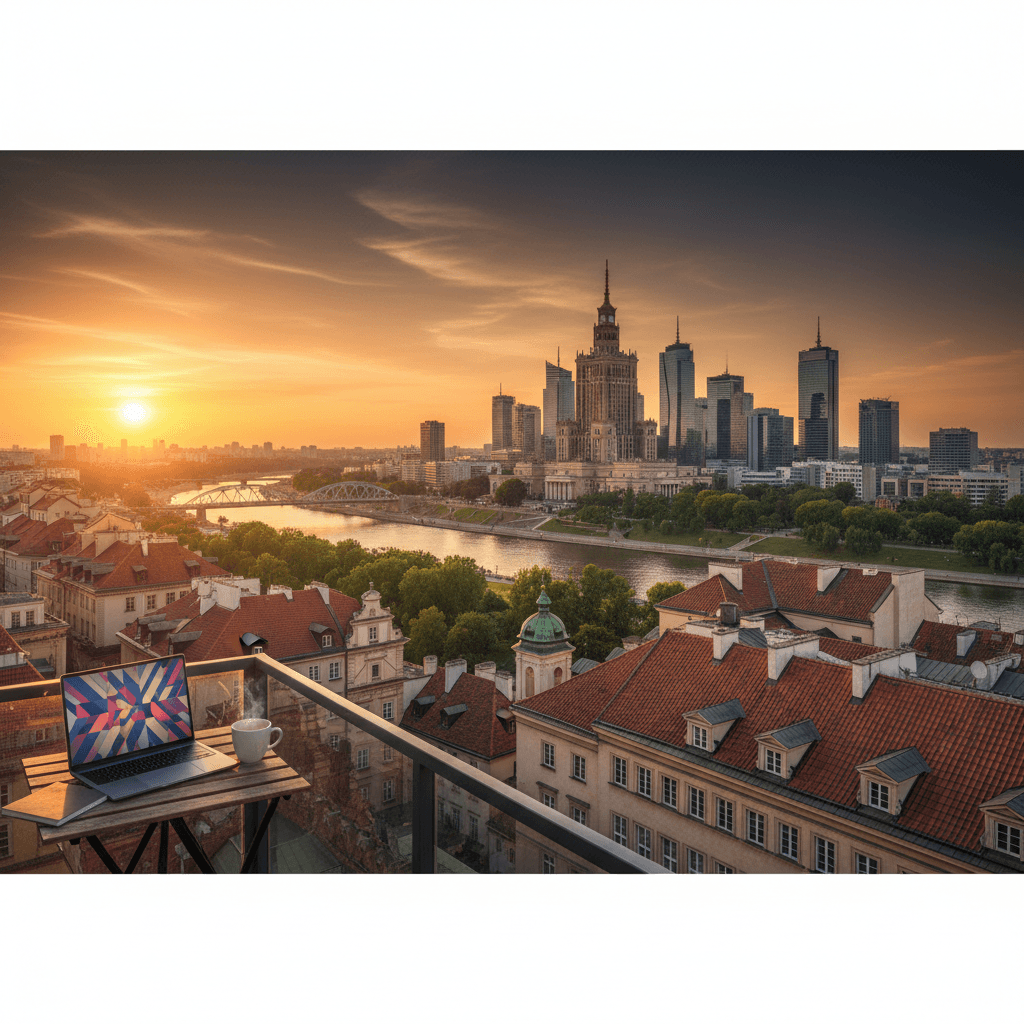
Warsaw doesn't ease you in gently. You step out of Centralna station and it hits you all at once: the cold bite of wind off the Vistula, the smell of fried zapiekanka from a street cart, tram bells cutting through traffic and this skyline that's, honestly, unlike anything else in Europe. Soviet-era blocks shoulder up against glass towers and somehow it works.
The city was leveled in WWII and rebuilt almost entirely from scratch, which gives it a psychological texture you don't get in Prague or Lisbon. Warsawians are proud of that and they should be, the resilience isn't just historical mythology, it shows up in how the city operates: fast, practical and a little impatient with people who can't keep up.
For nomads, the pitch is straightforward. You get EU-standard infrastructure at roughly half Western European prices, with Google and Microsoft offices anchoring a tech scene that makes career networking genuinely useful rather than performative. Coworking spaces like Brain Embassy and O4 are legit, fiber is fast and the English-speaking crowd under 40 is large enough that you won't feel stranded.
That said, it's not all upside. The winters are brutal, grey stretches from November through March where the sun barely shows and the cold turns gritty, it wears on people more than they expect. Some nomads also find the social scene a bit siloed; Warsaw's expat community is warm but small and outside that bubble, integration takes real effort.
The pace suits a certain type of traveler. If you're chasing slow mornings and beach sunsets, Warsaw will feel like a grind, the city moves fast and rewards people who move with it. But if you want a proper urban base with career infrastructure, good food (the steak tartare at Soul Kitchen is worth every złoty) and a cost of living that leaves room to actually save money, Warsaw makes a lot of sense.
Praga's street art, Mokotów's leafy streets, the Vistula cafes in summer when the whole city seems to exhale. There are moments here that are, turns out, genuinely hard to leave.
Warsaw isn't cheap by Eastern European standards, but it's, honestly, still a solid deal compared to Berlin or Amsterdam. Most nomads land around 4,800 PLN (~$1,300) a month for a comfortable mid-range life: a room in a shared flat, a few coworking days a week and enough złoty left over to eat out without stressing. Go solo in your own apartment and that number climbs fast.
Rents are where you feel the city's weight. A studio or 1-bedroom in Śródmieście runs 4,200 to 6,500 PLN, the central location costs you and the street noise outside your window at midnight will remind you of that daily. Mokotów is quieter and greener, with rents landing between 3,500 and 5,200 PLN. Praga Północ, turns out, is where the budget-conscious creative types have been landing, with shared rooms starting around 1,100 PLN and whole flats from 2,500 PLN, though gentrification is already doing its thing.
Here's a rough breakdown by budget tier:
- Budget (~3,000 PLN/$700): Shared room, cooking at home, public transit only
- Mid-range (~4,800 PLN/~$1,300): Shared flat, some dining out, occasional coworking
- Comfortable (~8,400 PLN/$1,960): Solo 1-bedroom, regular restaurants, full coworking membership
Food is genuinely cheap if you eat like a local. A Bar Mleczny lunch, the old-school milk bar canteens that survived communism and somehow taste better for it, runs 15 to 25 PLN. Mid-range spots charge 30 to 45 PLN for a proper sit-down meal, you can eat well without trying hard. Upscale dinners at places like Soul Kitchen will hit 150 to 250 PLN per person, which is frankly reasonable for the quality.
Coworking isn't free, obviously. Brain Embassy runs 800 PLN a month for a hot desk, WeWork sits at 900 PLN and O4 is the budget pick at 500 PLN. A monthly transit pass is around 160-170 PLN, the metro and trams are reliable enough that most nomads don't bother with Bolt unless it's late and cold, which in Warsaw means roughly November through March.
The math works. It's not Chiang Mai, but it's not London either.
Warsaw's neighborhoods are, honestly, more distinct than most European capitals give them credit for. Where you land shapes your entire experience, so it's worth thinking about who you are before you sign a lease.
Digital Nomads
Wola and Śródmieście are your two realistic options. Wola sits right on the metro line, Google and Microsoft have offices nearby and you'll find coworking spaces like Brain Embassy and O4 within walking distance of most apartments. Rents run 3,500 to 5,200 PLN for a one-bedroom, which isn't cheap, but the infrastructure justifies it.
Śródmieście is noisier, pricier (studios hit 4,200 to 6,500 PLN) and honestly a bit chaotic on weekends, but you're central to everything. Cafes like Stor let you work all day without anyone side-eyeing your laptop, internet is fast and the English-speaking crowd is thick enough that you won't feel isolated.
Expats
Most expats, turns out, end up in Mokotów. It's quieter, greener and feels noticeably more settled than the center. Rents are slightly lower than Śródmieście at 3,500 to 5,200 PLN, the parks are genuinely good and the neighborhood doesn't feel like it's trying too hard. Nightlife is thin here, don't expect much after 10pm.
Wola works too, especially if your company has an office in the tech corridor. The construction noise is real though, some blocks feel like a permanent building site.
Families
Żoliborz is the quiet, intellectual corner of Warsaw that families consistently recommend. It's the farthest from the center, which is its main drawback, but the streets are calm, the parks are well-kept and the schools draw a mix of Polish and international kids. Mokotów runs a close second for the same reasons.
Solo Travelers
Skip the center and go straight to Praga Północ. It's weirdly energetic in a way Śródmieście isn't, street art on every corner, bars along Ząbkowska that smell like spilled beer and cigarettes in the best possible way and rents that bottom out around 2,500 PLN. It's gentrifying fast, so the edge won't last forever, get there now.
Shared rooms across Praga run 1,100 to 1,800 PLN, which makes it the only Warsaw neighborhood where a genuinely tight budget actually works.
Warsaw's internet is, honestly, some of the best you'll find in Central Europe. Residential fiber runs 150+ Mbps as a baseline, coworking spaces regularly hit 500+ Mbps and most nomads report zero dead zones across the city center. Even the cafes pull their weight, spots like Stor and Relax are genuinely all-day-work-friendly, not just tolerated.
The coworking scene is solid and getting better. You've got real options across different budgets and the spaces aren't just desks in a room, they tend to attract tech workers, startup founders and the occasional Google or Microsoft employee, so the networking side of things is, turns out, a legitimate perk.
- Mindspace: 750 PLN/month. Polished, good community events, popular with international teams.
- Brain Embassy: 800 PLN/month. Well-equipped, strong Wi-Fi, tends to fill up fast.
- WeWork: 900 PLN/month. Priciest of the bunch, the brand recognition doesn't always justify the cost here.
For mobile data, Orange, Play and Plus all work well. A SIM starter kit runs 20-50 PLN and a 30GB monthly plan is around 30 PLN, which is weirdly cheap by Western standards. You'll need your passport to buy one in-store, Orange at Złote Tarasy or the airport is the easiest pickup. If you'd rather skip the counter entirely, Airalo's eSIM works before you even land.
One thing worth knowing: cafe work culture is more relaxed here than in Western Europe, nobody's rushing you out after one coffee, but some smaller spots get crowded by midday. Wola and Śródmieście have the densest concentration of coworking options, Praga Północ is catching up fast as the neighborhood gentrifies and attracts more creative freelancers.
Connectivity isn't the problem in Warsaw, it never really is, finding a space that fits your working style and budget is the actual decision. Most nomads land in one of the central hubs and don't look back.
Warsaw is, honestly, one of the safer capitals in Central Europe. Pickpockets work the usual spots: crowded metro cars, the Old Town tourist drag, busy weekend markets. Keep your phone in a front pocket and you'll rarely have a problem.
Praga Północ deserves a mention here. It's genuinely fine during the day, the street art scene draws crowds and the bars on Ząbkowska stay lively, but some of the side streets go dark and quiet fast after midnight and that shift in atmosphere is real. Stick to lit areas at night and you won't stress about it.
Protests occasionally flare up near the Sejm building in Śródmieście, nothing violent typically, but the crowds and police presence can clog transport for hours. Check local news before heading downtown on politically charged dates, it saves a headache.
For healthcare, Warsaw's genuinely well-equipped. EU citizens with an EHIC card can use the public NFZ system at no cost, though wait times at public hospitals can stretch into the frustrating range, think weeks for non-urgent appointments. The smell of those waiting rooms, antiseptic and stale coffee, will motivate you to go private.
Most nomads skip the public system entirely and go straight to LuxMed or Medicover. Both have English-speaking doctors, same-week appointments and clean modern clinics scattered across Mokotów and Śródmieście. Monthly insurance plans run 200 to 450 PLN depending on coverage, which is genuinely cheap for what you get compared to Western Europe or the US.
Pharmacies, called apteka, are everywhere. Seriously, there's one on almost every block in the center and pharmacists often speak enough English to help you figure out the right cold medicine without a prescription. For anything minor, just walk in.
- Emergency number: 112 (general), 999 (ambulance)
- Public hospitals: Free with EHIC, long waits for non-urgent care
- Private clinics: LuxMed, Medicover; 200 to 450 PLN/month insurance
- Pharmacies: Apteka, citywide, no prescription needed for most basics
Travelers consistently say Warsaw feels safer than expected, it's a city that doesn't require constant vigilance, just basic urban awareness.
Warsaw's public transport is, honestly, one of the better systems you'll find in Central Europe and it's cheap enough that most nomads don't bother thinking about alternatives. A single 75-minute ticket runs 4.40 PLN, a 24-hour pass is 15 PLN, and a monthly pass is around 160-170 PLN. That's a very reasonable rate to go anywhere in the city.
The metro has two lines, they cross at Świętokrzyska in the center and trams fill in the gaps pretty well across Śródmieście and Mokotów. Download Jakdojade before you land, it handles routing across metro, tram and bus in one place and most nomads say it makes the whole system click immediately. Tickets are validated on board or at metro gates, don't forget to stamp them, inspectors do check.
For rides, Bolt and Uber both work well here. Expect to pay 3-5 PLN per kilometer with a start fee around 8-12 PLN, so short hops across Śródmieście stay reasonable, longer cross-city trips add up fast. Airport runs to Chopin typically land between 40-60 PLN depending on traffic.
Speaking of the airport: skip the taxi queue. The S2/S3 train connects Chopin Airport to the city center in about 20 minutes for a few zloty, bus lines 175 and 188 cover the same route if you're not in a rush. Turns out most travelers overpay for a cab on day one simply because they didn't know the train existed.
- Metro/tram/bus monthly pass: around 160-170 PLN
- Single 75-min ticket: 4.40 PLN
- Bolt/Uber per km: 3-5 PLN
- Airport train (S2/S3): ~20 minutes to center
- Veturilo bike share: first 20 minutes free
- Bolt scooters: 3.50 PLN unlock plus per-minute rate
The center is walkable, weirdly more so than it looks on a map, especially between Śródmieście and the Vistula riverfront. Winter changes that calculation, cold wind off the river bites hard in January and icy tram stops aren't fun at 8am. Plan for it.
Veturilo bike share works well from spring through October, docked stations are everywhere, the first 20 minutes cost nothing. It's a genuinely good way to cover ground on a clear May morning when the city actually feels like itself.
Polish is, honestly, not the easiest language to pick up. It's full of consonant clusters that'll tie your tongue in knots and the grammar shifts depending on gender, case and context in ways that take months to untangle. Don't stress too much about it though, because Warsaw's younger population and anyone working in hospitality or retail speaks decent English, you'll get by fine in Śródmieście without a single Polish word.
That said, the moment you leave the central neighborhoods or need to deal with a landlord, a government office or an older local, the English drops off fast. Bureaucracy here is conducted almost entirely in Polish, it's not hostile, just indifferent to the fact that you don't speak it.
A few phrases go a long way. Locals genuinely appreciate the effort, even a mangled dziękuję (jen-KOO-yeh, "thank you") gets a warmer response than pointing and hoping.
- Dziękuję , thank you
- Proszę , please (also used when handing something over)
- Przepraszam , excuse me / sorry
- Nie mówię po polsku , I don't speak Polish
- Czy mówi Pan/Pani po angielsku? , Do you speak English?
For translation, Google Translate's camera mode is turns out genuinely useful here, especially for menus, apartment listings on OLX and those infuriating government forms. The Polish keyboard input works well too once you install it. FunEasyLearn has a solid Polish module with around 5,000 phrases if you want to go deeper, though most nomads don't bother past the basics.
Signage in Warsaw is Polish-only almost everywhere. Metro announcements, tram displays, pharmacy labels. You get used to it, the Jakdojade transit app at least shows stop names clearly and doesn't require you to read anything in a hurry.
One thing worth knowing: Poles don't typically volunteer English first. They're not unfriendly, they're just not assuming. Start with przepraszam and a smile, then ask if they speak English and the conversation usually opens right up. It's a small thing, frankly, but it makes a noticeable difference in how interactions go.
Warsaw's winters are, honestly, brutal. We're talking grey skies from November through March, temperatures that dip below -4°C in January and a kind of bone-deep cold that makes even a short walk to the metro feel like a commitment. Most nomads who arrive in December without a proper coat regret it immediately, the wind off the Vistula cuts through layers faster than you'd expect.
That said, the city genuinely earns its reputation in summer. June through August is the sweet spot, with highs around 22-24°C, long evenings and the Vistula riverbanks filling up with people eating, drinking and working from laptops outside the floating bars. It doesn't feel like a European capital grinding through tourist season, it feels like a city that actually enjoys itself.
Spring and autumn are worth considering too, they're just unpredictable. May can be stunning, warm enough for cafe terraces but cool enough that you're not sweating through a coworking session. October turns the parks in Mokotów and Łazienki a deep amber, it's genuinely one of the better months to be here. November, though? It collapses fast. The light disappears, the skies go flat white and it stays that way for months.
Summer thunderstorms are worth flagging. July and August bring short, sharp downpours, averaging 60-70mm a month, they blow in fast and soak you before you've registered what's happening. Keep a compact umbrella in your bag from June onward, you'll use it.
- Best months: June, July, August for warmth and social life; May and September for fewer crowds and lower short-term rental prices
- Worst months: January and February, dark, cold and genuinely depressing if you're sensitive to grey weather
- Average July high: 24°C / 75°F
- Average January low: -4°C / 25°F
- Rainy season: Summer thunderstorms peak in July; winter is dry but overcast
If you're testing Warsaw for the first time, book June or September, you'll see the city at its most functional and most livable. Arriving in January is a real test of character, some people love the moody atmosphere, most don't.
Get a SIM card on arrival. Orange is, honestly, the easiest option: pick one up at Złote Tarasy mall or the airport arrivals hall, 30GB runs about 31 PLN and you'll need your passport. If you'd rather skip the queue entirely, load an Airalo eSIM before you fly.
For banking, don't bother converting cash at home. Revolut or Wise will handle PLN at near-interbank rates and most Warsaw cafes, trams and shops are contactless-friendly, so you won't need much physical cash anyway. ATMs are everywhere, though the airport ones charge fees, so wait until you're in the city.
Finding an apartment takes a little patience, it's not as instant as some cities. Domkaspot and OLX.pl are the two platforms most nomads use; filter specifically for fiber internet and WFH-friendly listings, because older buildings can have genuinely terrible connectivity even if the neighborhood looks great on paper. Praga Północ and Wola offer the best value right now, Śródmieście costs more and the street noise at night is real.
A few customs worth knowing before you land:
- Sunday shopping: Most large stores are closed; Żabka convenience stores are your fallback and they're on practically every block.
- Tipping: 10% is standard at sit-down restaurants, you say the total you want to pay when handing over cash rather than waiting for change.
- Greetings: A firm handshake is the default in professional settings, don't skip it.
- Protests and marches: Warsaw sees political demonstrations fairly regularly; they're generally peaceful but worth avoiding if you stumble into one.
Getting around is, turns out, simpler than it looks. Download Jakdojade for real-time tram and metro routes, it's the app locals actually use. A monthly transit pass is around 160-170 PLN, which is weirdly cheap for a capital city. Bolt and Uber both work well for late nights when the metro stops running.
Day trips are genuinely worth building into your schedule. Kraków is 2.5 hours by PKP intercity train and costs almost nothing booked a few days ahead. Buy tickets through the PKP Intercity app, not at the station window, the queue there will eat your afternoon.
Need visa and immigration info for Poland?
🇵🇱 View Poland Country GuideNomad Haven
Your home away from home
Monthly Budget Estimates
More cities in Poland
Bydgoszcz
🇵🇱 Poland
Poznań
🇵🇱 Poland
Lublin
🇵🇱 Poland