Villa La Angostura
🇦🇷 Argentina
The Gardens of Patagonia
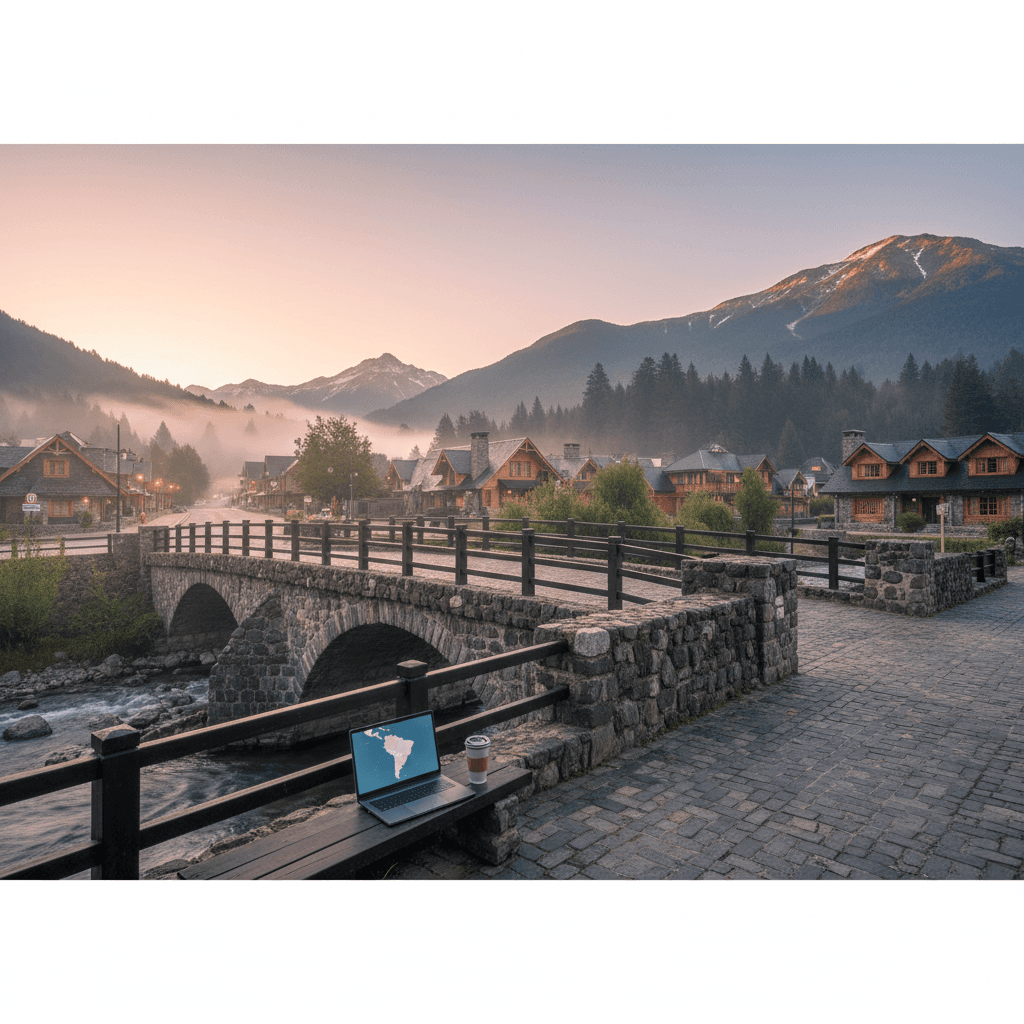
If Bariloche is the loud, energetic capital of the Lakes District, Villa La Angostura is its sophisticated, quiet younger sibling. Often called the Gardens of Patagonia, this town feels less like a rugged outpost and more like a carefully curated alpine village. It is tucked into the northern shores of Lago Nahuel Huapi, where the water is a deep, icy blue and the air smells permanently of pine needles and damp earth. For nomads, the draw here isn't a high-octane social scene; it's the chance to work from a wooden cabin while watching the mist roll off the mountains.
The aesthetic is strictly controlled by local building codes, which means you won't see any concrete eyesores or neon signs. Everything is stone, dark wood, and manicured gardens overflowing with roses and lupines. It creates a sense of being in a high-end mountain retreat, but without the pretension you might find in similar spots in the Swiss Alps. It is a place where the pace of life slows down to a crawl, and your biggest stress of the day is deciding which trail to hike before the sun sets.
A Different Kind of Nomad Life
Living here requires a shift in mindset. You won't find a dozen glass-walled coworking spaces or nightly networking mixers. Instead, the "office" is usually a corner table at a local chocolate shop or a deck overlooking the lake. Most nomads who settle here for a month or two are looking for deep work blocks and outdoor recovery. It is the kind of town where you spend your mornings crushing a project and your afternoons kayaking the crystal-clear waters of the Rio Correntoso, which is famously one of the shortest rivers in the world.
The vibe is decidedly cozy. When the southern winds pick up, the town retreats indoors to craft breweries and tea houses. There is a tangible sense of safety and community that makes it easy to leave your bike unlocked or walk home after a late dinner at one of the spots along the main drag, Avenida Arrayanes. It appeals to a more mature nomad crowd, often couples or solo travelers who have outgrown the hostel parties of Buenos Aires and want to reconnect with nature.
The Two Faces of the Villa
The town is essentially split into two main hubs. You have the town center, known as El Cruce, where the shops, pharmacies, and banks are clustered. This is the practical heart of the village. Then you have La Villa, the historic area near the port and the entrance to Los Arrayanes National Park. While the port area feels more like a postcard, most long-termers prefer staying closer to El Cruce for the convenience of being within walking distance of the supermarkets and the bus station.
- The Outdoor Lifestyle: The proximity to Los Arrayanes National Park means world-class trekking is literally at your doorstep. You can bike the 12-kilometer trail through the ancient forest or take a boat back from the peninsula if your legs give out.
- The Transit Hub: It serves as the gateway to the Road of the Seven Lakes. Being only 90 minutes from Bariloche, you have access to a major airport while maintaining your mountain solitude.
- The Seasonal Shift: The town transforms completely between seasons. Summer brings long days and lake swimming, while winter turns it into a base for the Cerro Bayo ski resort, located just 15 minutes from the center.
Ultimately, Villa La Angostura offers a rare balance. It provides enough infrastructure to keep a remote career on track while being remote enough to feel like a genuine escape. It is a place for those who prefer the sound of wind in the coihue trees over the sound of traffic, and who value a sunset over a nightclub.
The Cost of Living in Patagonia's Garden
Living in Villa La Angostura is a choice of lifestyle over budget optimization. While it doesn't carry the hefty price tag of global hubs like Zurich or New York, it's consistently one of the most expensive corners of Argentina. You're paying a premium for the Alpine scenery, the pristine lake views, and the safety that comes with a high end mountain village.
The local economy operates on a dual track. There is the official exchange rate and the "Blue Dollar" rate, which is the unofficial market rate. To make your money go further, you'll need to bring physical US Dollars and exchange them locally or use Western Union to pick up pesos. If you rely solely on international credit cards or ATMs, your costs will effectively double.
Monthly Budget Estimates
For a comfortable nomad lifestyle, expect to spend between $1,200 and $1,800 USD per month. This assumes you're using the parallel exchange rate and opting for a private rental rather than a shared hostel dorm. If you're looking for luxury lakefront living, that number can easily climb past $3,000 USD.
- One Bedroom Apartment (Monthly): $600 to $900 USD
- Cabaña or Tiny Home (Short term): $1,100 to $1,500 USD
- Dinner for two with wine: $35 to $50 USD
- Local craft beer: $3.50 to $5 USD
- Monthly Groceries: $250 to $350 USD
- Gym Membership: $30 to $45 USD
Housing and Neighborhoods
The rental market is tight, especially during the peak summer months of January and February and the winter ski season in July. Most nomads look for "Alquiler Temporario" (temporary rentals) because traditional three year leases are difficult for foreigners to secure without a local guarantor.
El Cruce (The Center) is where you'll find the most convenience. It's the heart of the town's commerce, meaning you can walk to the grocery store, the pharmacy, and the bus station. Prices here are moderate, but you trade the "forest vibe" for proximity to the main road.
Puerto Manzano is the upscale choice. It's a few miles outside of town and sits on a peninsula. It's filled with high end cabins and stunning architecture. You'll almost certainly need a rental car if you stay here, as it's a long walk to the nearest supermarket. Rent here is significantly higher, often quoted directly in USD.
Dining and Socializing
Eating out is one of the main pastimes here. The town is famous for its trout, deer, and wild boar dishes. While a high end dinner at a place like Tinto Bistro will dent your budget, you can find more affordable "minutas" (quick meals like schnitzel or pasta) at local rotisserias. Many nomads save money by shopping at supermarkets like La Anónima and cooking at home, as imported goods and specialty items carry a heavy "Patagonia tax" due to the logistics of trucking goods so far south.
Transportation Costs
Villa La Angostura is spread out. While the center is walkable, reaching the trailheads or the ski base at Cerro Bayo requires wheels. A local bus ticket is cheap, usually less than $1 USD, but schedules can be infrequent. Many expats find that renting a small car for $40 to $60 USD per day is a necessity for exploring the Seven Lakes Road or getting to Bariloche for major shopping trips.
The Digital Nomad Hub: El Cruce (Town Center)
If you need to be within walking distance of a reliable caffeine fix and a stable signal, El Cruce is your base. This is the commercial heart of Villa La Angostura, where the rustic Alpine architecture meets the practical needs of remote work. Most nomads gravitate here because it is the only part of town where you can realistically live without a car. You are steps away from the main bus terminal, which connects you to Bariloche and San Martin de los Andes.
The vibe is active but never frantic. You will find most of the town's breweries and cafes along Avenida Arrayanes. While dedicated coworking spaces are still a rarity in this corner of Patagonia, local cafes provide enough bandwidth for Zoom calls. Living here means you sacrifice a bit of that "isolated forest" feeling for the convenience of being near the grocery stores and the best empanada shops.
- Rent: Expect to pay between $600 and $900 USD for a modern one-bedroom apartment or a small studio.
- Vibe: Convenient, social, and walkable.
- Best for: Short-term stays and those without private transport.
The Expat Retreat: Puerto Manzano
For those planning to stay a few months or longer, Puerto Manzano is the gold standard. Located about 7 kilometers south of the center, this neighborhood is famous for its stunning architecture and peninsula views. It is much quieter than El Cruce and feels like a true mountain escape. Expats often choose this area because the houses are larger, often featuring wood-burning stoves and floor-to-ceiling windows overlooking the lake.
You will definitely need a rental car or a local "remis" (private taxi) to get around, as the walk into town is long and hilly. However, the trade-off is direct access to some of the best beaches on Lago Nahuel Huapi. It is a tight-knit community where neighbors actually know each other, making it easier to integrate if you speak a bit of Spanish.
- Rent: Larger cabins and houses typically range from $1,200 to $2,000 USD per month depending on lake proximity.
- Vibe: Upscale, residential, and surrounded by cypress forests.
- Best for: Long-term stays and those seeking privacy.
Families: Lomas del Correntoso
Families usually head toward Lomas del Correntoso or the areas near the Correntoso River. This neighborhood offers a great balance of safety and outdoor space. It is close to the Rio Correntoso, which is a local favorite for afternoon strolls and watching the sunset. The lots here are typically larger, giving kids plenty of room to run around outside.
The area is close enough to the local schools and the town center to be practical, but far enough away to avoid the summer tourist crowds that clog the main street. It feels like a genuine neighborhood rather than a tourist zone, which is a major plus for anyone trying to build a routine in Patagonia.
- Rent: Family-sized homes usually start around $1,100 USD.
- Vibe: Safe, quiet, and family-oriented.
- Best for: Parents who want a yard and easy lake access.
Solo Travelers and Adventurers: La Villa (The Port)
Not to be confused with the town center, La Villa is the historic area down by the piers and the entrance to Los Arrayanes National Park. This is the spot for solo travelers who want to be the first ones on the hiking trails every morning. It is a bit more rustic and "old world" than the rest of town, featuring the historic Messidor mansion nearby.
Living here puts you at the doorstep of the 12-kilometer trail through the Arrayanes forest. While there are fewer long-term rentals here, you can find small "hosterias" and tiny homes that cater to people who spend more time on the water than in front of a laptop. It is the most scenic part of the region, though you will have to commute to El Cruce for your main grocery runs.
- Rent: Tiny homes and loft apartments can be found for $700 to $1,000 USD.
- Vibe: Historic, scenic, and active.
- Best for: Hikers, photographers, and solo explorers.
Connectivity in the Garden of Patagonia
Villa La Angostura is a place where you come to disconnect from the grind, but unfortunately, sometimes you'll disconnect from the internet whether you want to or not. Because the town is tucked into the mountains and surrounded by dense forest, the infrastructure isn't quite as robust as what you'll find 90 minutes away in Bariloche. Most cabins and tiny homes rely on ADSL or fixed wireless connections that average between 10 Mbps and 25 Mbps. It’s plenty for emails and Slack, but you might find your video freezing during a heavy Zoom call if the wind picks up or the neighborhood is at peak usage.
Fiber optic is slowly rolling out through providers like Angostura Video Cable (AVC), but it is not a guarantee. If you are booking an Airbnb or a long term rental, always ask for a screenshot of a speed test before you commit. Power outages happen during winter storms or heavy spring winds, so having a backup plan is a requirement for anyone with a strict 9 to 5 schedule.
The Coworking Scene
You won't find a sprawling WeWork here. The coworking culture in Villa La Angostura is intimate and often doubles as a social hub. While dedicated shared offices are limited, the town offers a stable environment for those looking to escape their mountain cabin. It is smart to reach out to local spots via Instagram or WhatsApp a day ahead during the busy summer season to ensure availability.
For a more casual setup, many nomads head to the local cafes in the town center. These spots offer a "work friendly" vibe with decent WiFi and plenty of caffeine. Just keep in mind that "siesta" culture is real here; some smaller spots might close for a few hours in the afternoon, though the main cafes in the center usually stay open straight through.
Mobile Data and Backups
Since the local WiFi can be temperamental, a local SIM card is your best friend. Personal generally has the best coverage in the Neuquén province, followed by Movistar. You can pick up a SIM at a "kiosco" on the main street, Avenida Arrayanes, for a few dollars. Data packages are cheap, usually around $5 to $10 USD for several gigabytes, but don't expect 5G. You will mostly be working with 4G or LTE.
If you are planning to work from one of the more remote bays or a cabin deep in the forest, check the signal strength first. Moving just a few blocks can be the difference between a full signal and a total dead zone. Many remote workers now bring Starlink kits to Patagonia, as the clear southern sky makes for excellent satellite reception, bypassing the local infrastructure issues entirely.
Digital Nomad Hotspots
- Waldhaus: While it is technically a restaurant, the atmosphere is quiet during off peak hours and the lake views are unbeatable for low stress admin work.
Most nomads find that the best strategy is to front load their heavy uploads and meetings for the mornings when the networks are less congested. By the time the internet starts to lag in the late afternoon, it is usually a sign that you should close the laptop and head to the lake anyway.
A Peaceful Pocket of Patagonia
Villa La Angostura is frequently cited as one of the safest spots in Argentina. Because it is an upscale mountain village rather than a sprawling urban center, the frantic pace and petty crime common in Buenos Aires or even parts of Bariloche are virtually non-existent here. Most nomads find they can walk home from a brewery at 2:00 AM without a second thought. The main safety concerns are actually environmental rather than social, particularly if you are heading out into the national park alone.
The local police presence is subtle but consistent. You will see the provincial police patrolling the main drag, Avenida Arrayanes, especially during the high summer and winter seasons. While the risk of theft is low, it is still smart to keep your gear out of sight in rental cars at trailhead parking lots, as these can be opportunistic targets for "smash and grab" break-ins.
Healthcare Infrastructure
For a town of its size, the medical facilities are surprisingly capable, though they aren't designed for complex surgeries. The primary point of care is the Hospital Dr. Oscar Arraiz, located on Nahuel Huapi street. It handles emergencies, basic diagnostics, and general consultations. If you have a minor injury from hiking or a sudden illness, this is where you will head first.
Private clinics generally offer faster service and more personalized attention. If you encounter a serious medical emergency that requires specialized equipment or intensive care, you will likely be stabilized and then transported by ambulance to Bariloche, which is about 80 to 90 minutes away. Bariloche has world-class private facilities like the Sanatorio San Carlos that can handle almost any procedure.
Pharmacies and Prescriptions
Pharmacies, or farmacias, are easy to find along the main commercial strip. Local pharmacies on Av. Arrayanes are the most reliable options. They operate on a rotating "turnos" system for 24-hour service; there is always at least one pharmacy open in town at any hour of the night. You can usually find the schedule posted on the front door of any closed pharmacy.
- Over-the-counter: Common meds like ibuprofen (Ibupirac) and antihistamines are easy to get.
- Prescriptions: You will need a local doctor's script for antibiotics or specialized maintenance meds.
- Payment: Most pharmacies take credit cards, but having cash (pesos) can sometimes net you a small discount.
Practical Tips for Staying Healthy
The tap water in Villa La Angostura is generally safe to drink and often tastes better than bottled water because it comes directly from mountain sources. However, if you are staying in a more remote cabin with an independent well system, it is worth asking the owner if they use a filtration system.
If you are heading into the backcountry, be aware of Hantavirus. It is rare, but it is a known factor in the Andean-Patagonian region. The standard advice is to avoid camping near woodpiles, use sealed containers for food, and stick to well-marked trails. Additionally, the sun at this latitude and altitude is deceptively strong. Even on a cloudy day, the reflection off the lake can give you a nasty burn, so high-SPF sunscreen is a daily requirement for anyone working from a lakeside deck.
Emergency Contact Numbers
- Police: 101
- Medical Emergencies: 107
- Fire Department (Bomberos): 100
- Civil Defense: 103
The Logistics of Mountain Living
Villa La Angostura isn't your typical walkable urban hub. It is a sprawling, linear town stretched along the scenic Ruta 40. While the center is compact, the best cabins and lakeside spots are spread out across several kilometers. Most nomads find that while you can survive on foot for a few days, long term stays require a more strategic approach to mobility.
Car Rentals and the Freedom of the Lakes
If you have the budget, renting a car is the gold standard here. It is the only way to truly explore the Road of the Seven Lakes or reach the trailheads for Rio Bonito without a massive headache. Local agencies like Patagonia Rent a Car or Modena operate in the area, though many expats find better rates by picking up a vehicle at the Bariloche Airport (BRC) and driving the 90 minutes into town.
- Daily Rates: Expect to pay between $50 and $80 USD per day depending on the season and vehicle type.
- Fuel: Gas stations are located in the town center, but they can occasionally run dry during peak summer months or after heavy snow. Keep your tank at least half full.
- Parking: Generally easy and free throughout the town, though the main drag (Avenida Arrayanes) gets crowded during the afternoon rush.
Public Buses and the SUBE Card
For those sticking to a tighter budget, the local bus system is reliable but infrequent. The buses connect the main village (El Cruce) with the port area (La Villa) and outlying neighborhoods. You will need a SUBE card to ride, which is the same smart card used in Buenos Aires and Bariloche. You can buy and top these up at local kioscos marked with the SUBE logo.
The main bus terminal is located right in the center of town. From here, you can catch regional buses like Albus or Via Bariloche. These are perfect for day trips to San Martín de los Andes or Bariloche. A one way ticket to Bariloche typically costs around $5 to $8 USD and offers a scenic ride through the mountains.
Taxis and Remises
When the weather turns or you are carrying groceries back to a remote cabin, you will want a Remis. Unlike standard taxis, a Remis is a private car service you call in advance. They operate on fixed rates rather than meters for specific zones.
- Availability: They are most active during the day; late night pickups can be spotty without a prior booking.
- Apps: Don't expect Uber or Cabify to work reliably here. Stick to the local dispatch numbers provided by your host or found on signs around Avenida Arrayanes.
- Pricing: Short hops within the town limits usually run between $3 and $7 USD.
Cycling and Walking
Walking is delightful if you stay right in El Cruce, the town's commercial heart. However, the "Gardens of Patagonia" moniker comes with plenty of hills. If you are staying in the Puerto Manzano area, it is a long, hilly trek into town that isn't practical for daily errands.
Cycling is a popular alternative, especially for visiting Los Arrayanes National Park. Several shops in the center rent mountain bikes for roughly $15 to $25 USD per day. Just be prepared for gravel roads and significant elevation changes once you leave the paved main highway. Most nomads recommend a bike with thick tires to handle the volcanic ash and loose dirt common on the local trails.
The Rioplatense Twist
In Villa La Angostura, you'll encounter the distinct Castellano Rioplatense dialect common to Argentina and Uruguay. This isn't the Spanish you likely learned in high school. The most immediate difference is the sh sound used for double Ls (ll) and Ys. When a local tells you the town is bella, it sounds like be-sha. You'll also hear voseo, which is the use of vos instead of tú for "you." It changes the verb conjugations, so expect to hear ¿De dónde sos? instead of ¿De dónde eres?
The local speech is melodic and often punctuated with dramatic hand gestures. While the pace of life in the mountains is slower, the talking can still be fast. Don't be afraid to ask people to slow down or repeat themselves; the residents here, known as Angosturenses, are generally patient and proud of their town's reputation for hospitality.
Is English Enough?
Because Villa La Angostura is an upscale destination that attracts international tourists for skiing and fly fishing, you'll find a decent level of English in high end hotels, chocolate shops, and major tour agencies. However, that safety net thins out quickly once you step away from the main tourist drag of Avenida Arrayanes. In local supermarkets, hardware stores, or when dealing with regional bus drivers, English is rare.
For digital nomads planning a stay longer than a week, relying solely on English will feel isolating. Most expats find that a B1 intermediate level of Spanish is the "sweet spot" for truly integrating. It allows you to negotiate a medium term rental, understand the nuances of the Blue Dollar exchange rate discussions, and make friends at the local breweries.
Practical Communication Tips
- Download Offline Maps: Signal can be spotty when you're hiking in Los Arrayanes National Park or driving the Seven Lakes Road. Always have Google Maps or Maps.me available offline.
- WhatsApp is King: Like the rest of Argentina, everything happens on WhatsApp. You'll use it to book a table at a restaurant, inquire about a cabin rental, or message your laundry service. If a business has a phone number listed, it's almost certainly a WhatsApp account.
- Google Translate: The "Camera" feature is a lifesaver for reading menus or signs at the Río Correntoso. Download the Spanish pack for offline use.
- Local Slang: You'll hear che used constantly as a filler word or to get someone's attention, similar to "hey" or "mate." Boludo is also common among friends, but be careful using it yourself until you really understand the social context, as it can be offensive if said to a stranger.
Digital Connectivity
Staying connected is generally straightforward in the town center, but it requires some planning. Personal and Movistar are the primary mobile providers. Most nomads recommend grabbing a local SIM card rather than relying on expensive roaming. You can find these at small kiosks called locutorios in the center. While 4G is reliable in the main village, it drops off quickly once you head into the more remote forest areas or toward the mountain passes.
If you're working remotely, always verify the Wi-Fi speeds with your host before booking. While many modern cabins offer fiber optic, older properties might still rely on slower satellite or radio links that struggle during Patagonia's frequent wind storms. Most cafes along the main street are nomad friendly, provided you keep the coffee and medialunas (croissants) flowing.
The Seasonal Rhythm
Villa La Angostura follows a distinct four season cycle that dictates the town's pace and price points. Since it sits in the Southern Hemisphere, the seasons are flipped compared to North America or Europe. You'll find that the town transforms from a snowy alpine village in the winter to a lush, green lakeside retreat in the summer.
Most nomads prefer the shoulder seasons to avoid the massive influx of domestic tourists from Buenos Aires. While the weather is most predictable in the height of summer, the crowds can make finding a quiet spot to work in a local cafe nearly impossible during January.
Summer: Peak Season (December to February)
This is when the "Garden of Patagonia" truly earns its nickname. Expect long days with sunlight lasting until 10:00 PM, which is perfect if you're working remote and want to hit the trails or the lake after your shift. Temperatures usually hover between 18°C and 25°C (64°F to 77°F), though it can occasionally spike higher.
- Pros: Ideal weather for hiking Los Arrayanes National Park and exploring the Seven Lakes Road. All mountain huts and outdoor gear rentals are fully operational.
- Cons: Prices for short term rentals skyrocket. You'll need to book your accommodation months in advance, and the main drag, Avenida Arrayanes, becomes quite crowded.
Autumn: The Photographer's Choice (March to May)
Many long term expats consider this the best time to be in town. The lenga and ñire trees turn brilliant shades of red and orange, creating a landscape that looks like a painting. Temperatures start to dip, ranging from 5°C to 15°C (41°F to 59°F).
By April, the summer crowds have vanished, and you can often negotiate better monthly rates for cabins. It's quieter, cooler, and the wind tends to die down, making the lakes look like glass. Just be prepared for more frequent rainfall as May approaches.
Winter: The Ski Scene (June to August)
If you're a fan of winter sports, this is your window. Cerro Bayo is the local boutique ski resort, located just 15 minutes from the town center. It's smaller and more upscale than Bariloche's Catedral, offering a more intimate experience. Temperatures stay between -2°C and 8°C (28°F to 46°F).
- Pros: World class skiing and snowboarding with incredible lake views. The town feels cozy with wood fires burning in every restaurant and chocolate shop.
- Cons: Power outages can happen during heavy snowstorms. If you rely on stable home internet for Zoom calls, ensure your rental has a backup generator or a solid cellular data signal as a hotspot.
Spring: The Awakening (September to November)
Spring is a bit of a wildcard in Patagonia. You'll see the flowers start to bloom in October, but the weather can be temperamental. One day it's sunny and 15°C (59°F), the next it's sleeting. This is the windiest time of year, which can make lake activities like kayaking a bit of a challenge.
For budget conscious nomads, November is a sweet spot. The weather is warming up, the trekking trails are opening back up, and the summer price hikes haven't kicked in yet. You get the beauty of the region without the logistical headaches of the high season.
The Verdict for Nomads
If you want the best balance of reliable weather and manageable costs, aim for March or November. You'll avoid the school holiday rushes of January and July while still enjoying enough warmth to explore the mountains. If you're coming for the "work from anywhere" lifestyle, remember that the shoulder seasons offer the peace and quiet you'll likely need to actually get things done.
Connectivity and Power
Internet in the mountains can be hit or miss, but Villa La Angostura is better equipped than most remote Patagonian outposts. Most modern cabins and central apartments offer fiber optic connections reaching speeds of 50 to 100 Mbps. However, the town is prone to power flickers during heavy winter snowfalls or spring windstorms. Local nomads usually keep a portable power bank charged and use a local SIM card as a backup. Personal hotspots via Personal or Movistar generally provide reliable 4G coverage in the town center, though signals drop off quickly once you head toward the Seven Lakes road.
Money Matters
Handling money in Argentina requires a bit of strategy. While credit cards are widely accepted in supermarkets and upscale restaurants, you'll get a significantly better exchange rate by using the MEP dollar or the Blue Dollar. Many expats use Western Union to send themselves money, picking up pesos at the local branch in the town center. Be prepared for lines, especially on Friday afternoons. Small businesses often offer a 10% to 15% discount if you pay in cash (efectivo), so it pays to keep a stack of pesos on hand for your daily coffee or empanada run.
Getting Around
The town is divided into two main hubs: El Cruce (the commercial center) and La Villa (the lakeside area). If you're staying in a cabin in the woods, you'll likely want a rental car. For those without wheels, the local bus system, Cardales, connects the main neighborhoods and the port. You'll need a SUBE card to ride, which you can buy and top up at local kiosks. Taxis and remises (private cars) are available but can be scarce during the peak summer season in January and February. If you're planning to explore the Seven Lakes or drive to Bariloche, book your rental car weeks in advance.
The Social Scene
Villa La Angostura doesn't have a dedicated coworking space yet, but the cafe culture is strong. You'll find nomads tucked into corners at Nicoletto or other central coffee shops, where the Wi-Fi is steady and the staff won't hover if you stay for a few hours. Because the town is small, the expat community is tight-knit and mostly revolves around outdoor activities. Join local Facebook groups or show up at the local breweries like Epulafquen or Viejos Tiempos around 7:00 PM to meet people. It's a "know your neighbor" kind of place, so a friendly "Buen día" goes a long way in building rapport with the locals.
Health and Safety
This is easily one of the safest spots in Argentina. Violent crime is almost non-existent, and most residents leave their doors unlocked. The biggest risks here are environmental, like getting lost on a trail or driving on icy roads in July. For medical needs, the Hospital Dr. Oscar Arraiz handles emergencies and general consultations. For specialized care, most residents make the 90-minute drive to the larger clinics in Bariloche. Always carry a physical map or download offline maps before hiking, as GPS can be unreliable in the deeper parts of Los Arrayanes National Park.
Seasonal Planning
The town transforms every few months. Summer (December to March) is perfect for lake swims and hiking, but prices for short-term rentals spike. Autumn (April and May) is the photographer's favorite, with the lenga trees turning bright red. Winter (June to August) brings the ski crowd for Cerro Bayo, making the town feel like a cozy alpine village. If you're looking for peace and lower rent, the shoulder seasons of October and November offer crisp weather and plenty of solitude to get work done.
Need visa and immigration info for Argentina?
🇦🇷 View Argentina Country GuideHidden Gem
Worth the effort
Monthly Budget Estimates
More cities in Argentina
San Martín de los Andes
🇦🇷 Argentina
La Plata
🇦🇷 Argentina
San Rafael
🇦🇷 Argentina