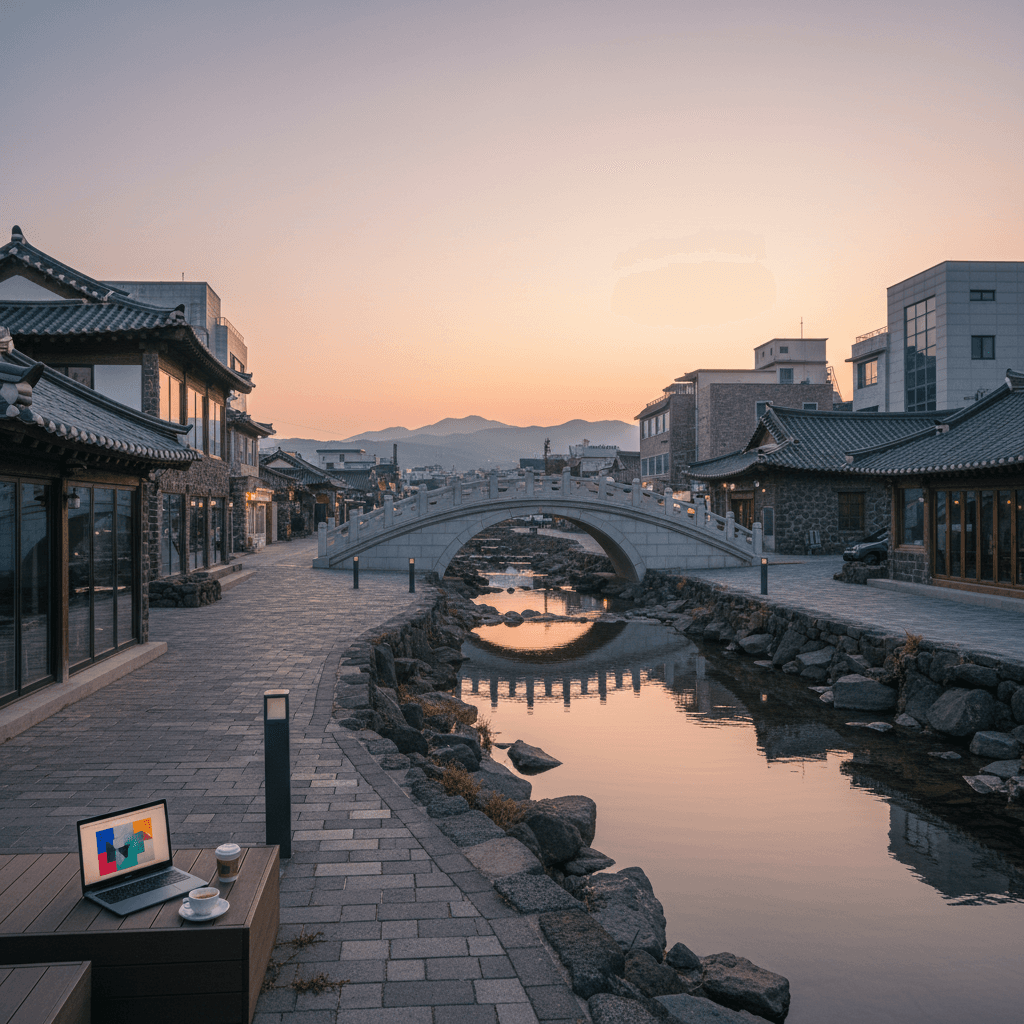
Seogwipo
🇰🇷 South Korea
The Vibe: Volcanic Serenity Meets High-Speed Work
Seogwipo isn't your typical South Korean concrete jungle. While Seoul feels like living in the future at 2x speed, Seogwipo is a deep exhale. Located on the southern rim of Jeju Island, it's a place where jagged volcanic cliffs meet the Pacific, and the air smells more like sea salt and tangerines than subway stations. For nomads, the draw isn't just the scenery; it's the rhythm. You're trading the 24/7 neon grind for a life dictated by the tides and the occasional haenyeo, the legendary female divers, emerging from the water with their daily catch.
Most travelers find the atmosphere here incredibly grounding. It’s a "slow-cation" destination where you can hammer out a project in a glass-walled cafe overlooking the ocean and then spend your sunset hiking the Olle trails. It feels rural and raw, yet you’re never more than a few minutes away from 100+ Mbps internet and a perfectly pulled espresso. It's this juxtaposition of ancient basalt landscapes and cutting-edge infrastructure that makes Seogwipo feel like a secret headquarters for focused, creative work.
The Financial Reality
Living here is significantly easier on the wallet than life in the capital. Expats generally report that their monthly expenses drop by 30% to 50% compared to Seoul. While you won't find the rock-bottom prices of Southeast Asia, the quality of life for the cost is hard to beat.
- Budget Tier: Roughly ₩1.5M ($1,070) per month. This covers a modest studio, plenty of street food from the Olle Market, and public bus transport.
- Mid-Range Tier: Roughly ₩2.5M ($1,780) per month. This allows for a nicer apartment near the coast, regular dinners of black pork BBQ, and a dedicated coworking membership.
- Comfort Tier: ₩4M ($2,850+) per month. This gets you a high-end rental with a sea view, frequent taxi use via Kakao T, and weekend scuba diving or guided tours.
Where to Plant Your Flag
Choosing a neighborhood in Seogwipo depends entirely on how much "city" you still need in your life. The island is bigger than it looks, so your choice of base dictates your social life.
Central Seogwipo
- Best For: Solo nomads and those who don't want to rent a car.
- The Draw: Everything is walkable. You have the Seogwipo Olle Market for cheap eats and plenty of modern cafes with reliable WiFi.
- The Trade-off: It gets touristy on weekends, and the "nature" is a bit more manicured than the wilder coasts.
- Rent: Expect to pay around ₩1,000,000 for a central, modern studio.
Sagye Fishing Village (Andeok-myeon)
- Best For: Deep focus and nature lovers.
- The Draw: This is the soul of Jeju. You're working in the shadow of Sanbangsan Mountain. It's home to the Sagye Fishing Village Co-Working Office, which offers a serene, low-cost environment for remote workers.
- The Trade-off: It’s remote. If you don't enjoy your own company or long walks, the lack of nightlife might feel isolating.
- Rent: Prices drop here, often between ₩500,000 and ₩800,000 for local apartments.
Aewol (West Coast)
- Best For: Families or those staying for several months.
- The Draw: Incredible sunsets and a relaxed, beach-town feel. It’s popular with the creative expat crowd.
- The Trade-off: It’s a long haul to the airport and lacks the concentrated amenities of the city center.
Connectivity and Logistics
South Korea’s infrastructure is legendary, and Seogwipo is no exception. Public WiFi is everywhere, but most nomads grab a local KT SIM for around ₩50,000 to stay tethered during mountain hikes. For a formal desk, the Creative Economy Innovation Centre is a staple, but the local cafe culture is the real winner here. Most shops don't mind if you linger for hours, provided you’re buying the occasional latte.
Getting around is simple if you’re patient. The blue and red buses are efficient at ₩1,200 a ride, but for real freedom, download Kakao T for taxis. Just be prepared for a language gap; while younger locals in cafes might speak some English, you'll want Papago installed on your phone to navigate menus and chat with landlords. It’s a small price to pay for living in a place where your morning commute is a walk past a UNESCO-listed waterfall.
The Price of Paradise
Living in Seogwipo is a breath of fresh air for your bank account, especially if you're coming from Seoul or major Western hubs. You'll find that your money stretches 30% to 50% further here than in the capital. While it isn't "dirt cheap" like parts of Southeast Asia, the quality of life per dollar is hard to beat. Most digital nomads find they can live comfortably on about $1,780 (₩2.5M) per month, though budget-conscious travelers can squeeze by on $1,070 (₩1.5M) if they stick to local markets and rural guesthouses.
Housing and Neighborhoods
Your biggest expense will be rent, but even that is manageable. In Central Seogwipo, a modern studio or one-bedroom apartment near the Olle Market usually runs around ₩800,000 to ₩1,500,000 depending on size and location. This area is the go-to for solo nomads because it's walkable and close to the best cafe setups. If you're willing to head further out to the Sagye Fishing Village in Andeok-myeon, you can find quieter, more traditional spots for ₩500,000 to ₩800,000 ($350 to $570).
- Central Seogwipo: Best for those who want to be near the action. It's walkable and packed with cafes, though it gets touristy during the peak summer months.
- Aewol: A favorite for families and slow travelers. It's quieter with beautiful beach access, but you'll likely need a car or scooter to get around comfortably.
- Sagye Village: The ultimate choice for deep focus. It's serene and sits right between the mountains and the sea, though amenities are sparse compared to the city center.
Dining and Groceries
Eating out is one of the highlights of Jeju life. A quick meal of street food or a bowl of noodles at a local market will set you back ₩5,000 to ₩10,000 ($3.50 to $7). For a mid-range dinner, like the island's famous black pork BBQ, expect to pay around ₩20,000 ($14) per person. If you're feeling fancy, upscale seafood dinners start at ₩40,000 ($28). Most expats recommend shopping at the Seogwipo Olle Market for fresh produce to keep grocery costs down.
Connectivity and Workspace
South Korea's internet is legendary, and Seogwipo is no exception. Most cafes offer speeds clocking in over 100 Mbps for the price of a latte. For a more formal setup, the Sagye Fishing Village Co-Working Office is a nomad favorite, often offering free or very low-cost desk space with incredible views. In the city center, coworking spaces like the Creative Economy Innovation Centre charge daily rates between ₩10,000 and ₩20,000 ($7 to $14). For mobile data, travelers usually grab a Holafly eSIM for about $20 to $50 a month or a local KT prepaid SIM for ₩30,000.
Transport and Utilities
Getting around is surprisingly cheap if you use the bus system. A single ride is only ₩1,200 ($0.85). If you're in a rush, the Kakao T app is the local version of Uber; taxis start at a base fare of ₩3,000 ($2.15). Utilities like electricity and high-speed home internet are reliable and rarely exceed $100 to $150 a month, even with the air conditioning blasting during the humid July monsoon season.
The Nomad Visa
If you're planning to stay long-term, Korea's digital nomad visa (the Workation Visa) is an option, though it has a high bar. You'll need to prove an annual income of approximately ₩85 million. For those who don't meet that, many nomads simply utilize the generous tourist visa allowances, which are sufficient for a few months of exploring the waterfalls and hiking the Olle trails.
For Nomads and Social Seekers: Central Seogwipo
If you want to be where the action is, Central Seogwipo is your best bet. It is the most walkable part of the city, packed with independent cafes, local markets, and a surprisingly high concentration of coworking spots. You can spend your mornings working from a cafe overlooking the harbor and your evenings wandering through the Seogwipo Olle Market for street food like spicy rice cakes or fresh hallabong juice.
Most solo travelers find this area the easiest place to meet others, especially since the Creative Economy Innovation Centre and various work friendly cafes attract a consistent crowd of remote workers. You can expect to pay around ₩1,000,000 ($715 USD) for a decent studio here. While it gets a bit touristy during the weekends, the convenience of having everything from banks to bus terminals within a ten minute walk makes it the most practical choice for short to medium stays.
For Peace Seekers and Nature Lovers: Sagye Fishing Village
Located in Andeok-myeon, Sagye is the neighborhood nomads choose when they want to actually get work done without distractions. It sits right between the dramatic Sanbangsan mountain and the coast, offering some of the most serene views on the island. The vibe here is rural and traditional, but it has become a hotspot for "workations" thanks to the Sagye Fishing Village Co-working Office. This space offers a quiet lounge and reliable WiFi, often for free or a very low daily fee, right by the water.
Living here feels like stepping back in time, though you'll need the Kakao T app for taxis since buses are less frequent. Rent is more affordable than the city center, often ranging from ₩500,000 to ₩800,000 ($350 to $570 USD) for local guest houses or small apartments. It is perfect if your idea of a lunch break is a quick hike up a volcanic trail or a walk along a black sand beach.
For Families and Long-Term Expats: Aewol
Technically on the western edge but highly accessible to Seogwipo's northern reaches, Aewol is where many expats choose to settle down. It is quieter than the city center and offers more spacious residential options, making it ideal for families or those who want a "beach house" lifestyle. You'll find plenty of scenic coastal drives and quiet rentals tucked away from the main roads.
- Housing: Larger flats and houses are easier to find here than in the dense city center.
- Atmosphere: Very relaxed with a focus on outdoor living and weekend brunch culture.
- Downside: Nightlife is almost non-existent, and you will definitely want to rent a car or a scooter via the Swing app to get around effectively.
For Urban Access: Jeju City
While most people come south for the Seogwipo vibe, some expats prefer staying in the north near Jeju City. It feels more like a standard Korean city with better access to the airport and larger hospitals like Jeju National University Hospital. It is busier and lacks the quaint charm of the southern coast, but it provides the most consistent urban amenities and higher-end shopping.
- Best for: Those who need to fly to Seoul frequently or prefer a wider variety of international food.
- Cost: Mid-range meals cost around ₩15,000 to ₩25,000 ($11 to $18 USD), similar to Seogwipo but with more options.
- Connectivity: The bus network radiates from here, making it a central hub for exploring the entire island.
Quick Cost Comparison by Area
- Central Seogwipo: High walkability, rent around ₩1M, great for solo nomads.
- Sagye Village: High tranquility, rent ₩500k to ₩800k, best for deep work.
- Aewol: High scenic value, varied rental prices, best for families.
- Jeju City: High convenience, standard urban pricing, best for frequent travelers.
Connectivity on the Island
South Korea is famous for having some of the fastest internet on the planet, and Seogwipo doesn't drop the ball. You can expect average speeds of 100+ Mbps in most central areas. Public WiFi is everywhere, from the bus stops to the beach boardwalks, and it's generally reliable enough for a quick Slack check or an upload. Most nomads find that even the smallest seaside cafes offer a stable connection that puts Western fiber to shame.
For your own data, skip the airport kiosks if you want to save a few bucks. Travelers often recommend grabbing a Holafly eSIM for unlimited data, which usually runs between $20 and $50 per month. If you prefer a local physical card, KT or SK Telecom offer prepaid options for around ₩50,000 to ₩60,000 for substantial data (e.g., unlimited throttled). You can pick these up at convenience stores like GS25 or CU once you get settled in town.
Coworking Spaces in Seogwipo
The coworking scene in Seogwipo is more intimate than the massive hubs in Seoul. It's less about corporate networking and more about finding a quiet corner with a view of the Pacific. Daily rates typically range from ₩10,000 to ₩20,000.
- Sagye Fishing Village Co-Working Office: Located at 13-1 Hyeongjehaean-ro in Andeok-myeon, this is a favorite for those who want to escape the city. It's open weekdays from 9am to 6pm and offers a serene lounge atmosphere. It's often free or very low-cost, making it a top choice for nomads living on the southwest side.
- Creative Economy Innovation Centre: This is a more formal setup geared toward startups and entrepreneurs. It's a solid choice if you need a professional environment and high-speed infrastructure for heavy video editing or large file transfers.
- Central Seogwipo Work Cafes: Since dedicated coworking spaces are somewhat limited, many expats treat the local cafe culture as their office. Look for places near the Seogwipo Olle Market where the WiFi is fast and the staff won't mind if you linger for a few hours over a latte.
The Cafe Culture Alternative
If you don't need a dedicated desk, Seogwipo's cafes are built for remote work. Many have floor-to-ceiling windows overlooking the volcanic coastline. Unlike in some European cities, it's culturally acceptable to work from a cafe here as long as you buy a drink every few hours. Just keep an eye out for "No Laptop" signs in the very small, boutique shops, though these are rare in the larger spaces.
Expats recommend using the Kakao T app to find your way between spots and Naver Maps to check if a cafe has power outlets before you trek there. If you're struggling with the language, the Papago app is your best friend for translating WiFi passwords or asking for a charger. Most nomads find that while English is limited, the locals are incredibly tech-savvy and helpful when it comes to getting you connected.
Practical Tools for the Digital Nomad
To keep your workflow smooth while hopping between Sagye and Central Seogwipo, you'll want a few specific apps on your phone. Digital nomads here swear by these for daily life:
- Kakao Pay or Naver Pay: Essential for quick payments at cafes and markets if you don't want to carry cash.
- T-money: This is your universal transport card. You can buy one at any convenience store for about ₩3,000 and load it up to use on buses, which cost ₩1,200 per ride.
- Swing: If you're working in the flatter parts of town, use this app to grab an electric scooter for about ₩10,000 a day. It's often faster than waiting for the bus when you're moving between your rental and a coworking spot.
While Seogwipo feels more like a retreat than a tech hub, the infrastructure is robust. You'll get the peace of a rural fishing village without the frustration of a lagging Zoom call.
A Safe Haven for the Solo Professional
Seogwipo is arguably one of the safest places you can park your laptop in East Asia. Most nomads find the city exceptionally secure, often leaving their equipment on a cafe table while they grab a refill without a second thought. Street crime is practically non-existent, and solo female travelers frequently report feeling comfortable walking alone at night through central neighborhoods like Seogwipo-si or the Olle Market area.
While the risk of theft or violence is low, you should still keep your wits about you in rural areas after dark. Street lighting can be sparse once you get away from the main coastal roads or deeper into the Andeok-myeon countryside. If you're hiking the Olle Trails alone, let someone know your route, as the volcanic terrain can be tricky if the weather shifts suddenly.
Healthcare Quality and Access
The standard of medical care in Seogwipo is world class, though the experience feels more functional and efficient than what you might find in North America or Europe. For anything serious, Jeju National University Hospital has a strong presence here. Most expats recommend heading there for specialized consultations or emergency needs. The facilities are modern, and you'll often find English speaking staff in the international departments, though having a translation app like Papago ready is always a smart move.
For minor ailments, look for local clinics marked with a green cross. These are everywhere in central Seogwipo and usually operate on a walk-in basis. You can expect to pay around ₩15,000 to ₩30,000 for a standard consultation if you don't have local insurance. Most nomads find the service incredibly fast, often getting in and out with a prescription in under thirty minutes.
- Emergency Services: Dial 119 for ambulance and fire services. They have English translation services available if you stay on the line.
- Police: Dial 112 for the police. In tourist-heavy areas, you may encounter the Tourist Police, who are specifically trained to help foreigners.
- Pharmacies: Look for the word Yak (약) in red or yellow. For basic skincare and over the counter basics, Olive Young locations are scattered throughout the city.
Practical Health Tips for Nomads
The tap water in Seogwipo is technically safe to drink, but most locals and long term expats prefer filtered water or bottled options for the taste. If you're staying in an older rental in the Sagye Fishing Village, it's better to stick to the dispensers provided in your coworking space or guesthouse.
Pharmacy culture is slightly different here. Many medications that require a prescription elsewhere might be available over the counter, but the pharmacists are strict about dosages. If you have specific chronic medications, bring a copy of your prescription from home. Travelers often find that while the care is excellent, the language barrier in smaller neighborhood pharmacies can be a hurdle, so keep your Naver Dictionary app pinned to your home screen.
Emergency Contacts and Apps
Before you land, download Emergency Ready, the official government app that provides alerts for extreme weather or safety instructions in English. Since Jeju is prone to typhoons during the summer months, this is a non-negotiable for staying informed. For navigation to the nearest hospital, use Naver Maps or Kakao Maps, as Google Maps is notoriously unreliable for walking directions and specific business locations in South Korea.
Getting from the Airport
Most nomads arrive at Jeju International Airport (CJU) on the north side of the island. While it's on the opposite coast, getting down to Seogwipo is straightforward. You'll want to look for the Limousine Bus #600, which departs every 15 to 20 minutes. It costs about ₩5,500 (roughly $4) and drops you off at major hotels and hubs in central Seogwipo within 80 minutes. If you're in a rush or carrying heavy gear, a taxi will run you between ₩35,000 and ₩45,000, taking about an hour depending on traffic.
The Bus System and T-Money
Public transit is surprisingly efficient for a volcanic island. The local buses are color-coded: red for express routes, blue for main lines, and green for local feeders. A standard ride is ₩1,200. You'll need a T-money card, which you can buy and top up at any GS25 or CU convenience store. Tap your card when you board and again when you get off to ensure you get the transfer discount. Most nomads find the #201 and #202 buses the most useful; they circle the coast and stop at the best beaches and coastal coworking spots.
Essential Apps for Navigation
Google Maps is notoriously unreliable for walking or driving directions in South Korea. Download Naver Maps or KakaoMap immediately. They provide real-time bus arrivals and precise walking paths through Seogwipo's winding alleys. For ride-hailing, Kakao T is the local equivalent of Uber. You can set it to pay the driver directly with cash or a physical card if you haven't linked a local bank account yet. The base fare starts around ₩3,000, making it an affordable way to get home after a late dinner at the Olle Market.
Walking and Micromobility
Central Seogwipo is highly walkable, especially around the Lee Jung-seop Street area and the harbor. The sidewalks are well-maintained, and the pace is slow enough that you won't feel rushed. For longer coastal stretches, look for Swing or Beam electric scooters. You'll see them parked on street corners; you just scan the QR code with the app. It usually costs about ₩10,000 for a day of casual riding. Just be careful on the hilly sections near the waterfalls, as the battery can drain faster than expected.
Driving and Scooter Rentals
If you plan to stay in more remote areas like Sagye Fishing Village or Aewol, renting a car or a gas-powered scooter is the way to go. You'll need an International Driving Permit (IDP) and your physical passport. Rental cars are relatively cheap, often starting at ₩30,000 per day for a compact model. Expats recommend Lotte Rent-a-Car or SK Rent-a-Car for their English-language booking systems. Driving in Seogwipo is much less stressful than in Seoul, but watch out for the "Silver Zones" near parks where speed limits drop to 30km/h and fines are doubled.
- Airport Express Bus: ₩5,500, 80 minutes to central hubs.
- Local Bus Fare: ₩1,200 with T-money card.
- Taxi Base Fare: ₩3,000 to ₩3,800.
- Scooter Rental: Approximately ₩10,000 per day via apps.
- Must-have Apps: Kakao T (taxis) and Naver Maps (navigation).
Language Barriers and Daily Life
In Seogwipo, Korean is the primary language, and it's much more dominant here than in the international hubs of Seoul or Busan. While you'll find English signage at major tourist sites like the Cheonjiyeon Waterfall or the Seogwipo Olle Market, daily life requires a bit more effort. Most hotel staff and younger cafe owners in central Seogwipo speak basic English, but as you move toward rural areas like Sagye or Andeok-myeon, English proficiency drops significantly.
Most nomads find that locals are incredibly patient, but they don't expect you to be fluent. Learning a few polite phrases goes a long way. Annyeonghaseyo (hello) and Gamsahamnida (thank you) are non-negotiable for daily interactions. If you're working from a local cafe, asking WiPi issseumnikka? (is there WiFi?) will be your most used phrase. Travelers often say that the "Jeju smile" bridges the gap when words fail, especially when interacting with the haenyeo (female divers) at the coastal stalls.
The Digital Toolkit
Relying on standard translation apps can be hit or miss because Jeju has its own distinct dialect, though almost everyone speaks standard Korean to outsiders. Expats recommend downloading Papago or Naver Dictionary immediately. These apps handle the Korean syntax much better than other global competitors and offer reliable offline modes for when you're hiking the Olle Trails.
For getting around, Kakao T is the gold standard for ride-hailing. The interface is available in English, which saves you from having to explain your destination to a driver who might not speak your language. Similarly, Naver Maps is much more accurate than Google Maps for bus routes and walking paths across the island.
Communication for Remote Work
If you're planning to stay for a few months on the Workation (Hallyu) visa, which requires a minimum annual income of approximately ₩85 million, you'll need a local phone number for more than just calls. Many local services and apps require "identity verification" via a Korean SIM. Nomads recommend picking up a KT or SK Telecom prepaid SIM for about ₩30,000 to get 20GB of data and that vital local number. For shorter stays, a Holafly eSIM provides unlimited data for roughly $20 to $50 a month, though it won't give you a number for app registrations.
Social Etiquette and Nuance
Communication in Seogwipo is as much about body language as it is about words. A slight bow when greeting someone or receiving change at a market is standard practice. Tipping isn't part of the culture here, and attempting to do so might actually cause confusion or a polite refusal. When dining out for black pork BBQ or seafood, it's common to call for the server by saying yeogiyo (over here) rather than waiting for them to check on your table.
Connecting with other nomads usually happens online first. The Jeju Island Expats Facebook group and InterNations are the best spots to find meetups. While the community is smaller than in the north of the island, you'll find a tight-knit group of remote workers at the Sagye Fishing Village Co-Working Office or the Creative Economy Innovation Centre. Most social interaction happens over shared meals or weekend dive tours, where the relaxed island pace makes it easy to strike up a conversation.
The Seasonal Rhythm
Seogwipo sits on the southern edge of Jeju Island, protected by the massive Hallasan mountain. This geography gives it a humid subtropical climate that stays significantly warmer than Seoul. If you're coming from the mainland in January, the 10°C breeze will feel like a tropical vacation compared to the sub-zero winds of the north.
Most nomads aim for the shoulder seasons. Spring, specifically March through May, brings out the famous canola flowers and cherry blossoms. Temperatures hover between 15°C and 22°C, making it the perfect time to work from a cafe patio or hike the Olle trails without breaking a sweat. It's the sweet spot for productivity and outdoor exploration.
Fall is the other goldilocks zone. From September to November, the humidity drops, the skies turn a sharp blue, and the maple leaves change. Travelers often say this is the most reliable time for outdoor work sessions because the air is crisp and the monsoon rains have finally retreated. Expect highs around 20°C throughout October.
Survival Guide: July and August
If you can avoid it, don't plan your deep-work retreat for mid-summer. July and August are the "Jangma" or monsoon months. It's not just the rain; it's the oppressive humidity and temperatures hitting 32°C. During this window, the island gets crowded with domestic tourists, prices for short-term rentals spike, and the air feels thick enough to chew.
If you're here during the summer, you'll want to stick close to the water in neighborhoods like Aewol or Sagye. The sea breeze helps, but you'll spend most of your time hunting for the strongest air conditioning. Most expats recommend staying indoors between 11 am and 4 pm, using that time to grind at a coworking spot like the Sagye Fishing Village Co-Working Office before heading to the beach at sunset.
Winter in the South
Winter in Seogwipo is mild but damp. From December to February, you'll see averages between 5°C and 10°C. You won't see much snow at sea level, though Hallasan will be capped in white, offering a great weekend trip for hikers. It's the quietest time on the island. While it's too cold for swimming, it's the cheapest time to snag a long-term apartment in Central Seogwipo for around ₩500,000 to ₩800,000 per month.
Quick Seasonal Breakdown
- Spring (March to May): The peak aesthetic. Highs of 18°C. Best for hikers and photographers.
- Summer (June to August): Hot, wet, and busy. Highs of 32°C. Expect heavy rain in July and high humidity.
- Fall (September to November): The nomad favorite. Highs of 22°C. Dry weather and perfect for outdoor cafes.
- Winter (December to February): Quiet and cool. Highs of 10°C. Great for saving money on rent and enjoying the "slow life."
For the best balance of reliable internet, manageable weather, and social opportunities, aim to land in Seogwipo in late September. You'll catch the tail end of beach weather and cruise straight into the most comfortable working months of the year.
Getting Settled and Staying Connected
Seogwipo operates at a much slower frequency than Seoul, which is exactly why nomads love it. To hit the ground running, download Kakao T for taxis and Naver Maps for navigation; Google Maps is notoriously unreliable across South Korea. For internet, you can pick up a KT or SK Telecom prepaid SIM at the airport for around ₩30,000, though many long term travelers prefer Holafly eSIMs for ease of use. You'll find free public WiFi almost everywhere, from the local bus to the beach, usually hitting speeds well over 100 Mbps.
If you need a dedicated desk, the Sagye Fishing Village Co-Working Office is the local favorite. It's located at 13-1 Hyeongjehaean-ro and offers a serene, low cost environment overlooking the water. In central Seogwipo, the Creative Economy Innovation Centre provides a more corporate setup, but most nomads just hop between the city's high design cafes. Expect to pay between ₩10,000 and ₩20,000 for a day pass at formal spaces.
Cost of Living and Budgeting
Living here is significantly cheaper than the mainland. While Seoul can eat up a budget quickly, Seogwipo is manageable on roughly $1,780 USD (₩2.5M) per month for a mid range lifestyle. Most expats recommend using Wise for transfers and keeping Kakao Pay or Naver Pay on your phone for daily transactions.
- Housing: A studio or one bedroom apartment in central Seogwipo or Aewol typically runs between ₩500,000 and ₩1M ($350 to $700 USD). Use apps like Zigbang to scout local listings.
- Food: Street food at the Seogwipo Olle Market costs about ₩7,000. A meal of Jeju's famous black pork BBQ will set you back around ₩20,000, while a high end seafood dinner starts at ₩40,000.
- Transport: Local buses are a flat ₩1,200. If you're staying in the city center, it's highly walkable, but for rural exploring, Swing scooter rentals cost about ₩10,000 a day.
Choosing Your Neighborhood
Where you stay depends entirely on your tolerance for isolation. Most solo nomads gravitate toward Central Seogwipo because it's walkable and packed with markets. If you want a more traditional village feel, look into Sagye; it's quiet, near the Sanbangsan trails, and has a tight knit local vibe. Aewol on the west coast is the go to for families or anyone wanting a beach flat, though the nightlife there is practically non existent.
Health, Safety, and Language
This is one of the safest places you'll ever visit. Crime is incredibly low, and solo female travelers often report feeling comfortable walking alone at night. If you need a doctor, Jeju National University Hospital has a Seogwipo branch with high quality care. For emergencies, dial 119 for an ambulance or 112 for the tourist police; both usually have English speakers available.
Language is the biggest hurdle. English isn't widely spoken outside of major hotels. You'll want to keep Papago installed for real time translations. Learning a few basics like Annyeonghaseyo (hello) and Gamsahamnida (thank you) goes a long way with the local shopkeepers. If you're asking for the WiFi password, just say WiPi issseumnikka?
Weather and Seasonal Timing
Jeju is subtropical, meaning it gets humid. October is widely considered the best month to visit, with dry air and temperatures around 22°C. Avoid July and August if you can; the monsoon rains are heavy and the humidity is intense. January is cool but rarely freezing, with highs around 10°C, making it a decent winter escape for those who don't mind a bit of a chill.
Visa and Customs
South Korea recently introduced a Digital Nomad Visa (Hallyu), though it requires a high annual income of roughly ₩88M. Most short term nomads enter on a standard tourist waiver. When you're here, remember to remove your shoes when entering homes or traditional guesthouses. Tipping isn't practiced and can sometimes be seen as confusing or even rude, so just pay the sticker price and enjoy the hospitality.
Need visa and immigration info for South Korea?
🇰🇷 View South Korea Country GuideEasy Landing
Settle in, no stress