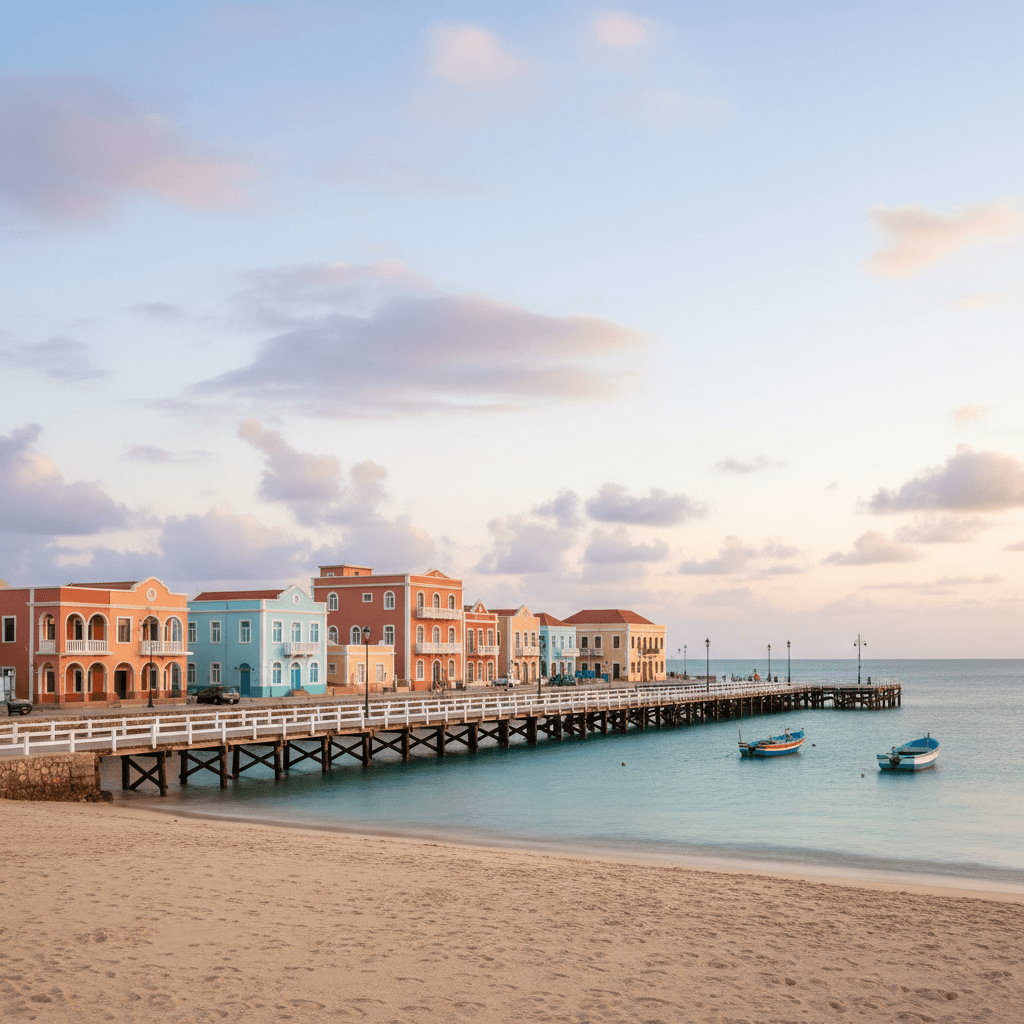
Santa Maria
🇨🇻 Cape Verde
Santa Maria moves at its own pace and it will, honestly, take you a few days to stop fighting it. This is a small beach town on Sal Island where the main street smells like grilled fish and salt air, where vendors call out from doorways and where the afternoon heat makes rushing feel genuinely absurd. That's not a flaw in the experience, it's the whole point.
The concept locals live by is morabeza, a Cape Verdean spirit of warmth and unhurried hospitality that's baked into every interaction. It's African, Portuguese and Brazilian all at once, which sounds like a marketing line until you're sitting at a plastic table eating pastéis de tuna for 500 CVE while funaná music drifts out of a nearby bar. The cultural blend is real, it doesn't feel performed.
For nomads, the pitch is simple: stunning beaches, fiber internet that actually hits 50-100 Mbps in most Santa Maria apartments and a cost of living that comes in around €1,200-1,500 a month at a comfortable mid-range. The expat and nomad community is small but active, mostly coordinating through Facebook groups and most people find it easy to plug in socially within a week.
Still, Santa Maria isn't for everyone. Grocery prices are brutal because almost everything's imported, tourist-facing restaurants charge tourist prices without apology and the persistent beach vendors get old fast. Power outages happen, they're not constant but they're not rare either, so a power bank isn't optional. And if you need cultural variety beyond beach, watersports and seafood dinners, you'll hit the ceiling quickly.
What makes this place different from, say, Bali or Medellín is the sheer smallness of it. Santa Maria is walkable in twenty minutes end to end, the kitesurfing at Kite Beach is world-class and the turquoise water is, frankly, unreasonably good-looking. But the town doesn't try to be more than it's. There's no pretense of a "scene," no co-living complexes with rooftop yoga, just a genuinely laid-back beach town that turns out to work surprisingly well for remote work if you go in with the right expectations.
Come for a month of deep focus and slow evenings. Don't expect a metropolis.
Santa Maria isn't cheap and that surprises a lot of people who assume "Cape Verde" means budget travel. The island runs on imports and you feel that at the supermarket, where groceries cost roughly double what you'd pay in Europe. That said, if you're earning a Western salary, you can live, honestly, quite well here without burning through your savings.
Monthly rent for a studio or one-bedroom in Santa Maria runs 15,000 to 25,000 CVE ($150 to $250 USD), which sounds low until you factor in that decent apartments go fast and landlords know the nomad market well. Head inland to Espargos and you'll drop that to 10,000 to 20,000 CVE, though you're trading beach access for authenticity and a quieter street scene that smells more like grilled fish and dust than sunscreen.
Food costs depend entirely on where you eat. Street pastéis de tuna run 500 to 1,000 CVE ($5 to $10), filling and genuinely good, a meal at Barracuda or Chez Pastis for two will hit around 5,000 CVE ($50) and upscale seafood spots push well past that. Most nomads find the sweet spot in local spots off the main drag, tourist pricing on the waterfront is frankly aggressive.
Here's a rough monthly breakdown by tier:
- Budget: ~€1,200/month (shared flat, street food, minimal going out)
- Mid-range: ~€1,500/month (private studio, mix of cooking and dining out, coworking)
- Comfortable: €1,800+/month (modern apartment, regular restaurants, activities)
Coworking at GoHub Sal or Hub Sal runs €20 to €50 a month, turns out that's one of the better deals on the island. Aluguer minibuses between Santa Maria and Espargos cost €1 to €2, taxis are €2 to €3 around town. You won't need a car if you stay central, Santa Maria is walkable in a way that most island towns aren't.
The one line item people consistently underestimate is groceries. Wine, cheese, anything imported, it adds up fast, local produce and fresh catch from the market is where you save. Budget accordingly and you won't be caught off guard.
For Digital Nomads
Santa Maria town is where most nomads land and honestly, it makes sense. You're walking distance from GoHub Sal (around €20-50/month, 60 Mbps fiber, backup power for outages) and a dozen cafes, the salt air hits you the moment you step outside and the social scene basically builds itself through the "Sal Digital Nomads" Facebook group. Rents run 15,000-25,000 CVE ($150-250 USD) for a studio, which sounds cheap until groceries cost double what you'd pay in Europe.
Vila Verde is, turns out, the better pick if you actually need to get work done. It's quieter, the apartments are newer, internet tends to be more stable and you won't have vendors knocking on your elbow every ten minutes on the promenade. You'll need transport to reach town, though, so factor in €1-2 aluguer rides or a scooter rental.
For Expats
Long-termers tend to split between Santa Maria and Espargos. Santa Maria is walkable and social, Espargos is cheaper at 10,000-20,000 CVE ($100-200 USD) and feels more like actual Cape Verde. Frankly, if you're staying six months or more, Espargos makes financial sense, you just won't find much English spoken and the amenities are thinner.
The expat community is real and active, mostly coordinated through Facebook groups. They'll tell you where to find apartments before they hit Airbnb, which pharmacies stock what you need and which landlords are worth dealing with.
For Families
Vila Verde and Murdeira are the obvious choices. Modern apartments, quieter streets, better value per square meter and you're not navigating the noise and foot traffic of the tourist center with kids in tow. The tradeoff is real: you're dependent on a car or regular aluguer runs for everything.
For Solo Travelers
Stay in Santa Maria. Full stop. The social infrastructure is there, the beach is steps away and Tortuga suits surfers who want ocean views with fewer people around, though the facilities are, weirdly, almost nonexistent beyond the scenery itself. Santa Maria's compact enough that you'll know the same faces at Ocean Café within a week, which is either charming or claustrophobic depending on your personality.
Santa Maria's internet is, honestly, better than you'd expect for a small island in the Atlantic. Fiber connections in town apartments and hotels run 35-100 Mbps and most places include it in the rent. Power outages happen, so keep a power bank close.
Mobile data fills the gaps well enough. Both CV Móvel and Unitel T+ sell SIM cards at the airport and in town for around €5, with 5-10GB data packages. 4G coverage across Santa Maria is solid, Espargos less so. If you're working from somewhere remote, Starlink is an option, though that's a whole setup project.
The coworking scene is small, turns out, but functional. Your main options:
- GoHub Sal: The best-equipped space in town. Fiber at 60 Mbps, ergonomic setups, backup power for outages, roughly €20-50/month depending on your plan.
- Hub Sal: More bare-bones, hot desks around €20/month, fine if you just need a desk and decent wifi.
- Cape Verde Coworking (Espargos): Cheapest at €15/month, but you're commuting out of Santa Maria, which most nomads don't bother with.
- Ocean Café: Not a coworking space, but a €10 day pass gets you wifi and lunch. Upload speeds hover around 4 Mbps, so don't plan a video-heavy day here.
For lighter work, Cape Fruit café works fine. The vibe is relaxed, the coffee's decent, nobody rushes you out. Just don't expect to run a Zoom call on their connection without some anxiety.
GoHub is where most nomads land. It's central, the backup power is genuinely useful when the grid hiccups and €20-50/month is weirdly cheap compared to what you'd pay in Lisbon or Las Palmas for a similar setup.
One thing worth being direct about: this isn't a city with a deep coworking culture. There's no buzzing hub with networking events every week and a kombucha tap in the corner. It's quiet, it's functional and frankly that suits a lot of people just fine. If you need serious infrastructure, GoHub delivers, the rest is backup.
Santa Maria is, honestly, one of the safer spots you'll find in West Africa. Violent crime is rare, the vibe is relaxed and most nomads walk around at night without a second thought. That said, petty theft on the beach is a real and consistent problem, so don't leave your laptop bag unattended while you're in the water.
The outskirts of Espargos are a different story after dark, it's not dangerous exactly, but it's not somewhere you want to be wandering alone at midnight either. Stick to Santa Maria's center and you'll be fine, common sense goes a long way here.
One health risk that catches people off guard: shigellosis outbreaks have been reported on the island, spread through contaminated food and water. Drink bottled water. Always. Street food is generally fine from busy stalls with high turnover, but be selective, your stomach will thank you.
For medical care, Clinitur in Santa Maria is your go-to. Consultations run €20-30, the staff speak English and it's clean and competent for most routine issues. The public hospital in Espargos is basic, turns out "basic" here means you wouldn't want to be treated for anything serious there. For anything beyond minor illness or injury, medical evacuation to mainland Portugal or the Canary Islands is the realistic outcome, which is exactly why evacuation insurance isn't optional. It's mandatory. Don't arrive without it.
Pharmacies are scattered throughout Santa Maria and they're well-stocked for standard medications. For emergencies, dial 112.
A few practical points worth keeping in your back pocket:
- Clinitur clinic: Santa Maria center, English-speaking staff, €20-30 per consultation
- Public hospital: Espargos, basic facilities only, not recommended for serious conditions
- Emergency number: 112
- Water: Bottled only, tap water isn't safe to drink
- Insurance: Medical evacuation coverage is non-negotiable before you land
The overall safety picture is genuinely good for a destination of this type, most expats here are weirdly relaxed about it after the first couple of weeks. Just don't flash expensive gear on the beach, get your evacuation insurance sorted before you fly and you'll have very little to worry about.
Santa Maria is, honestly, one of the most walkable towns in Cape Verde. The main strip, the beach road, the restaurants, the coworking spaces , you can cover most of it on foot in under 20 minutes, so for day-to-day life you won't need much else.
When you do need to leave town, aluguers are your go-to. These shared minibuses run between Santa Maria and Espargos for €1-2, they fill up and go rather than running on any fixed schedule, so you might wait ten minutes or thirty depending on the time of day. Turns out most nomads find the wait half the fun , you're crammed in with locals, someone's playing music, the windows are down. It's cheap, it's authentic and it gets you there.
Taxis are the other option. Blue and yellow cabs charge €2-3 for rides within town and the airport transfer from SID runs €15-18. There are no ride-hailing apps here, no Uber, no local equivalent, so you're flagging down cabs or asking your accommodation to call one. Not a dealbreaker, just something to know before you land.
For more flexibility, scooter rentals run roughly €5-10 per day and are worth it if you're planning to explore the island's salt ponds at Pedra de Lume or the port at Palmeira. Bikes are available too, though the wind off the Atlantic can be punishing on exposed stretches, frankly more resistance than most people expect.
- Walking: Santa Maria town center is fully walkable
- Aluguer: €1-2 per ride, Espargos to Santa Maria route
- Taxi: €2-3 in town, €15-18 airport transfer
- Scooter rental: €5-10 per day
- Ride-hailing apps: none available on the island
If you're staying in Vila Verde or Murdeira, you'll need transport sorted from day one, those areas require wheels to reach town comfortably. Santa Maria itself, though, rewards the people who slow down and walk it. You notice more, you spend less and weirdly the town feels smaller and more manageable every week you stay.
Portuguese is the official language, Kriolu (Cape Verdean Creole) is what everyone actually speaks day to day. They're related but distinct and honestly, don't expect to pick up Kriolu quickly. It's a genuinely complex language with roots in Portuguese, West African languages and centuries of island history.
In Santa Maria, English gets you surprisingly far. Most restaurant staff, coworking hosts and shop owners in the tourist center speak at least functional English, sometimes quite good English. The further you get from the beachfront strip, the less that holds, so a few basic phrases go a long way.
A handful of phrases worth knowing:
- "Obrigado/a" , Thank you (obrigado for men, obrigada for women)
- "Bu ta papia Inglês?" , Do you speak English?
- "Kwadu!" , Careful! (you'll hear locals shout this constantly)
- "Morabeza" , No direct translation, it means something like warmth and hospitality; use it and people genuinely light up
Google Translate handles Portuguese well, it's less reliable with Kriolu, there just isn't enough training data. Most nomads find the app sufficient for menus, signs and basic back-and-forth with vendors, but don't rely on it for anything nuanced.
Espargos is a different story. The capital is more local, less tourist-facing and English drops off noticeably there. If you're staying in Espargos to save on rent, which is a reasonable call, learning a few dozen Portuguese phrases isn't optional, it's just practical.
One thing that catches people off guard: Cape Verdeans often mix Kriolu and Portuguese mid-sentence, switching fluidly without noticing. So even if your Portuguese is solid, conversations can still feel slippery. Don't take it personally, just lean into it.
The communication style here is, weirdly, both formal and extremely relaxed at the same time. Greetings matter. Walking into a shop and launching straight into a question without a "bom dia" first will get you a cold response, it's considered rude. Take the ten seconds. Say hello, smile, let the interaction breathe a little. Turns out that's not just politeness, it's how things actually get done here.
Santa Maria sits in a tropical dry zone, so the temperature honestly doesn't swing much. Year-round, you're looking at 24-30°C (75-86°F), which sounds perfect until August rolls around and the humidity turns the air thick and sticky. Most nomads time their stays to avoid that stretch entirely.
The dry season, November through June, is when the island is at its best. Skies stay clear, the trade winds keep things from feeling oppressive and Kite Beach is alive with sails from dawn to dusk. That wind, though, it's not always gentle. Some days in January and February it's a gritty, sand-carrying blast that gets into your laptop bag, your coffee, your everything.
The rainy season runs August through October, it's not dramatic by tropical standards, more like brief afternoon showers that clear fast. Still, humidity peaks in September, when highs hit around 30°C and the lows barely drop below 25°C at night. Sleeping without AC becomes genuinely uncomfortable, which means higher electricity costs if you're renting.
Season Breakdown
- Nov-Jun: Dry, breezy, cooler nights; best for work-life balance and outdoor activity
- Jul-Oct: Humid, occasional showers, peak heat; fewer tourists but stickier days
- Dec-Mar: Coolest and most comfortable; also the busiest tourist period, so expect higher short-term rental prices
- Aug-Sep: Hottest and most humid; weirdly, this is when you'll find the best long-stay rental deals
December through March draws the biggest crowds, European package tourists mostly and prices for accommodation and restaurants creep up noticeably. If you're staying a month or longer, landlords are more flexible on rate, but don't expect much movement during peak weeks.
For nomads, the sweet spot is, frankly, November or April. The humidity has either broken or hasn't arrived yet, the winds are manageable and the island feels less like a resort and more like a place people actually live. Carnival in February and March adds some noise and energy to the streets if that appeals to you, though it does mean tighter accommodation availability.
There's no bad time to visit in a catastrophic sense, turns out any month here beats a northern European winter. But the humidity in August is real, plan around it if you can.
Get a local SIM on arrival. CV Móvel and Unitel T+ both sell starter packs at the airport and in Santa Maria shops for around €5, with 5-10GB of data included, which is honestly enough for a week of normal use. Top up at any convenience store.
Cash still runs this island. ATMs (look for the Vinti4 network) accept international cards, but don't count on them always working, machines run dry on weekends and after busy holiday periods. Carry a backup stash because a lot of smaller restaurants and street vendors won't touch a card.
Apartments are easier to find than you'd think. Airbnb has decent listings, but expats recommend going direct through local rental sites or Facebook groups like "Cape Verde Digital Nomads" once you're on the ground, you'll almost always get a better price than the tourist rate. Studios in Santa Maria run 15,000-25,000 CVE a month; Espargos is cheaper at 10,000-20,000 CVE if you don't mind the commute.
Power cuts happen. They're not daily, but they're not rare either, so a power bank is worth packing and any serious work session should probably happen at a coworking space with backup power, like GoHub Sal, rather than your apartment.
A few things to know before you arrive:
- Emergency number: 112 for all emergencies
- Medical care: Clinitur clinic in Santa Maria handles most issues for €20-30 a consultation, staff speak English
- Water: Don't drink from the tap; bottled water is cheap and everywhere, recent shigellosis outbreaks have been traced to food and water hygiene
- Getting around: Aluguers (shared minibuses) run between Espargos and Santa Maria for €1-2, taxis are €2-3 for town trips and around €15-18 to the airport
- Evacuation insurance: Get it, the public hospital in Espargos is, frankly, basic
The pace here is slow by design. "No stress" isn't a marketing slogan, it's turns out the actual operating mode of the island and fighting it's exhausting. Restaurants take their time, government offices take longer. Build that into your schedule and you'll be fine.
Day trips to the Salinas salt ponds or Palmeira port break up the beach routine nicely. Inter-island flights are short and cheap, making Santiago or Fogo easy add-ons.
Need visa and immigration info for Cape Verde?
🇨🇻 View Cape Verde Country GuideEasy Landing
Settle in, no stress