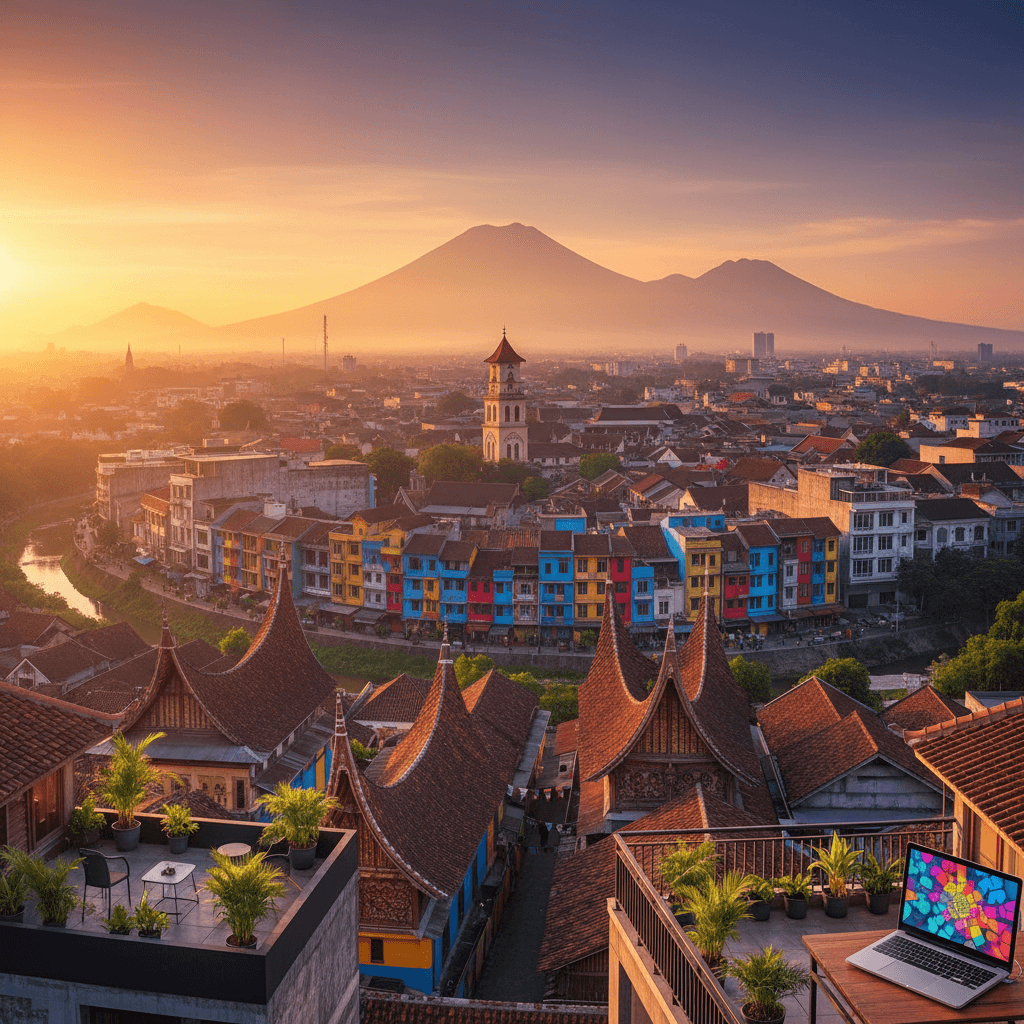
Malang
🇮🇩 Indonesia
The High-Altitude Chill
Malang is the cool, collected sibling to Indonesia's more chaotic urban centers. Perched in the East Java highlands, it trades the oppressive humidity of Jakarta for a crisp, mountain breeze that stays around 24 to 27 degrees Celsius most of the year. It feels like a city built for walking, filled with wide, tree-lined boulevards and Dutch colonial architecture that gives the place a dignified, slightly nostalgic atmosphere.
Most nomads find that Malang offers a slower, more intentional pace of life. It is not Bali; you won't find beach clubs or a massive westernized infrastructure here. Instead, you get a authentic Indonesian experience where the cost of living is remarkably low, typically ranging from $500 to $1,100 per month depending on how much you want to splurge. It is a basecamp for adventure, perfectly positioned for 3:00 AM runs to Mount Bromo or weekend treks to the Tumpak Sewu waterfalls.
The Neighborhood Breakdown
- Malang Kota (Central): This is the heart of the action. It is walkable and packed with heritage buildings and cafes. It is the best spot for solo travelers who want to be near the best coffee shops, though it can get noisy during peak traffic hours.
- Mulyorejo: If you are looking for modern apartment complexes and a quieter vibe, this is the expat favorite. It is more expensive, with some high-end 2BR units hitting $1,800, but smaller studios are much more affordable.
- Lowokwaru: This is the university district. It is crowded and energetic, filled with students, cheap street food, and a social atmosphere that makes it easy to meet locals.
Work and Connectivity
While the internet isn't blazing fast, a steady 10 Mbps is the standard, which handles video calls and remote uploads just fine. Telkomsel is the reliable choice for mobile data; you can grab a 25GB SIM for about $3 to keep as a backup. The coworking scene is growing, with G-Space and Ngalup being the primary hubs for the remote crowd. If you prefer the cafe culture, Busker Beans and Beryl Coffee & Work Space are nomad staples where you can post up for the price of a $1 latte.
Living Costs and Practicalities
Your money goes incredibly far here. A street food dinner or a basic Nasi Warung meal will rarely cost more than $1. Even if you prefer upscale dining, you will struggle to spend more than $10 on a feast. Rent for a solid 1BR studio in a central area usually lands between $200 and $400.
Getting around is simple if you use Gojek or Grab. A scooter ride across town is usually about $1, and it is the best way to bypass the heavy afternoon traffic. While the city is generally very safe with low crime rates, solo female travelers often report feeling more comfortable in groups, as the local culture is quite traditional. English proficiency is also lower than in tourist hubs, so keep Google Translate handy for daily interactions.
The Social Scene
Don't come to Malang expecting a wild clubbing scene. The nightlife is laid-back and centered around live music and student hangouts. Hugo's in Cyber Mall is a popular spot for a $2 Bintang, while Levels Brewhouse offers a slightly more polished environment. Most social connections happen in the coffee shops or through small Facebook and InterNations groups. It is a city that rewards those who are willing to initiate a conversation and embrace the local "santai" (relaxed) lifestyle.
When to Go
Timing is everything in the highlands. The dry season from June to August is spectacular, offering the clearest skies for mountain views. Avoid January and February if you can; the heavy rains can turn the streets into rivers and make those mountain excursions nearly impossible.
The Bottom Line
Malang is one of those rare spots where your dollar stretches so far you might actually feel a bit guilty. It is a high altitude escape from the sweltering heat of the Indonesian coast, offering a lifestyle that is remarkably cheap without feeling stripped back. Most nomads find they can live comfortably here for $700 to $900 a month, while those on a true budget can easily get by on $500 if they lean into the local warung scene and shared housing.
The city operates on a different rhythm than Bali. It is quieter, more traditional, and significantly more affordable. You aren't paying the "expat tax" here. Instead, you are paying $1 for a solid plate of Nasi Goreng and maybe $2 for a large Bintang at a student hangout like Hugo’s in Cyber Mall.
Monthly Budget Tiers
- The Budget Nomad ($500 to $700): You’ll be staying in a local guesthouse or a shared house in Lowokwaru, eating street food, and using a scooter or the local angkot vans to get around. You’ll likely work from home or cheap cafes rather than dedicated coworking spaces.
- The Mid-Range Pro ($700 to $900): This covers a private studio apartment, daily cafe visits, and a dedicated desk at a spot like Ngalup or G-Space. You’ll eat out at a mix of local spots and mid tier restaurants.
- The High Life ($900 to $1,100): This tier gets you a modern, furnished Airbnb in a prime spot like Mulyorejo, frequent weekend trips to Bromo, and the ability to eat at the city’s few upscale establishments without checking the price tag.
Housing and Neighborhoods
Rent is your biggest variable. In the central Malang Kota area, you can find 1BR studios for $200 to $400. It is walkable and packed with cafes, but it can get noisy with the traffic and morning calls to prayer. If you want something more modern, expats often look toward Mulyorejo. While a full furnished 2BR house there can run $1,800 a month, smaller units and studios are much more reasonable.
Lowokwaru is the university district. It is crowded and a bit chaotic, but it is the heartbeat of the city's social life. It’s the best place to find cheap eats and meet local students who are often eager to practice their English. Expect to pay around $28 a night if you are just passing through and booking via Airbnb, but monthly rates drop significantly if you negotiate in person.
Day-to-Day Expenses
Eating is a highlight here because it’s nearly impossible to spend a lot of money. A typical meal at a warung costs about $1. Even if you head to a nicer cafe like Busker Beans for a coffee and a meal, you are rarely looking at more than $5. For groceries, local markets are significantly cheaper than the western style supermarkets.
Getting around is best handled via Gojek or Grab. A quick scooter trip across town usually costs less than $1, and even a car ride rarely exceeds $3. If you want more freedom, scooter rentals are common and affordable. Just be aware that the traffic in Malang can be heavy and the roads are often narrow; it is not the most beginner friendly place to ride.
Connectivity and Work
Internet speeds hover around 10 Mbps on average. It’s enough for Zoom calls and standard remote work, but you’ll want a backup. A Telkomsel SIM card is a must. You can grab 25GB of data for about $3 for a few days, or a 10GB monthly plan for around $12. For a professional setup, Beryl Coffee & Work Space offers hot desks for about $65 a month, providing AC and reliable WiFi that beats most home setups.
Healthcare and Safety
Malang is generally safe, though solo female travelers often report feeling more comfortable in groups due to the local culture. Healthcare is the one area where you shouldn't expect western standards. RSSA Dr. Saiful Anwar is the primary hospital for emergencies, but for anything serious, most expats head to Surabaya or even Singapore. Make sure your insurance is dialed in before you arrive.
For Nomads and Solo Travelers: Malang Kota (Central)
If you want to be in the middle of the action without losing that laid back highland vibe, the city center is your best bet. This area is the most walkable part of town, filled with Dutch colonial architecture and a high density of cafes that double as makeshift offices. You will find the most reliable internet here, which is why it is the primary hub for the digital nomad community.
Most solo travelers gravitate toward the streets near Beryl Coffee & Work Space or G-Space. These spots offer the social infrastructure that Malang sometimes lacks. You can grab a hot desk for around $65 a day if you need focused deep work, or just camp out at Busker Beans with a $1 coffee. Just keep in mind that the center can get noisy with traffic and calls to prayer, so bring decent noise cancelling headphones.
- Estimated Rent: $200 to $400 for a central 1BR studio.
- Vibe: Social, walkable, and productive.
- Top Spot: The area around Tugu Monument for history and proximity to Malang Station.
For Long-Term Expats and Families: Mulyorejo
Mulyorejo is where you go when you are tired of the backpacker trail and want a "real" home. It is significantly quieter than the city center and features more modern housing developments. Expats often choose this neighborhood because the air feels a bit fresher and the streets are wider, making it easier to manage if you are renting a car instead of dodging traffic on a scooter.
While it is the most expensive part of Malang, "expensive" is relative. You can find a fully furnished 2BR house or modern apartment for roughly $1,800 a month, though smaller studios are much cheaper. The downside is the distance; you will rely heavily on Gojek or Grab to get to the better restaurants and coworking hubs in the center. It is a trade-off between convenience and peace.
- Estimated Rent: $400+ for premium studios; $1,800 for family sized homes.
- Vibe: Quiet, residential, and modern.
- Top Spot: Gated communities near the western edge of the district.
For Students and Budget Seekers: Lowokwaru
Lowokwaru is the university heart of the city, dominated by Brawijaya University. Because of the massive student population, the prices here are bottom of the barrel. This is the place to stay if you want to live on $500 a month without feeling like you are depriving yourself. The streets are lined with warungs where a full meal of nasi campur costs $1 and a Bintang at a student bar like Hugo's is only $2.
The energy here is high, but it is crowded. You will be sharing the road with thousands of scooters, so it is not for the faint of heart. However, it is the best place to find Ngalup Coworking Space and meet local Indonesian creators and tech students. If your English is great but your Indonesian is rusty, you will find more English speakers among the younger crowd here than anywhere else in the city.
- Estimated Rent: $150 to $250 for a basic room or small apartment.
- Vibe: High energy, very affordable, and crowded.
- Top Spot: The blocks surrounding Jl. Soekarno-Hatta for the best food and nightlife.
Quick Comparison of Living Costs
Your choice of neighborhood will dictate your monthly burn. Most nomads find that even with a "comfortable" lifestyle, they rarely cross the $1,100 mark.
- Budget Tier (Lowokwaru): $500 to $700 total monthly spend. This covers a basic room, local street food, and using free cafe WiFi.
- Mid-Range Tier (Malang Kota): $700 to $900 total monthly spend. This gets you a nice studio, daily cafe visits, and a dedicated coworking membership.
- Comfort Tier (Mulyorejo): $900 to $1,100 total monthly spend. This includes an upscale Airbnb or modern apartment, frequent Western meals, and private transport.
Connectivity and Speed
Malang is a pleasant surprise for digital nomads who expect rural Indonesian speeds. While it won't compete with the fiber optics of Singapore or Jakarta, the city offers a stable baseline. Average speeds hover around 10 Mbps, which is plenty for Zoom calls, Slack, and standard cloud uploads. If you're doing heavy video editing, you'll want to scout your specific accommodation before committing to a long term stay.
Mobile data is your best friend here. Most nomads rely on Telkomsel as their primary provider because it has the most reliable coverage in East Java. You can pick up a SIM card at a GraPARI store for about Rp40,000 ($2.50) plus data. A typical monthly plan with 10GB of data costs roughly $12. For short term bursts, you can grab 25GB for three days for around Rp49,000 ($3). It's a smart move to keep a local SIM as a hotspot backup for those occasional highland power flickers.
Top Coworking Spaces
The coworking scene is smaller than Bali's but much more focused. You won't find many "influencers" posing for photos; instead, you'll find local entrepreneurs and serious remote workers. Most spaces are concentrated around the university districts or the central city core.
- Ngalup Coworking Space: This is the local favorite for community vibes. It's a great spot to meet Indonesian tech talent and often hosts networking events. It's affordable and has a functional, no frills setup.
- G-Space: Located in a convenient part of town, G-Space offers a professional environment with reliable AC and ergonomic seating. It's popular with nomads who need a quiet zone for deep work.
- Beryl Coffee & Work Space: This is the premium option in Malang. It feels more like a modern office with amenities like showers and high end coffee. A monthly dedicated desk runs approximately $300-400 USD depending on membership tier, with day passes available at lower rates. It's pricey for the area, but the reliability is worth it for many.
The Cafe Culture
If you prefer the "laptop and a latte" lifestyle, Malang has a thriving cafe culture thanks to its huge student population. The local etiquette is relaxed, but it's polite to order a fresh drink or snack every two hours if you're taking up a table. Most of these spots have decent free WiFi, though they can get noisy during the afternoon rush.
Busker Beans is a standout for nomads. The atmosphere is work friendly, the coffee is top tier, and the staff won't hover if you're there for a few hours. Other cafes in the Lowokwaru area are great for social working, as you'll be surrounded by students from the nearby universities. Just keep in mind that many local cafes are open air, so if you need AC, stick to the dedicated coworking spaces or upscale spots in Malang Kota.
Practical Costs for Remote Workers
Your "office" budget in Malang can be as low or high as you want. Here is a breakdown of what to expect for your monthly workspace expenses:
- Budget Nomad: $0 to $50. This involves working from your guesthouse or cheap local warungs where you just pay for your coffee.
- Mid Range: $50 to $100. This covers a mix of cafe hopping and a part time hot desk membership at a place like Ngalup.
- Comfort Tier: $100 to $150+. This gets you a full time dedicated desk at a premium space like Beryl with all the perks included.
Most expats find that a $100 monthly budget for "office costs" provides a great balance of professional coworking and the freedom to explore the city's better cafes. Digital payments like Gojek and OVO are widely used in these spaces, making it easy to settle your bill without fumbling for small change.
Keeping Your Cool in the Highlands
Malang is a breath of fresh air compared to the chaotic energy of Jakarta or Surabaya. It feels like a large, sleepy town where the crime rate stays remarkably low. For most nomads, the biggest "danger" isn't a mugging; it's a pothole or a stray scooter. While you can walk around with a sense of ease that's hard to find in other Indonesian cities, the lack of street lighting in some areas means you should stick to Gojek or Grab rides after the sun goes down.
Solo female travelers often find the city respectful but conservative. You won't face much aggression, but you will likely deal with persistent stares or "hello mister" shouts regardless of your gender. It's best to dress modestly, covering your shoulders and knees, to blend in better with the local university crowd and avoid unwanted attention. If you're part of the LGBTQ+ community, discretion is the golden rule here. Indonesia is socially conservative, and Malang doesn't have a visible "scene," so keeping your private life private is the safest way to avoid local friction.
Healthcare Reality Check
If you're dealing with a routine stomach bug or a minor infection, you'll be fine. For anything serious, the infrastructure shows its cracks. RSSA Dr. Saiful Anwar Hospital is the primary facility in town. It's capable of handling emergencies, but don't expect the polished bedside manner or English fluency you'd find in Bali or Singapore. Expats often complain about slow response times and a lack of empathy in the public system.
For minor issues, pharmacies (known locally as Apotek) are everywhere. Kimia Farma is a reliable chain where you can find most basics over the counter. If you have a chronic condition, bring a surplus of your medication, as specific brands can be hard to track down in East Java. For major surgeries or specialized care, most long-term residents head straight to Surabaya or hop a flight to Singapore.
Staying Safe on the Road
The real safety risk in Malang is the traffic. The roads are narrow, and the mix of angkots (public minivans), scooters, and trucks creates a frantic environment. If you aren't an experienced rider, don't make Malang the place where you learn to ride a scooter. The highland rains make the asphalt slick, especially during the heavy downpours from November to March.
- Emergency Number: Dial 112 for general emergencies or 110 for the police.
- Travel Insurance: Make sure your policy covers scooter accidents; many don't unless you have a valid international motorcycle license.
- Water Safety: Never drink the tap water. Even for brushing your teeth, most nomads stick to bottled or filtered water to avoid the dreaded "Bali Belly" equivalent.
- Crowds: While rare, political demonstrations can happen near government buildings in Malang Kota. They're usually peaceful, but it's smarter to give them a wide berth.
Practical Health Tips
The mountain air is a perk, but the humidity still brings mosquitoes. While malaria isn't a major concern in the city, Dengue Fever pops up occasionally. Use repellent if you're hanging out in garden cafes or heading toward the plantation areas. If you start feeling a sudden, high fever combined with bone-deep aches, get a blood test at a local clinic immediately. A basic consultation usually costs less than $15, so there's no reason to wait and see.
The Daily Commute
Malang is a highland city where the cool air makes the idea of walking tempting, but the infrastructure often says otherwise. While the city center is manageable on foot, the lack of consistent sidewalks and the chaotic flow of traffic mean you'll likely rely on wheels for anything more than a few blocks. Most nomads skip the struggle and head straight for the super-apps.
Ride-Hailing and Apps
If you haven't downloaded Gojek or Grab yet, do it before you leave the airport. These apps are the lifeblood of local transport. You can summon a car (Gocar/GrabCar) for longer trips or rainy days, but the ojek (motorcycle taxi) is the pro move for dodging gridlock.
- Short trips: Expect to pay around $1 for a quick scooter ride across town.
- Car rides: Larger vehicles usually cost between $3 and $5 depending on distance and demand.
- Food delivery: These apps also handle GoFood, which is perfect for those late-night deadlines when you don't feel like venturing out.
Public Transport: The Angkot
For a truly local experience, look for the blue minivans known as Angkot. They don't have fixed schedules; they follow specific routes designated by letters on their windshields (like LDG or AL). It is incredibly cheap, usually costing just a few thousand Rupiah, but it requires a bit of a learning curve and some basic Indonesian to tell the driver where you want to hop off. It's not the most efficient way to get to a meeting, but it's great for budget-conscious slow travelers.
Renting Your Own Wheels
Experienced riders often choose to rent a scooter for maximum freedom. This usually costs between $50 and $100 per month. It's the best way to explore the outskirts or make a run to the nearby apple orchards in Batu. Just be aware that traffic rules are more of a suggestion here. If you aren't confident on a bike, stick to the backseat of a Grab. For those arriving from Surabaya, a private car transfer will run you about $70, though many nomads take the train for a more scenic and affordable entry.
Walking and Safety
The city core near Malang Kota is the most walkable part of town, featuring colonial-era architecture and clusters of cafes. Outside of this pocket, the "sidewalks" can be narrow, uneven, or blocked by street food vendors. Pedestrians aren't usually given the right of way, so keep your wits about you when crossing. Most expats recommend staying in Mulyorejo or near the universities in Lowokwaru to keep your daily commute to coworking spaces like Ngalup or G-Space short and sweet.
Key Transport Costs at a Glance
- Monthly Transport Budget: $50 to $100 depending on how often you leave the city.
- Scooter Rental: Roughly $4 to $7 per day for short-term asks.
- Airport Transfer (MLG): Usually under $10 via ride-hailing apps for local arrivals.
- Train to Surabaya: Approximately $3 to $12 depending on the class of service.
The Language Barrier
Malang is a city where your smile and a translation app will do more heavy lifting than your English skills. While the local student population and staff at high end hotels might speak some English, the general proficiency across the city is low. You will find that most residents communicate primarily in Bahasa Indonesia, often flavored with the local East Javanese dialect, Walikan, which famously reverses words as a form of slang.
Most nomads find they can get by in the central Malang Kota district or around the universities in Lowokwaru with basic English, but venturing into local warungs or traditional markets requires a different approach. Don't expect menus or signage to be bilingual. If you're staying for more than a few weeks, learning the basics isn't just a courtesy; it's a necessity for daily life.
Essential Phrasebook
Locals are incredibly patient and usually thrilled when an expat tries to speak the language. Even a butchered attempt at a greeting goes a long way in building rapport. Start with these basics:
- Halo: Hello
- Terima kasih: Thank you
- Ya / Tidak: Yes / No
- Dimana?: Where?
- Berapa?: How much?
- Satu, Dua, Tiga: One, Two, Three
Digital Communication and Tools
Since English isn't a given, Google Translate is your best friend. The camera feature is particularly useful for deciphering menus at street food stalls or reading labels at the supermarket. For messaging, WhatsApp is the undisputed king of communication in Indonesia. Whether you're booking a scooter rental, talking to a landlord in Mulyorejo, or checking if G-Space has a desk available, you'll do it through WhatsApp.
When using apps like Gojek or Grab, drivers will often message you in Indonesian to confirm your location. Having a few saved responses like "Saya di depan" (I am in front) can save you a lot of frustration. Most nomads recommend using the auto-translate feature within these apps to keep things moving smoothly.
Staying Connected
You can't rely on being offline here. To keep your translation apps and maps running, you'll need a local SIM card immediately. Telkomsel provides the most reliable coverage in the highlands, especially if you plan on taking weekend trips to Mount Bromo.
- Where to buy: Head to a GraPARI (Telkomsel's official store) with your passport to get registered properly.
- Cost: Expect to pay around Rp40k for the SIM itself, plus data packages like 25GB for three days (Rp49k) or a monthly 10GB plan for about $12.
- Top-ups: You can add credit easily through the MyTelkomsel app or at any Indomaret or Alfamart convenience store.
Cultural Nuances in Communication
Communication in Malang is as much about body language as it is about words. Indonesians generally value "saving face," so direct confrontation is rare and often considered rude. If you're negotiating rent for a studio or discussing a service, keep your tone soft and your demeanor patient. Expats often note that a "yes" sometimes means "I understand you" rather than "I agree," so it's always smart to double check details for important arrangements.
Remember to use your right hand for giving or receiving items, including money and business cards. Using your left hand is a social faux pas. In a city where you'll likely be one of the few foreigners in the room, these small gestures of local etiquette speak louder than any vocabulary you might lack.
The Sweet Spot: When to Book Your Flight
Malang sits at a comfortable elevation in the East Java highlands, which means you can ditch the oppressive humidity of Jakarta or Surabaya. The city stays relatively cool with temperatures hovering between 24°C and 27°C year-round. It is the kind of weather where you can actually walk to a cafe without needing a second shower by the time you arrive.
The absolute best window to visit is between June and August. During these months, the rain almost entirely disappears, and you get crisp, sunny days with clear views of the surrounding volcanoes. July is the gold standard for weather; it is the driest month of the year with only about 4 days of light rain on average. If you are planning to trek Mount Bromo or head out to the Tumpak Sewu waterfalls, this is when you want to be here. The trails are dry, and the sunrise views are rarely blocked by cloud cover.
The Rainy Season Reality
If you arrive between November and March, prepare for a different pace of life. This is the peak of the monsoon season. January and February are the wettest months, often seeing over 400mm of rainfall and roughly 19 rainy days per month. The downpours usually happen in the mid-afternoon, turning the streets into temporary rivers and making the city's notorious traffic even more chaotic.
Most nomads find the rainy season manageable if they have a solid setup at a coworking space like Ngalup or G-Space. You just have to time your scooter trips carefully. The upside to the wet season? The landscape becomes incredibly lush, and the waterfalls are at their most powerful, though hiking can get slippery and a bit risky.
Seasonal Breakdown for Nomads
- Dry Season (June to September): Peak conditions. Expect highs of 29°C to 30°C and very low humidity. This is the busiest time for tourism, so book your Airbnbs in Mulyorejo or Malang Kota in advance.
- Shoulder Season (April, May, and October): A bit of a gamble, but often rewarding. You will see fewer tourists and lower prices on short-term rentals. The rain starts to pick up in late October, but it is usually just a quick afternoon burst.
- Rainy Season (November to March): Expect grey skies and daily soakings. It is a great time for deep work and cafe hopping, but bad for outdoor adventures. Make sure your scooter rental has good tires and you always carry a poncho.
What to Pack
Because of the highland climate, you will need more than just board shorts and flip-flops. Evenings in Malang can get surprisingly chilly, especially if you are riding a scooter. Locals and expats recommend keeping a light jacket or hoodie handy. If you plan on doing the Bromo sunrise tour, you will actually need a heavy fleece or a puffer jacket; temperatures at the crater rim can drop toward 0°C before the sun comes up.
For daily life in the city, stick to modest, breathable clothing. Malang is more conservative than Bali, so dressing slightly more covered up helps you blend in and shows respect for the local culture, especially when visiting government offices or smaller neighborhoods like Lowokwaru.
The Bottom Line on Costs
Malang is one of the most budget friendly hubs in Southeast Asia, especially compared to the skyrocketing prices in Bali. Most nomads find they can live comfortably on $700 to $900 a month, while those on a strict budget can squeeze by on $500 if they stick to local warungs and shared housing. If you want a higher end experience with a private Airbnb and daily cafe visits, you'll still rarely cross the $1,100 mark.
- Budget Tier ($500 to $700): Expect to pay $200 for basic rent, $150 for local food, and keep your transport costs around $50.
- Mid Range ($700 to $900): This covers a $300 studio, $200 for a mix of cafes and street food, and a $100 coworking membership.
- Comfort Tier ($900 to $1,100): You'll get a prime $400 apartment, $250 for upscale dining, and plenty of room for weekend trips to Bromo.
Where to Set Up Base
The city layout can be confusing at first, but most expats gravitate toward three main pockets. Malang Kota is the central hub. It's the most walkable part of the city and puts you within striking distance of the best cafes, though the traffic noise can be a headache during rush hour.
Mulyorejo is the choice for those seeking modern comforts. You'll find newer apartment complexes here, with furnished two bedroom units going for around $1,800 a month, though smaller studios are significantly cheaper. It's quieter and feels more suburban.
Lowokwaru is the university district. It's crowded and hectic, but it's where the social energy is. It's the cheapest area for food and housing, making it a magnet for younger nomads and students. You'll find plenty of $1 meals here and a high density of coffee shops.
Staying Connected
Internet speeds usually hover around 10 Mbps. It's enough for Zoom calls and standard remote work, but you won't be breaking any speed records. For a dedicated workspace, Ngalup Coworking Space and G-Space are the top picks. Beryl Coffee & Work Space is another solid option, offering hot desks for about $65 a day or $194 for a full month, complete with AC and showers.
For mobile data, grab a Telkomsel SIM card. You can get 25GB for three days for about $3, or a 10GB monthly plan for $12. Head to a GraPARI office to get registered properly; it's much easier than trying to navigate the registration process at a small street kiosk.
Getting Around
Don't bother trying to navigate the public angkot buses unless you have plenty of time and a bit of patience. Most nomads rely exclusively on Gojek or Grab. A scooter ride across town usually costs less than $1. If you're coming from Surabaya, a private transfer will run you about $70, while local airport transfers from MLG are just a few dollars via the apps.
Health and Safety
Malang is generally safe, but the infrastructure has some gaps. RSSA Dr. Saiful Anwar Hospital is the primary facility for emergencies. While it handles trauma and urgent care, travelers often find the service less empathetic than what they're used to back home. For minor issues, pharmacies are everywhere. Solo female travelers should stay aware, as the city isn't always the most progressive environment, and the roads can be treacherous for inexperienced scooter riders.
Timing Your Visit
The weather in the highlands is a massive draw, staying between 24°C and 27°C year round. However, the rain is no joke. Avoid January and February, when the city gets drenched with over 400mm of rain. The sweet spot is July and August. These are the driest months with only about four days of rain, making it the perfect time for sunrise treks to Mount Bromo or visits to Tumpak Sewu.
- January: 19 rain days, heavy downpours.
- June: 7 rain days, great for outdoor adventures.
- July: 4 rain days, the peak of the dry season.
- December: 15 rain days, very humid.
Social Life and Etiquette
Nightlife is low key and centers around student bars. Hugo's at Cyber Mall is a popular spot where a Bintang beer costs about $2. For live music, check out Levels Brewhouse. When eating out, remember that the right hand is for eating and the left is for hygiene. Tipping isn't mandatory, but a 7.5% tip is a nice gesture for good service. Since English proficiency is low, keep Google Translate handy and learn basics like Terima kasih (Thank you) and Dimana? (Where?).
Need visa and immigration info for Indonesia?
🇮🇩 View Indonesia Country GuideHidden Gem
Worth the effort