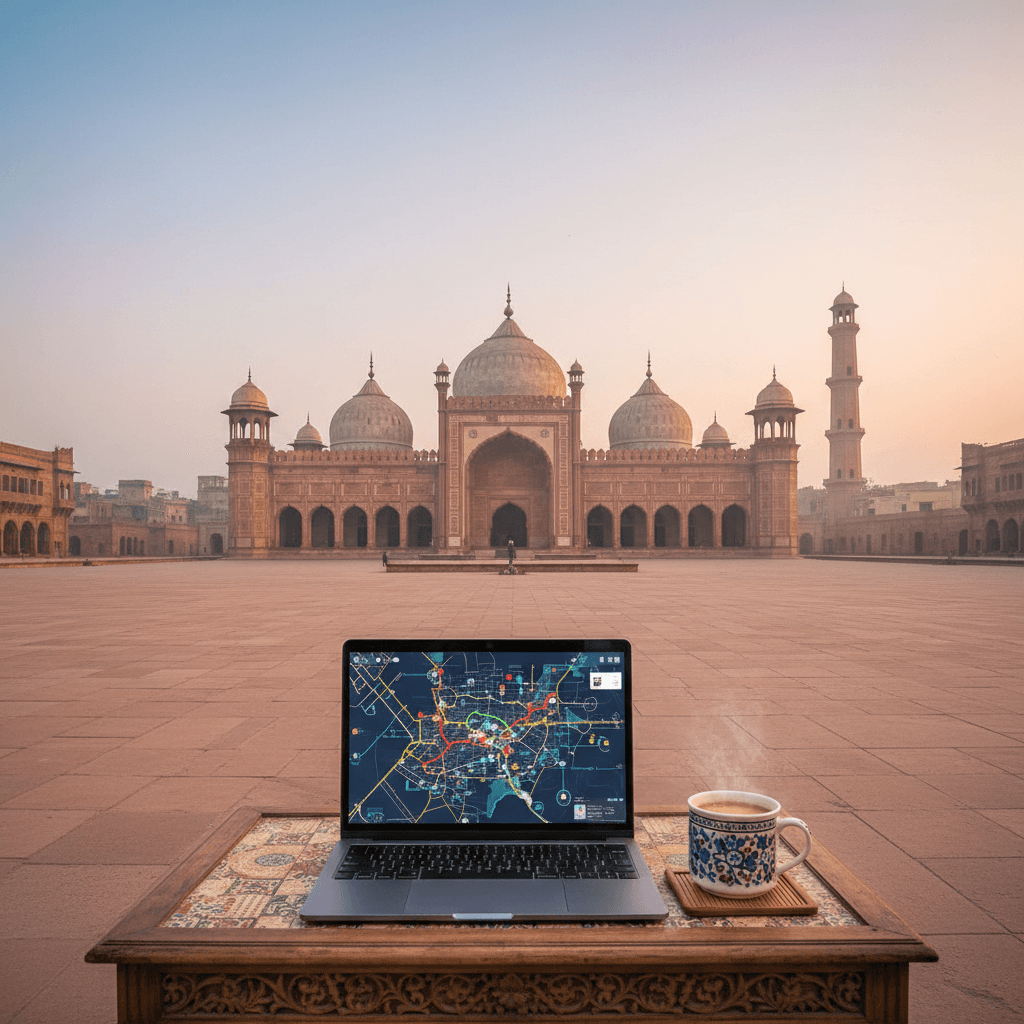
Lahore
🇵🇰 Pakistan
Lahore feels loud before it feels friendly. Horns stack up outside, the azaan rolls over it all and then someone hands you chai or a plate of gol gappe like that settles everything. It’s chaotic, sure, but the city has a warm, lived-in confidence that nomads tend to remember long after they leave.
The cost of living is the real hook. A basic month can land around $400 to $500 and that includes a simple studio, street food and cheap rides, while a more comfortable setup in DHA with nicer meals and coworking pushes past $1,000, which, surprisingly, still feels affordable compared with a lot of nomad cities. Not expensive. Not at all.
Most people split into a few camps:
- Gulberg: Best if you want cafes, MM Alam Road and a more social nomad rhythm, though rent runs higher and traffic gets annoying fast.
- DHA, especially Phase 5: Cleaner, calmer, more reliable on power and security, but you’ll probably need a car or Careem for everything.
- Johar Town: Good value, lots of everyday convenience and it’s easier on the wallet, even if it feels less polished than Gulberg or DHA.
The remote work scene is decent and growing. Launchbox in DHA, Kickstart 67 in Gulberg and WorkBridge in Johar Town cover the main moods, from networking to budget desks and internet usually sits around 20 to 50 Mbps citywide, with the better spaces hitting 100 Mbps or more, so you can actually get work done, most days anyway. WiFi is, honestly, one of Lahore’s brighter spots.
Food is half the point of being here. Nihari at breakfast, karahi at lunch and late-night street snacks that smell like frying oil, cumin and exhaust, then hit you with more flavor than you expected. Alcohol’s restricted, nightlife stays conservative and that does make evenings quieter than some nomads like, but the trade-off is cheap, excellent eating everywhere.
The city does have friction. Traffic can wreck a day, power cuts still happen and summer heat is brutal, the kind that clings to your skin and makes even short walks feel stubborn. Still, if you stay in Gulberg, DHA or Johar Town, keep your head up at night and accept that Lahore runs on patience, you’ll probably end up liking it more than you planned.
Lahore is cheap, but not bargain-bin cheap. A solo nomad can live on $400 to $500 if you keep rent tiny and eat street food most days and that still gets you chai, rickshaws and a life that feels properly local.
Once you move up to a one-bedroom in a decent area and mix in cafes, Careem rides and the occasional sit-down dinner, the monthly bill lands around $600 to $800, while a more comfortable setup with DHA housing, coworking and better restaurants usually pushes past $1,000. The noise tells you a lot too, horns outside, generators kicking in during outages, prayer calls drifting over the heat and then the smell of fried snacks and exhaust in the same breath.
Typical monthly budgets
- Budget: $400 to $500, basic studio, street food, rickshaws, very little margin for extras.
- Mid-range: $600 to $800, better flat, mixed dining, Careem, a few coworking days.
- Comfortable: $1,000+, DHA apartment, upscale meals, regular coworking, less stress, honestly.
Neighborhood price feel
- Gulberg: studios and small 1BRs often run about $100 to $200, pricier near MM Alam Road, but you get cafes and a stronger nomad crowd.
- Johar Town: usually $80 to $150 for a studio or 1BR, which, surprisingly, makes it one of the best value picks if you can live with traffic and a less polished feel.
- DHA: expect $150 to $300 for a 1BR, sometimes more in newer blocks, because you’re paying for security, cleaner streets and fewer headaches.
Food stays very manageable if you eat like locals. Street snacks and meals are often $1 to $3, mid-range places sit around $3 to $5 and upscale dinners start at about $10, so you can go from a $2 plate of nihari to a polished cafe brunch without wrecking your budget.
Transport isn’t bad either. Careem, Uber and InDrive rides add up to roughly $25 to $50 a month for many nomads, rickshaws are cheaper but noisy and negotiable and the Orange Line is handy when traffic turns the roads into a crawling mess, which it often does.
Coworking is still reasonable. Budget spaces can start around $34 a month in Johar Town, solid mid-range spots in Gulberg sit closer to $57 to $85 and better equipped places in DHA can hit $85 or more, though the backup power and fast internet are sometimes worth it.
Lahore’s best areas split pretty cleanly by lifestyle and the wrong pick will annoy you fast. Traffic jams are loud, the air can feel gritty and a cheap apartment near the wrong road can make everyday life miserable, honestly.
Nomads
- Gulberg: Best all-around pick for solo workers, with cafes on MM Alam Road, coworking nearby and enough foot traffic that you don’t feel stranded after dark. It’s pricier than Johar Town, though and parking is a headache.
- Johar Town: Better if you want value, with studios often around $80 to $150 and easier access to budget coworking like WorkBridge. The tradeoff is heavier traffic and a less polished feel, which, surprisingly, some nomads prefer because it’s more local and less glossy.
Most nomads end up in one of those two because they want WiFi, food and a short rickshaw ride to somewhere useful. Gulberg feels more polished, Johar Town feels more lived-in and both can work if you don’t mind the constant honking.
Expats
- DHA, especially Phase 5: The safest, easiest setup for longer stays, with better roads, reliable power, green streets and cleaner air than most of the city. It’s car-dependent and expensive, but that’s the deal.
- Gulberg: Good for expats who want cafes, restaurants and a bit of nightlife without living in a bubble. Rents are still manageable compared with major global cities, but crowds and noise show up fast.
Expats who stay a while usually like DHA because the day-to-day friction is lower, from backup power to grocery runs and that matters when the summer heat is brutal. Gulberg works if you want a little more energy and don’t mind the mess.
Families
- DHA: The obvious family choice, with security, schools, wide roads and fewer random power annoyances.
- Lake City: Popular with families who want quieter streets and a more suburban setup, though you’ll want a car and patience for commutes.
Families usually skip central Lahore because the noise never fully stops and school runs can eat your morning. DHA and Lake City cost more, but they’re calmer, cleaner and less chaotic after sunset.
Solo Travelers
- Gulberg: Best base if you want to walk to coffee, eat late and meet people without trying too hard.
- DHA: Better if you care more about sleep, safety and smooth logistics than bar-hopping.
Solo travelers should stay in areas where a Careem ride is easy and the street feels active, because old-city edges can get sketchy at night. Pick Gulberg for vibe, DHA for calm and skip anywhere that sounds cheap but sits miles from everything.
Lahore’s internet is decent, not magical. In Gulberg and DHA, you’ll usually get 20 to 50 Mbps in apartments and cafes and coworking spots can hit 100 to 200 Mbps, which, surprisingly, is enough for video calls, cloud work and the occasional cursed file upload, if the power stays on.
The real issue is consistency, not speed. A fast connection in Lahore can still wobble when the grid gets moody, so most nomads keep a local SIM handy, a charged power bank in their bag and a backup café in mind for the afternoons when the fan hums, the traffic honks and the router starts acting up.
Best Coworking Spots
- Launchbox, DHA Phase 5: about PKR 15,000 a month, around $85, strong for remote workers who want backup power and a proper desk.
- Kickstart 67, Gulberg: about PKR 10,000 a month, around $57, busier and better if you want to meet people.
- WorkBridge, Johar Town: about PKR 6,000 a month, around $34, cheapest of the bunch and perfectly fine if you just need a quiet seat and stable WiFi.
Launchbox feels the most polished. Kickstart is good for networking, though it can get lively and a little noisy and WorkBridge is the budget pick, plain and simple. Local cafes also work well for laptop time, with enough outlets, decent coffee and that mix of espresso smell, cardamom and aircon that makes long work sessions tolerable.
Mobile Data
- Best networks: Zong and Jazz are the usual picks for nomads.
- Cost: roughly $5 to $10 a month for heavy data use.
- Setup: bring your passport, buy it at a shop and expect activation to take 2 to 3 hours.
Honestly, a local SIM is the easiest win in Lahore. Buy one on arrival, then use Careem or Uber for rides, Google Translate for the odd market negotiation and your coworking space for the stuff that can’t wait, because the city’s traffic, noise and occasional blackout will test your patience fast.
Gulberg is the best base if you care about cafes and a social scene, DHA is better if you want steadier power and calmer streets and Johar Town gives you the lowest monthly burn. Don’t expect perfectly smooth internet everywhere, but if you plan for the hiccups, Lahore works just fine for remote work.
Lahore feels safe enough in the right pockets, but you still need to stay awake. Stick to DHA, Gulberg and Johar Town, because old city lanes, dark side streets and crowded event spaces are where petty theft and random hassle show up fastest. The traffic is loud, the air can smell like exhaust and kebab smoke at the same time and honestly, that mix of chaos is part of the deal.
Pakistan sits at a Level 3 advisory, so this isn’t a place for careless wandering, especially near large crowds, religious processions or the edges of the old city after dark. Most travelers still describe Lahore as welcoming and easy enough to manage, but you shouldn’t get sloppy with your phone, your bag or your plans, because opportunistic theft happens and the city, weirdly enough, can feel fine one minute and overstimulating the next.
Where to Stay Safer
- DHA: Best overall for peace of mind, with better security, cleaner streets and more reliable power.
- Gulberg: Fine for solo nomads, but stay alert around busy roads and nightlife strips.
- Johar Town: Good value, though traffic and street noise can be a pain.
For healthcare, private hospitals are the move if you can afford them. FMH usually gets better reviews than the big public hospitals, while Mayo, Jinnah and Services are there for serious cases but can be crowded, slow and short on staff or supplies, which sounds harsh because it's. Pharmacies are easy to find and most basic meds are available without much drama.
Keep emergency numbers saved before you need them. Police: 15 and medical help: 1122. If you get food poisoning, a scooter scrape or a random fever, don’t wait around hoping it’ll pass, get to a private clinic or hospital fast, because Lahore heat, street food and dehydration can turn annoying quickly into miserable.
Practical Healthcare Notes
- Best choice: Private hospitals and clinics for faster, cleaner care.
- Public hospitals: Useful in emergencies, but expect delays.
- Pharmacies: Widespread, so you won’t be stranded for basic medication.
Bring travel insurance if you’re staying more than a few days, especially if you ride motorcycles, eat aggressively from street stalls or have any ongoing medical needs. The humidity sticks to your skin in summer, winter fog can wreck your sinuses and the city’s air is often gritty enough to make a mask worth packing. Not glamorous. Still, most nomads handle Lahore fine if they keep their neighborhood sensible, their phone in a pocket and their expectations grounded.
Lahore’s getting around is cheap, noisy and a little chaotic. Honking is constant, rickshaws dart across lanes and the air can smell like exhaust, frying oil and dust all at once, so don’t expect a calm commute.
For most nomads, Careem, Uber and InDrive are the easiest choice and honestly they’re still inexpensive by international standards, with short rides often landing in the PKR 50 to 200 range. Rickshaws are even cheaper if you negotiate first, though drivers will push back on the price if you look too eager.
Ride-hailing: Careem, Uber, InDrive
Typical fare: PKR 50 to 200
The Orange Line Metro is the best public transport option if you want to avoid traffic, which, surprisingly, can chew up an hour for a trip that should take ten minutes. Fares are around PKR 20 to 40, it’s clean enough and it gets crowded fast at rush hour, so keep your bag in front of you.
Walking works in parts of Gulberg and DHA, but only in the sense that you can stroll between cafes or shops without hailing a ride every five minutes. Outside those pockets, sidewalks can vanish, cars park wherever they like and crossing a road feels like a small negotiation with fate.
- Best for walking: Gulberg, DHA core areas
- Not great for walking: Old city edges, wide arterial roads
- Bike/scooter scene: Barely there, so don’t plan on it
Airport transfers are straightforward and Careem usually gets you from the airport to central Lahore for about PKR 500 to 800 in 20 to 40 minutes, depending on traffic. Turn up late at night and the ride can still feel smooth, though the road noise and flickering headlights make the whole thing feel more exhausting than it should.
Neighborhood transport vibe
- Gulberg: Easiest for quick rides, plenty of drivers, annoying traffic around MM Alam Road
- DHA: More car-dependent, safer-feeling, better if you hate street chaos
- Johar Town: Good value, but traffic snarls are common and distances add up
If you’re staying a while, budget roughly $25 to $50 a month for transport, depending on how often you move around and whether you lean on ride-hailing instead of the metro. That’s the real tradeoff here, cheap movement, but not always fast movement.
Lahore runs on Urdu and Punjabi and in the better parts of the city, English gets you far enough for apartments, coworking, ride-hailing and most cafe orders. In markets, though, expect slower back-and-forth, gestures and a bit of negotiation, because the rhythm changes the moment you leave Gulberg or DHA and step into a street stall with oil sizzling, fans rattling and people talking over each other.
Most nomads get by just fine with a few words and a calm attitude. Shukriya goes a long way and so does Kitna? when you’re asking about prices, though honestly, you’ll get a better reaction if you smile and keep your tone light.
Useful phrases:
- Shukriya, thanks.
- Kitna?, how much?
- Madad, help.
English is common with younger people, students, office staff and anyone tied to tourism or business, but outside those circles it drops fast. That means a rickshaw driver, shopkeeper or pharmacy clerk may understand you well enough, then answer in Urdu, so keep your phone ready with Google Translate voice or an English-Urdu app when the conversation gets sticky.
Communication here can be warm and direct and sometimes a little blunt. People may call out from a shop, ask where you’re from or keep chatting while handing over your chai and that’s normal, not rude. The city sounds like honking, prayer calls, sandals on tile and vendors shouting prices, which, surprisingly, can feel comforting once you stop fighting it.
What to expect
- Urban English: solid in cafes, offices and coworking spaces.
- Street English: patchy, especially in older markets.
- Best move: use short sentences, numbers and gestures.
- Backup: translation apps and a little patience.
If you’re staying a while, pick up a few basics and don’t stress about perfect grammar. Lahore locals usually appreciate the effort, even when you mangle pronunciation and that tiny bit of Urdu can make a taxi ride, apartment hunt or food stall conversation feel a lot smoother, frankly, than relying on English alone.
When to Go
October through February is the sweet spot, honestly. Days sit around 10 to 25°C, evenings cool off enough for a light jacket and the city feels far more livable when you’re not sweating through your shirt at 10 a.m. or inhaling hot dust on Ferozepur Road.
Winter mornings can be foggy, which sounds romantic until your rickshaw crawls along at a snail’s pace and everything smells like exhaust, chai and damp concrete. Still, this is when Lahore feels easiest for nomads, with lower heat, better walking conditions in Gulberg and DHA and fewer days where the air feels like a hair dryer.
Month-by-Month Reality
- April to June: Brutal. Temperatures often hit 35 to 45°C and the heat clings to your skin the second you step outside, so plan around indoor work and short rides.
- July to August: Monsoon season, with heavy rain, sticky humidity and sudden downpours that turn roads into a mess, then you get that loud, satisfying sound of rain hammering tin roofs.
- September: Better, but still warm, with the city slowly exhaling after summer, though the air can stay gritty and dusty.
- October to February: Best overall, cooler days, manageable nights and the most comfortable time for cafes, coworking and actual sightseeing.
What Nomads Should Expect
Summer in Lahore isn’t just hot, it’s draining. Power cuts can still happen, traffic gets louder and slower and the pollution sits in the air like a film, so if you’ve got asthma or hate feeling sticky all day, don’t romanticize it.
Winter has its own quirks. Fog can wreck morning plans and the cold tile floors in older homes are miserable, but the tradeoff is real, you can walk more, eat outdoors without melting and enjoy the city’s street food without feeling half-dead by sunset.
Best Plan by Season
- For long stays: Arrive in October or November, settle in before the holiday rush and you’ll have the easiest run of the year.
- For budget travelers: Summer can be cheaper, but you’ll pay for it in sweat, noise and extra rides because walking becomes a punishment.
- For food and exploring: Late autumn and winter are best, especially for Food Street, the Old City and evening cafés in Gulberg.
If you want Lahore at its most tolerable, go late fall through early spring. Anything else and you’ll spend a lot of time looking for shade, cold water and a fan that actually works.
Lahore is cheap, but it isn’t easy. The heat smacks you in the face in summer, the diesel haze sits low on the road and the horns never really stop, though the city’s friendliness softens the rough edges fast.
Money and monthly costs
A solo nomad can get by on $400 to $500 if you keep rent low and eat local and a more comfortable setup lands around $600 to $800 with a decent apartment, regular Careem rides and a few café lunches. If you want DHA, coworking and proper sit-down dinners, budget $1,000 or more, honestly, because the nicer places add up fast.
- Budget: Johar Town studio, street food, rickshaws, around $400 to $500 a month.
- Mid-range: Gulberg one-bedroom, mixed dining, ride-hailing, around $600 to $800.
- Comfortable: DHA apartment, coworking, upscale meals, $1,000 plus.
- Meals: Street eats run $1 to $3, mid-range spots $3 to $5 and fancier dinners start around $10.
Where to stay
Gulberg is the best all-round pick for solo nomads, with cafes, coworking and MM Alam Road close by, though traffic gets stupidly tight at rush hour. DHA, especially Phase 5, feels calmer and more polished, with better backups and cleaner streets, but you’ll rely on a car more than you’d like.
Johar Town is the value play. It’s more relaxed, full of students and families and you’ll find better rent here, but the tradeoff is heavier traffic and fewer polished hangouts, which, surprisingly, some people prefer because it feels less performative.
Getting connected
Buy a Jazz or Zong SIM if you’re staying a while, the shop will ask for your passport and sometimes your hotel details, then activation usually takes a couple of hours. Internet is decent in most parts of the city, 20 to 50 Mbps is normal and coworking spaces like Launchbox, Kickstart 67 and WorkBridge are the safe bet when your apartment WiFi starts acting up.
- Launchbox, DHA Phase 5: about PKR 15,000 a month, strong backup power, around 150 Mbps.
- Kickstart 67, Gulberg: about PKR 10,000 a month, good for meeting people.
- WorkBridge, Johar Town: about PKR 6,000 a month, best on a tighter budget.
Getting around and staying safe
Use Careem, Uber or InDrive for most trips, because haggling with rickshaw drivers every time gets old fast. The Orange Line is handy for a few routes, but Lahori traffic can be maddening and if you’re crossing town at the wrong hour, you’ll hear your own patience fray in the heat and honking.
Stick to DHA, Gulberg and Johar Town after dark, avoid empty lanes near the old city late at night and don’t wander into big crowds during tense events. Pharmacies are easy to find, private hospitals are the better option if you need proper care and for everyday life, modest dress and right-hand eating will save you a lot of awkwardness.
Need visa and immigration info for Pakistan?
🇵🇰 View Pakistan Country GuideEasy Landing
Settle in, no stress