La Paz
🇧🇴 Bolivia
Landing in La Paz feels like dropping into a giant, rust colored bowl carved out of the Andes. At 3,660 meters, the air is thin, crisp, and carries the scent of roasting coffee and diesel. It is a place that demands your respect. You will likely spend your first 48 hours moving in slow motion as your lungs adjust to the altitude, but once you find your breath, you realize this city is unlike any other nomad hub in South America.
The High Altitude Vibe
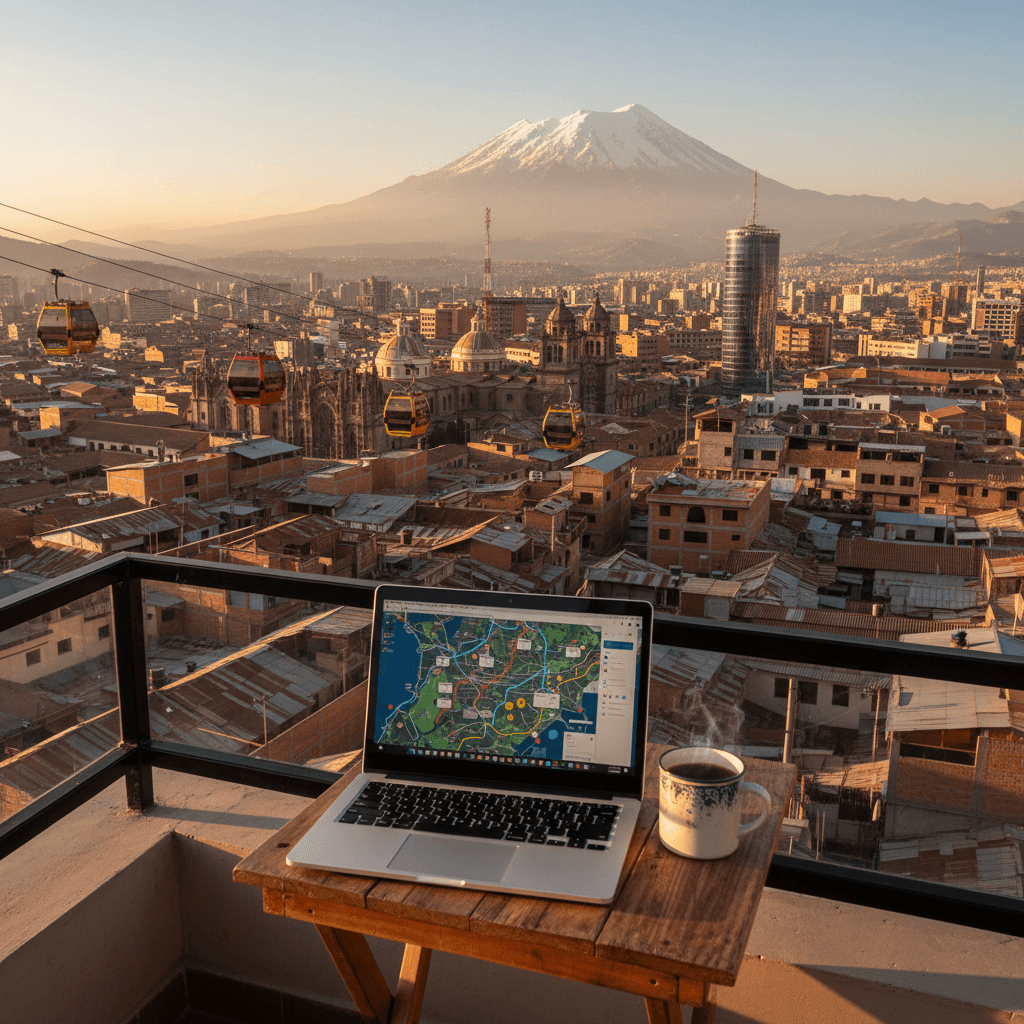
La Paz is beautiful in a way that feels slightly chaotic. It is a vertical city where your daily commute involves the Mi Teleférico, a world class cable car system that acts as a subway in the sky. For 3 BOB (about $0.45), you can glide over the sprawling metropolis, watching the transition from the glitzy skyscrapers of the center to the brick houses clinging to the canyon walls. It is a visual trip every single time you leave your apartment.
The culture here is deeply rooted. You will see Cholitas in traditional bowler hats and layered skirts selling everything from quinoa to electronics right next to modern glass office buildings. It is a city of contrasts that has not yet been "sanitized" for tourism. While places like Medellin or Mexico City feel like they are catering to nomads, La Paz still feels like it belongs to the Paceños. You are just a guest in their high altitude world.
The Nomad Reality Check
Living here is incredibly affordable, but it comes with a few trade-offs. Most nomads find that while the cost of living is low, with a comfortable monthly budget sitting around $900 to $1,100, the infrastructure is still catching up. Internet speeds usually hover between 10 and 20 Mbps. It is enough to get the job done, but you will want to scout out specific spots like Impact Hub La Paz or EQ Spaces if your work involves heavy video calls.
The community is small and intimate. You won't find the massive nomad meetups of Bali here. Instead, you'll meet a gritty, adventurous crowd of remote workers and expats who prefer hiking the surrounding peaks to sitting in a trendy beach club. Most people hang out in the Historic Center or at spots like Cafe Sol, where the coffee is strong and the atmosphere is cozy enough to hide away from the Andean chill.
What Sets It Apart
- The Food Scene: You can eat a $3 meal at a local market or drop a fraction of what you would pay in London for a world class tasting menu at Gustu, founded by the co-founder of Noma.
- Safety: Despite the visual chaos, travelers often find La Paz feels safer than many other major Latin American capitals. Use common sense at night, especially in the steeper districts, but generally, it is a welcoming place.
- The Landscape: You are surrounded by 6,000 meter peaks. If you are an outdoor enthusiast, the trekking and climbing opportunities are world class and practically in your backyard.
- Affordability: With an average local income around $500 a month, your dollars or euros go an incredibly long way. A high end lifestyle here is cheaper than a budget lifestyle in New York.
If you need blazing fast fiber optic and a Starbucks on every corner, La Paz might frustrate you. But if you want a city that feels authentic, offers dramatic views from every window, and keeps your bank account happy, this canyon city is a top tier choice for 2025 and 2026. Just remember to pack some coca leaves for the altitude and a heavy coat for the nights.
The Bottom Line on Your Budget
La Paz is one of the most affordable capitals in South America. If you're coming from the US or Europe, your money goes incredibly far here. A solo nomad can live quite well on $900 to $1,100 a month, while those on a tighter budget can scrape by on as little as $650 if they stick to local markets and basic housing.
Most of your savings will come from the low cost of services and food. The average local income is around $500 a month, so prices for everyday items like transport and groceries are scaled accordingly. You'll find that your biggest "splurge" will likely be high speed internet or a modern apartment with actual heating, which is a luxury in this high altitude climate.
Accommodation and Rent
Finding a place in La Paz is a bit of a mixed bag. While prices are low, the quality of housing varies wildly. You'll want to look specifically for places with heating and reliable WiFi, as many older buildings in the Historic Center lack both.
- Budget Tier: Expect to pay $400 to $500 for a basic one bedroom in a central area. It'll be functional but likely lacks modern finishes.
- Mid-Range: $600 to $800 gets you a much more comfortable setup, often with better views and more reliable utilities.
- Comfortable/Luxury: At $1,000+, you're looking at the top tier of the market, including modern apartments in the newer parts of town.
Eating and Drinking
The food scene is where La Paz really shines for the price. You can bounce between $3 street snacks and world class fine dining without breaking the bank. Expats often rave about the value at Gustu, where you can get a high end meal for a fraction of what you'd pay at a similar Michelin level spot in New York or London.
- Groceries and Local Markets: A monthly spend of $150 to $200 is plenty if you shop at local stalls. Street food items usually cost between 20 and 50 BOB ($3 to $7).
- Mid-Range Dining: A solid dinner at a nice sit down restaurant will usually run you $15 to $25 per person.
- Coffee Culture: Digital nomads frequent Cafe Sol or Café Vida, where a coffee and a snack will set you back about $5.
Transport and Connectivity
Getting around is surprisingly cheap thanks to the Mi Teleférico cable car system. It's not just a tourist attraction; it's the most efficient way to navigate the canyon. Each ride is only 3 BOB (about $0.45). If you prefer the ground, Uber is active and very affordable, with base rates starting around 4 BOB ($0.60).
Coworking is a necessary expense for most because home internet can be spotty. You have a few solid options depending on your needs:
- La Casa de la Cultura: The most affordable desk in town at roughly $75 a month.
- Impact Hub La Paz: A more social, entrepreneurial environment for about $145 a month.
- EQ Spaces Cowork: The premium choice at roughly $235 a month, offering the best views and most ergonomic setups in the city.
Daily Life and Extras
Don't forget to budget for the little things that make La Paz unique. A night out at a Peña restaurant for live folk music and dancing is a must, and it's generally very affordable. While the city is safe compared to many of its neighbors, you'll still want to factor in a little extra for Ubers at night rather than walking through unfamiliar districts alone. Overall, if you have $1,200 in your pocket, you'll be living one of the most comfortable lifestyles the city has to offer.
For Digital Nomads: El Centro and Sopocachi
If you need to be within walking distance of a reliable desk and a strong espresso, the historic city center (El Centro) is your best bet. It is the city's heartbeat, where colonial architecture meets the chaos of daily commerce. You will find Impact Hub La Paz and EQ Spaces Cowork here, which are the gold standard for connectivity in a city where home internet often tops out at a sluggish 10-20 Mbps. Living here means you are steps away from Cafe Sol, a favorite haunt where a coffee and snack will run you about 20 to 50 BOB.
While the research focuses on the center, many nomads gravitate toward the adjacent Sopocachi neighborhood for its Bohemian vibe. It is slightly more relaxed than the core but keeps you close to the Mi Teleférico yellow and purple lines. Expect to pay between $600 and $800 for a mid-range one-bedroom apartment that actually includes modern perks like a washing machine and decent heating, which is a luxury at this altitude.
For Expats: The Southern Zone (Zona Sur)
Expats looking for a more "Western" lifestyle usually head downhill. Because La Paz is built into a bowl, the lower you go, the warmer it gets and the easier it is to breathe. The Southern Zone sits at a lower elevation than the 3,660-meter center, making the physical transition to Bolivian life much smoother. This is where you will find the higher-end grocery stores and world-class dining like Gustu, where you can experience fine dining for a fraction of European prices.
The community here is more established, though the digital nomad scene is still in its "baby steps" phase. Rent in these comfortable pockets can easily cross the $1,000 mark for premium builds. It feels more suburban and manicured than the center, providing a quiet retreat from the city's famous intensity. You will likely rely on Uber here, which is incredibly affordable with base rates starting around 4 BOB.
For Solo Travelers: The Historic Hub
If you are arriving alone and want to soak up the culture immediately, stay near Plaza Murillo. It is the most walkable part of the city and keeps you surrounded by museums, monuments, and the famous peñas restaurants. These spots are perfect for solo travelers because they offer dinner and live folk music, making it easy to enjoy the local scene without feeling out of place at a table for one.
Safety is a major plus here; travelers generally find La Paz safer than many other South American capitals. However, stick to the well-lit main drags of Avenida 16 de Julio at night. Being central also gives you the best access to the Mi Teleférico. For just 3 BOB, you can hop on a cable car to scout the city from above, which is the safest and most scenic way to get your bearings without getting lost in the steep, winding alleys.
For Families: Lower Altitudes and Green Spaces
La Paz can be a tough sell for families due to the thin air and steep hills, so the priority is usually comfort and space. Families should look toward the residential pockets in the lower valleys of the city. These areas offer more green space and a reprieve from the congestion of the Historic Center. You will find larger apartments here, often with three bedrooms, though finding a place with "modern" amenities like consistent central heating requires a diligent search.
The Mi Teleférico system is a lifesaver for families. It is clean, efficient, and avoids the erratic driving of local buses. It makes outings to the various museums or the Long Night of Museums festival much easier to manage with kids in tow. Just keep in mind that Spanish is the primary language for everything from school enrollments to grocery shopping, as English proficiency remains low even in nicer neighborhoods.
Connectivity Realities
Working from 12,000 feet comes with some literal and figurative hurdles. While La Paz isn't a high-speed tech hub yet, the infrastructure is catching up. You'll generally find speeds between 10 to 20 Mbps in the city center. It's enough for standard Zoom calls and Slack, but if you're uploading massive video files, you'll need to be strategic about where you sit.
Most nomads find that the local fiber connections in modern apartments are reliable, but the city's topography can occasionally mess with signals. If you head into the more rural outskirts or take a weekend trip to the Yungas, don't expect to get much done. Stick to the urban core for a stable connection.
Top Coworking Spaces
The coworking scene is small but tight-knit. Since the nomad community here is still in its early stages, these spaces are the best places to find your tribe and secure the most reliable bandwidth in the city.
- Impact Hub La Paz: Located right in the heart of the city, this is the gold standard for remote workers. It costs around $145 (1,000 BOB) per month. You get high-speed internet, professional meeting rooms, and access to a community of local entrepreneurs.
- EQ Spaces Cowork: If you want a view while you grind, this is the spot. It's very central and features ergonomic furniture that your back will appreciate. It's on the pricier side at roughly $235 (215 EUR) per month, but the proximity to bars and restaurants makes the transition from work to happy hour seamless.
- La Casa de la Cultura: This is a more budget-friendly, relaxed option in the center. At approximately $75 (500 BOB) per month, it offers a cultural atmosphere and decent speeds without the corporate vibe.
Laptop-Friendly Cafes
If you prefer the hum of a coffee shop over a dedicated office, La Paz has a few reliable haunts. Just keep in mind that while many cafes have WiFi, they aren't always thrilled if you camp out for six hours on a single espresso.
- Cafe Sol: This is the unofficial nomad headquarters. It's cozy, the internet is surprisingly snappy, and you can grab a coffee or snack for $3 to $7 (20-50 BOB).
- Café Vida: Travelers often recommend this spot for its secluded corners. It's a great place to tuck away for a few hours of deep work when you need to escape the chaotic energy of the streets outside.
Mobile Data and SIM Cards
Don't rely solely on cafe WiFi. Local SIM cards are cheap and the 4G coverage throughout the urban areas of La Paz is solid. You can pick up a card at the airport or at various kiosks in the Historic Center. While specific data packages vary, mobile data is often more consistent than the WiFi in older buildings. Use your phone as a hotspot if the building's router starts acting up due to the altitude or aging wiring.
Expats recommend getting your SIM registered immediately with your passport to avoid service interruptions. Having a local number also makes it much easier to use Uber, which is the safest and most efficient way to get your laptop and gear across the city for about $0.60 (4 BOB) as a base rate.
Keeping Your Wits in the Clouds
La Paz is a bit of an anomaly in South America. While many regional hubs struggle with high crime rates, most nomads find this city feels surprisingly safe. It lacks the edge you might feel in parts of Bogota or Quito. However, it's still a major metropolis in a developing country, so you can't just wander around on autopilot.
The general consensus is that the historic center and the southern zones are fine during the day. As the sun goes down, you'll want to be more selective. Avoid walking alone in the city's poorest districts, many of which are visible from the Mi Teleférico lines. If you're heading home late from a peña restaurant or a bar, skip the walk and use Uber. It's affordable, with base rates starting around 4 BOB ($0.60), and it provides a digital trail that street taxis don't.
Pickpocketing is the most common headache. Crowded markets and busy transit hubs are the primary spots for light fingers. Keep your phone in a front pocket and don't hang your bag on the back of your chair at Cafe Sol or other popular nomad hangouts. If you're using the cable cars, keep your backpack in front of you when getting on and off.
The Real Danger: Altitude
The biggest threat to your health isn't crime; it's the 3,660 meter (12,000+ feet) elevation. Altitude sickness, locally known as soroche, hits almost everyone to some degree. You'll likely experience headaches, shortness of breath, or insomnia during your first few days. Most expats recommend taking it very slow for the first 48 to 72 hours.
Hydration is your best friend here. You'll also see locals and travelers alike drinking coca tea or chewing coca leaves to mitigate the symptoms. You can find "Sorojchi Pills" at almost any local pharmacy without a prescription. If you have pre-existing heart or lung conditions, consult a doctor before booking your flight, as the thin air puts significant strain on the body.
Healthcare and Pharmacies
If you do get sick beyond altitude issues, the healthcare system is functional but varies wildly in quality. For anything serious, nomads usually head to private clinics in the southern part of the city or the more modern facilities near the city center. These private options are where you're most likely to find English speaking staff, though Spanish is still the primary language of medicine here.
- Pharmacies: You'll find "Farmacias" on nearly every second block in the center. They are well stocked with most basics and are a great first stop for minor ailments.
- Emergency Services: While emergency info is sometimes localized, having a good travel insurance policy that includes medical evacuation is a smart move given the city's geographical isolation.
- Water Safety: Do not drink the tap water. Stick to bottled water or high quality filters to avoid stomach issues that can ruin a week of work.
Overall, La Paz is a place where common sense goes a long way. If you stay hydrated, watch your belongings in the markets, and use ride-hailing apps at night, you'll likely find it one of the more relaxed capitals in the region.
The Sky-High Transit System
La Paz isn't built for a traditional subway. The geography is far too vertical for that. Instead, the city has revolutionized urban transit with Mi Teleférico, the highest and longest cable car system on the planet. For nomads, this isn't just a tourist attraction; it's the most reliable way to get around.
There are 10 different lines color coded like a metro map. It's incredibly cheap at only 3 BOB (about $0.45) per ride. The cars are clean, quiet, and offer some of the most dramatic commutes you'll ever experience. Most expats use the lines to hop between the steep canyon walls, skipping the legendary traffic jams that plague the streets below.
Ride-Hailing and Taxis
While local buses (micros) and shared minivans (trufis) are everywhere, they can be a headache to figure out if your Spanish isn't great. Most remote workers stick to Uber for door-to-door trips. It's remarkably affordable here, with a base rate starting around 4 BOB ($0.60).
Using Uber is generally considered the safest and quickest way to get home after a late dinner at Gustu or a night out at the peñas-restaurants in the center. It removes the need to negotiate fares in Spanish, which is helpful since English proficiency is quite low among local drivers.
Navigating on Foot
The Historic Center is quite walkable once you're there. You'll find most of the museums, the Plaza Murillo, and coworking spots like Impact Hub within a reasonable walking distance. However, walking in La Paz comes with two major caveats: the hills and the air.
The city sits at over 3,660 meters, so even a slight incline can leave you winded. Most newcomers find they need a few days to acclimate before attempting long walks. The sidewalks in the center can also get incredibly crowded with street vendors and shoppers, so you'll often find it faster to take a cable car for anything more than six or seven blocks away.
Transportation Cost Estimates:
- Cable Car Ride: 3 BOB ($0.45)
- Uber Base Fare: 4 BOB ($0.60)
- Monthly Transport Budget: Most nomads spend between $30 and $50 depending on how often they head to the lower, wealthier zones of the city.
Safety and Practical Tips
While La Paz is safer than many other South American capitals, you should still keep your wits about you. Travelers often recommend avoiding solo walks through unfamiliar districts at night, especially the poorer areas that you might see from the cable car lines. Stick to well-lit areas in the Centro Histórico or use a ride-hailing app if you're moving between neighborhoods after dark.
If you're heading to the airport, plan for extra time. While the cable cars are punctual, the road traffic can be unpredictable. There aren't many bike or scooter rentals available yet, mostly because the topography makes traditional cycling a workout reserved for the very brave or the very fit.
The Spanish Reality Check
If you’re planning to touch down in La Paz expecting to get by with English, you’re in for a wake-up call. English proficiency among locals is low to moderate at best. Outside of high-end hotels or world-class restaurants like Gustu, you won't find many people who speak it fluently. Most nomads find that while they can navigate the basics with hand gestures and a smile, real life here requires at least a functional grasp of Spanish.
Spanish is the heartbeat of the city, but it isn’t the only language you’ll hear. In the markets and more traditional neighborhoods, Aymara is widely spoken by the indigenous population. You don't need to learn it, but picking up a few greeting terms can go a long way in building rapport with the local vendors. It shows respect for the deep-seated heritage that makes La Paz so distinct from other South American capitals.
Survival Tactics for Non-Speakers
Expats recommend downloading Google Translate or DeepL for offline use before you arrive. You'll need it for everything from reading menus at local peñas-restaurants to explaining your destination to an Uber driver. Since the digital nomad community here is still in its "baby steps" phase, you won't always have a bubble of English speakers to fall back on.
If your Spanish is rusty, your best bet is to head to coworking hubs like Impact Hub La Paz or EQ Spaces Cowork. The staff and members there are much more likely to speak English, and they can help bridge the gap when you're trying to figure out local logistics or lease agreements. Many travelers often say that the lack of English is actually a blessing in disguise, as it forces you to immerse yourself in the culture much faster than you would in a more westernized hub.
Key Phrases to Know
You don't need to be fluent to survive, but you do need to be polite. Bolivian culture is generally formal when it comes to greetings. Always start an interaction with a "Buen día" (Good day) or "Buenas tardes" (Good afternoon) before jumping into a question. Here are a few essentials for your first week:
- ¿Cuánto cuesta? (How much does it cost?) – Vital for the markets where prices aren't always marked.
- La cuenta, por favor. (The check, please.) – Use this at the pizzerias and cafes.
- ¿Habla inglés? (Do you speak English?) – It’s a long shot, but worth asking.
- ¿Dónde está el Teleférico? (Where is the cable car?) – You’ll be using this system constantly to get around.
- No pica, por favor. (Not spicy, please.) – Helpful if you’re sensitive to some of the local llagua sauce.
Communication Tools and Connectivity
Because you'll be relying on translation apps, having a solid data plan is mandatory. Mobile coverage in the urban center is generally good, though internet speeds can be a bit of a rollercoaster, often hovering between 10-20 Mbps. Most nomads grab a local SIM card immediately to stay connected while navigating the winding streets of the Historic Center.
Expect to use WhatsApp for almost everything. From booking a table to chatting with a potential landlord or your Uber driver, it's the primary way the city communicates. If a business has a phone number listed, don't bother calling; just send a text. It gives you the added benefit of being able to translate their responses in real-time, which saves a lot of stress during those first few weeks of acclimatization.
The High Altitude Reality
La Paz isn't just high; it sits at a staggering 3,660 meters (12,000+ feet). This altitude dictates everything about the weather and how you'll feel during your first week. The air is thin and crisp, meaning the sun feels intense during the day, but temperatures plummet the second it drops behind the canyon walls.
The city generally experiences two main seasons: the dry season and the rainy season. Because of the elevation, you won't find tropical heat here. Instead, expect a permanent spring or autumn vibe that requires a "layers-always" wardrobe strategy.
Dry Season: May to October
Most nomads and hikers agree this is the best time to visit. You'll get clear, deep-blue skies and almost zero rainfall, which is perfect if you're planning to tackle the nearby treks or spend your weekends exploring the Historic Center. This is also when the Long Night of Museums usually takes place, letting you hop between cultural spots for free under the stars.
The trade-off is the cold. While daytime temperatures hover around 15°C (59°F), nighttime temperatures in June and July often dip toward 0°C (32°F). Since many apartments in La Paz lack central heating, you'll want to confirm your Airbnb or rental has a space heater or plenty of heavy alpaca blankets. Expats often joke that the best way to stay warm is a visit to a local market for a 50 BOB ($7) wool sweater.
Rainy Season: November to March
Expect frequent afternoon downpours and overcast skies during these months. January and February are the wettest, which can make the steep, cobblestone streets of the Centro Histórico quite slippery. On the plus side, the surrounding mountains turn a brilliant green, and the dust of the city settles.
The temperature stays slightly more consistent during the day, rarely feeling "freezing" because of the cloud cover, but the dampness can make the indoors feel chilly. If you're working from Impact Hub La Paz or Cafe Sol, these months are actually quite cozy for deep work sessions while the rain hits the windows.
Acclimatization Tips for New Arrivals
Don't underestimate the "Soroche" (altitude sickness). Most travelers find that the first 48 to 72 hours are a write-off for any serious physical activity. Local wisdom suggests drinking plenty of coca tea and staying hydrated to help your body adjust to the thin air.
- Sun Protection: The UV rays at this height are brutal. Even on cloudy days, you'll burn in under 20 minutes without high-SPF sunscreen.
- Hydration: You'll need to drink twice as much water as usual. It helps with the headaches that often plague nomads during their first week.
- The "Bowl" Effect: Remember that the city is a canyon. The lower you go (toward the southern zones), the warmer it gets. The higher you go (toward El Alto), the colder and windier it becomes.
When to Book
If you want the perfect balance of manageable weather and cultural events, aim for May or September. You'll avoid the peak winter freeze of July and the heavy rains of January. These shoulder months are ideal for riding the Mi Teleférico for 3 BOB to catch a sunset without a cloud in sight. Just remember that regardless of when you arrive, a heavy jacket and a pair of sturdy walking shoes are non-negotiable items for your suitcase.
Acclimatizing and Health
The first thing you'll notice in La Paz isn't the scenery, it's the thin air. At 3,660 meters, altitude sickness is a real hurdle for most newcomers. Plan to spend your first 48 to 72 hours taking it very easy. Local expats swear by mate de coca (coca leaf tea) to help with headaches and fatigue, but staying hydrated is your best defense.
While the city is generally safer than other major South American hubs, it pays to be smart. Stick to well lit areas at night and avoid solo wandering in the poorer districts on the outskirts, which you'll see from the cable cars. Most travelers feel comfortable in the central districts, but keep your phone tucked away when walking through crowded markets.
Connectivity and Remote Work
If your job requires heavy video editing or constant high speed streaming, La Paz will test your patience. Average speeds hover between 10 and 20 Mbps. While many cafes have decent WiFi, it can be spotty. Serious nomads usually head to Impact Hub La Paz or EQ Spaces Cowork, where the infrastructure is more reliable. A monthly hot desk at Impact Hub runs around $145, while EQ Spaces is closer to $235.
For mobile data, grab a local SIM card as soon as you arrive. Coverage is solid throughout the city bowl, but it drops off quickly once you head into the mountains. Since English proficiency is low among locals, keep a translation app downloaded for offline use. You'll need it for everything from ordering salteñas to negotiating taxi fares.
Getting Around the Canyon
Forget traditional subways. The Mi Teleférico cable car system is the crown jewel of La Paz transit. It's clean, silent, and offers the best views in the city for just 3 BOB (about $0.45) per ride. It's the most efficient way to hop between neighborhoods without getting stuck in the notorious mountain traffic.
- Uber: It's available, safe, and incredibly cheap with base rates starting around 4 BOB ($0.60).
- Walking: The Historic Center is walkable but steep. Your calves will get a workout, and the altitude makes every staircase feel like a mountain climb.
- Buses: They're everywhere and very cheap, but the routes can be confusing for newcomers. Stick to the Teleférico or Uber until you've found your bearings.
Budgeting for the High Life
Your dollar goes a long way here. A comfortable lifestyle for a digital nomad usually totals between $900 and $1,100 per month. If you're on a tighter budget, you can get by on $650 if you stick to local markets and basic housing.
- Housing: A decent one bedroom in a central area typically costs between $400 and $600. Finding modern amenities like reliable heating and in unit washers can be a hunt, so check listings carefully.
- Dining: You can grab street food for $3 to $7. For a splurge, Gustu offers world class fine dining that would cost triple the price in New York or London.
- Groceries: Most nomads spend roughly $200 to $300 a month on food if they mix market shopping with occasional restaurant visits.
Language and Culture
Spanish is the primary language for business and daily life. You'll also hear Aymara spoken frequently, especially in the bustling street markets. Don't expect many people to speak English outside of high end hotels or coworking spaces. Learning basic Spanish phrases isn't just helpful; it's a necessity for navigating the city. Locals are generally patient, but showing effort goes a long way in building rapport.
Need visa and immigration info for Bolivia?
🇧🇴 View Bolivia Country GuideOff the Radar
Pioneer territory