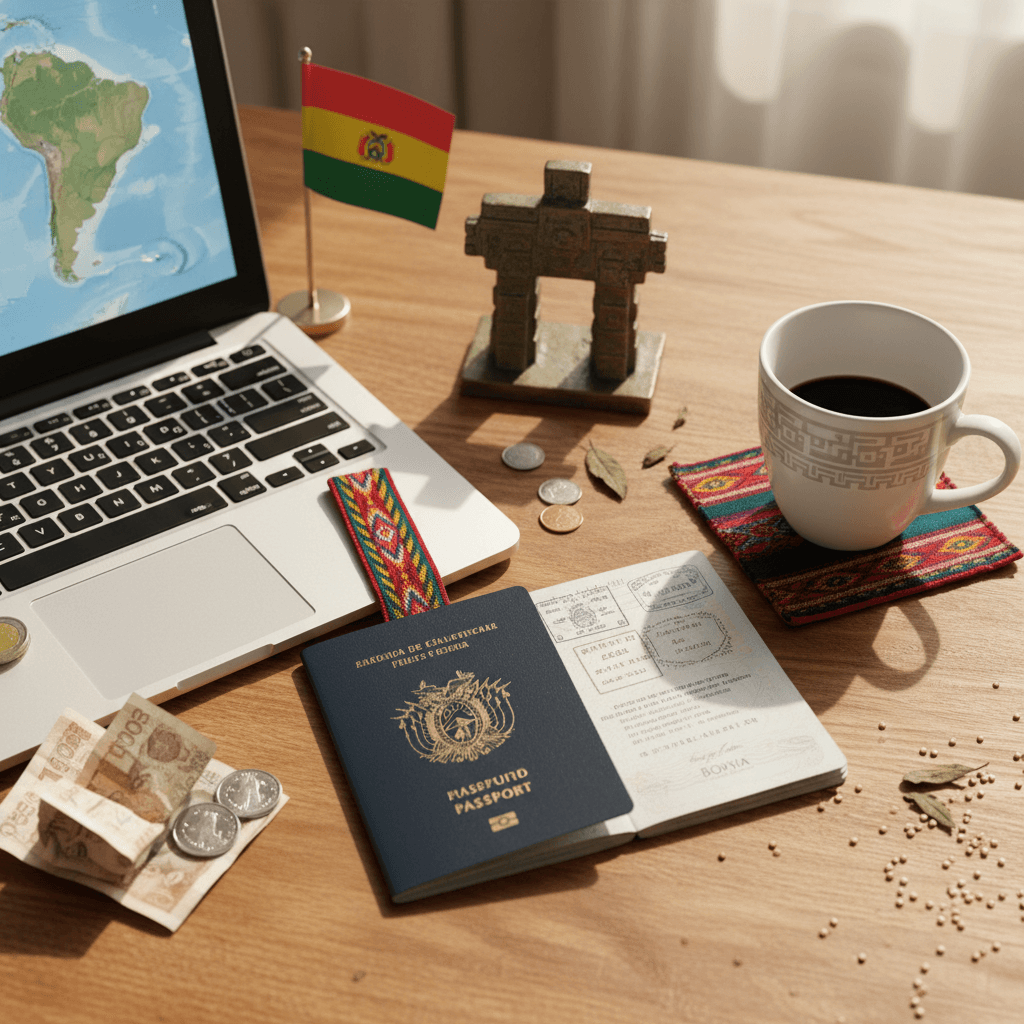
Bolivia

Policy Stability
Stamped Nomad ExclusiveHow likely visa and immigration policies are to remain unchanged
Quick Facts
N/A
$300/mo
3 months
Yes
$700/mo
31 Mbps
4/10
Medium
Medium
Low
GMT-4
Entry Methods Available
Best For
Bolivia has long been a bit of a wildcard for travelers, but recent policy shifts have made it significantly more accessible for the modern nomad. The government categorizes every nationality into three distinct groups. Understanding which bucket you fall into is the difference between a breezy airport exit and a stressful afternoon at a consulate.
The Group System
Group I: These citizens enjoy visa-free entry for tourism. You can stay for up to 90 days per calendar year. This group includes most of the EU, the UK, Canada, Australia, Japan, and most South American neighbors.
Group II: Travelers in this category generally need to apply for a visa in advance at a consulate or, in specific cases, at the border. There is usually a fee involved, often around $160 for certain nationalities.
Group III: This is the most restricted tier. Applicants need special authorization from the Directorate of Migration (DIGEMIG) before a visa can be issued.
The biggest news for 2025 is the massive expansion of Group I. In a move to boost tourism, Bolivia shifted eight countries including the United States, Israel, South Korea, and South Africa into the visa-free category. If you hold a passport from one of these nations, the days of paying hefty fees and hunting down local consulates are over.
Staying Longer: Extensions and Permanence
Most travelers get an initial 30-day stamp upon arrival. If you want to stay longer, you can extend this twice at a DIGEMIG office, totaling 90 days. The first two extensions are typically free, while further stays up to 150 days may incur a fee of roughly $30. Always keep an eye on your calendar; overstaying results in daily fines that must be paid before you are allowed to leave the country.
For those looking to set up a base for more than a few months, the Specific Purpose Visa is the go-to option. This covers remote work, internships, or volunteer positions. It requires a more rigorous paper trail, including a police record and proof of financial stability. It is valid for 30 days initially but acts as the gateway to temporary residency.
The Digital Shift: SIGEMIG and E-Visas
Bolivia is currently overhauling its migration tech through the SIGEMIG system. Most travelers are now required to complete an online pre-registration form before landing. This digital shift includes a new E-Visa portal for those who still require entry permits, allowing you to upload documents and pay fees online rather than mailing your passport to an embassy.
By 2026, the government plans to implement mandatory biometric registration for any first-time long-stay applicants. This will standardize the process across all land borders and airports, though it means you should expect a slightly longer wait during your first entry as they scan your fingerprints and take a digital photo.
Standard Entry Requirements
Regardless of your group, there are a few non-negotiables you need to have ready when you reach the immigration desk:
A passport valid for at least 6 months from your date of entry.
A printed copy of your Yellow Fever vaccination certificate if you are traveling to high-risk tropical areas like the Amazon.
Proof of a return or onward ticket.
Evidence of a hotel booking or an invitation letter from a local host.
A 4x4 cm photo with a red background for physical applications.
Business and Investment
If you are heading to Santa Cruz or La Paz for more than just coffee and mountain views, the Multiple-Entry Business Visa is worth the effort. It is valid for one year and allows you to stay for up to 90 days at a time. You will need to provide legalized company documents and a local tax ID (NIT) if you are representing a Bolivian entity. This is the best route for nomads looking to scout investment opportunities or sign local contracts without the hassle of constant renewals.
The Current Reality
Bolivia hasn't jumped on the official digital nomad visa bandwagon yet. You won't find a dedicated remote work permit in their immigration catalog, but that doesn't mean the country is closed to location-independent professionals. Most nomads currently operate in a bit of a gray area, utilizing standard entry methods to explore the high-altitude life in La Paz or the tropical heat of Santa Cruz.
Because there is no specific "nomad" law, your legal status depends entirely on how long you plan to stay and whether you want to do things strictly by the book. For short stints, the tourist path is the default. For longer stays or those who want a more "official" footprint, there is a specific pathway that bridges the gap between a traveler and a resident.
The Tourist Path (Short Stays)
The majority of nomads entering Bolivia do so on a standard tourist visa. Depending on your nationality, this is either a visa-free entry, a visa on arrival, or a pre-arranged sticker from a consulate. While the initial entry is often for 30 days, you can generally extend this at a migration office (DIGEMIG) for a total of 90 days per calendar year.
Fees for this vary wildly. Many Europeans and South Americans pay nothing. Citizens from "Group 3" countries, including the United States, usually pay a fee around $160. While remote work isn't explicitly mentioned in tourist regulations, it is generally tolerated as long as you aren't seeking local employment or selling services to Bolivian companies.
The Specific Purpose Visa (Visa de Objeto Determinado)
If you want to stay longer than 90 days or prefer a more robust legal standing, the Specific Purpose Visa is your best bet. This is designed for people entering the country for business, volunteer work, or specific projects. It serves as the primary stepping stone for anyone looking to transition into temporary residency.
- Initial Duration: 30 days, which must be extended once you land.
- Total Potential Stay: Can be extended for 120 to 180 days, or used as a base for a one-year temporary residency.
- Estimated Cost: Fees range between $85 and $250 depending on your nationality and specific processing requirements.
- Solvency Requirements: You will need to prove you can support yourself. While there is no hard-coded number, showing bank statements with at least $300 to $500 per month is the standard benchmark for approval.
How to Apply
You should start this process at a Bolivian consulate before you arrive. It is much harder to switch from a tourist visa to a Specific Purpose Visa once you are already inside the country. The paperwork is straightforward but requires some legwork.
You will need a passport valid for at least six months, a certificate of good conduct or a police record from your home country, and a flight itinerary. You also need a yellow fever vaccination certificate if you plan on visiting tropical regions like the Amazon basin. Once you enter Bolivia with this visa, you must head to a DIGEMIG office within your first 30 days to register and finalize your extension or residency paperwork.
Taxes and Local Restrictions
Bolivia’s tax system is mostly territorial. If you are a non-resident and your income comes from clients or employers outside of Bolivia, you generally won't owe local income tax. However, if you stay longer than 183 days in a year, you technically become a tax resident. At that point, the rules get more complex, and it is smart to chat with a local accountant.
The biggest rule to remember is about the local market. Whether you are on a tourist visa or a Specific Purpose Visa, you are strictly prohibited from taking a job at a Bolivian company or competing for local contracts. Keep your business international, and you likely won't run into any issues with the authorities.
Key Requirements Summary
- Economic Solvency: Proof of funds, usually via three months of bank statements.
- Clean Record: An official police background check from your country of residence.
- Health: Yellow fever vaccine record and sometimes a general health certificate.
- Exit Strategy: Proof of a return or onward flight is frequently requested at the border.
The Three-Tier System
Bolivia manages its borders using a tiered classification system. Your nationality determines whether you can breeze through immigration with a simple stamp or if you need to tackle some paperwork before you pack your bags. Recent updates have shifted several major countries into the visa-free category, making the country more accessible for digital nomads than it has been in years.
Group I includes the lucky travelers who enter visa-free. This list covers MERCOSUR and Andean nations, most of the EU, and several recent additions including the United States, South Korea, Israel, and South Africa. If you are in this group, you just need a passport with six months of validity to get your entry stamp.
Group II travelers typically need a visa but can often secure it on arrival. This applies to many nationalities that do not have a local Bolivian consulate. Group III is the most restrictive category, requiring prior consultation with Bolivian immigration (DIGEMIG) through an embassy before you arrive.
Entry Requirements and Costs
If you are a Group II traveler picking up a visa at the airport or a land border, come prepared with $52 USD in crisp, clean cash. Immigration officers are notoriously picky about the condition of US bills; any small tears or markings could lead to a rejection. You will also need a printed application form, a passport photo, and proof of your return flight or onward travel.
While Group I travelers do not pay an entry fee, everyone should be ready to show a few specific documents if asked. These include:
- A passport valid for at least six months.
- Proof of economic solvency, such as a recent bank statement.
- A Yellow Fever vaccination certificate if you are traveling from or into high-risk tropical areas.
- A printed copy of your lodging reservation for at least your first night.
Staying Longer: Extensions and Limits
The standard entry stamp gives you 30 days in the country. If you fall in love with the high-altitude life in La Paz or the chill vibes of Sucre, you can extend your stay twice. Each extension grants an additional 30 days, bringing your total to 90 days per calendar year.
To get an extension, you must visit a DIGEMIG office. The main office in La Paz is located at Av. Camacho 1468. The process is generally free or involves a very small administrative fee under 100 BOB. Bring your passport, a photocopy of your photo page, and a photocopy of your entry stamp. It is best to do this a few days before your current 30 days expire to avoid any stress.
Overstays and Border Runs
Bolivia tracks your 90-day annual limit closely. While some nomads try "border runs" to neighboring countries like Peru or Chile to reset their time, this only works if you physically leave Bolivia to reset your allowance. The 90-day total is a calendar-year quota, so there is no automatic rollover at year-end; you must depart the country and re-enter to start a new period.
If you overstay your visa, you will face a daily fine when you try to leave the country. This fine is calculated based on Housing Development Units (UFV) and usually hovers around 25 to 26 Bolivianos per day (roughly $3.50 USD). Overland travelers should make sure they receive an official entry stamp at land borders, since missing a stamp can trigger fines for illegal stay and delays upon departure. You can pay the fine at the border or airport, but it can cause significant delays. It is always better to visit a migration office and stay legal rather than dealing with the headache of fines and potential entry bans at the departure gate.
Nomad Pro-Tip: The TAM Card
When you enter the country, you might receive a Tarjeta Andina de Migración (TAM) card. Keep this small piece of paper safe. You will need to present it when you leave the country or when you apply for an extension at a migration office. If you lose it, you will have to visit an immigration office to get a replacement, which is a bureaucratic hurdle you definitely want to avoid.
Navigating the Paperwork Trail
Bolivia doesn't roll out a red carpet for digital nomads with a dedicated visa, but that doesn't mean you can't set up a long-term base in the Andes. Most visitors start on a standard tourist entry, which usually grants 30 days and can be extended up to 90 days per year. If you want to stay longer, you have to transition into a more formal residency status through the Dirección General de Migración (DIGEMIG).
The process almost always begins with a Specific Purpose Visa (Permanencia Transitoria por Objeto Determinado). You generally obtain this at a Bolivian consulate before you arrive. It’s a 30-day entry permit designed to let you get your feet on the ground and file for longer residency once you reach cities like La Paz or Santa Cruz.
Residency Pathways for Nomads
Since there is no specific freelancer or digital nomad visa, remote workers often have to get creative. Most choose a path based on work, family, or "rentista" status (living off foreign income). While the government doesn't have a formal "Golden Visa" for investors, you can secure residency by starting a local business or showing proof of employment with a local entity.
- Temporary Residency (1 to 3 years): This is the most common route for expats. It covers work, study, or family ties. You can renew this as long as your circumstances don't change.
- Rentista Status: If you can prove a steady monthly income from abroad of at least $300, you may qualify under the specific purpose category. This is the closest thing Bolivia has to a retirement or passive income visa.
- MERCOSUR and Andean Nationals: If you hold a passport from a neighboring South American country, the process is significantly faster and cheaper, often granting an immediate 2-year residency.
The Requirements List
Bolivian bureaucracy is famous for its love of stamps and original documents. You need to visit the DIGEMIG office, located at Av. Camacho 1468 in La Paz, within 30 days of entering the country to start your application. Make sure everything is translated into Spanish and carries the proper apostilles from your home country.
- Valid Passport: Must have at least 6 months of validity remaining.
- Criminal Background Check: Required from your home country and sometimes from Interpol locally.
- Health Certificates: You might need proof of a yellow fever vaccination depending on where you plan to live.
- Proof of Income: Bank statements showing at least $300 per month or a valid local work contract.
- Application Photos: Usually a specific size with a white background, easily obtained at shops near the migration office.
Breakdown of Costs
Fees in Bolivia are calculated in UFVs (Unidad de Fomento de Vivienda), which is an inflation-adjusted index. When converted to US Dollars, these prices fluctuate, but they generally fall within a predictable range. All payments must be made in Bolivianos at Banco Unión.
- Specific Purpose Visa: Costs between $130 and $410 depending on your nationality and specific category.
- Temporary Residency (1-3 years): Expect to pay between $415 and $780 for the processing fees.
- Family-Based Residency: Roughly $210 for a 1 to 3-year stay.
- Permanent Residency: Once you qualify, the fee is approximately $2,040.
Budget an extra $100 to $300 for administrative extras. This covers professional translations, notary fees, and the various certificates required by local police and health departments.
The Road to Permanent Status
If you fall in love with the high-altitude lifestyle, you can apply for Permanencia Definitiva after holding temporary residency for 2 to 3 years. To keep your status, you cannot be out of the country for more than 90 days per year. After three years of total residency, you become eligible to apply for naturalization and a Bolivian passport. It is a slow climb, but for those who want a permanent home in the heart of South America, the path is well-defined.
Bolivia remains one of the few places in South America where your dollar doesn't just stretch; it performs gymnastics. For nomads who have watched prices skyrocket in Medellin or Buenos Aires, the Bolivian highlands and tropical lowlands offer a refreshing financial breather. You can comfortably live a high-quality lifestyle here for a fraction of the cost of a mid-sized North American city.
The financial landscape is split between the "Altiplano" (the high-altitude cities like La Paz and Sucre) and the tropical plains of Santa Cruz. While Sucre offers a colonial dream for those on a shoestring, Santa Cruz provides a more modern, albeit pricier, experience. Most nomads find their sweet spot between $800 and $1,400 per month, which covers a private apartment in a safe neighborhood, daily restaurant meals, and a dedicated desk at a coworking space.
La Paz: The High-Altitude Hub
La Paz is a city of contrasts, where the cost of living depends heavily on your choice of neighborhood. Sopocachi is the nomad favorite, offering a mix of bohemian cafes and modern amenities.
- Budget Tier: ~$600–$900. Best for those sharing a flat or living slightly outside the center. Includes local market shopping and public transit via the Teleférico.
- Comfortable Tier: ~$780–$1,400. Covers a private 1BR in Sopocachi, frequent dining out, and a full-time coworking membership.
- Premium Tier: $1,500+. Includes luxury high-rise living in the Zona Sur, private drivers, and high-end international dining.
Sucre: The Budget Colonial Gem
Sucre is consistently the most affordable major city in the country. Its compact size means you'll save significantly on transport, as most things in the white-washed colonial center are walkable.
- Budget Tier: ~$500–$800. Incredible value for slow travelers. You can find basic but charming studios for as low as $150.
- Comfortable Tier: ~$640–$1,280. Allows for a premium colonial-style apartment and daily meals at the city's best cafes.
- Premium Tier: $1,300+. You will struggle to spend more than this unless you are staying in the city's finest boutique hotels.
Cochabamba: The Culinary Capital
Known for the best weather and the best food in Bolivia, "Cocha" offers a middle ground. It is more modern than Sucre but lacks the chaotic price spikes of La Paz.
- Budget Tier: ~$550–$850. Focuses on local "almuerzo" specials which often cost less than $3 for three courses.
- Comfortable Tier: ~$700–$1,100. Includes a modern apartment in the northern zones and plenty of weekend trips to the surrounding valleys.
- Premium Tier: $1,200+. Covers upscale living in the Recoleta neighborhood and private healthcare.
Santa Cruz: Tropical Modernity
Santa Cruz is the economic engine of Bolivia and its most expensive city. It feels more like Brazil than the Andes, and the prices reflect that shift toward international standards.
- Budget Tier: ~$650–$950. Requires staying away from the "Equipetrol" luxury district and sticking to local transport.
- Comfortable Tier: ~$920–$1,710. The standard for most nomads here. Covers air-conditioned apartments (a necessity) and coworking spaces.
- Premium Tier: $1,600+. Access to the city's elite social clubs, luxury condos with pools, and high-end nightlife.
Breaking Down the Basics
Understanding where your money goes helps in planning your monthly burn rate. Bolivia is a cash-heavy society, so always keep small bills on hand for daily transactions.
- Rent: A furnished 1BR in a nomad-friendly area typically ranges from $250 to $500. Airbnb is convenient but carries a heavy markup; local listings or Facebook groups can cut your rent by 30 percent if you stay long-term.
- Food and Drink: If you eat like a local, you can survive on $5 to $10 a day. A mid-range dinner for two with drinks at a trendy spot in La Paz will run you about $30 to $40.
- Transportation: The Teleférico in La Paz is a steal at roughly $0.45 per ride. Taxis and Ubers are plentiful and rarely cost more than $3 to $5 for cross-city trips.
- Connectivity: Monthly coworking memberships average $80 to $150. Spaces like Cowork Sopocachi or Nómada provide the reliable fiber internet that home rentals sometimes lack.
- Health: Private healthcare is affordable. A visit to a specialist often costs under $40, though international nomad insurance is recommended for major emergencies or medical evacuation.
The Top Cities for Nomads in Bolivia
Bolivia is one of the last frontiers for remote workers in South America. While it doesn't have the massive digital nomad hubs of Medellin or Buenos Aires, it offers a distinct, raw charm for a fraction of the price. You can live comfortably here for $700 to $1,000 a month, which is about 1.6 times cheaper than global averages. The community is small but tight-knit, favoring those who prefer authenticity over polished tourist traps.
La Paz: The High-Altitude Hub
La Paz is the beating heart of the country's nomad scene. It’s a chaotic, beautiful sprawl of cable cars and mountain peaks. Most nomads congregate in the Sopocachi neighborhood, where you'll find the best density of cafes and coworking spaces like Cowork Sopocachi and Selina. Internet speeds generally hover between 10 and 50 Mbps, which is plenty for video calls and standard workflows.
Life here is incredibly cheap, with a total monthly cost of around $715 including rent. When you aren't working, the nightlife is surprisingly gritty and fun, featuring legendary rock bars like Equinoccio. Just keep your wits about you in crowded markets and stick to well-lit areas at night to avoid petty crime.
- Pros: Incredible mountain access, the largest coworking scene in the country, and a deeply diverse local culture.
- Cons: The 3,600-meter altitude can cause serious sickness for newcomers, traffic is a nightmare, and safety requires constant vigilance.
- Estimated Monthly Cost: $715
- Internet Speed: 10-50 Mbps
- Vibe: Urban, high-energy, and culturally rich.
Sucre: The White City
If La Paz feels too intense, Sucre is the remedy. This colonial gem is known for its whitewashed buildings and a much slower pace of life. It’s the safest feeling city in Bolivia for many travelers and attracts a crowd interested in history and Spanish immersion. The internet is surprisingly reliable at around 30 Mbps, and while there are fewer dedicated coworking spaces, the cafe culture is excellent.
The cost of living sits between $900 and $1,000. While that is higher than La Paz, you are often paying for a higher standard of colonial-style housing and a more relaxed environment. It’s the kind of place where you stay for a week and end up staying for three months.
- Pros: Very affordable, a pleasant temperate climate, and a beautiful, walkable historic center.
- Cons: The nomad community is quite small, and the nightlife is much more subdued compared to the bigger cities.
- Estimated Monthly Cost: $900-$1,000
- Internet Speed: 30 Mbps
- Vibe: Relaxed, historic, and charming.
Santa Cruz de la Sierra: The Modern Frontier
Santa Cruz is the business engine of Bolivia and feels entirely different from the Andean highlands. It’s tropical, flat, and much more modern. This is where you’ll find the fastest internet in the country, often reaching 39-41 Mbps. Spaces like The Hub and McWork cater to a more corporate and entrepreneurial crowd.
Expect to pay about $770 a month here. While rent is roughly 7% higher than in La Paz, you get more modern amenities for your money. The social scene is driven by "Camba" culture, which means plenty of outdoor parties, upscale bars, and a humid, tropical energy that lasts well into the night.
- Pros: Fastest internet in Bolivia, a booming business environment, and a very lively social scene.
- Cons: It can get oppressively hot, and it lacks the deep indigenous cultural feel found in the mountains.
- Estimated Monthly Cost: $770
- Internet Speed: 39-41 Mbps
- Vibe: Modern, tropical, and business-oriented.
Other Options
Cochabamba is worth a look if you are a foodie, as it's considered the culinary capital of the country. It has a few coworking spots like Nómada, but the internet can be a struggle, often dipping to 5 Mbps. It’s best suited for those who don't rely on heavy bandwidth and want to escape the typical nomad trail entirely.
The Connectivity Landscape
Bolivia has undergone a massive digital transformation over the last few years. While it once had a reputation for sluggish dial-up speeds, the country has aggressively rolled out fiber optic cables across its urban corridors. Today, over 90% of fixed connections in the country are fiber-based. If you are sticking to the major hubs like La Paz or Santa Cruz, you can expect a reliable experience that handles video calls and heavy uploads without much drama.
National download speeds for fixed broadband hover around 36.7 Mbps, though your mileage varies depending on the provider. Comteco and Tigo are the current frontrunners for stability. In the high-altitude neighborhoods of La Paz, speeds typically sit between 25 and 39 Mbps, while the tropical business hub of Santa Cruz often sees a slightly more consistent 34 Mbps. If you venture into rural areas, the infrastructure is still catching up, so plan your "off-grid" stints carefully.
Top Coworking Hubs
For serious deep work, the local coworking scene is your best bet. These spaces understand the nomad need for redundancy and high-speed backups. Most top-tier spots offer monthly hot desk passes between $100 and $200 USD.
- EQ Spaces Cowork (La Paz): This is the gold standard for many. A monthly pass runs about $180 USD, but you get blazing 70 Mbps speeds and a professional community.
- Cowork Sopocachi (La Paz): Located in the heart of the bohemian district, this spot costs roughly $120 USD per month and is surrounded by the city's best coffee shops.
- Squemas Cowork (La Paz): A solid mid-range option at $140 USD monthly with a modern layout.
- McWork (Santa Cruz): This is a more corporate-leaning space. Dedicated desks can range from $161 to over $400 USD depending on the level of privacy and amenities you need.
- Co Marca (La Paz): A reliable community-focused space with monthly access for $145 USD.
The Cafe Culture Reality Check
While La Paz and Santa Cruz are full of beautiful cafes, don't rely on them for your most important meetings. Cafe WiFi is notoriously hit-or-miss. You might find a spot with a decent connection during a quiet Tuesday morning, but as soon as the lunch rush hits, speeds often crater below 20 Mbps. Public hotspots are generally slow and lack the security you need for sensitive work. Use cafes for clearing your inbox, but keep a backup plan for anything involving a camera or a deadline.
Mobile Data and SIM Cards
A local SIM is your insurance policy against a power outage or a flaky router. Entel generally offers the widest coverage, especially if you plan on traveling between cities. You can pick up local data for as little as $3 to $5 per GB. 4G is standard in the cities and surprisingly resilient.
If you prefer the convenience of an eSIM and want to be connected the moment you land, Nomad offers several tiers that work on the Viva and Tigo networks:
- 1GB (7 days): $8 USD
- 3GB (30 days): $19 USD
- 10GB (30 days): $29 USD
For most nomads, a combination of a monthly coworking membership and a 10GB mobile backup provides the perfect balance of freedom and reliability. Just remember that in high-altitude La Paz, the topography can occasionally create "dead zones" between the steep hills, so test your signal before signing a long-term apartment lease.
The Reality of Care in Bolivia
Bolivia is a bit of a contradiction when it comes to medical care. On one hand, you have access to some of the most affordable private healthcare in South America, with costs often 60% to 80% lower than what you would pay in the US or Europe. On the other hand, the public system is notoriously overstretched and underfunded.
Most digital nomads and expats stick exclusively to the private sector. The public system, known as SUS, is technically free for residents, but the facilities often deal with long queues and shortages of basic supplies. If you are living the nomad lifestyle, you want the efficiency of private clinics where many doctors have trained abroad and speak English.
Top-Tier Hospitals and Clinics
If you are basing yourself in one of the major hubs, you will have access to high-quality facilities that meet international standards. Santa Cruz and La Paz are your best bets for serious medical needs.
- Clínica Foianini (Santa Cruz): This is arguably the best facility in the country. It is internationally accredited and handles complex surgeries and advanced imaging.
- Clínica Alemana (La Paz): A long-standing favorite for expats. They have over 700 physicians on staff and are well-versed in dealing with international insurance providers.
- Clínica del Sur (La Paz): Located in the lower-altitude southern zone, this clinic is modern and has a high concentration of English-speaking staff.
- Centro Médico de Cochabamba (Cochabamba): The primary reliable option if you are staying in the valley city, offering solid general services.
Insurance: Local vs. International
You have two main paths here, and the price difference is significant. Local private insurance is a steal if you plan on staying for more than six months. These plans usually cover pre-existing conditions and offer direct billing with local hospitals.
Local Private Insurance Costs
- Ages 30-40: $30 to $60 per month
- Ages 41-55: $40 to $80 per month
- Family Plans: $100 to $200 per month
International Health Plans
- Standard Coverage: $80 to $150 per month
- Premium Coverage: $150 to $300+ per month
- Family Plans: $500 to $1,200 per month
International plans are pricier but offer the peace of mind of medical evacuation, which is vital if you plan on trekking in remote areas like the Salar de Uyuni or the Amazon basin.
Out-of-Pocket Costs
If you choose to self-insure for minor issues, you will find the prices very manageable. A consultation with a specialist in a private clinic typically runs between $30 and $60. Even complex hospital stays or minor surgeries rarely exceed a few thousand dollars. Always ask for an itemized receipt, as most private hospitals expect payment upfront if you don't have a local insurance card.
Pharmacies and Prescriptions
Pharmacies, or farmacias, are everywhere. In the cities, you will see 24-hour pharmacies on a rotation system. One of the biggest perks for nomads is the accessibility of medication; many drugs that require a prescription in North America are available over the counter here. While generic drugs are prioritized and cheap, keep in mind that specific brand-name medications from abroad might occasionally be out of stock.
Emergency Protocol
In a crisis, dial 118 for an ambulance. However, traffic in La Paz and Santa Cruz can be a nightmare. In many cases, hailing a taxi or using a ride-share app to get to a private clinic is actually faster than waiting for an ambulance. For extreme emergencies in remote regions, air ambulance services like REVA operate in the country, but these are only accessible if you have high-end international insurance or very deep pockets.
Practical Tips for Nomads
While top doctors speak English, the nursing and administrative staff usually do not. Having a translation app or a basic grasp of Spanish medical terms will save you a lot of stress. Also, remember that altitude sickness is a legitimate medical concern in La Paz. Most clinics are experts at treating it, but give your body at least 48 to 72 hours to adjust before pushing yourself physically.
The Reality of Money in Bolivia
Managing your finances in Bolivia is a bit of a balancing act. While the country is technically a cash-based society, the digital landscape is shifting fast. The most important thing to understand before you land is the "dual rate" system. While the official exchange rate is pegged at 6.96 BOB per USD, the parallel market (the blue rate) often sits much higher, sometimes around 9.05 BOB per USD. This means using an ATM or a credit card can effectively make your life 30% more expensive than if you used cash.
Banking for Residents
If you are just passing through on a tourist visa, forget about opening a local bank account. You need a cédula de extranjero (foreigner’s ID card), which requires at least temporary residency. Once you have your residency sorted, the process is surprisingly quick, often taking just 10 to 30 minutes in person.
Most expats lean toward Banco Mercantil Santa Cruz (BMSC), BNB, or BCP. You will typically need to show your passport, your ID card, and a utility bill as proof of address. Most banks also ask for an initial deposit of about $100. Having a local account is a game-changer for paying local bills or receiving transfers via QR codes, which are ubiquitous in Bolivian shops and markets.
Wise, Revolut, and International Cards
Don't expect to order a new Wise or Revolut card once you arrive. Neither service issues cards to Bolivian residents. However, if you already have one from home, they work perfectly fine for withdrawals and card payments. Wise is particularly useful for sending money from your home bank directly into a Bolivian bank account. These transfers use local rails, meaning the money often hits the destination in seconds with fees as low as 0.5% to 1%.
ATMs and Cash Strategy
Bolivian ATMs are a mixed bag. Banks like BMSC, BNB, and BCP generally do not charge their own operator fees for foreign cards, though your bank at home likely will. Withdrawal limits usually range between 2,000 and 4,500 BOB (roughly $290 to $650) per transaction.
- The Cash Rule: Always carry crisp, clean $50 or $100 USD bills. Bolivian exchange houses (casas de cambio) are notoriously picky; a tiny tear or a stray pen mark can render a bill useless.
- Where to Exchange: In La Paz, Calle Camacho is the go-to spot for competitive rates. You will get a significantly better deal here than at any ATM.
- QR Payments: If you want to avoid carrying stacks of cash, apps like Simple QR allow you to pay merchants at rates closer to the parallel market (around 8.8 BOB/USD).
Money Transfer Methods
Since relying solely on ATMs is a recipe for losing money, you need a multi-pronged approach to stay funded.
- Remittance Services: Apps like Xoom, Remitly, and Ria are reliable for sending money to yourself for cash pickup at Banco Fie or ServiRed locations.
- Wise: Best for those with local bank accounts who want to move money quickly from abroad.
- Crypto: After years of a total ban, Bolivia legalized crypto in 2024. The government is now regulating exchanges, and supervised banks can offer custody services. However, unlicensed P2P trading remains technically prohibited, so stick to licensed platforms.
The Crypto Shift
The new regulations mean that fintech companies and virtual asset service providers must be fully licensed as Empresas de Tecnología Financiera by April 30, 2026. This is good news for nomads who prefer decentralized finance, as it brings a level of legal clarity that was missing for a decade. Just ensure any platform you use is moving toward compliance with ASFI (the local financial regulator) to avoid service interruptions.
Settling in with the Family
Moving your family to the heart of the Andes is a bold move, but Bolivia is surprisingly accommodating for digital nomads with kids. The culture is deeply centered around family life; you will find that locals are incredibly patient and welcoming toward children in restaurants and public spaces. While the logistics require some legwork, the low cost of living and high quality of private education make it a viable long-term base.
The Family Reunion Visa
If you are heading to Bolivia as a resident or national, your inner circle can join you via the Family Reunion (Dependent) Visa. This applies to spouses, minor children, and even dependent parents. It is a solid pathway because it grants access to the same rights you have, including work permits, healthcare, and the school system.
The application is handled at a Bolivian embassy or consulate. You will need to budget about $30 USD for the fee, and the process typically wraps up within 3 to 20 days. Here is what you need to gather for your kids:
- Valid passports and recent photos.
- Proof of relationship, such as legalized or apostilled birth certificates.
- A clean criminal record for any applicants of age.
- Medical certificates and proof of financial solvency, like bank statements.
- Parental consent forms if one parent is traveling separately with a minor.
Once you arrive, you will head to the Bolivian Immigration Office to finalize the residency. It is renewable, so it grows with your stay.
Education and International Schools
Most nomad families gravitate toward private international schools in La Paz, Santa Cruz, or Cochabamba. These institutions usually offer the International Baccalaureate (IB) or IGCSE curricula, making it easy for kids to transition back to schools in Europe or North America later. You can expect to pay anywhere from $5,000 to $15,000 USD annually in tuition. Top-tier schools might nudge closer to $20,000 USD when you factor in all the bells and whistles.
For example, the American International School of Bolivia in Cochabamba is a popular choice, with yearly fees ranging from $1,283 to $5,328 USD depending on the grade level. On top of tuition, keep these extra costs in mind:
- Registration fees: $500 to $1,000 USD.
- Uniforms: $150 to $300 USD.
- Extracurriculars: Varies by school, but sports academies for soccer or swimming are very affordable.
Keeping the Kids Healthy
Bolivia has a dual healthcare system. The public system, known as SUS, provides free basic services to legal residents, including children under five and pregnant mothers. However, most expats stick to private insurance. Private clinics in major cities offer high-quality care and often have English-speaking staff who prioritize international patients.
The biggest health hurdle for families is often the altitude, especially in La Paz. It takes a few days for little lungs to adjust, so keep everyone hydrated and take it easy at first. Also, stick to bottled water and be mindful of hygiene to avoid the "Bolivian belly" issues that can sideline a family for a few days.
Top Cities for Families
Each major city has a different vibe for kids. Santa Cruz is the favorite for those who hate the cold; it is tropical, flat, and full of parks. La Paz is more dramatic and cultural, though the steep hills can be a workout with a stroller.
- Santa Cruz de la Sierra: Known for its zoo, water parks, and warm weather. It feels the most modern and "suburban."
- La Paz: Offers incredible museums and the cable car system (Mi Teleférico), which kids love. Stick to Sopocachi or Zona Sur for the safest, most family-friendly neighborhoods.
- Cochabamba: The "City of Eternal Spring" has great botanical gardens and a more relaxed pace.
- Sucre: Home to Parque Cretácico, a massive dinosaur park with actual fossilized footprints that is a hit with younger children.
Childcare and Daily Life
Childcare is remarkably affordable compared to Western standards. If you need a full-day private preschool in a city like Santa Cruz, you are looking at roughly $180 USD per month. The general average for expat-quality childcare across the country sits around $168 USD. If you are on a tight budget, public-subsidized options exist for as low as $7 to $12 USD per month, though these are less common for the nomad community.
Safety is generally good, but use common sense. Petty crime happens in tourist hubs, and political protests can occasionally shut down streets in La Paz. Always have a first-aid kit handy and plenty of sun protection, as the Andean sun is much stronger than it feels.
Street Smarts and Personal Security
Bolivia is generally a peaceful place for foreigners, but the current economic climate and a shortage of US dollars have spiked petty crime rates. You aren't likely to face violent confrontation; however, pickpockets and bag-snatchers are incredibly efficient in crowded spots like La Paz's central markets and busy bus terminals. Keep your phone out of sight and never hang your bag on the back of your chair at a cafe. Germany's updated travel advisory strongly advises against travel to the Chapare region and parts of the Santa Cruz-Brazil border.
Express kidnappings are a specific risk to watch for, particularly near overland borders. These aren't long-term ransoms but rather short-term abductions where criminals force you to withdraw cash from ATMs. Stick to registered radio taxis or apps like Uber and Yango rather than hailing random cars off the street. If you're heading to Santa Cruz, be slightly more vigilant than in La Paz, as it has a higher reputation for organized theft. Overland travelers should be careful at land borders, where checkpoints can be unstaffed or buses may pass through without stopping, and foreigners must ensure they receive an official entry stamp.
Scams are common but easy to spot once you know the patterns. Watch out for:
- Fake Police: Never show your passport or wallet to "plainclothes" officers. Real police will take you to a station before searching you.
- The Spill Scam: Someone "accidentally" spills mustard or liquid on you, and while a friendly stranger helps you clean up, their partner lifts your wallet.
- Counterfeit Cash: Always check your change for fake bills, especially 100 and 200 boliviano notes.
- The Bracelet Trick: If someone tries to tie a "free" string around your wrist, pull away. They will demand payment the second it's knotted.
Social Norms and Cultural Nuances
Bolivian culture is a deep blend of Catholic traditions and indigenous worldviews. Respecting elders is the golden rule here; always offer your seat on a bus to an older person and use formal greetings like "buenos días" before jumping into a question. When dining, remember that Bolivians are quite formal. Even fruit is often eaten with a knife and fork, and eating with your fingers is seen as poor manners.
If you're invited to a local home, bring a small gift like chocolates or flowers. It’s polite to decline a first offer of food, but once your host insists, accept it. Clearing your plate is the best way to show you enjoyed the meal. Photography is a sensitive subject; many locals, particularly in rural markets, believe photos can capture part of their soul or simply find it intrusive. Always ask "puedo?" and be prepared to offer a few coins in exchange.
LGBTQ+ Life
The legal landscape is moving faster than social attitudes. While there are anti-discrimination laws on the books, Bolivia remains a conservative society. In 2023, only 40% of the population viewed the country as a good place for gay and lesbian people. Discretion is usually the default for locals, especially outside the big cities.
However, the vibe is shifting in urban hubs. La Paz has a growing queer scene, specifically in the Sopocachi and San Pedro neighborhoods. Santa Cruz feels more modern and has several inclusive bars and clubs. Pride marches happen annually in these cities and are growing in size, but public displays of affection may still draw unwanted stares in more traditional areas.
The Language Advantage
English proficiency is quite low, so you will need Spanish to get by. The silver lining is that Bolivia is one of the best places in the world to learn. The local accent is clear, slow, and lacks the heavy slang found in neighboring Argentina or Chile. Because you'll be forced to use it for everything from groceries to rent, your progress will be fast.
Private Spanish lessons are incredibly affordable, often starting around $4 per hour. Locals are patient with learners and appreciate the effort. If you plan to stay for more than a month, investing in a week of intensive classes will pay dividends in how you're treated by the community.
The Nomad Community
The expat scene is smaller than in Medellin or Mexico City, but it’s tight-knit. Most nomads congregate in La Paz, Cochabamba, and Santa Cruz. You'll find co-working spaces becoming more common, serving as hubs for both foreigners and local entrepreneurs. Since internet reliability can be hit-or-miss, these spaces are your best bet for a stable connection.
Integration usually happens through shared interests. Look for hiking groups, language exchanges, or football matches. Bolivians value personal relationships over cold transactions, so taking the time to chat with your local barista or neighborhood shopkeeper will make your stay much smoother. Be prepared for some bureaucratic headaches and slow infrastructure, but the low cost of living and the warmth of the people usually make up for the logistical hurdles.
Understanding Tax Residency
In Bolivia, the taxman follows the 183-day rule. If you spend more than half the year in the country, whether those days are consecutive or spread out across the calendar year, you are officially a tax resident. The clock starts the moment you land, and even partial days for arrivals and departures count toward your total.
Physical presence isn't the only trigger. You can be deemed a resident if Bolivia becomes the center of your economic interests or if you maintain a permanent home here. While most nomads just track their passport stamps, those looking to set up a more permanent base should be aware that "habitual residence" can override the day count in certain legal scenarios.
The Territorial Tax System
Here is the good news for the remote workforce: Bolivia operates on a territorial tax basis. This means the government generally only cares about income generated from Bolivian sources. If you are working for a company in London or freelancing for clients in New York and that money stays in a foreign bank account, it is typically not subject to Bolivian tax.
However, any income earned from labor performed within Bolivian borders or from local assets is taxed at a flat rate of 13%. This is known as the RC-IVA (Regimen Complementario al Impuesto al Valor Agregado). Unlike many other countries, there are no progressive brackets; whether you earn a little or a lot from local sources, the rate stays the same.
Double Taxation and Treaties
To avoid paying twice on the same income, Bolivia has signed Double Taxation Treaties (DTTs) with several nations. If you are from one of these countries, you might have additional protections or different residency triggers:
- Andean Community: Colombia, Ecuador, and Peru.
- Europe: France, Germany, Spain, Sweden, and the United Kingdom.
- South America: Argentina.
For example, the treaty with Spain specifically looks at where you have a "permanent home" to break a tie if you happen to meet residency requirements in both countries simultaneously.
Digital Nomad Specifics
Bolivia does not currently offer a specific "Digital Nomad Visa" with its own tax perks. You will likely be entering on a standard tourist or specific purpose visa. Because there is no special regime, you fall under the general tax laws. While there are no specific "expat breaks," you can often deduct certain business expenses or social security contributions if you are filing as a self-employed individual with local earnings.
Crypto and Digital Assets
The relationship between Bolivia and cryptocurrency is complicated. Back in 2014, the central bank banned financial institutions from handling crypto, meaning you won't find local banks or ATMs facilitating Bitcoin trades. However, holding or trading crypto as an individual isn't a criminal act.
From a tax perspective, there are no bespoke crypto laws. Any gains you realize or income you earn from mining is treated as general income. If you convert crypto to fiat currency while operating as a tax resident, expect that 13% rate to apply, though in some business contexts, it could climb toward the 25% corporate rate.
Filing and Paperwork
The tax year follows the calendar year, ending on December 31. If you have Bolivian-sourced income to report, you need to obtain a Tax Identification Number (NIT) and file your returns by March or April of the following year. For those working for local entities, the employer usually withholds the 13% monthly, saving you the headache of manual filings. If you are self-employed and earning locally, you will likely need to make quarterly payments to the Servicio de Impuestos Nacionales (SIN).
Staying Connected
Internet in Bolivia can be a bit of a gamble, so having a solid data plan is your first priority. For short stays or immediate connectivity upon landing, eSIMs are the way to go. Airalo, Holafly, and Ubigi offer plans starting as low as $2.90, though most decent data packages for a week or more sit around €19. If you want a painless setup, GoMoWorld is a traveler favorite because it skips the annoying QR code process with plans starting at €3.99.
If you are sticking around for a month or longer, grab a physical SIM from Tigo. They have the most reliable 4G/5G coverage in major cities. Other solid digital-only options include Nomad, which starts at $8 for 1GB, and Maya Mobile. Both allow hotspot sharing, which is a lifesaver when your Airbnb Wi-Fi decides to take a siesta.
Getting Around
Navigating La Paz is an adventure, but don't rely on Google Maps for transit; it doesn't understand the local logic. Download Moovit instead. It is the only app that accurately tracks the complex web of buses, trufis (shared taxis), and the Mi Teleférico cable car system.
- EasyTaxi and Yango: Use these for city rides. They set the fare in the app, so you don't have to haggle with drivers or worry about being overcharged.
- Llamabus: This is the go-to for intercity travel. You can compare different bus companies, check schedules, and see which ones actually offer working Wi-Fi before you book.
- Microbuses: If you take these colorful local buses, remember to put large bags on the roof and double-check your stop with the driver before you sit down.
Where to Set Up Your Desk
Most nomads gravitate toward La Paz, but the vibe changes significantly depending on the neighborhood. Sopocachi is the bohemian center. It is packed with colonial charm, art galleries, and cafes like Café Trabajo. It is safe, lively, and has the most consistent internet speeds in the city.
If you have a higher budget and prefer a polished, modern environment, head to Zona Sur or Calacoto. These areas are much flatter, warmer, and full of high-end restaurants and green spaces. You will find professional coworking hubs like The Office here. Centro is great for a few days of sightseeing and cheap market food, but it is loud and can get sketchy after dark, so it is generally better for visiting than living.
Daily Logistics
For housing, Airbnb is the standard for finding apartments with reviews that specifically mention Wi-Fi speeds. If you are looking for a community right out of the gate, Selina La Paz or The Adventure Brew Hostel are popular hubs for networking with other remote workers.
When you don't feel like cooking, you have plenty of delivery options. Yango Delivery and PedidosYa are the most established, while Rappi is growing fast. If you need groceries or a quick meal in under 15 minutes, Yaigo is the newest player on the scene.
Local Nuances and Pitfalls
The high altitude is no joke. Give yourself at least three days to acclimatize before scheduling heavy meetings or long hikes. Also, keep in mind that indoor heating is rare in Bolivia. Even if it looks sunny outside, stone buildings get cold fast, so pack high-quality layers for working indoors.
While you are practicing your Spanish, try to move beyond Duolingo. Local grammar is specific, and direct translations from English often sound clunky or confusing. Focus on learning phrases in context and don't be afraid to chat with vendors at the markets; they are usually patient and appreciate the effort.
Emergency Contacts
Keep these numbers saved in your phone just in case. The tourist police are specifically trained to help foreigners and are your best bet for non-violent disputes or lost documents.
- General Police: 110 or 120
- Ambulance: 118
- Tourist Police (La Paz): +591 2 2225016
- Tourist Police (Santa Cruz): 322-5016
- Clínica Alemana (Private Hospital): +591 2 24 32 155
- Lost Credit Cards: 800-10-0188
Latest Nomad News
The small print in Bolivia's 90 day stay rule
Germany updated its travel advisory for Bolivia, strongly advising against trips to the Chapare region and parts of the Santa Cruz-Brazil border. The guidance also clarifies that tourists must exit Bolivia to renew their 90-day visa-free allowance rather than relying on local extensions.
Brazil accepts CIN biometric IDs for entry to Argentina starting in Aug
Mercosul nations have agreed to accept the new Brazilian National Identity Card (CIN) as a valid travel document for entry. Starting in Aug., Brazilian citizens and residents holding the biometric card can cross borders into eight neighboring countries without a passport.
Bolivia roadblocks across 8 departments strand nomads and tourists
Nationwide demonstrations and roadblocks are currently obstructing intercity travel and access to the La Paz/El Alto airport. Travelers and expats in Bolivia should avoid road travel between cities and allow significant extra time for airport transfers.
Why Bolivia’s Visa-Free Access Matters for Digital Nomads
Effective December 1, 2025, Bolivia will remove visa requirements for citizens of the US, Israel, South Korea, South Africa, and several EU nations. This policy reversal simplifies entry for travelers and remote workers, eliminating the previous fee and application process imposed on these nationalities.
TerraPay and Banco Ganadero Enable Real-Time Transfers to Bolivia
Creates a vital financial lifeline for expats and remote workers in Bolivia to receive instant, low-cost international bank transfers from major global corridors.
More Guides from South America

Stay Updated on Bolivia
Get notified about visa changes, policy updates, and new information for digital nomads in Bolivia.