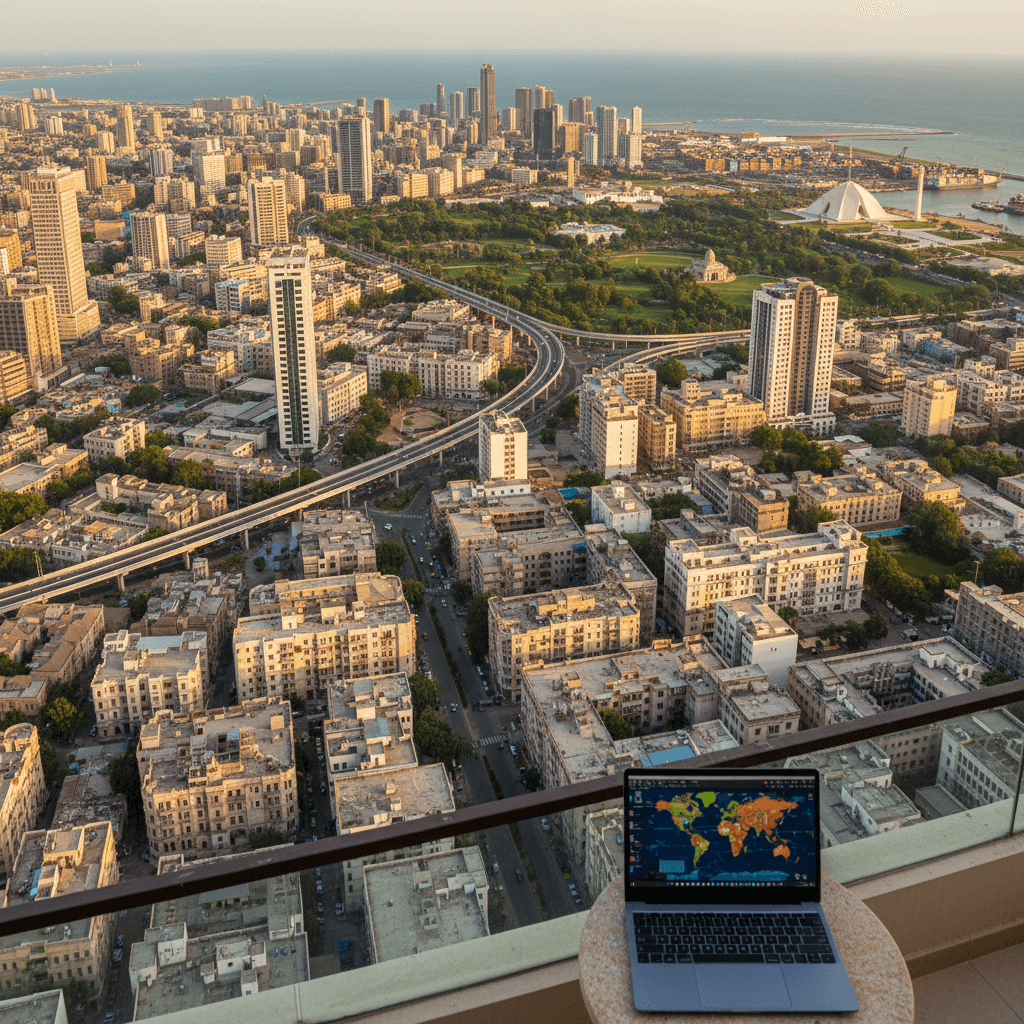
Karachi
🇵🇰 Pakistan
Karachi feels like money, grit and sea air all shoved into one huge, impatient sprawl. It’s Pakistan’s commercial engine, so the pace is fast, the honking never really stops and the city can feel chaotic the second you land, but most nomads settle into it once they figure out where to live and how to move around. Honestly, the draw is pretty clear, cheap rent, strong food, beach access and a social scene that’s bigger than most people expect.
It’s not a mellow city. Summers are brutally hot, traffic can swallow half your day and some neighborhoods still feel rough around the edges after dark. Still, Karachi has a warmth that’s hard to fake, strangers will chat, shopkeepers remember you and there’s usually chai, cardamom, diesel and grilled meat in the air somewhere nearby.
Where the vibe works best
- Clifton: Best if you want sea views, nicer cafes, mall access and the easiest expat social life. It’s cleaner than most parts of the city, though night walks still need common sense.
- DHA: The safest-feeling option for many nomads, with gated streets, better roads and calmer residential pockets in Phases 5, 6 and 8. Quiet. Convenient. More car-dependent.
- PECHS: More central and usually cheaper than Clifton or DHA, with decent access to offices, schools and restaurants. It’s practical, if a bit less polished.
- Boat Basin: Good for food-first people, there’s always something sizzling and the area stays lively well into the evening.
Daily life is cheap by global standards and that changes the feel of the city. A studio can run roughly PKR 20,000 to 50,000 in central areas, street food can cost under $2 and a Careem ride across town might only be a few dollars, which, surprisingly, makes frequent outings far less painful than in most big cities.
What expats and nomads actually deal with
- Internet: CoSpace, BullPen and Letswork options make working remotely doable and cafe culture is strong in Clifton and DHA.
- Transport: Use Careem, Uber or InDrive, not random buses or unmarked taxis, because safety and sanity both matter here.
- Food: Burns Road, BBQ Tonight, Xander’s and Kolachi give you everything from greasy street snacks to sea-facing dinners.
- Safety: Clifton and DHA are the usual picks, but even there, avoid dim streets at night and keep your phone tucked away.
Karachi isn’t polished and that’s part of the point. It’s loud, salty, humid and a little stubborn, with calls to prayer floating over traffic and rain hammering tin roofs when the monsoon hits, then suddenly you’re at the beach at sunset, eating grilled fish with the city still humming behind you. That contrast is the whole place.
Karachi is cheap by global standards, though the city can still surprise you if you stay in the polished pockets of Clifton or DHA. A solo nomad usually gets by on about $330 to $380 a month before rent and food is where the savings show up fast, with biryani stalls, chai and late-night kebabs costing less than a coffee back home.
Not cheap luxury. Cheap life. A basic one-bedroom in the center usually runs PKR 20,000 to 50,000, while something outside the center can drop to PKR 12,000 to 30,000, though the better buildings in DHA and Clifton climb much higher once you add generators, security and half-decent maintenance.
Typical monthly costs
- Studio or 1BR in city center: PKR 20,000 to 50,000
- 1BR outside center: PKR 12,000 to 30,000
- 3BR in center: PKR 45,000 to 100,000
- Coworking day pass: $10 to $20
- Ride-hailing trip: $1 to $3
Food is where Karachi feels almost absurdly affordable. Street food on Burns Road can run $0.50 to $2, a decent mid-range meal is usually $3 to $8 and upscale dinner in Clifton can jump to $15 to $40, with the AC blasting and the smell of grilled meat drifting through the room, honestly, right into your clothes.
Groceries stay manageable if you shop local, not imported. Milk is around $0.82 a liter, bread about $0.48 and chicken fillets roughly $3.10 per kilo, so most expats cook at home a few nights a week and save the restaurant splurge for weekends or meetings.
Where your money goes best
- Clifton: Best for comfort, cafes, sea views, higher rents
- DHA: Best for security, cleaner streets, family setups
- PECHS: Good value, central, less polished but practical
- Boat Basin: Great for eating out, lively and central
Karachi isn’t a place where you pay for scenery, you pay for convenience, safety and air conditioning. If you want the calmest day-to-day setup, DHA phases 5, 6 and 8 usually make the most sense, but if you’re social and don’t mind a little noise, Clifton keeps you close to restaurants, malls and the sea breeze that, weirdly, can still feel damp and salty in the evening.
One warning: cheap rent can be fake cheap if the building has bad power backup, weak internet or a landlord who disappears when the water pump breaks. Add those annoyances up and a slightly pricier place in a better neighborhood often ends up cheaper in real life.
Karachi’s best base depends on how much noise you can tolerate. Traffic honks all day, generators kick on during outages and the sea air in Clifton can smell like salt, exhaust and fry oil all at once. Pick your neighborhood carefully.
Nomads
Most nomads end up in Clifton or Boat Basin. Clifton gives you better cafes, safer-feeling streets and easy access to coworking spots and malls, while Boat Basin is louder, more food-heavy and weirdly handy if you want to work, eat, then work again without crossing half the city.
- Clifton: Best for cafes, sea views and meeting other expats, though nights can feel quiet and a little empty.
- Boat Basin: Strong restaurant scene, central location and decent for short stays, but parking is a headache.
- PECHS: Cheaper than Clifton, still central and good if you want to keep rent sane while staying close to commercial areas.
Expats
DHA is the safest bet for expats who want fewer headaches. The roads are wider, security is visible and daily life feels more orderly, honestly, which matters when you’re dealing with heat, errands and Karachi’s habit of making simple tasks take longer than they should.
- DHA Phase 5, 6, 8: Best mix of security, parks, private schools, clinics and cleaner streets.
- Clifton: Better for social life and beachfront dining, but it’s less calm than DHA.
- Karachi Cantonment: Quieter and greener, good if you want a slower pace and less street chaos.
Families
Families usually prefer DHA, then Karachi Cantonment. The bigger draw is straightforward, reliable access to schools, pharmacies and healthcare, plus streets that feel less frantic after dark. Summers are brutally hot, so having parks, backup power and decent roads isn’t a luxury here.
- DHA: Best overall for schools, safety and day-to-day convenience.
- Karachi Cantonment: Calmer, greener and better if your family values space over nightlife.
- PECHS: Works for budget-conscious families, though it’s busier and less polished.
Solo travelers
Solo travelers should keep it simple, stay in Clifton, DHA or a solid hotel near Boat Basin. Don’t book random guesthouses in unknown neighborhoods and skip crowded market areas like Saddar unless you’re with someone who knows the city well, because pickpocketing and confusion are part of the deal there.
- Clifton: Best for first-timers who want comfort and easy ride-hailing access.
- DHA: Safer at night, though it’s more residential and less lively.
- Boat Basin: Good for food and convenience, but stay alert after dark.
Karachi’s internet is decent where it matters, though home connections can still be moody. In Clifton, DHA and parts of PECHS, fiber is usually solid, while older buildings sometimes need a backup SIM because a rainstorm, a power cut or plain bad wiring can knock things around. Honestly, that’s Karachi: good enough for work, but rarely carefree.
The best setups are in coworking spaces with dual internet, backup power and security staff who actually pay attention. CoSpace is a strong pick if you want a proper desk and fast fiber, BullPen gets praise for its rooftop work area and CCTV and Letswork is handy if you like hopping between spots without committing to one lease. The WiFi isn’t the problem most days, the inconsistency is. Turns out, the real headache is making sure you’ve got a second connection when the first one dies mid-call.
Best Coworking Options
- CoSpace: Fast fiber, 24/7 WiFi, professional setup, good for focused work.
- BullPen: Dual internet, rooftop workspace, lunch area, electronic access cards, CCTV.
- Letswork: Handy if you want flexibility, with multiple Karachi spaces bookable through one platform.
Cafes work too, especially in Clifton and DHA, where the laptop crowd settles in around espresso machines and cold A/C. Cafe Flo, Cafe Aylanto and Xander’s are all common choices, though service can be slow when the place is packed and the music’s up too loud. The upside is simple, you can work through a flat white, a sandwich and an afternoon that smells faintly of coffee, grilled chicken and sea air from nearby roads.
What Nomads Usually Do
- SIM cards: Jazz, Zong and Telenor are easy to find, passport required.
- Mobile data: Good enough in urban areas, handy for backup when WiFi drops.
- Ride-hailing: Careem and Uber make it easier to move between home, cafes and coworking spots.
If you’re staying a while, get a local SIM on day one and don’t rely on one internet source. That’s the smartest move, frankly, because Karachi’s power cuts and patchy connections can ruin a deadline faster than traffic can. Most nomads end up working in Clifton or DHA, then ducking into a cafe or coworking space when the apartment WiFi starts acting up, which happens more than anyone here likes to admit.
Safety
Karachi feels safest in Clifton and DHA, where you’ll see guards, gated streets, brighter lighting and a lot more people who look like they’re on their way to a meeting rather than a fight. Still, don’t get lazy, a quiet lane after dark can turn sketchy fast and the honking, exhaust and hard summer humidity don’t exactly make you feel relaxed.
The city has had real security improvements since the bad old years, but it also still logs a lot of crime, so street smarts matter more here than in many nomad hotspots. Honestly, I’d skip walking alone at night, avoid poorly lit blocks and stay out of unfamiliar industrial or market-heavy areas unless you’re with someone who knows the route.
- Best areas: Clifton, DHA Phases 5, 6 and 8, PECHS, Boat Basin
- Avoid: unlit side streets, remote industrial zones, unknown budget guesthouses, crowded markets after dark
- Transport: Use Careem, Uber or InDrive and check the plate and driver name before you get in
- Public buses: Skip them, they’re overcrowded and not a good bet for visitors
Carry yourself like you’re paying attention, because that usually gets you left alone. Which, surprisingly, goes a long way here.
Healthcare
Private healthcare in Karachi is better than people expect, especially in the main residential and business districts, though the quality can swing a bit from one facility to another. Expats usually go private and honestly, that’s the move, because it’s faster, cleaner and less of a headache when you’re already sick.
Pharmacies are everywhere and many meds are sold without much fuss, but don’t assume that means every drugstore is well-stocked or properly staffed. If you need anything serious, get seen early, because traffic, heat and waiting around in airless clinics can make a small problem feel a lot worse.
- Insurance: Get international coverage with evacuation, local care alone isn’t enough
- Emergency: Rescue 1122
- Pharmacies: Common across the city, with basic antibiotics, painkillers and stomach meds easy to find
For routine care, most nomads use private hospitals and clinics near Clifton or DHA, then keep a small pharmacy stash at home for heat headaches, stomach issues and dehydration. That’s not paranoia, it’s Karachi.
Karachi’s getting around game is simple and a little annoying, you’ll almost always be better off using Careem, Uber or InDrive than trying to piece together public transport. Buses are crowded, loud and frankly not built for newcomers, with the heat, exhaust and constant horn blasts making even a short ride feel longer than it's.
Ride-hailing is the default. A short trip usually runs about $1 to $3 and that’s the price most nomads and expats accept without much arguing. Confirm the plate and driver name before you get in, because app cancellations happen, drivers sometimes call for the exact pickup spot and a wrong car in Karachi can turn into a headache fast.
If you’re staying for more than a week, a car starts to make sense, especially in DHA or Clifton where distances are manageable but still too long to walk in the afternoon heat. Traffic is the real monster here, honestly, with scooters cutting across lanes, buses squeezing through gaps and everyone leaning on the horn like it’s part of the steering system.
Best Options by Situation
- Short city trips: Careem, Uber or InDrive
- Airport runs: Prebook through your hotel or use an app
- Daily living: Car rental or private driver if you’re staying longer
- Late-night movement: Stick to app-based rides, don’t hail random taxis
Walking is patchy. Clifton and DHA have the best sidewalks and the least chaotic street life, though even there you shouldn’t wander alone late at night, especially on quieter side streets where the lighting drops off fast and the air gets still in that uneasy way Karachi has after dark.
For neighbourhoods, DHA is the easiest place to live without losing your mind over transport, because the roads are wider, the phases are organized and parking, weirdly, is less of a daily battle than in central Karachi. Clifton is close behind, but roads near the beach and commercial strips get clogged, so a ten-minute errand can stretch if you leave at the wrong hour.
Airport transfers: Use an app or arrange a hotel pickup. Unmarked cabs are a bad idea and the airport area can feel hectic the second you step outside, with heat, shouting, luggage carts and drivers calling out fares before you’ve even found the curb.
If you’re renting a scooter or motorcycle, think twice. The city’s traffic doesn’t forgive hesitation and one bad merge can ruin your week, so most travelers stick to cars or just keep their lives centered around a few walkable blocks, a café and a reliable driver.
English works fine in Karachi, especially in Clifton, DHA, PECHS and around the main business districts. In offices, malls, cafes and coworking spaces, you’ll get by easily, though the accent can be thick and the pace can be fast, so don’t be shy about asking people to repeat themselves. Urdu is the everyday language and honestly, a few polite Urdu phrases go a long way with taxi drivers, shopkeepers and security staff.
Most locals in expat-friendly areas speak at least basic English, but street-level conversations can shift quickly into Urdu or a mix of Urdu and English. That’s normal. You’ll hear calls to prayer drifting over traffic, bike horns snapping in the background and then a vendor switching languages mid-sentence without missing a beat, which, surprisingly, makes daily life easier once you get used to it.
If you’re working remotely, keep things simple and direct. People respond well to plain English, short messages and clear meeting times and if you need something urgent, WhatsApp is usually faster than email. The bureaucracy can be maddening, so confirm addresses, spell names twice and don’t assume forms will be understood the first time.
Useful Urdu Phrases
- Hello: As-salamu alaykum
- Thank you: Shukriya
- How much? Kitna hai?
- Yes / No: Haan / Nahi
- Where is...? ...kahan hai?
In markets and older neighborhoods, basic Urdu makes life smoother and usually gets you better treatment. Prices can still be quoted inconsistently, so ask twice and stay calm, because a friendly tone matters more than perfect grammar. The same goes for rides, deliveries and medical visits, where one clear sentence beats a long explanation.
Language-wise, Karachi is practical, not polished. You’ll hear English in one room, Urdu in the next and a lot of code-switching in between, especially among younger professionals and people working in tech, media or hospitality. If you can handle that mix, you’ll fit in fast, if you can’t, you’ll still manage, but expect a few awkward moments and the occasional blank stare.
Bottom line: English is enough for most nomads, but basic Urdu makes the city feel less like a transaction and more like a conversation. Don’t overcomplicate it. Speak clearly, keep your messages short and learn a few phrases before you land.
Karachi’s weather is the part people underestimate, then complain about. Summers are brutally hot, with thick humidity that sticks to your skin and makes even a short ride feel like you’ve stepped into a steam room, while winter is short, dry and honestly the only time the city feels relaxed enough for long walks or café hopping.
The sweet spot is November to February. You get cooler evenings, clearer skies and less of that metallic haze that hangs over the roads when traffic is inching along and the horn chorus starts up. If you’re working remotely, this is when Clifton, DHA and even Boat Basin feel easier to live in, because you’re not fighting the heat every time you leave the apartment.
Skip the peak summer stretch if you can. May through August can be miserable, with heat, humidity and occasional power cuts making the whole day feel heavier than it should and walking outside at midday is a bad idea unless you enjoy sweating through your shirt before lunch. September and October are a bit better, though monsoon rain can dump water onto streets fast, then you’re stuck in slow traffic with the smell of wet dust and exhaust everywhere.
Best months at a glance
- November to February: Best overall, cooler weather, easier transport and better conditions for beach visits, café work and sightseeing.
- March to April: Warm but manageable, good for shorter stays if you don’t mind rising temperatures by late morning.
- May to August: Avoid if possible, the heat is punishing and humidity makes it worse.
- September to October: Transitional, still warm, but often more livable than summer, with some rain and patchy conditions.
If you’re beach-minded, winter is also the best time for Clifton Beach and a sunset dinner at Kolachi, because the sea breeze actually helps instead of feeling like hot air blown off a hairdryer. Weirdly, Karachi can feel most social in the cooler months too, since people stay out later and the café scene gets much more active.
Pack for both comfort and chaos. Light cotton clothes, a good power bank and a rainproof bag matter more than stylish outfits and if you’re arriving in summer, book accommodation with reliable AC and backup power, because that’s the real survival kit.
Karachi runs hot, loud and a little chaotic and if you’re staying here for more than a week, you’ll feel it fast, from the roar of generators to the smell of grilled kebabs drifting off Burns Road. Summers are brutally hot, honestly, so plan your errands early, keep water on you and don’t expect to stroll around at noon like you’re in a temperate city.
Most nomads and expats stick to Clifton, DHA or PECHS because the roads are better, the cafes are stronger and the day-to-day friction is lower. Clifton is livelier, DHA is calmer and more secure, PECHS is a practical middle ground and Boat Basin is good if you want food on tap and don’t mind noise at night.
Money and daily costs
- Studio rent: PKR 20,000 to 50,000 in central areas, lower outside the core.
- Meal budget: Street food can be under $2, while a decent sit-down lunch is usually $3 to $8.
- Transport: Careem, Uber and InDrive are cheap, most short rides land around $1 to $3.
- Coworking: Expect roughly $10 to $20 for a day pass.
The payment system is still cash-heavy in places, so keep small bills handy, because a driver, delivery rider or corner shop might not want to fuss with change. Cards work in malls and bigger restaurants, though weirdly some polished-looking places still prefer cash for smaller bills.
Getting around without losing your patience
- Best app rides: Careem is usually the smoothest, Uber works too, InDrive can be cheaper if you don’t mind haggling.
- Airport transfers: Book through your hotel or an app, don’t grab an unmarked taxi.
- Walking: Limited outside Clifton and DHA and night walks are a bad idea.
Public buses are packed, noisy and not what most travelers use, so skip them unless you really know the route. The traffic can be infuriating, with honking that never seems to stop and a ten-minute trip can stretch into forty if the city decides to choke up.
Safety, internet and basics
- Safer areas: Clifton and DHA have better lighting, visible security and generally calmer streets.
- Connectivity: Coworking spaces like CoSpace and BullPen are the most reliable bet for fast internet.
- SIM cards: Jazz, Zong and Telenor are easy to buy with a passport.
- Healthcare: Private hospitals are the norm for expats and travel insurance is smart.
At night, stay on main roads and don’t drift into poorly lit side streets, even in decent neighborhoods, because that’s where Karachi gets sketchy fast. If you need meds, pharmacies are everywhere and many sell common prescriptions over the counter, which is convenient, though not always reassuring.
English is widely spoken in business areas, cafes and most places where nomads hang out, so you’ll get by fine. Urdu helps with taxis, shops and everyday life and even a few basic phrases make people warm up quickly.
Need visa and immigration info for Pakistan?
🇵🇰 View Pakistan Country GuideHidden Gem
Worth the effort