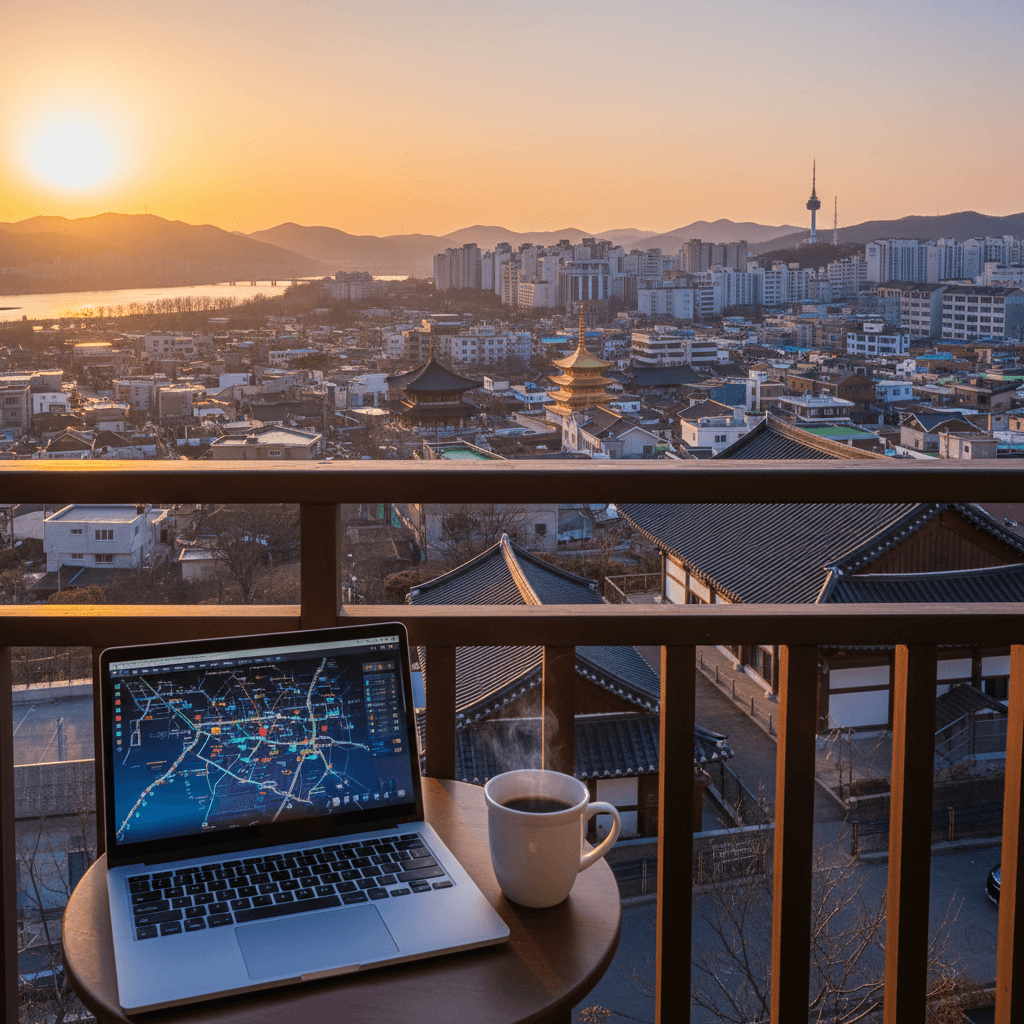
Chuncheon
🇰🇷 South Korea
The Lakeside Escape
Chuncheon is the city where Seoul goes to breathe. While the capital is a high speed blur of neon and concrete, Chuncheon feels like a long, slow exhale. It is surrounded by the Soyang and Uiam Lakes, giving the entire place a misty, waterfront atmosphere that earns it the nickname City of Lakes. You won't find the frantic energy of Gangnam here; instead, you get a city that moves at the speed of a bicycle on a riverside path.
For nomads, the vibe is distinctively academic and outdoorsy. Because it houses major institutions like Kangwon National University, there is a youthful energy in the air, but it is tempered by the quiet stillness of the mountains. It is the kind of place where you spend your morning working from a high end cafe overlooking the water and your afternoon hiking through pine forests. It feels less like a temporary stop and more like a sanctuary for deep work.
The Emotional Landscape
Living here feels like being in on a secret. Most travelers blast past on the ITX train toward the east coast, but those who hop off find a city that is remarkably easy to live in. There is a sense of calm confidence in Chuncheon. It doesn't try too hard to be trendy because it knows it is beautiful. You will likely find yourself adopting a slower pace, trading late night clubbing for long dinners of spicy Dakgalbi and quiet walks along the Gongjicheon Stream.
The city has a quirky, creative undercurrent too. Hosting the Chuncheon International Mime Festival isn't just a random event; it reflects a community that values physical theater, arts, and unconventional expression. This creative streak makes it a magnet for artists and slow travelers who find the rigid corporate culture of Seoul a bit too suffocating. It is a place that rewards curiosity, whether that is finding a tiny pottery studio in an alleyway or discovering a floating cafe on the lake.
What Sets It Apart
Chuncheon offers a specific balance that is hard to find elsewhere in South Korea. You have the infrastructure of a modern city, including lightning fast internet and efficient public transit, but you are never more than ten minutes away from total wilderness. It is the perfect middle ground between the overwhelming density of Seoul and the isolation of the rural countryside.
- The Water Connection: The city is defined by its relationship with the lake. Whether you are kayaking at Mulle-gil or just watching the fog roll off the water in the morning, the presence of the lake lowers your heart rate.
- The Culinary Identity: This is the undisputed home of Dakgalbi (spicy stir fried chicken). The city takes its food seriously, and the social ritual of sharing a massive pan of chicken with friends is a foundational part of the local experience.
- Access to Nature: With spots like Namiseom Island and Samaksan Mountain nearby, your weekends are naturally filled with fresh air and incredible views.
- The Student Pulse: The large student population keeps the cost of living lower than Seoul and ensures there are plenty of affordable, laptop friendly cafes and late night eateries.
Nomads often come for a weekend and end up staying for a month. The ease of the 60 minute train ride back to Seoul means you never feel disconnected, but the quiet nights and mountain air make you feel a world away. It is a city that invites you to put down your phone, grab a bike, and actually look at the horizon.
The Chuncheon Budget Breakdown
Living in Chuncheon feels like a breath of fresh air compared to the wallet draining pace of Seoul. You get the perks of proximity to the capital without the soul crushing rental prices. Most nomads find they can live comfortably here on about $1,400 to $1,800 per month, though you can definitely trim that down if you're savvy about where you eat and sleep.
The local currency is the Korean Won (KRW). While card payments are accepted almost everywhere from 7-Eleven to tiny fried chicken shops, keeping some cash on hand for traditional markets like the Chuncheon Nangman Market is a smart move. Expect to spend significantly less on leisure and housing than you would in Busan or Seoul.
Monthly Housing Estimates
- One-Room Studio (Hyoja-dong or near Kangwon National University): $350 to $550 per month. These are usually compact but efficient, often coming partially furnished.
- Modern Officetel (near Chuncheon Station or Onui-dong): $600 to $900 per month. These are higher end, newer buildings with better security and amenities.
- Airbnb or Short Term Guesthouse: $900 to $1,300 per month. This is the easier route if you don't want to deal with the heavy "key money" deposits required for traditional Korean leases.
Expats recommend looking around the Hyoja-dong area if you want a younger vibe with cheaper eats. If you prefer being near the water and the newer developments, Onui-dong is the spot, though you'll pay a premium for those river views and proximity to the Namchuncheon station.
Food and Dining Out
Chuncheon is famous for Dakgalbi (spicy stir fried chicken), and you'll find it everywhere. A massive meal for two at a specialized spot on Myeongdong Dakgalbi Street usually runs around $25 to $30 including drinks. For daily life, you'll likely mix home cooking with quick stops at local spots.
- Local Meal (Bibimbap or Gukbap): $7 to $10.
- Mid-range Dinner for Two: $35 to $50.
- Iced Americano at a Trendy Cafe: $3.50 to $5.
- Large Beer at a Convenience Store: $2.50 to $4.
- Monthly Grocery Bill: $300 to $450 depending on how much imported cheese or fruit you buy.
Transport and Tech
Getting around is remarkably cheap. The city is walkable in parts, but the bus system is reliable and integrates perfectly with the T-Money card you likely picked up at Incheon Airport. A standard bus fare is about $1.10. If you're heading into Seoul for the weekend, the ITX-Cheongchun high speed train costs about $7.50 and gets you to Yongsan in about 75 minutes.
High speed internet is a given. Most apartments include it in the management fee, but if not, a dedicated line is around $25 a month. For mobile data, a monthly unlimited SIM or eSIM will set you back about $45 to $60. If you need a workstation, local cafes are very welcoming, but dedicated spots like the Gangwon Creative Economy & Innovation Center offer professional environments for very low daily rates or even for free during certain programs.
Lifestyle and Entertainment
Your "fun money" goes further here. A movie ticket is roughly $11, and a gym membership in a neighborhood like Seoksa-dong averages $40 to $70 per month. If you're here during the Chuncheon International Mime Festival, ticket prices for major shows are usually around $15 to $25, while many street performances are free to watch. Most travelers find that the biggest perk of Chuncheon is the free access to hiking trails and lakeside paths, which keeps the entertainment budget very low.
The Digital Nomad Hub: Hyoja-dong
If you want to be where the energy is, Hyoja-dong is the spot. It sits right near Kangwon National University, which means the area is packed with affordable cafes and students working on laptops. It doesn't have the high-rise corporate feel of Seoul; instead, you get mural-covered alleys and a laid-back, academic vibe.
- The Vibe: Youthful, creative, and budget-friendly.
- Coworking: Most nomads skip formal offices here and head to Coffee Post or A Twosome Place near the campus gate for fast Wi-Fi and 4,500 KRW americanos.
- Estimated Rent: 450,000 to 650,000 KRW for a modern studio (officetel).
The Expat Choice: Onui-dong and Toegye-dong
Expats who plan on staying more than a few months usually gravitate toward the southern side of the city. These neighborhoods feel more established and polished. You're close to the Chuncheon Nambu (South) Bus Terminal and the E-Mart, which is a lifesaver when you need familiar groceries or household gear. It's quieter than the university district but much more convenient for daily life.
- The Vibe: Suburban, organized, and convenient.
- Local Perks: Easy access to the Gongjicheon Stream paths for morning runs and the best connectivity to the Gyeongchun Line train back to Seoul.
- Estimated Rent: 600,000 to 900,000 KRW for a larger one-bedroom or small apartment.
Families and Slow Travelers: Geunduwa-dong
For those traveling with kids or anyone who wants a view of the water, the areas near Legoland and the Uiamho Lake waterfront are ideal. It's much more spacious here. You aren't cramped in narrow city streets. Instead, you have wide sidewalks and proximity to the Chuncheon International Mime Festival grounds, which transforms the area into a massive performance space every May.
- The Vibe: Scenic, quiet, and family-oriented.
- Proximity: Close to the Soyanggang Skywalk and major parks.
- Estimated Rent: 800,000 to 1,200,000 KRW for family-sized apartments.
Solo Travelers and Short-Stayers: Joyang-dong (Myeong-dong)
Don't confuse this with the Myeong-dong in Seoul, though it serves the same purpose. This is the heart of the city's shopping and dining. If you're only here for a week or two, staying here keeps you within walking distance of the Dakgalbi Street, where you can get the city's famous spicy chicken for about 14,000 KRW per person. It's the most "urban" Chuncheon gets.
- The Vibe: High-energy, central, and tourist-friendly.
- Stay: Mostly boutique hotels and guesthouses rather than long-term rentals.
- Daily Costs: Expect to pay 50,000 to 80,000 KRW per night for decent mid-range lodging.
Most travelers find that Chuncheon is small enough that you're never truly stuck in one place. The bus system is reliable, but many expats end up buying a cheap bicycle. Since the city is mostly flat and built around the river, it's often faster to bike between Hyoja-dong and the lakeside than it is to wait for a shuttle.
Connectivity and Speed
South Korea is famous for having some of the fastest internet on the planet, and Chuncheon is no exception. You can expect reliable 5G coverage across the entire city, and even the most basic studio apartments usually come with fiber optic lines capable of 500 Mbps to 1 Gbps. If you are planning to work from your rental, you rarely need to worry about lag during video calls or large file uploads.
For mobile data, most nomads pick up a SIM card from providers like SK Telecom or KT. If you are staying longer than 90 days on a digital nomad visa, you can get a local phone number linked to your Alien Registration Card, which makes life much easier for using apps like KakaoTaxi. For shorter stays, an e-SIM is the way to go. You will find free public Wi-Fi on almost every city bus and in most public parks, though these networks aren't always secure for sensitive work.
Coworking Spaces in Chuncheon
Chuncheon does not have the massive coworking franchises you see in Seoul, but it has local hubs that are much more affordable. Most of these spaces are concentrated near Kangwon National University (KNU) or the Chuncheon City Hall area.
- Gangwon Creative Economy and Innovation Center: This is a government backed hub located near the university. It is a favorite for startups and solo entrepreneurs. They often have open lounge areas where you can work for free or a very low daily fee, though it feels more like a professional office than a social club.
The Cafe Culture Alternative
In Chuncheon, the "Koffice" culture is king. Koreans take their coffee and their study habits seriously, so working from a cafe for four hours is perfectly acceptable as long as you buy a drink. The Gubongsan Mountain Cafe Street is famous for its views, but it is better for casual emails than a full workday because it gets crowded with tourists on weekends.
For a real work session, head to the Hyoja-dong neighborhood near the university. You will find plenty of "Study Cafes" like Choi-gang Study Cafe or Begin Study Cafe. These are different from regular coffee shops; they are silent, offer high speed internet, individual booths, and often have free snacks or tea. They usually charge by the hour, typically around 2,000 KRW per hour or 12,000 KRW for a full day.
Practical Tips for Remote Workers
If you need to print documents or scan a contract, most CU or GS25 convenience stores have 24 hour printing kiosks that are very easy to use with a credit card. Also, keep in mind that many local coworking spaces might have limited English speaking staff. Having Papago or Google Translate ready on your phone will help you navigate the sign up process for memberships.
Most nomads find that the best way to stay productive here is to split the week between a dedicated study cafe for deep focus and the Chuncheon City Library for a change of scenery. The library is modern, free, and has great views of the surrounding mountains, though you will need to arrive early to snag a seat with a power outlet.
Safety in the City
Chuncheon is remarkably safe, even by South Korea's high standards. You'll often see locals leave their laptops or phones on tables at Gongji-cheon park cafes while they head to the restroom. While you should still use common sense, the risk of petty theft or violent crime is incredibly low here. Most nomads feel comfortable walking through neighborhoods like Hyoja-dong or Seoksa-dong well after midnight without a second thought.
The biggest safety concern you'll actually face is the traffic. Delivery scooters are notorious for zipping onto sidewalks or ignoring red lights in the Myeong-dong shopping district. Always look both ways before stepping off a curb, even if the pedestrian light is green. If you're out late, the streets are well lit and CCTV is everywhere, which adds a layer of security that many expats find reassuring.
For emergencies, dial 112 for police or 119 for fire and ambulance services. Most operators in Chuncheon speak limited English, so it helps to have a translation app or a local friend's number ready. However, the police are generally helpful and will go out of their way to assist foreigners if you run into trouble or lose your wallet.
Healthcare Facilities
You aren't going to struggle to find high quality medical care here. Chuncheon is a regional hub, meaning it has better facilities than many other cities of its size. Kangwon National University Hospital is the primary go to for serious issues or specialized care. They have an international clinic with staff who speak English, though it's always smart to book an appointment in advance if it isn't an emergency.
Another reliable option is Hallym University Sacred Heart Hospital. It's a large, modern facility that handles everything from routine checkups to emergency surgeries. For minor ailments like a cold or a small scrape, look for local clinics (indicated by a green cross) in Onui-dong. These smaller clinics are much faster and cheaper than the big hospitals; a standard consultation usually costs between 10,000 and 20,000 KRW if you're paying out of pocket.
Pharmacies and Prescriptions
Pharmacies, or Yak-guk, are easy to spot by their bright red or blue "Pharmacy" signs. You can find them on almost every major street corner in the city center. Most pharmacists speak enough English to help you with basic over the counter meds for headaches or digestion. If you have a specific prescription from home, bring the physical bottle or a clear photo of the label. Many medications that require a prescription in the West are available over the counter here, but it's best to check first.
- Kangwon National University Hospital: Best for English speaking staff and complex issues.
- Hallym University Sacred Heart Hospital: Excellent emergency services and modern diagnostics.
- Local Clinics: Found in every neighborhood, perfect for quick, affordable checkups.
- Pharmacy Hours: Most are open from 9:00 AM to 9:00 PM, with select "late night" pharmacies available in Chuncheon Station area.
Insurance and Costs
If you're staying on a long term visa, you'll likely be enrolled in the National Health Insurance (NHI), which is fantastic and covers most costs. For digital nomads on a tourist stay or the new workation visa, private travel insurance is a must. Even without insurance, medical costs in Chuncheon are surprisingly manageable. A typical dental cleaning might run you 50,000 KRW, while an X-ray or blood test rarely exceeds 80,000 KRW at a standard clinic.
Expats often recommend keeping a digital copy of your blood type and any allergies on your phone. In the unlikely event of an emergency, having this information ready in Korean via a translation app can save precious time. Overall, the healthcare system here is efficient, high tech, and far more accessible than what most North Americans or Europeans are used to back home.
The ITX-Cheongchun and Local Rail
Most nomads arrive in Chuncheon via the ITX-Cheongchun, a high speed train that connects Seoul's Yongsan Station to Chuncheon in about 75 minutes. It costs about 8,000 KRW for a reserved seat. It's a double decker train, and if you can snag a seat on the upper level, you'll get great views of the Han River as you head east.
For a cheaper but slower alternative, the Gyeongchun Line is part of the standard Seoul subway system. You can use your T-money card to tap in and out. It takes about 2 hours from Sangbong Station and stops at both Namchuncheon Station and Chuncheon Station. Most expats prefer Namchuncheon Station because it's closer to the university district and more active neighborhoods.
Navigating the City by Bus
Chuncheon is small enough that you don't need a car, but the bus system is the backbone of local travel. The city recently overhauled its bus routes to make them more efficient for residents. You'll see green "village" buses that circle specific neighborhoods and larger blue buses that connect the outskirts to the city center.
The standard bus fare is about 1,250 KRW with T-money. If you're coming from Seoul, your T-money or Cashbee card works perfectly here. Just remember to tap your card on the reader when you get off if you want a free transfer within 40 minutes.
Essential Navigation Apps
Don't bother with Google Maps here. It doesn't work for walking directions or real time transit in Korea. You'll need to download Naver Maps or KakaoMap. Both have English interfaces now and provide incredibly accurate bus arrival times.
- Naver Maps: Best for finding specific cafes or coworking spots in the Hyoja-dong area.
- KakaoMap: Often has more accurate user reviews for local "Dakgalbi" restaurants.
- Kakao T: The go-to app for hailing taxis. You can link a card or pay the driver directly with cash or T-money.
Taxis and Ride Hailing
Taxis are plentiful and relatively affordable compared to Western cities. The base fare starts around 4,000 KRW. Since Chuncheon isn't massive, a cross-town trip rarely exceeds 10,000 KRW. If you're out late in the Gangwon National University area, you'll find plenty of taxis waiting near the main gate. Most drivers won't speak much English, so having your destination written in Korean or showing it on Kakao T is the way to go.
Cycling the Lakeside
Chuncheon is famous for its cycling paths, especially the loop around Uiamho Lake. It's one of the best ways to get around if you're staying near the water. The city has a public bike sharing system, but many nomads find it easier to rent a high quality road bike from shops near Chuncheon Station for about 10,000 to 15,000 KRW for the day.
The paths are flat, well paved, and separated from car traffic. It's a legitimate commuting option if you're staying in Gongji-cheon and need to get to a cafe in Soyang-dong. Just be mindful of the wind coming off the water during the colder months.
Walking the Neighborhoods
If you're based in Myeong-dong (the central shopping district, not the Seoul version) or Hyoja-dong, you can reach most daily necessities on foot. The city is quite hilly in certain residential pockets, so wear decent shoes. Walking from the Chuncheon Romantic Market to the Mime Festival venues is easy and gives you a much better feel for the local street art and small galleries than a bus ride ever would.
Getting Around the Language Barrier
You will find that English proficiency in Chuncheon is noticeably lower than what you'd experience in Seoul or Busan. Since it is a university town, the areas around Kangwon National University and Hallym University are your best bets for finding English speakers. Most students can communicate basic concepts, even if they are a bit shy about their fluency. Outside of these student hubs, expect to rely heavily on technology and gestures.
Most digital nomads in the area suggest learning the Hangul alphabet before you arrive. It is famously logical and can be learned in a single afternoon. Being able to read signs for Dak-galbi (the city's famous spicy chicken) or recognize the word for "exit" in the subway station makes daily life much smoother. While you can get by with just a smile, knowing basic phrases like "Gamsahamnida" (Thank you) goes a long way with local shopkeepers in the Chuncheon Romantic Market.
Essential Apps and Tech
Don't rely on Google Maps here. It is notoriously unreliable for walking directions and transit in South Korea. Instead, download Naver Maps or KakaoMap. Both have English interfaces now and are pinpoint accurate for finding tucked away cafes in Soyang-ro. For real time communication, Papago is the gold standard for translation. It handles Korean nuances much better than other services and has a great photo translation feature for reading menus that don't have English subtitles.
- Naver Maps: Best for bus routes and finding local business hours.
- Papago: Use the "Voice" mode for quick back and forth conversations with taxi drivers.
- KakaoTalk: The primary messaging app. If you meet a local friend or need to message a guesthouse, they will ask for your "Kakao."
Communication in the Nomad Community
Chuncheon is a quieter alternative to the capital, so the expat community is smaller and tighter. Much of the English language communication happens in private Facebook groups or KakaoTalk "Open Chats." If you are looking for specific info on the Chuncheon International Mime Festival or local workshops, these digital hangouts are where you will find the most current advice. People are generally very helpful because the community is small enough that everyone wants to help the few foreigners in town feel welcome.
Social Etiquette and Nuance
Korean communication is often about what isn't said. You will notice locals are very polite and might avoid saying a direct "no" to a request. If you get a vague "it might be difficult," that is usually a polite refusal. When paying at a convenience store or handing over your T-Money card for a refill, use two hands. It is a small gesture that shows a lot of respect for the local culture. You don't need to be fluent to be well liked; showing that you understand these small social cues is often more important than your vocabulary.
If you find yourself in a situation where language is a total barrier, look for a younger person with a smartphone. Most locals are incredibly tech savvy and will happily pull out their own translation app to help you find the right bus or order a specific dish. The "foreigner friendly" vibe in Chuncheon is high, even if the English levels aren't always there to match.
The Seasonal Sweet Spot
Chuncheon is tucked away in the mountains of Gangwon Province, which means you get a much more dramatic seasonal shift than you might find in Busan or Jeju. Most nomads agree that May and June are the absolute gold standard for a visit. The air is crisp, the cherry blossoms have finished their show, and the humidity hasn't yet turned the city into a sauna. You can spend your afternoons working from a cafe deck overlooking Uiamho Lake without breaking a sweat.
September through early November is the second peak window. This is when the surrounding hills turn deep shades of crimson and gold. It is also the best time for hiking the nearby peaks like Obongsan. The temperature usually sits between 15°C and 22°C, making it perfect for those who like to take their laptop to a park and work outdoors. You will want a light jacket for the evenings, as the valley location means temperatures drop quickly once the sun dips behind the mountains.
Surviving the Extremes
If you are planning to stay through the summer, brace yourself for late July and August. This is monsoon season. It doesn't just rain; it pours with an intensity that can ground your travel plans for days. The humidity often climbs above 80%, and temperatures frequently hit 32°C. Most expats find themselves retreating to air-conditioned coworking spots or the massive underground shopping malls during the midday heat. It is sticky, but the city stays lively, especially with people heading to the water for flyboarding and jet skiing.
Winter in Chuncheon is a different beast entirely. Because it is further north and inland than Seoul, it gets biting cold. January is the harshest month, with lows often hitting -10°C or -15°C. The upside? This is the best time for digital nomads who double as skiers. You are a short hop away from major resorts like Elysian Gangchon. The city takes on a quiet, serene vibe, and rental prices for short-term stays sometimes dip during this off-peak period, provided you don't mind the chill.
Timing Your Cultural Calendar
You should try to align your arrival with the local festival circuit if you want to see the city at its most energetic. The Chuncheon International Mime Festival usually takes over the streets in late May to early June. It is one of the top three mime festivals in the world and brings a massive influx of international artists and energy to the downtown core. It is a fantastic time for networking and seeing a more experimental side of Korean culture that you won't find in the bigger tech hubs.
If you are a fan of local food, the Dakgalbi and Makguksu Festival typically in June or October is a mandatory experience. While the weather can be hit or miss, the atmosphere around the festival grounds is electric. Just be aware that accommodation prices in neighborhoods like Hyoja-dong or near the Namchuncheon Station tend to spike during these weeks. Booking your Airbnb or guesthouse at least four to six weeks in advance is a smart move if you want to be near the action.
Quick Seasonal Breakdown
- Spring (April to June): Mild weather, blooming flowers, and the best time for lakeside cycling. Highs of 18°C to 24°C.
- Summer (July to August): Hot, humid, and rainy. Great for water sports but tough for outdoor work. Highs of 30°C+.
- Autumn (September to November): Clear skies and stunning fall foliage. Ideal for hikers and photographers. Highs of 14°C to 21°C.
- Winter (December to March): Dry and very cold. Best for winter sports fans and those who enjoy quiet, snowy landscapes. Lows of -12°C.
Getting Around the City
Chuncheon is remarkably easy to navigate once you understand the local rhythm. Most nomads rely on the T-money card, which you can pick up at any convenience store like GS25 or CU for about 3,000 KRW. You can use it for both the local buses and the Gyeongchun Line, the subway that connects the city directly to Seoul in about 80 minutes.
For quick trips, download KakaoTaxi. It is the gold standard here because Uber is largely non-existent. Expect a base fare of around 4,800 KRW. If you are feeling active, the city is famous for its bike paths along the Soyang River. Renting a bike near the Gongjicheon Sculpture Park costs roughly 5,000 KRW per hour, and it is often faster than the bus during peak afternoon traffic.
Connectivity and Coworking
South Korea has the fastest internet on the planet, so you will rarely struggle with speeds. Most cafes in the Hallym University area or near Gangwon National University are laptop friendly. These areas offer reliable fiber optic speeds and plenty of outlets for those needing to get work done.
For a more casual vibe, check out the larger franchises like A Twosome Place near the waterfront. Most expats find that as long as you buy a coffee every few hours, nobody will mind you camping out with a laptop. Just make sure to have a KakaoMap or Naver Map installed, Google Maps is notoriously inaccurate for walking directions and transit times in Korea.
Budgeting for Your Stay
Chuncheon is significantly more affordable than Seoul, especially regarding rent and dining. You can live quite comfortably here on $1,800 to $2,200 per month. A solid meal of Dakgalbi (spicy stir-fried chicken), the city's signature dish, will run you about 15,000 KRW per person. If you stick to local markets like Chuncheon Romantic Market, your grocery bill will stay low.
- Monthly Studio Rent: 450,000 to 700,000 KRW
- Cheap Meal: 8,000 to 10,000 KRW
- Craft Beer: 7,000 to 9,000 KRW
- Gym Membership: 50,000 to 80,000 KRW per month
Language and Social Life
English isn't as widely spoken here as it is in Itaewon or Hongdae. Learning basic Hangul is a game changer for reading menus and signs. Most younger locals and university students have a decent grasp of English and are usually happy to help if you look lost. For socializing, the Chuncheon International Mime Festival held in May is a massive event where the whole city comes alive, and it is the easiest time to meet fellow travelers and artists.
Safety is a non-issue. You can walk alone at 3:00 AM in almost any neighborhood without a second thought. If you ever run into trouble, the 1330 Korea Travel Hotline offers 24/7 assistance in English, which is a literal lifesaver for medical emergencies or complex translations.
Seasonal Survival
The weather fluctuates wildly. Winters are biting and dry, often dropping to -10°C, so a heavy "long padding" coat is mandatory. Summers are humid and rainy, particularly during the monsoon season in July. The sweet spots are May and October, when the foliage around Nami Island turns brilliant colors and the temperature sits at a perfect 20°C. Most nomads find that a high quality air purifier is a good investment for the spring months when yellow dust levels can spike.
Need visa and immigration info for South Korea?
🇰🇷 View South Korea Country GuideHidden Gem
Worth the effort