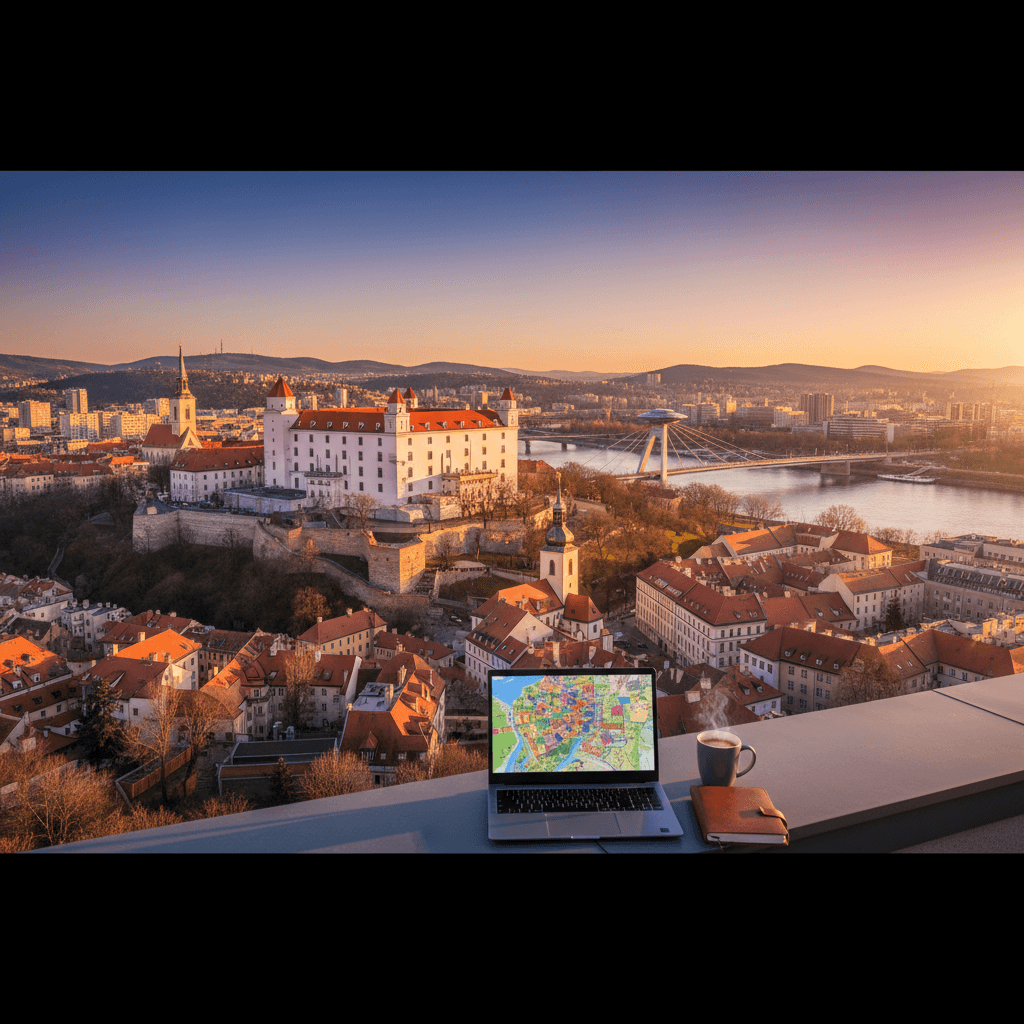
Bratislava
🇸🇰 Slovakia
Bratislava is, honestly, a city that doesn't try to impress you. It just quietly works. No overwhelming metro system, no tourist crush that makes you want to hide indoors, no rent that bleeds your account dry by the 15th. What you get instead is a compact Central European city where the old town smells like fresh coffee and cobblestone dust, trams clatter past Baroque facades and you can walk from your apartment to a decent coworking space in under fifteen minutes.
Most nomads who land here come for a week and stay for two months. The math is hard to argue with: a comfortable mid-range life runs around $950-$1100 a month, internet averages 93 Mbps and the safety score sits at around 70 out of 100 (Numbeo). That's not marketing copy, that's genuinely what people find when they show up.
The vibe is relaxed to the point of being almost sleepy, which is either exactly what you need or quietly maddening depending on your personality. Staré Mesto, the old town, is walkable and cafe-dense, the kind of place where you can nurse a flat white for three hours without anyone bothering you, it's that kind of city. Ružinov, just east, is where expats tend to actually live once they figure out the center's rent premium isn't worth it.
What makes Bratislava genuinely different from other budget-friendly nomad spots is the proximity factor. Vienna is 60 kilometers away. Budapest is under three hours by train. So when the city's smallness starts to close in and it will after a few weeks, you've got legitimate escapes that don't require a flight.
The winters, though, are a real consideration. December through February runs cold and grey, the kind of damp chill that, turns out, makes even the prettiest old town feel a bit grim. April through October is a different story entirely, especially summer evenings when the outdoor terraces fill up and the Danube catches the last of the light.
Bratislava isn't trying to be Berlin or Lisbon. It's smaller, quieter and frankly more livable for it. Short-to-medium stays are where it shines, three to five months is the sweet spot most nomads land on before the limited nightlife and familiar streets start feeling repetitive.
Bratislava is, honestly, one of the more affordable European capitals you can base yourself in right now. The numbers are hard to argue with: a comfortable mid-range month runs around $837, covering a one-bedroom in the center, eating out a few times a week and getting around without thinking too hard about it. Budget harder and you're closer to $678, which is genuinely doable if you cook most meals and sleep outside the center.
Rent is where you'll feel the biggest difference depending on your neighborhood choice. A studio or one-bedroom in Staré Mesto (Old Town) runs €800 to €900 a month, sometimes more, the tourist-friendly location costs you. Move out to Ružinov and that same space drops to €650 to €720, expats consistently recommend it for the value and the transit access, even if it's not as atmospheric.
Typical Monthly Costs
- Budget tier: ~$678 (outside center, home cooking, public transport only)
- Mid-range: ~$837 (center 1BR, some dining out, occasional coworking)
- Comfortable: $1,200 to $1,500 (upscale dining, regular coworking, taxis)
- Rent, city center 1BR: €750 to €1100, average around €920
- Rent, outside center: €650 to €800
- Monthly transit pass: €40.50
- Coworking day pass: ~€10; monthly ~€95
- Cheap meal out: €10
- Mid-range dinner for two: ~€60
Food is cheap, turns out, even by Central European standards. A bowl of bryndzové halušky at a local spot in Old Town costs almost nothing, street food runs around €10 for a full meal and a McDonald's combo is €9.50 if you're keeping score. Groceries from Billa or Lidl are where the real savings stack up if you're staying longer than a few weeks.
Transport is a non-issue. The tram and bus network covers the city well, €40.50 gets you unlimited rides for a month and Bolt or Uber fill the gaps for late nights or airport runs at €5 to €12 a ride. The center is walkable enough that some nomads don't bother with a pass at all.
One thing to factor in: Bratislava's low costs can, frankly, mask how quickly lifestyle creep happens here. Vienna is 60 kilometers away and easy to reach, so weekend trips across the border become routine, that's a real budget line you'll want to plan for.
Bratislava's small enough that neighborhood choice genuinely matters, it shapes your whole experience here. Pick wrong and you'll spend money on taxis you didn't budget for or pay tourist-area rent for a street that smells like bratwurst and selfie sticks.
For Digital Nomads: Staré Mesto (Old Town)
This is where most nomads land first and honestly, it makes sense. You're walking distance from cafes with reliable WiFi, the coworking options and the kind of cobblestone-and-coffee-shop atmosphere that makes a Tuesday feel less like work. Rent runs higher here, €888 or more for a one-bedroom, but you're paying for zero-commute access to everything.
The downside is real. Summers bring tourist foot traffic that clogs the narrow streets and the noise from outdoor terraces bleeds into apartments well past midnight. Still, for short-to-medium stays, it's hard to argue against the convenience.
For Expats and Long-Term Stays: Ružinov
Expats who've been here more than three months almost always migrate to Ružinov. Rents drop noticeably, you're looking at €650 to €750 for a decent one-bedroom and the neighborhood has a lived-in feel that Old Town frankly doesn't. There's a tram connection into the center, grocery stores that aren't priced for tourists and University Hospital Ružinov nearby if healthcare access matters to you.
- Rent (1BR): €650-750/month
- Transport to center: Tram, under 15 minutes
- Watch for: Traffic congestion during rush hour and, turns out, occasional industrial odors from the refinery side of the district
Skip Vrakuňa entirely. It's on the outskirts, safety scores drop and there's no upside that justifies it.
For Families: Karlova Ves
Quiet, green and close to the Danube. Karlova Ves is where families with kids settle because the schools are solid, the parks are actual parks with trees and space and the streets don't feel chaotic. It's farther from the center, which is a real inconvenience if you're commuting daily, so factor that €40.50 monthly transit pass into your budget from day one.
For Solo Travelers: Old Town, Short Stay Only
Solo travelers passing through for a week or two should just stay in Staré Mesto and not overthink it. The walkability is genuinely good, meetups and expat brunches happen regularly around the center and you can cover the whole city on foot without ever needing Bolt or a tram.
Bratislava's internet is, honestly, better than most Western European capitals. Average download speeds sit around 93 Mbps, with upload around 34 Mbps and reliability scores an 8.2 out of 10. That's genuinely fast enough for video calls, large uploads and anything else you'd throw at it on a normal workday.
Cafe wifi is strong across the board, cafes like Lab.cafe regularly push past 100 Mbps and the coffee's good enough that you won't feel weird sitting there for four hours. Most nomads spend their first week or two working from cafes in Staré Mesto before deciding whether a coworking space makes sense for a longer stay.
The coworking scene is small but functional. There are roughly ten spaces in the city, day passes run around €10 ($11), monthly memberships around €95 ($105). Not bargain-basement, but fair for what you get. CBC Center is worth checking out, it's one of the more established options with reliable infrastructure and actual meeting rooms if you need them.
- Day pass: ~€10 ($11)
- Monthly desk: ~€95 ($105)
- Notable spaces: CBC Center; check nomadranker for current listings
- Cafe standout: Lab.cafe, 100+ Mbps, good for solo work sessions
For a SIM card, pick one up at the airport or any mobile shop in the center, 10GB+ plans run around €20 a month, which is turns out pretty standard for Central Europe. eSIM options work fine too if you'd rather not deal with a physical card. Coverage across the city is solid, you won't hit dead zones in the neighborhoods nomads actually use.
One honest caveat: the coworking options are limited compared to cities like Prague or Budapest, so if you need a wide variety of spaces to rotate through, Bratislava will feel thin. There's no sprawling nomad campus or multiple tiers of membership to choose from. What's here works, it just doesn't overwhelm you with choice and for a city this size, that's frankly about right.
Revolut and other EU fintechs work seamlessly here, ATMs are everywhere in the center and you won't have any friction with day-to-day banking.
Bratislava is, honestly, one of the safer cities you'll find in Central Europe. The overall safety score sits at around 70 out of 100 (Numbeo) and in Staré Mesto specifically it climbs even higher, meaning you can walk home from a late dinner without that low-level anxiety you'd feel in a lot of bigger capitals. The streets are quiet, not eerie quiet, just calm.
That said, not everywhere is equal. Vrakuňa, on the city's outskirts, has a noticeably different feel and most nomads and expats skip it entirely. Stick to the center, Ružinov or Rusovce and you're fine day or night.
Petty theft is rare but not impossible, so don't leave a laptop bag unattended at a cafe just because the vibe feels relaxed. It's the kind of city that makes you drop your guard, which is mostly a good thing, though it shouldn't become carelessness.
Healthcare
Slovakia runs on EU healthcare standards, so the infrastructure is solid. For public hospitals, University Hospital Ružinov and University Hospital Staré Mesto are the main options. If you want English-speaking staff without the guesswork, head to BORY, a private hospital where the staff are used to dealing with expats and international patients and won't leave you piecing together a diagnosis through Google Translate.
Pharmacies are everywhere in the center, turns out they're almost as common as cafes and most carry standard European medications without much fuss. For anything minor, a pharmacist can often advise you directly, saving a trip to a clinic.
- Emergency number: 112 (EU standard, works across Slovakia)
- Best private hospital: BORY (English-speaking staff, expat-friendly)
- Public hospitals: University Hospital Ružinov, University Hospital Staré Mesto
- Travel insurance: Non-negotiable if you're not an EU resident; public care for non-EU visitors gets complicated fast
One practical note: if you're from outside the EU, don't assume the public system will handle you smoothly. It won't. Get travel or expat health insurance sorted before you arrive, not after you need it.
Overall, Bratislava doesn't demand much vigilance. It's genuinely low-stress on the safety front and the healthcare options are good enough that most nomads don't think twice about it.
Bratislava is, honestly, one of the more walkable capitals
Slovak is the official language and outside the Old Town, you'll run into it constantly. Street signs, menus at local spots, pharmacy labels, the automated tram announcements, all in Slovak. It's a Slavic language, so if you speak Czech or Polish you'll pick it up faster than most, but for everyone else it's honestly pretty opaque at first.
The good news: English works fine in Staré Mesto and anywhere nomads tend to spend time. Cafe staff, coworking receptionists, most restaurant servers in the center, they're comfortable in English, sometimes surprisingly so. Step into a local grocery store in Ružinov or try to sort out a bureaucratic errand, though and you'll feel the gap fast.
Google Translate is, turns out, your most-used app here. The camera translation feature handles menus and signs well enough and Slovak pronunciation is at least phonetically consistent once you learn the accent marks. Download the offline Slovak pack before you arrive, because there are dead zones and you don't want to be squinting at a pharmacy label with no signal.
A few phrases that actually get used:
- Dobrý deň , good day (formal greeting, use this with older locals)
- Ahoj , hi/bye (casual, fine with younger people)
- Ďakujem , thank you
- Prosím , please, also used to mean "here you go" or "you're welcome"
- Rozumiem , I understand (useful when someone's speaking Slovak at you and you want to politely signal you've caught something)
Making the effort with even one or two of these goes a long way, locals notice and they warm up quickly. Bratislava isn't, weirdly, a city where people are cold toward foreigners, it's more that they won't assume you want English until you signal it.
German is, frankly, more useful here than you'd expect, given how close Vienna is. Older residents especially may default to German before English. It won't carry you everywhere, but it's worth knowing if you have it.
For longer stays, a few sessions with a Slovak tutor on iTalki costs almost nothing and handles the practical gaps that Google Translate misses.
Bratislava sits in a cool temperate zone, so the gap between its best and worst months is, honestly, dramatic. Summers are warm and pleasant, winters are grey and genuinely cold and the shoulder seasons are where most nomads quietly agree the city earns its reputation.
April through June and September through October are the sweet spots. Temperatures run 20 to 28°C, the Old Town smells like fresh pastry and cut grass rather than exhaust and wet wool and you can actually sit outside at a cafe without negotiating with the weather. Rain still shows up around 9 to 10 days a month, it's Central Europe after all, but it's the light kind that passes quickly rather than the all-day soaking that kills your plans.
July and August get warm, peaking around 28 to 30°C, which sounds ideal until you realize Bratislava's Old Town is compact and stone-paved and it holds heat. It's not brutal the way southern European cities get, but it's sticky enough that coworking spaces start feeling more appealing than cafe terraces. Tourist numbers also peak in summer, which changes the feel of Staré Mesto noticeably.
Winter is the honest downside. December through February brings temperatures that regularly dip below freezing, turns out the Danube wind makes minus five feel colder than it reads and the days are short and overcast for weeks at a stretch. Some nomads find a certain charm in the Christmas markets and mulled wine circuit, but if you're sensitive to grey skies and limited daylight, this season will grind on you.
- Best months: May, June, September, October
- Summer (Jul/Aug): 28 to 30°C highs, warm but manageable, more tourists
- Spring/Autumn: 20 to 28°C, low crowds, best overall conditions
- Winter (Dec-Feb): minus 5 to 10°C, short days, cold wind off the Danube
- Rain: roughly 9 to 10 days per month year-round, rarely severe
For most nomads, May or September is the call. You get the good weather, the city feels like itself rather than a tourist backdrop and you're not fighting for a table anywhere.
Bratislava's low cost of living is, honestly, one of its strongest selling points. A comfortable mid-range budget runs around $837 a month, covering a one-bedroom in the center, some eating out and a monthly transit pass. Budget tighter and you can get by on $678; spend more freely and $1,200 to $1,500 gets you coworking memberships, upscale dinners and zero financial stress.
For SIM cards, pick one up at the airport or any phone shop in the center, 10GB+ plans run around €20 a month and eSIM options work fine if you'd rather sort it before landing. Banking is painless, Revolut works seamlessly here, ATMs are everywhere and you won't run into the cash-only headaches that plague smaller Slovak towns.
Finding an apartment is straightforward. Flatio.com is the go-to for furnished, short-term stays, ZoznamRealit.sk and Real-Estate-Slovakia.com cover longer leases. Expect to pay €700 to €900 for a decent one-bedroom in the center, less if you're willing to base yourself in Ružinov, which expats consistently recommend for value without sacrificing access.
Getting around is cheap and easy. Public trams and buses cost €1.20 per ride or €40.50 for a monthly pass, the network is reliable and the Old Town is walkable enough that you won't need it daily. Bolt and Uber cover everything else, city rides typically land between €5 and €12, it's rarely worth stressing about transport here.
For connectivity, the city's average WiFi sits around 93 Mbps, which is turns out faster than most Western European capitals. Coworking day passes run about €10, monthly memberships around €95. CBC Center is a solid option; Lab.cafe is popular with nomads who prefer working from a café with proper espresso and speeds that won't frustrate.
A few things worth knowing before you arrive:
- Language: English works fine in the center and tourist areas; Google Translate is your friend anywhere else.
- Emergencies: Dial 112, EU standard. Private hospital BORY has English-speaking staff.
- Weather: Winters are genuinely cold, dipping to -5°C and the grey skies drag on longer than you'd expect.
- Day trips: Devín Castle and Vienna (one hour by boat or bus) save Bratislava from feeling claustrophobically small after a few weeks.
Need visa and immigration info for Slovakia?
🇸🇰 View Slovakia Country GuideEasy Landing
Settle in, no stress