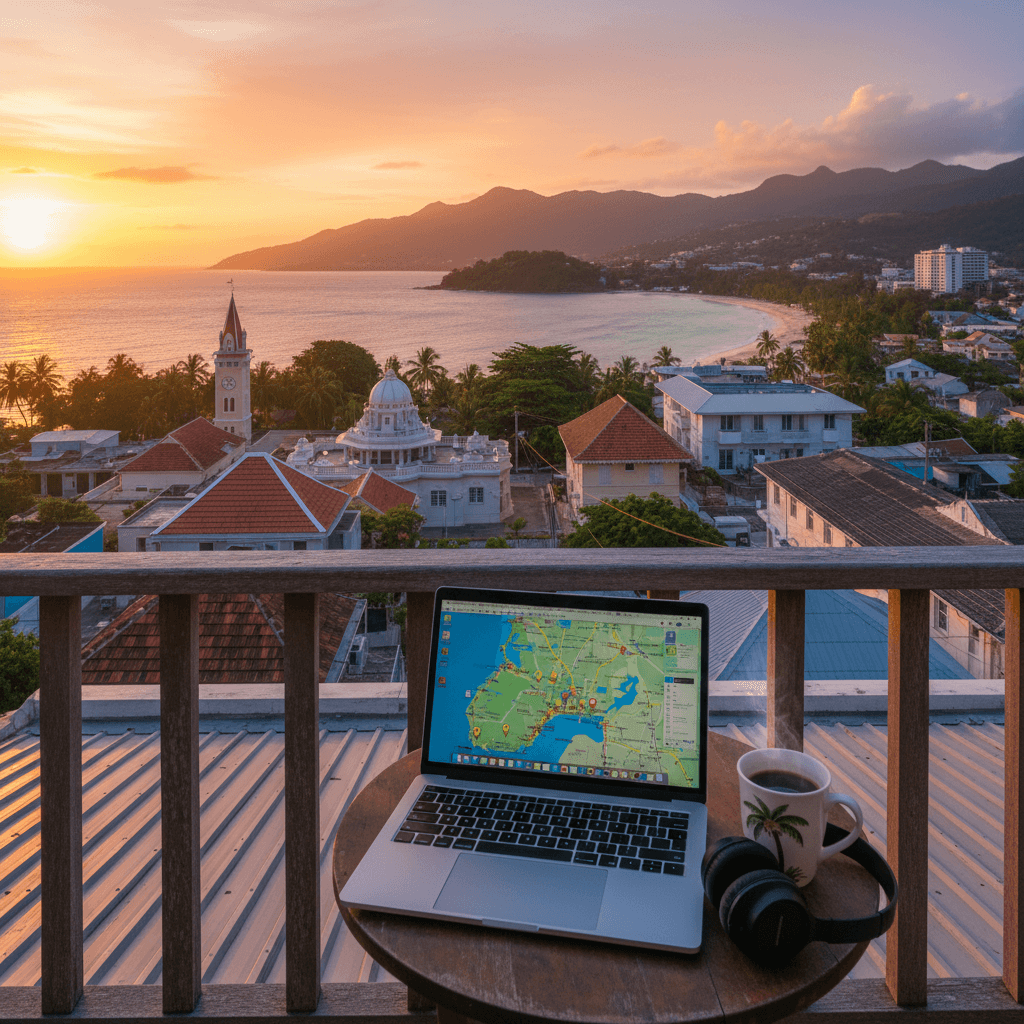
Beau Vallon
🇸🇨 Seychelles
Beau Vallon is, honestly, the closest thing Seychelles has to a social hub, which isn't saying a huge amount on an archipelago this quiet. It's a single crescent bay on Mahé's north coast, about 20 minutes from Victoria and it pulls together pretty much everything a nomad needs: beach, food, decent internet and enough other travelers around that you won't feel completely marooned.
The vibe is relaxed but not sleepy. Wednesday nights at Bazar Labrinn, the weekly night market, the smell of grilled fish drifts down the beach and you'll find locals, expats and tourists all crammed around the same plastic tables, which is about as socially integrated as this island gets. During the day it's quieter, the water is flat and warm and the pace slows to something close to nothing.
That said, it's not cheap. Not even close. Most nomads land here expecting a laid-back tropical escape and then quietly panic when they realize a comfortable month runs $2,500 to $3,500 before coworking, car rental or any kind of social life. The beachfront restaurants are gorgeous and genuinely good, but eating out daily adds up fast and the grocery stores aren't exactly budget-friendly either.
What makes Beau Vallon different from other beach nomad spots is the combination of safety and isolation, it's one of the safest places you'll work remotely, full stop, but the community infrastructure just isn't there yet. There's no real coworking culture on the beach itself, no weekly nomad meetups, no Slack group with 400 members. You meet people at water sports, at Beach Shak over a Rasta Mai Tai at sunset or not at all.
The internet, turns out, is solid enough: around 80 Mbps download on a good connection, though power outages are a real thing and they'll catch you mid-call if you're not prepared. The weather from May through October is genuinely spectacular, warm and dry with a sea breeze that keeps the humidity bearable. December and January are a different story, frequent heavy showers and the kind of sticky heat that makes concentrating feel like a personal achievement.
Come here because you want beauty and calm, not because you're chasing a nomad scene. The scene doesn't really exist yet.
Beau Vallon is, honestly, one of the pricier places you can pick as a base in the Indian Ocean. Most nomads land here expecting a laid-back beach town and leave with a credit card bill that tells a different story.
A realistic monthly budget for a single person runs around $2,900 and that's not living lavishly. Rent for a furnished one-bedroom sits between $850 and $1,420 depending on how close you want to be to the beach, groceries add another $350 or so and eating out is where things quietly spiral because even a mid-range dinner for two runs about $60 and the beachfront spots charge more without apology.
Here's a rough breakdown by how you want to live:
- Budget ($2,000,2,500/month): Shared housing, street food from the Wednesday night market at Bazar Labrinn, buses everywhere at SCR 12 a ride. Doable, not comfortable.
- Mid-range ($2,500,3,500/month): Your own studio, a mix of cooking at home and eating at places like Beach Shak, the occasional taxi when the bus schedule doesn't cooperate.
- Comfortable ($4,000+/month): Private villa, upscale meals at STORY Seychelles, a rental car so you're not dependent on anyone.
Transport is one area that doesn't hurt too badly. The SPTC bus network covers Mahé well, the app handles routes and payments and a card costs SCR 50 to get started, it's genuinely one of the better public systems in the region. Taxis to the airport run around $30, car rentals go for $400,600 a month if you want real freedom.
Food costs depend entirely on your discipline. Street food at the night market smells incredible and costs around $19 a plate, that's the move if you're watching your spending. Supermarket groceries are pricey by regional standards because most of it's imported, you'll feel that at checkout.
Coworking at Blend in Providence runs SCR 500 a day or SCR 5,000 a month, which, surprisingly, isn't outrageous given what you'd pay in European capitals. Mobile data, though, is a different story. Airtel's 5GB plan costs $20 and lasts seven days, Cable & Wireless charges $64 for 5GB over a month. Neither is great value.
Bottom line: Beau Vallon rewards people who plan their spending before they arrive, not after.
For Digital Nomads
Beau Vallon Beachfront is, honestly, the obvious base. You're walking distance to supermarkets, restaurants and the water and the 80 Mbps download speeds hold up well enough for calls and async work. The catch? It's loud, it's touristy and the rent reflects all of that, studios run $850 to $1,420 a month before you've bought a single meal.
Power cuts happen. Not constantly, but enough that a backup SIM with Airtel mobile data isn't optional, it's just smart planning. Most nomads who stay longer than a month end up treating the beach as their decompression space and working from hotel lobbies or Chatterbox cafe when the vibe at home gets stale.
For Expats and Long-Term Stays
Bel Ombre sits just inland from the coast, quieter, greener and noticeably less chaotic than the beachfront strip. You'll need a car or scooter to get to Beau Vallon proper, which, turns out, most long-term expats consider a feature rather than a flaw. The separation from the tourist noise is worth it.
Victoria is the budget play. It's a 20-minute bus ride at SCR 12 a trip, housing is cheaper and you're close to markets and practical services. It's urban and not particularly scenic, but expats who prioritize cost over beach access often end up happier there than they expected.
For Families
Bel Ombre again. It's the only area that genuinely makes sense for families, the health center is nearby, the streets are calm and you're not fighting through sunburned tourists to get to a grocery store. The tradeoff is real though, you're car-dependent and Beau Vallon's Wednesday night market at Bazar Labrinn becomes a weekly outing rather than a casual stroll.
For Solo Travelers
Stay on the beachfront. Full stop. The social infrastructure here is thin compared to Southeast Asian nomad hubs, so proximity to Beach Shak, the night market and the water sports crowd is, frankly, how you'll meet anyone at all. It's expensive for what it is, but the safety is good and the beach itself compensates for a lot.
Connectivity here is, honestly, better than you'd expect for a small island. WiFi averages around 80 Mbps download and 50 Mbps upload, which handles video calls and large uploads without drama. The real frustration is the power grid, it cuts out occasionally and can take your connection with it, so a fully charged laptop and a mobile data backup aren't paranoia, they're just common sense.
For SIMs, you've got two options: Airtel (5GB for 7 days, SCR 271/$20) or Cable & Wireless (5GB for 30 days, SCR 849/$64). Neither is cheap. Pick up a SIM at the airport on arrival or at shops in Beau Vallon; Airtel also offers eSIM if you want to sort it before you land.
Dedicated coworking is thin on the ground near the beach itself. The main option is Blend in Providence, a short drive away, with day passes at SCR 500 ($38) and monthly memberships at SCR 5,000 ($380). While there are occasionally mobile or floating coworking initiatives like Coboat that pass through the islands, there are few other permanent, fixed offices in the area. Neither is walking distance from Beau Vallon, which is the obvious downside if you're beachfront.
Most nomads end up working from cafes or hotel lobbies. Chatterbox is a solid fallback, decent WiFi, air conditioning that actually works and strong enough coffee to get through a morning of calls. The Cable & Wireless Internet Cafe in Beau Vallon is weirdly useful as a backup when your accommodation connection drops.
A few things to know before you set up shop:
- Power outages: Invest in a power bank and keep your laptop charged; outages are infrequent but real
- Blend day pass: SCR 500 ($38), monthly SCR 5,000 ($380), located in Providence
- Airtel SIM: 5GB/7 days for SCR 271 ($20); eSIM available via Airtel.sc
- Cable & Wireless SIM: 5GB/30 days for SCR 849 ($64); better value for longer stays
- Cafe fallback: Chatterbox for reliable WiFi and a working environment
The nomad community here is small, frankly almost nonexistent compared to Southeast Asia hubs. You won't find weekly coworking meetups or Slack groups with 500 members. What you get instead is a quiet beach, fast enough internet and the kind of solitude that's either exactly what you needed or slowly maddening, depending on your personality.
Beau Vallon is, honestly, one of the safer places you can land as a nomad in the Indian Ocean. Violent crime is rare, petty theft is low and there aren't any neighborhoods you need to actively avoid. That said, don't leave your laptop bag unattended on the beach while you swim, it's not paranoia, it's just common sense.
Day safety scores around 83 out of 100, which tracks with what most travelers actually experience: a relaxed, low-tension environment where you're more likely to lose something to carelessness than to crime. Moderate corruption exists at bureaucratic levels, but it doesn't really touch day-to-day life for visitors.
For emergencies, dial 999 or 112, both are toll-free and work from any phone.
Healthcare is functional, not spectacular. The Beau Vallon Health Centre handles primary care, routine consultations and maternal health, it's fine for minor issues and surprisingly quick by regional standards. Anything serious, think surgical care, imaging or specialist treatment, you're heading to Seychelles Hospital in Victoria, about 20 minutes by bus. It's a public facility and it works, though expats with complex needs sometimes fly to Réunion or South Africa for treatment.
Travel insurance isn't optional here. Medical evacuation from a remote island is eye-wateringly expensive without coverage and the hospital, turns out, has real limits on advanced care. Get a policy that explicitly covers evacuation before you arrive.
Pharmacies are easy to find. Euro Medical near the beach area is the most convenient, supermarkets like Shreeji also stock basics. Prescription availability can be patchy for less common medications, so bring a solid supply of anything you rely on regularly.
- Emergency number: 999 or 112
- Primary care: Beau Vallon Health Centre (walk-in, routine consults)
- Advanced care: Seychelles Hospital, Victoria (20 min by bus)
- Pharmacy: Euro Medical (Beau Vallon); pharmacy counters at Shreeji supermarket
- Travel insurance: Mandatory; confirm medical evacuation is covered
- Medications: Bring personal prescriptions, local stock is limited
Overall the safety picture here is genuinely good, weirdly good compared to similarly priced destinations. It's one of Beau Vallon's strongest selling points and most nomads say it noticeably reduces the mental load of daily life.
Getting around Beau Vallon is, honestly, simpler than most beach destinations this size, but it does require knowing which options are actually worth your time and money.
The public bus system run by SPTC is the obvious starting point. Every ride on Mahé costs SCR 12 (under $1), regardless of distance and buses connect Beau Vallon to Victoria and the airport in 20 to 30 minutes. Grab a bus card for SCR 50, load it up and use the SPTC app for routes and schedules. It works surprisingly well for a small island.
Taxis exist, though there's no Uber or Grab here. A ride to the airport runs around SCR 400 (roughly $30) and drivers don't negotiate, that's just the price. If you're splitting it or it's late and the buses have stopped, it's fine. For daily use, though, taxis add up fast and most nomads find them frustrating to rely on consistently.
Car rental is the real game-changer if you're staying more than a week or two. Expect to pay $400 to $600 a month, which sounds steep until you realize how much of Mahé you're locked out of without wheels. South Mahé, the quieter beaches, the hiking trails, none of that's practical by bus. Expats almost universally recommend renting, especially if you're based somewhere like Bel Ombre rather than the beachfront strip.
Beau Vallon itself is walkable along the bay. Supermarkets, restaurants and the Wednesday night market at Bazar Labrinn are all within easy reach on foot, you won't need a car just to eat or grab groceries. Scooters, weirdly, aren't a legal option here, they're banned on Mahé, so don't factor that in.
For airport transfers specifically:
- Bus plus taxi combo: Around $23 to $28 total
- Direct taxi: Around SCR 400 ($30), door to door
- Car rental pickup: Available at the airport if you want flexibility from day one
The honest summary: buses for daily errands, a rental car if you want to actually explore. Everything else is secondary.
Seychellois Creole, known locally as Seselwa, is the mother tongue here. French runs a close second, woven into signage, menus and casual conversation. English, though, is the one you'll actually use day-to-day in Beau Vallon and most people working in tourism, hospitality or retail speak it well enough that you won't feel stranded.
That said, dropping even a few words of Creole goes a long way, it signals respect and tends to crack open warmer interactions than you'd get otherwise. Locals genuinely appreciate the effort, even when the pronunciation is rough.
Useful Creole Phrases
- Bonzour , Good morning
- Bonswar , Good evening / Good night
- Allo , Hello (casual)
- Komman sava? , How are you?
Start with Bonzour at the Wednesday night market or when flagging down a bus driver, honestly, it's the simplest way to stop feeling like a tourist and start feeling like someone who actually lives there.
Google Translate handles Seselwa reasonably well for written text, though the audio feature is hit or miss, don't rely on it for anything time-sensitive. Download the language pack offline before you arrive because mobile data, turns out, can get patchy in spots further from the beachfront.
One thing worth knowing: French speakers sometimes slip into French mid-conversation assuming you'll follow, especially in more formal settings like clinics or government offices. It's not rude, it's just habit. A polite "English, please?" works fine, most people switch without any fuss.
Communication infrastructure is solid for the most part. 80 Mbps average download speeds mean video calls rarely drop and Airtel and Cable & Wireless both offer decent mobile coverage across Mahé. The Cable & Wireless internet cafe in Beau Vallon is a reliable backup on days the power grid decides to misbehave, which happens more than you'd like.
For SIM cards, Airtel's 5GB seven-day plan runs around SCR 271, Cable & Wireless offers 5GB for thirty days at SCR 849, both available at the airport or local shops. Pick one up on arrival, don't wait.
Beau Vallon is warm year-round, there's no getting around that. But "warm year-round" covers a lot of ground and the difference between a dry July and a soggy January is, honestly, significant enough to plan around.
The island runs on a tropical monsoon cycle split into two seasons. The dry season runs roughly May through October, driven by southeast trade winds that keep humidity manageable and rain rare. Temperatures sit between 30 and 34°C, the sky stays clear most days and the sea calms down enough for snorkeling and diving to actually be worth it. Most nomads and long-stay travelers time their arrival for this window and it shows in the beach crowds.
The wet season, December through April, is a different story. The northwest monsoon rolls in, bringing frequent afternoon downpours, humidity that clings to everything and temperatures that paradoxically dip slightly, hovering around 23 to 24°C at their lowest. December and January are the worst of it, rain hits hard and often and while showers usually pass within an hour, they can derail beach days and make outdoor work setups genuinely annoying.
- May to October: Dry, breezy, best visibility for water sports; peak tourist season, so accommodation prices climb
- November: Transitional, still decent but rain starts creeping in toward the end of the month
- December to January: Wettest months, high humidity, frequent showers; not unlivable, but not ideal
- February to April: Rain tapers off gradually; April sits at medium risk and is, weirdly, a solid shoulder-season pick if you want lower prices without the full monsoon experience
The sweet spot, frankly, is June through September. Prices are high but the weather earns it: dry air, consistent sun and southeast swells that make the surf at Beau Vallon actually interesting. You can sit outside at Beach Shak without watching your laptop screen fog up from the heat.
If budget matters more than weather, April or November can work, turns out the shoulder months are underrated. Just pack a light rain jacket and don't book anything that depends on guaranteed sunshine.
Seychelles isn't cheap. A single nomad spending carefully still lands around $2,900 a month and that's with buses and street food doing a lot of the heavy lifting. Budget closer to $3,500 if you want a private studio and the occasional sit-down dinner without doing math in your head.
The bus system is, honestly, one of the best deals on the island. SPTC runs frequent routes from Beau Vallon to Victoria and the airport for SCR 12 a ride, about $0.90 and their app handles routes, schedules and payments. Get the transit card for SCR 50 when you arrive, it saves the hassle of exact change every time. Taxis to the airport run around SCR 400 ($30), there's no ride-hailing app to speak of, so negotiate the fare before you get in.
For SIMs, Airtel and Cable & Wireless both sell at the airport and in town. Airtel's 5GB/7-day plan runs SCR 271 ($20), which sounds fine until you realize 5GB disappears fast on video calls, most nomads buy two and rotate. WiFi at accommodations averages around 80 Mbps download, solid enough for remote work, though power outages happen and they're annoying rather than catastrophic. Keep a mobile hotspot ready.
Banking is straightforward. ATMs are widespread, Wise works well for transfers and Shreeji in Providence is the go-to for currency exchange. For accommodation, Airbnb and Vrbo both list studios around $140 a night short-term, but monthly discounts bring that down significantly, always ask directly.
- Emergency number: 999 or 112, toll-free from any phone
- Healthcare: Beau Vallon Health Centre handles primary care; Seychelles Hospital in Victoria for anything serious
- Pharmacy: Available at supermarkets and Euro Medical clinic
- Dress code: Modest clothing off the beach, it's a small thing that locals genuinely notice
- Tipping: 10% is the standard expectation at restaurants
- Language: English works fine in Beau Vallon, a "Bonzour" or "Komman sava?" goes a long way with locals
The Wednesday night market at Bazar Labrinn is, turns out, the best social event of the week. Street food smells hit you before you even see the stalls, grilled fish, spiced Creole sauces, the whole thing. It's where expats, nomads and locals actually mix, skip the hotel bar and come here instead.
Need visa and immigration info for Seychelles?
🇸🇨 View Seychelles Country GuideHidden Gem
Worth the effort