Bavaro
🇩🇴 Dominican Republic
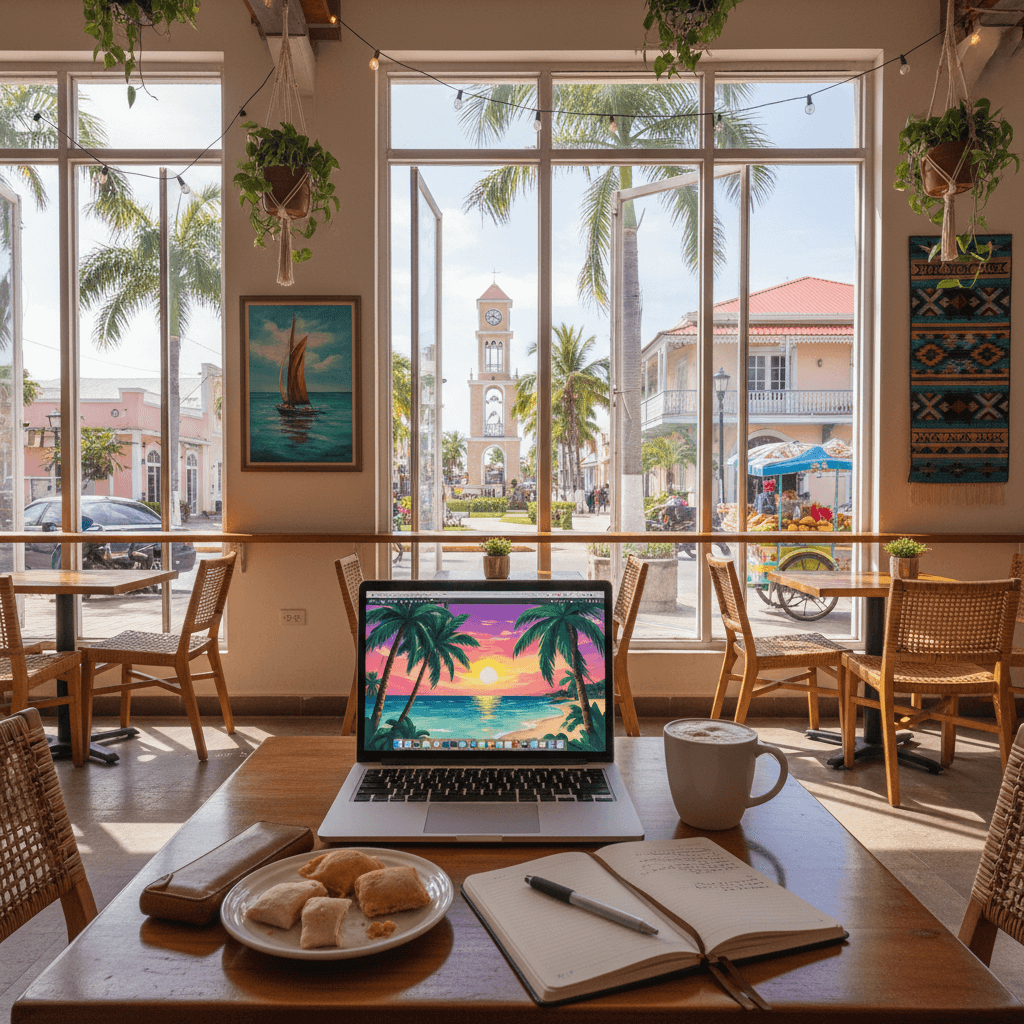
Bavaro isn't a resort town you pass through. It's a place people land for a week and quietly start pricing apartments. The combination of white-sand beach access, fiber-optic internet and a genuinely established nomad community makes it stick in a way that's hard to explain until you're sitting at a café in Los Corales, laptop open, watching pelicans dive into turquoise water fifty meters away.
The vibe is, honestly, somewhere between Caribbean beach town and functional expat suburb. You've got the sensory overload of the main strip, motorbikes weaving through traffic, the smell of frying plantains mixing with sunscreen, reggaeton bleeding out of open-air restaurants at noon. Then two blocks over, it's quieter, there's a yoga studio, a coworking space, a smoothie bar full of people on video calls.
What makes Bavaro different from other beach nomad spots is that the infrastructure actually works. That sounds like a low bar, it isn't. Reliable 100 to 300 Mbps fiber, private hospitals with English-speaking doctors, supermarkets stocked with imported goods, a coworking scene that's, turns out, more developed than most cities three times its size. Most nomads are genuinely surprised by how easy day-to-day life is here compared to other Caribbean destinations.
Still, it's not without friction. Peak season runs December through April and the crowds are real, the roads clog up, restaurant waits get long and the energy shifts from laid-back to loud. Some neighborhoods require a car and if you end up somewhere like Cocotal or Uvero Alto without one, you'll feel it fast. The humidity clings from June onward, the kind that makes you shower twice before noon.
The culture is a genuine mix. Bavaro sits at the intersection of everyday Dominican life and international tourism, so you get local colmados selling cold Presidente for a dollar next to wine bars charging Miami prices. Expats recommend leaning into both sides rather than retreating into the all-inclusive bubble, the real texture of the place is in that overlap.
Comfortable living runs $1,500 to $2,500 a month, budget travelers can do it for less and the beach is free. That math, weirdly, is hard to argue with.
Bavaro, honestly, punches well above its weight for value. Most nomads land here expecting resort prices and leave surprised, you can live comfortably without constantly watching your bank account. The sweet spot is $1,500 to $2,000 a month for a genuinely decent setup.
Housing
Where you live changes everything. El Cortecito and Verón are the local neighborhoods, cheaper by 30 to 50 percent, but you'll hear more Spanish than English and the vibe is decidedly less polished. Los Corales and White Sands are where most nomads end up, walkable, beachy and priced accordingly.
- Studio (El Cortecito/Verón): $400 to $600/month
- 1-bedroom (Los Corales/White Sands): $800 to $1,400/month
- 2-bedroom villa (Cocotal/Cap Cana): $1,500 to $3,000/month
Sign an annual lease. Landlords will drop 15 to 25 percent off the monthly rate, especially if you negotiate during low season when units sit empty and the humidity clings to everything.
Food
Street food is cheap and good. A plate of rice, beans and chicken from a local comedor runs $3 to $5 and you'll smell the garlic and sofrito from half a block away. Mid-range restaurants in Los Corales average $12 to $25 a meal, upscale spots push $50 and up.
Getting Around
Shared taxis, called guaguas, cost under $3 a ride and cover most of the main corridors. Renting a scooter runs $10 to $25 a day, which turns out to be the most practical option once you've waited in the heat for a guagua that's running 40 minutes late.
Budget Tiers at a Glance
- Budget ($1,200 to $1,500/month): Studio in a local neighborhood, street food most days, public transport, shared coworking
- Mid-range ($1,500 to $2,000/month): 1-bedroom in an expat area, mix of cooking and restaurants, occasional coworking day passes
- Comfortable ($2,000 to $2,500/month): 1 to 2 bedroom near the beach, regular dining out, dedicated coworking desk
Coworking memberships run $90 to $300 a month at spaces like Cana Work or Masa Business District, not cheap, but the infrastructure is legitimately solid and the AC alone is worth something when it's 90 degrees outside.
For Digital Nomads: Los Corales Beach Village
Most nomads end up in Los Corales and honestly, it's not hard to see why. You can walk to cafés with solid WiFi, yoga studios, the beach and a dozen decent restaurants without ever needing a car. The salt air hits you the moment you step outside, there's usually the low thrum of reggaeton from somewhere down the block and the whole neighborhood feels like it was quietly designed for people who work on laptops.
Rent runs $800 to $1,400 a month for a one-bedroom, which isn't cheap by Dominican standards, it's the price of the convenience though and most nomads find it worth it. Peak season (December through April) gets crowded and loud, that's the main complaint you'll hear.
For Expats: El Cortecito
If you're staying longer than a few months and want to actually live somewhere rather than just vacation, El Cortecito is worth a serious look. Rents run 30 to 50% lower than Los Corales, studios start around $400 a month and you're surrounded by everyday Dominican life rather than tourist infrastructure. Less English spoken here, fewer international grocery options, but expats who've made the switch rarely go back.
It's, turns out, one of those neighborhoods where you figure out the city faster because you have to. Motorbike taxis buzz past constantly, street food smells like garlic and fried plantain and the whole place just feels less performative.
For Families: Cocotal Golf & Country Club
Families tend to gravitate toward Cocotal, a gated community with pools, tennis courts, golf and 24-hour security. It's quiet in the way that actually means quiet, not just "quieter than a resort." The tradeoff is that you'll need a car for everything, groceries, school runs, coworking, all of it. Rents start around $1,500 a month for a two-bedroom.
For Solo Travelers: White Sands
White Sands is, weirdly, one of the better-kept secrets in the area. It's cheaper than Los Corales, less chaotic than El Cortecito and the infrastructure is improving fast. Solo travelers who want a home base without the peak-season circus find it fits well, the social scene is smaller but it exists and you're still close enough to Los Corales to tap into that when you want it.
Connectivity in Bavaro is, honestly, better than most people expect from a Caribbean beach town. Fiber-optic is widely available, speeds of 100 to 300+ Mbps are realistic in most neighborhoods and the two main providers, Claro and Altice, both offer 24/7 support and plans that won't break the bank. Viva exists too, though its 50 Mbps DSL ceiling makes it the weaker option for anyone doing video calls all day.
Power outages do happen, turns out more often than the glossy expat blogs admit. Most coworking spaces and well-equipped apartments have backup generators, so it's worth confirming that before you sign anything.
Coworking Spaces
The coworking scene here is small but functional and the spaces that do exist are genuinely decent. Many nomads find that local business centers and shared offices offer the necessary infrastructure for a productive stay.
- Day pass: $15 to $25
- Monthly membership: $200 to $400
- Dedicated desk: $300+ per month
Not cheap, especially once you factor in accommodation. Most nomads find the day pass model works well during the first week while they're figuring out which spot fits their rhythm.
Café Working
Several cafés in Los Corales and El Cortecito cater to laptop workers, the WiFi is reliable enough for light work and the vibe is relaxed. Noah Restaurant and Lounge, Joy Nutritional Popsicle and local cafes in Los Corales are the names that come up repeatedly among the remote worker crowd. Expect ambient music, salt air drifting in from the beach and staff who're used to seeing someone park a laptop for three hours, it's not frowned upon here.
SIM Cards
Pick up a prepaid SIM from Claro or Altice right at the airport. Both have 5G coverage in Punta Cana and the plans are frankly cheap compared to what most nomads pay back home. It's a solid backup when the apartment WiFi decides to take a day off.
Bavaro sits in what locals and expats call the "Safe Bubble," a stretch covering Punta Cana, Bavaro and Cap Cana that's, honestly, one of the safer places you'll find in the Caribbean. Streets are well-lit, gated communities have real security (not just a guy waving cars through) and the general atmosphere doesn't carry that low-grade tension you feel in some other Dominican cities. That said, petty theft happens, tourists with phones out on the beach are easy targets and isolated stretches at night are genuinely unwise.
Standard precautions apply. Don't flash expensive gear, don't wander unfamiliar areas alone after dark, keep a copy of your passport somewhere other than your wallet. Most nomads find that after a week or two, the place feels pretty relaxed, it's the first few days when you're still reading the environment that matter most.
Healthcare
Hospiten Bavaro is the anchor facility here, a full-service private hospital with emergency care, surgery and staff who are used to treating foreigners. It's part of a Spanish chain, the doctors are often U.S. or European trained and turns out, many speak solid English. Centro Medico Punta Cana handles general medicine and emergencies and is a reasonable backup option.
Private care runs 50 to 80 percent cheaper than U.S. prices, which sounds dramatic until you actually see a bill and realize a doctor's visit might cost you $40. Wait times at private facilities are short, sometimes shockingly so compared to what you're used to back home. Skip public hospitals entirely, the quality gap is significant and there's no reason to deal with it when private options are this accessible.
- Pharmacies: Abundant throughout Bavaro; stock both local generics and international brands
- Emergency number: 911 works in the Dominican Republic
- Travel insurance: Expats strongly recommend it; Hospiten charges upfront and you claim later
Health Precautions
Get your routine vaccinations sorted before you arrive, including COVID-19 and flu. The DR has seen outbreaks of vaccine-preventable diseases, it's not fearmongering, just fact. Mosquito repellent is non-negotiable in wetter months, dengue is present in the region and the mosquitoes here are aggressive in a way that catches people off guard.
Bavaro doesn't have a subway, a reliable bus grid or anything resembling a formal transit system. What it does have is a patchwork of options that, once you figure out the logic, works pretty well.
The cheapest way to get around is the guagua, a shared minivan taxi that runs fixed routes for under $3 a ride. They're loud, packed and smell like exhaust and someone's lunch, but they'll get you between El Cortecito, Los Corales and the main commercial strip without burning through your budget. Most expats use them daily without issue, you just need to know the routes because there are no posted schedules.
For anything more flexible, motorbike taxis (called motoconchos) are everywhere. They're cheap, fast and honestly a little chaotic, weaving through traffic while the driver shouts at pedestrians. Negotiate the fare before you get on, because the price doubles if you look like a tourist. Scooter rentals run $10 to $25 a day if you'd rather drive yourself.
Regular taxis are available throughout Bavaro, though they're not metered. Agree on the price upfront, that's the standard expectation not a negotiation tactic, arguing about it will get you nowhere. Ride-hailing apps like InDriver operate in the area and give you a bit more price transparency, most nomads find them worth using for longer trips or late nights.
Car rental is worth considering if you're staying somewhere like Cocotal or Uvero Alto, where walkability is basically nonexistent and the distance to a decent coffee shop is genuinely annoying. Rates start around $30 to $50 a day from local agencies, international chains are available near the airport.
Los Corales is, turns out, the one neighborhood where you can actually ditch the vehicle entirely. Cafes, restaurants, coworking spaces and the beach are all within walking distance, which is why it's popular with nomads who don't want to deal with transport logistics every day.
- Guagua (shared taxi): Under $3 per ride
- Motoconcho: $1 to $3, negotiate first
- Scooter rental: $10 to $25 per day
- Car rental: $30 to $50 per day
- Best app: InDriver for on-demand rides
Spanish is the language of Bavaro. Full stop. While English gets you surprisingly far in tourist corridors like Los Corales and El Cortecito, the moment you step into a local colmado, negotiate with a landlord in Verón or try to sort out a utility bill, you'll feel the gap immediately if your Spanish is weak.
Most service workers in hotels, coworking spaces and expat-facing restaurants speak functional English and honestly, some speak it well. But "functional" covers a lot of ground, so don't assume complex conversations will go smoothly. Medical staff at Hospiten Bávaro are generally an exception, many are genuinely fluent, which matters when you're trying to describe symptoms accurately.
Dominican Spanish is, turns out, its own thing entirely. It's fast, heavily accented and drops consonants mid-word in ways that'll confuse even confident Spanish speakers at first. The "s" at the end of words often disappears completely, "vosotros" doesn't exist here and slang terms like "dime" (literally "tell me," used as a casual greeting) will catch you off guard. Give yourself a few weeks to calibrate.
Expats recommend downloading Google Translate before you land, it works offline and the camera translation feature is genuinely useful for menus and signage. WhatsApp is, frankly, how everything gets done here. Landlords, contractors, local businesses, even some doctors communicate almost exclusively through it, so set it up and get comfortable using voice messages because Dominicans love them.
A few practical notes on communication:
- SIM cards: Claro and Altice both sell prepaid SIMs at the airport; get one immediately for a local number
- WhatsApp: Non-negotiable for daily life; most businesses won't respond to email
- Google Translate: Download Spanish offline packs before you arrive
- Learning Spanish: Even basic phrases earn real goodwill; locals notice and appreciate the effort
If you're planning to stay longer than a month, invest in even a few weeks of Spanish lessons. Several tutors in the area offer sessions through italki or in person and the difference it makes to your daily life isn't small. Ordering food without pointing at a menu feels good, negotiating rent in Spanish feels even better.
Bavaro sits in the tropics, so there's no getting around the heat. Temperatures hover between 77°F and 90°F (25°C to 32°C) year-round, which sounds lovely until you step outside in August and the humidity hits you like a warm, wet towel. Sweat is, honestly, just part of the daily routine from June through September.
The year breaks into two seasons: dry and wet. That's really all you need to know to plan around.
Dry Season (December to April)
This is peak Bavaro. Lower humidity, reliable sunshine and temperatures that actually feel comfortable, especially in the evenings when the trade winds pick up off the Atlantic. Most nomads and long-term travelers target January through March as the sweet spot, the weather's ideal and you can actually sleep without the AC running at full blast all night.
The downside? Everyone else knows this too. Prices for short-term rentals climb 20 to 30%, Los Corales gets crowded and the beaches fill up with resort tourists. If you're planning a longer stay, lock in an annual lease before you arrive, landlords are far more flexible on price when you're not competing with peak-season demand.
Wet Season (May to November)
The wet season gets a bad reputation it doesn't fully deserve. Rain usually comes in short, intense afternoon bursts, the kind that flood the streets for twenty minutes and then disappear, leaving everything smelling like wet earth and frangipani. Mornings are frequently clear and perfectly workable.
Still, June through November is also hurricane season and the Dominican Republic sits in an active corridor. Direct hits on Bavaro are rare, but tropical storms can bring days of grey skies, power fluctuations and spotty internet, which matters a lot if you're on a client call. September and October are, frankly, the riskiest months, most long-term nomads either leave or stock up on backup power solutions.
The Verdict
For short visits, November or late April hits a balance between good weather and thinner crowds, you'll get decent prices without fighting for a sunbed. For stays of three months or longer, most expats recommend arriving in November, riding out the dry season and then deciding whether the summer heat and rain is something they can work around.
Best overall months: November, January, February, March. Avoid September and October unless you're genuinely budget-hunting and don't mind the weather gamble.
Bavaro rewards the prepared traveler, it punishes the one who wings it. A few things to know before you land will save you real money and real headaches.
Money & Payments
The Dominican peso is the local currency and you'll want cash for street food, guaguas and smaller shops. ATMs are, honestly, everywhere in Bavaro, but withdrawal fees stack up fast, so pull out larger amounts less often. Most restaurants and coworking spaces accept USD or cards, though the exchange rate at point of sale is usually worse than what you'd get at a bank or Cambio.
Getting a SIM Card
Do this at the airport. Claro and Altice both have kiosks before you exit arrivals and a prepaid SIM with a solid data package runs you $10 to $20. Both carriers have 5G coverage in Bavaro, turns out it's actually reliable, which makes the whole "will I have internet on the way to my apartment" anxiety completely unnecessary.
Transportation Reality
Shared taxis, called guaguas, cost under $3 a ride and connect most of Bavaro's main corridors. They're loud, they smell like exhaust and someone's lunch and they're genuinely the fastest way to understand how the city moves. For longer trips or late nights, negotiate taxi fares before you get in, not after, because drivers will quote tourist prices with a straight face and no apology.
Healthcare & Pharmacies
Hospiten Bavaro is your go-to for anything serious, it's a full private hospital with English-speaking staff and costs that are 50 to 80% below U.S. prices for equivalent care. Pharmacies are on nearly every block and stock most international medications without the prescription drama you'd face back home.
Safety Common Sense
Bavaro is safe by Caribbean standards, don't let anyone tell you otherwise, but that doesn't mean you switch your brain off. Stick to lit streets at night, don't flash expensive gear on the beach and skip the isolated stretches of road after dark.
Vaccinations & Health Prep
- Routine vaccines: Make sure they're current before you travel
- COVID-19 and flu: Recommended, cases of vaccine-preventable illness do get reported here
- Mosquito precaution: Bring repellent; dengue is a real concern in rainy season
Annual leases, negotiated in low season between May and October, can knock 15 to 25% off your rent. That's the kind of saving that actually moves the needle on your monthly budget.
Need visa and immigration info for Dominican Republic?
🇩🇴 View Dominican Republic Country GuideEasy Landing
Settle in, no stress