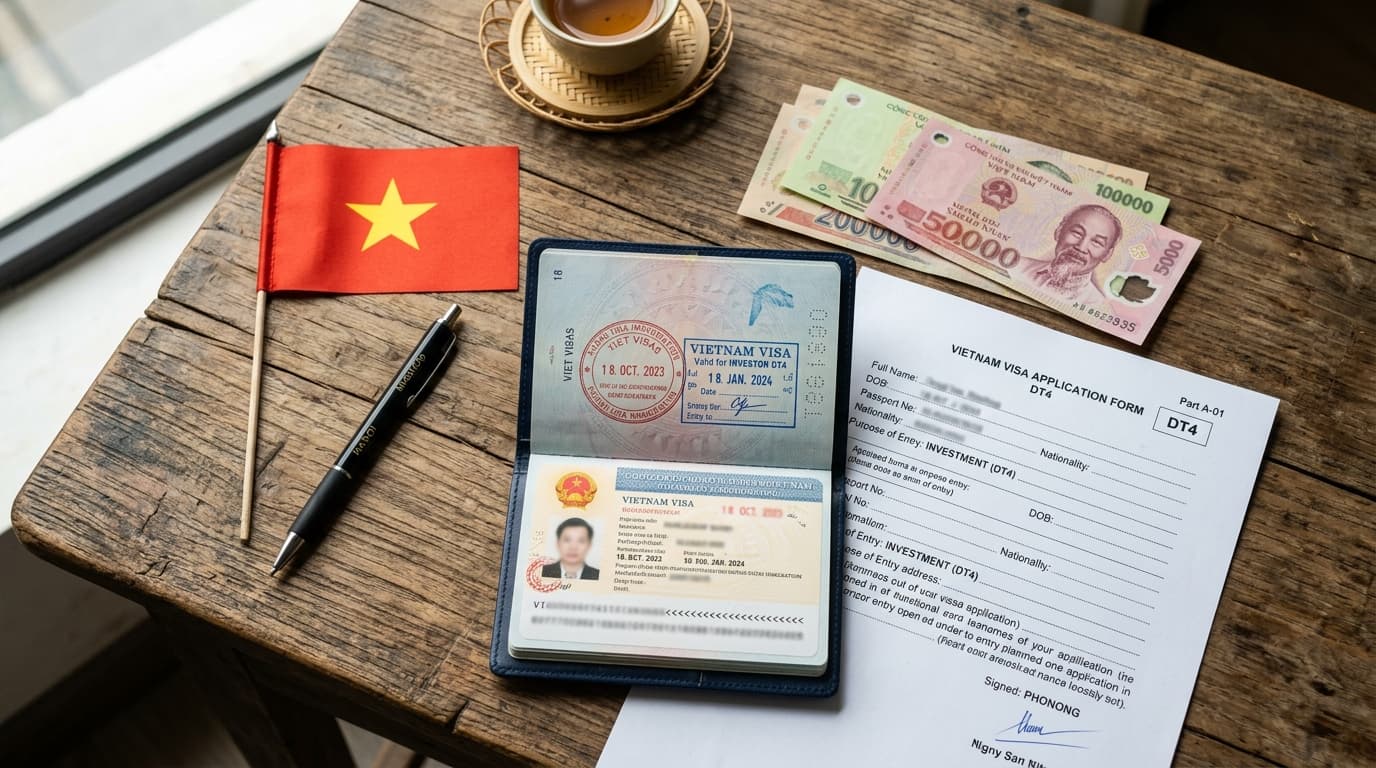
Vietnam DT4 Investor Visa

At a Glance
- $135 one-timegovernment visa fee by validity; multiple-entry tiers are USD 50 (up to 90 days), USD 95 (over 90 to 180 days), USD 135 (over 180 days to 1 year) · a 12-month DT4 visa
- 12 monthsnot more than 12 months
- No temporary residence card for DT4; the holder applies for a new DT4 visa (up to 12 months) through the sponsoring company while the investment is keptLaw 51/2019 grants temporary residence cards only to DT1, DT2 and DT3 holders
- The Vietnamese company in which the investor holds capital sponsors the application at the Immigration Department (Cục Quản lý xuất nhập cảnh); the visa is then issued at a Vietnamese mission abroad or at the border, or an investor already in Vietnam can change visa purpose with proof of investor statusLaw 47/2014 as amended by Law 51/2019 (sponsored visas; Art. 7 purpose change for investors)
- Nothe TT (dependant) visa lists DT1, DT2 and DT3 holders but not DT4
- No. DT4 gives no temporary residence card and no route to permanent residence; raising contributed capital to VND 3 billion or more moves the investor to DT3, which does carry a temporary residence cardLaw 51/2019: temporary residence cards only for DT1 to DT3
DT4 is Vietnam's investor visa for the smallest stakes. Under Law 51/2019, which amended the 2014 law on the entry and residence of foreigners, it goes to foreign investors in Vietnam, and to representatives of foreign organizations investing there, whose contributed capital is under ₫3,000,000,000.
- Status: active, under Law 51/2019 in force since July 1, 2020
- Capital: under ₫3,000,000,000, with no legal minimum
- Length: up to 12 months per visa
- Government fee: $135 for a multiple-entry visa of more than 180 days and up to one year
- Residence card and dependent visas: none
DT4 is a business visa, not a residence route. Investors who contribute ₫3,000,000,000 or more fall under DT3 or a higher category, which comes with a temporary residence card. The Vietnam guide covers the e-visa and visa-free stays most remote workers use.
Law 51/2019 defines DT4 by who invests and how much:
- Who: a foreign investor in Vietnam, or a representative of a foreign organization that invests in Vietnam.
- Capital: contributed capital under ₫3,000,000,000. The figure is a ceiling, not a minimum. From ₫3,000,000,000, the investor moves up to DT3.
- Sponsor: the Vietnamese company in which the investor holds capital sponsors the visa.
Family: No. The law's dependent visa (TT) covers the spouse and children under 18 of DT1, DT2 and DT3 holders but leaves out DT4, so family members need a visa of their own, such as an e-visa.
Work: the visa covers the investment activity. A job or management role in Vietnam falls under the separate work permit rules, so the sponsoring company should confirm whether a permit or an exemption applies.
Law 51/2019 ties DT4 to proof of investment. The file has two sides:
- From the sponsoring company: its visa request to the Immigration Department, with its registration documents.
- Proof of investment: documents showing the applicant is an investor, or represents a foreign organization investing in Vietnam, and how much capital was contributed.
- From the applicant: a valid passport.
The Immigration Department sets the forms and the exact document list. Papers issued abroad may need consular legalization and a Vietnamese translation, which the sponsor or the Vietnamese mission issuing the visa can confirm.
- Visa fee: $135 for a multiple-entry visa valid more than 180 days and up to one year, under the fee schedule the Ministry of Public Security publishes (Circular 62/2023/TT-BTC, in force since April 1, 2026). Visas with shorter validity cost less under the same schedule.
- No fee cut: the temporary 50% cut under Circular 64/2025/TT-BTC covers passports and exit permits, not visa fees for foreigners.
- The investment: the capital itself, which has to stay under ₫3,000,000,000 for DT4.
- Other costs: company registration, translations, legalization and professional help have no fixed official price.
Where to apply: The Vietnamese company in which the investor holds capital sponsors the application at the Immigration Department (Cục Quản lý xuất nhập cảnh); the visa is then issued at a Vietnamese mission abroad or at the border, or an investor already in Vietnam can change visa purpose with proof of investor status.
The investment has to be set up or registered first, since the sponsor is the company the investor holds capital in. The e-visa portal issues EV visas only, so it can't be used for DT4.
No official processing time is published for DT4, and company registration adds time before the visa request.
- Length: up to 12 months per visa. The higher DT categories run longer.
- Renewal: No temporary residence card for DT4; the holder applies for a new DT4 visa (up to 12 months) through the sponsoring company while the investment is kept.
- Residence: No. DT4 gives no temporary residence card and no route to permanent residence; raising contributed capital to VND 3 billion or more moves the investor to DT3, which does carry a temporary residence card.
DT4 holders can't count years on the visa toward permanent residence. Investors planning several years in Vietnam should weigh the capital level before committing: from ₫3,000,000,000, DT3 applies and brings a temporary residence card.
DT4 carries no tax regime of its own. Under Vietnam's Personal Income Tax Law, in its consolidated version in force since July 1, 2026, a person is tax resident after 183 days or more in Vietnam in a calendar year or in 12 consecutive months from arrival, or when they have a permanent residence in Vietnam.
Residents and non-residents are taxed differently, and the company the investor holds capital in pays business taxes of its own. Investors should confirm both with the tax authority or an adviser, including any tax treaty between Vietnam and their home country.
Frequently Asked Questions
Does the DT4 visa come with a residence card?
No. DT4 gives no temporary residence card and no route to permanent residence; raising contributed capital to VND 3 billion or more moves the investor to DT3, which does carry a temporary residence card.
What is the minimum investment for a DT4 visa?
There isn't one. Law 51/2019 sets a ceiling: contributed capital under ₫3,000,000,000. At ₫3,000,000,000 or more, the investor falls under DT3 instead.
How long does a DT4 visa last?
Up to 12 months. No temporary residence card for DT4; the holder applies for a new DT4 visa (up to 12 months) through the sponsoring company while the investment is kept.
Can family members get dependent visas?
No. The dependent (TT) visa covers families of DT1 to DT3 holders only, so a DT4 holder's spouse and children need their own visa, such as an e-visa.
Can a DT4 visa be requested on the e-visa portal?
No. The e-visa portal issues EV visas only. DT4 is requested by the sponsoring Vietnamese company through the Immigration Department.
How It Compares
More Vietnam programs
| Program | Country | Income | Fee | Max stay | Renewable |
|---|---|---|---|---|---|
| Vietnam Golden Visa (UĐ1 Preferential Visa) | Vietnam | - | $165 | 60 mo |
Similar visas elsewhere
| Program | Country | Income | Fee | Max stay | Renewable |
|---|---|---|---|---|---|
| Egypt Citizenship by Investment | Egypt | $250,000 saved | $10,000 | - | |
| Antigua and Barbuda Citizenship by Investment | Antigua and Barbuda | - | $10,000 | - | - |
| Malta Permanent Residence Programme (MPRP) | Malta | €375,000 saved | €60,000 | 60 mo | |
| Dominica Citizenship by Investment | Dominica | $200,000 saved | $1,000 | - |
Vietnam Digital Nomad Guide
Cost of living, internet, healthcare, coworking, and every visa option for Vietnam.
Visa rules change. We'll tell you.
Get notified about policy updates and new requirements for the Vietnam DT4 Investor Visa and other Vietnam visas.