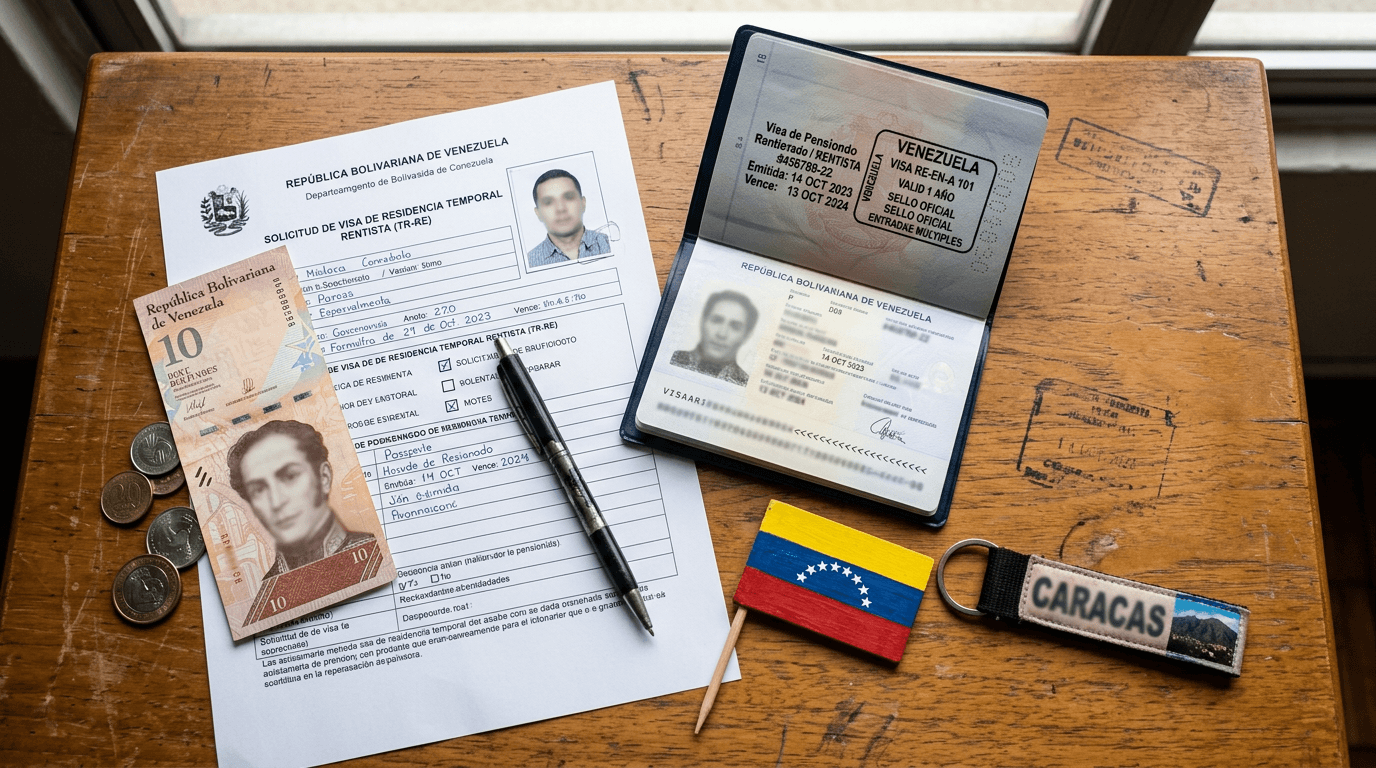
Venezuela Rentista Visa (TR-RE)

At a Glance
- $1,200 a monthlawful income or pension generated abroad · main applicant
- $500 a monthfixed monthly income per accompanying family member · each accompanying family member
- Set by each Venezuelan embassy or consulate; no single amount is publishedall applicants
- 1 yearmultiple entries, with an equal period of stay · main applicant
- Extendable for equal one-year periods by the Ministry of Interior, Justice and Peace, on proof that the foreign income sources continuevisa holder
- Venezuelan embassy or consulate abroadall applicants
- Yesextra USD 500 a month per accompanying family member · accompanying family members
Last checked Oct. 9, 2026
The Transeúnte Rentista visa (TR-RE) is Venezuela's visa for foreigners who live on lawful income or a pension generated abroad. The Foreign Ministry (MPPRE) grants it to non-migrants, so it suits retirees and others with steady foreign income who want a longer base than a tourist stay.
The visa is issued for 1 year with multiple entries and a permitted stay of the same length. It can be extended inside Venezuela for equal periods while the foreign income continues.
The ministry's wording, rentas lícitas o pensión, points to passive income and pensions. It does not mention salary or freelance earnings from remote work, so remote workers should confirm with the consulate that their income qualifies before applying.
Key terms
- Status: active
- Income: at least $1,200 a month generated abroad, plus $500 a month for each accompanying family member
- Validity: 1 year, multiple entries
- Where to apply: Venezuelan embassy or consulate abroad
- Consular fee: Set by each Venezuelan embassy or consulate; no single amount is published
The TR-RE is open to foreigners who live on lawful income or a pension generated outside Venezuela. The main applicant must show income equivalent to at least $1,200 a month from abroad, according to the Foreign Ministry (MPPRE).
Applicants traveling with family must also show fixed income of $500 a month for each accompanying person, plus documents proving the family ties.
The ministry's page sets no age limit and names no nationality restrictions. What matters is that the income is lawful, comes from abroad and is likely to continue, because extensions depend on it.
The page speaks of lawful rentas (income such as rents or investment returns) and pensions. Salary or freelance pay from foreign clients is not mentioned either way, so a remote worker should get the consulate's view in writing before filing.
The Foreign Ministry (MPPRE) lists these documents for the TR-RE:
- The original passport and a copy, valid for at least 6 months
- Two recent color photos, facing forward, ID card size
- Proof of income of at least $1,200 a month generated abroad
- For each accompanying family member, proof of a further $500 a month and documents proving the family tie
- A copy of a return ticket or a ticket out of Venezuela
- A medical certificate issued by the health authority of the country of origin
- The receipt for the consular fee
Individual embassies and consulates may add requirements or ask for documents in a particular form, such as legalized or translated copies. The checklist should be confirmed with the mission before filing.
- Consular fee: Set by each Venezuelan embassy or consulate; no single amount is published
- Income test, main applicant: $1,200 a month
- Income test, each family member: $500 a month
The Foreign Ministry (MPPRE) says the cost of the consular fee must be checked with the embassy or consulate, so no single amount applies everywhere.
Other costs depend on the applicant's documents: the medical certificate, the ticket and any legalization or translation the mission asks for. No official figures are published for these.
- Contact the Venezuelan embassy or consulate that serves the applicant's place of residence and confirm its checklist, fee and appointment rules.
- Gather the documents the Foreign Ministry lists, in the form the mission asks for.
- Submit the file, pay the consular fee and keep the receipt, which is part of the file.
- Once issued, the visa runs for 1 year with multiple entries.
The ministry publishes no processing time, so the mission should be asked for its current wait.
Tourist and business visas can be requested online through the Foreign Ministry's Cancillería Digital portal. No official source shows the TR-RE on that portal, so it is filed at a Venezuelan embassy or consulate abroad.
The TR-RE is granted for 1 year with multiple entries, and the permitted stay is the same length.
Extensions: Extendable for equal one-year periods by the Ministry of Interior, Justice and Peace, on proof that the foreign income sources continue. The ministry states no limit on the number of extensions.
TR-RE holders can later apply to SAIME, the immigration service, to change their status. No official source gives a timeline for that, so it should be checked with SAIME before planning on it.
The visa rules say nothing about tax. Under Venezuela's Organic Tax Code, an individual is tax resident after more than 183 days, continuous or not, in a calendar year or in the year before it, or after setting up a residence or home in Venezuela.
A TR-RE holder who spends most of the year in Venezuela crosses that line. No official source describes a special tax regime for TR-RE holders or for foreign pensions and investment income.
Applicants should check how Venezuela and their current country of tax residence treat that income before moving.
Frequently Asked Questions
How much income does the Venezuela TR-RE require?
At least $1,200 a month from lawful income or a pension generated abroad, plus $500 a month for each accompanying family member.
How much does the TR-RE cost?
Set by each Venezuelan embassy or consulate; no single amount is published. The Foreign Ministry says the consular fee must be checked with the embassy or consulate.
How long is the TR-RE valid, and can it be extended?
It is valid for 1 year with multiple entries and can be extended for equal periods while the foreign income continues.
Can the TR-RE be requested online?
Tourist and business visas can be requested online through the Foreign Ministry's Cancillería Digital portal, but no official source shows the TR-RE there. It is filed at a Venezuelan embassy or consulate abroad.
Can remote workers use the TR-RE?
The ministry describes it for people living on lawful income or a pension from abroad, which points to passive income, and does not mention remote work pay. Remote workers should confirm with the consulate that their income qualifies.
How It Compares
Similar visas elsewhere
| Program | Country | Income | Fee | Max stay | Renewable |
|---|---|---|---|---|---|
| Liechtenstein Financially Independent Residence Permit | Liechtenstein | CHF 2,600/mo | CHF 1,060 | 12 mo | |
| Italy Elective Residence Visa | Italy | €31,000/yr | €116 | 12 mo | |
| Dominican Republic Pensionado / Rentista | Dominican Republic | $1,500/mo | $200 | 12 mo | |
| Lebanon Income-Based Residency Permit | Lebanon | LBP 50,000,000/mo | LBP 18,000,000 | 12 mo | - |
Venezuela Digital Nomad Guide
Cost of living, internet, healthcare, coworking, and every visa option for Venezuela.
Visa rules change. We'll tell you.
Get notified about policy updates and new requirements for the Venezuela Rentista Visa (TR-RE) and other Venezuela visas.