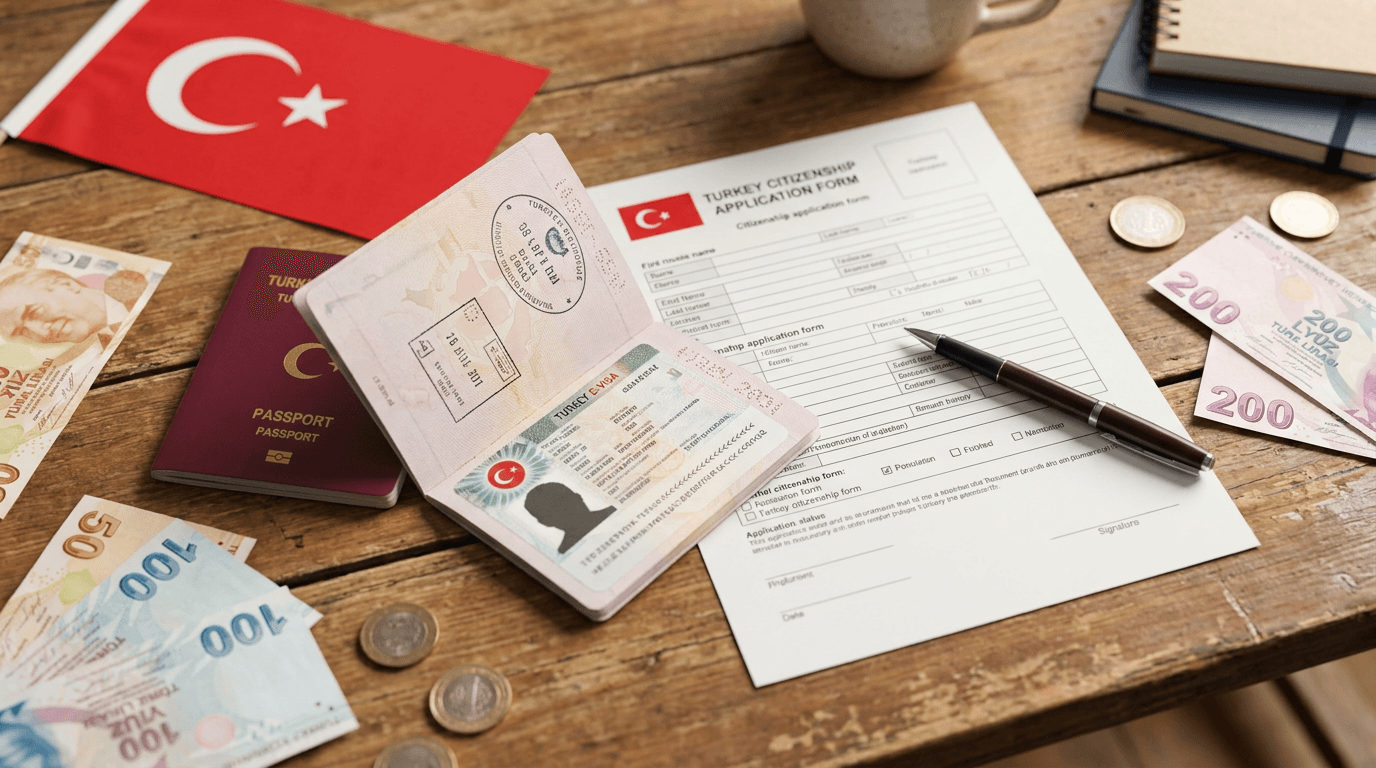
Turkey Citizenship by Investment — Turkey

Visa Program Briefing

Turkey Citizenship by Investment

TurkeyGolden / Investor Visa
Brandon Richards
Brandon Richards ·

Visa Data Sheet

Minimum Savings
$400,000 – $500,000 in savings
Application Fee
$170 – $16,170
RenewableResidency PathRemote Work
The Full Briefing

Turkey’s citizenship by investment route isn't a visa and that distinction matters. A tourist visa or e-Visa only gives you temporary entry. This program is an exceptional naturalisation pathway under Turkish citizenship law and it starts with a qualifying investment, a special short-term residence permit and a presidential decision.

The legal basis sits in Article 12 of Turkish Citizenship Law No. 5901 and Article 20 of the Regulation on the Implementation of the Turkish Citizenship Law. In practice, the state uses this route to bring in foreign capital, not casual long-stay visitors.

Any foreign national can apply if they meet one of the approved investment options and pass security and public-order checks. Eligible family members, usually a spouse and minor children, can be included in the application.

Main investment routes

  • Real estate: Buy property worth at least $400,000 and register a three-year no-sale restriction on the title deed.
  • Fixed capital investment: Invest at least $500,000 in fixed capital, subject to ministry confirmation.
  • Employment creation: Create jobs for at least 50 people.
  • Bank deposit: Deposit at least $500,000 in a bank operating in Türkiye and keep it there for three years.
  • Government bonds: Buy $500,000 in government bonds and hold them for three years.
  • Investment funds: Buy at least $500,000 in real estate investment fund or venture capital fund shares and hold them for three years.
  • Private pension system: Contribute at least $500,000 to approved pension funds and keep the money in the system for three years.

The process isn't automatic. After making the investment, you first get a certificate of eligibility from the relevant authority, then apply for a short-term residence permit under Article 31/1(j) and only after that submit the citizenship application. The final decision sits with the president.

That’s the part many people miss. Meeting the threshold doesn’t guarantee approval and it’s a lot more serious than a standard tourist stay. There’s no direct shortcut from a holiday visa to a Turkish passport.

For most applicants, the real estate route is the most familiar one, but it’s not the only path. The cleanest rule to remember is simple: if you’re looking at an e-Visa, you’re looking at temporary entry. If you’re looking at citizenship by investment, you’re looking at a formal naturalisation process with money on the table and paperwork to match.

Turkey’s citizenship by investment route is a full citizenship program, not a residence permit dressed up with nicer branding. It sits under Article 12(b) of the Turkish Citizenship Law and is granted by exceptional naturalisation, which means the final decision still depends on presidential approval.

The basic qualifier is simple: you need to be a foreign national who makes one of the approved investments and follows the paperwork chain. The official rules don’t publish a nationality blacklist for the citizenship program itself, though property purchases can be subject to separate country-based restrictions in Türkiye, so the real-estate route can be messier than the others.

There isn’t a fixed minimum age listed in the official program pages, but in practice this is an adult investor route. The government sources also don’t spell out a standard family-inclusion rule on the pages cited here, so don’t assume spouse or children are automatically handled until your file is checked by the relevant authority.

To qualify, you generally need one of these investment tracks:

  • Real estate: Buy property worth at least $400,000 and commit not to sell it for three years.
  • Fixed capital investment: Invest at least $500,000, confirmed by the Ministry of Industry and Technology.
  • Job creation: Create at least 50 jobs, with the Ministry of Labour and Social Security certifying the file.
  • Bank deposit: Place at least $500,000 in a Turkish bank and keep it blocked for three years.
  • Government bonds: Buy at least $500,000 in government bonds and hold them for three years.
  • Investment funds: Buy at least $500,000 in real estate investment fund shares or venture capital fund shares and hold for three years.
  • Private pension system: Contribute at least $500,000 and keep the funds in the system for three years.

The money thresholds are set in dollars or equivalent foreign currency. The official pages don’t give a fixed Turkish lira conversion, so the rate at the time of your transaction matters.

There’s also a separate short-term residence permit step for many applicants before citizenship is finalized. The citizenship route itself isn’t income-based and the government sources don’t give a monthly salary floor for this program. What they do require is proof that the investment meets the threshold and that the right certificate has been issued by the relevant authority.

Source 1 | Source 2

Turkey’s citizenship by investment route isn't a visa or a residence permit. It’s an exceptional citizenship process and the official investment thresholds are fixed, not negotiable: $400,000 for real estate or $500,000 for the other qualifying routes, plus a 3-year holding period for the asset.

The government materials I could verify don’t publish a public income requirement for this route. They also don’t expose a full, itemized document checklist on the pages I accessed, so anyone promising a neat one-page list is probably filling in gaps.

What you do have to show

  • Identity documents: Your passport and basic applicant details are part of the citizenship file.
  • Proof of the qualifying investment: This can be title deed records, bank deposit records, fund or bond documents or other evidence tied to the approved investment route.
  • Certificate of conformity or eligibility: The official ministry or competent authority has to confirm that your investment meets the program rules before the citizenship step moves forward.
  • Real estate annotation: If you buy property, the title deed must show the 3-year no-sale commitment.

For real estate investors, the key piece is the title deed annotation. Without that 3-year restriction recorded properly, the file won’t match the citizenship rules. For non-property routes, the government still wants proof that the money went into one of the approved channels, such as fixed capital, bank deposits, government bonds, real estate investment fund shares or venture capital fund shares.

What the official pages don’t clearly spell out

  • Spouse and children: The public pages I accessed don’t give a confirmed document list for family members.
  • Police clearance: I couldn’t confirm a published background-check requirement from the official pages reviewed.
  • Health insurance: The citizenship-stage insurance rule wasn’t clearly listed in the materials I could verify.
  • Apostille and translation rules: I couldn’t confirm a public, route-specific standard for these documents.

The citizenship application itself uses the VAT-4 form for exceptional citizenship, but the public NVI page doesn’t show the form contents or a full checklist. Processing time also isn’t fixed on the official government pages, so anyone quoting a neat timeline is relying on third-party estimates, not the source material.

Source 1 | Source 2

Turkey’s citizenship by investment route is simple on paper and messy in practice. The state sets the investment thresholds in law, but it doesn’t publish one clean, official fee sheet for the full process, so some costs are fixed and others are just the price of doing paperwork in Turkey.

The investment itself isn't a fee, but it's the headline number. Real estate starts at $400,000 with a three-year no-sale restriction. The other qualifying routes, fixed capital, bank deposits, government bonds or eligible fund shares, start at $500,000.

Government costs tied to the application

  • Citizenship processing fee: A fee is payable and applicants usually submit a payment receipt with the file. The government doesn’t publish a single fixed public amount for investment citizenship, so you need to check the current charge through the relevant office when you apply.
  • Residence permit stage: Investment applicants first need a short-term residence permit. That means a residence-permit tax plus a residence card fee, both of which are set through official systems and can change. The portals don’t give one universal number for every nationality.
  • Passport and ID after approval: Once you’re a citizen, you pay the same passport and ID fees as everyone else in Turkey. An example national schedule shows a 1-year passport at 5,454 TRY total, which works out to roughly $170 using the research’s indicative rate.

Real-world costs people usually forget

If you’re buying property, the extra charges add up fast. Title-deed transfer tax is ordinarily 4% of the declared value, often landing on the buyer in practice. On a $400,000 purchase, that’s about $16,000 before you even get to appraisal reports, compulsory earthquake insurance and other standard property charges.

Translation, notarization and apostille work also stack up. You’ll usually need passport copies, civil-status documents and Turkish translations and those aren’t free. Health insurance for the residence permit is another unavoidable cost and private plans are priced by age and coverage, not by any special citizenship rule.

The short version, this isn’t a low-cost passport route. The legal minimum starts at $400,000, but the real budget should include government fees, property taxes, card and passport charges, plus a fair amount for lawyers, translators and document handling.

Turkey’s citizenship by investment route, officially the “exceptional” citizenship path, doesn’t start with a passport application. It starts with an approved investment, then a short-term investor residence permit, then a separate citizenship filing that’s reviewed for presidential approval.

The cleanest route is still real estate. You need to buy property worth at least $400,000 and the title deed has to carry a 3-year resale restriction. Other qualifying options include a $500,000 fixed capital investment, a $500,000 bank deposit, $500,000 in government bonds or qualifying fund shares or creating jobs for at least 50 people.

How the process works

  • 1. Choose the investment route: Real estate is the most common option, but the deposit, bond, fund and job-creation routes are also available if you meet the stated thresholds.
  • 2. Secure the certificate of conformity: The relevant ministry or authority confirms that your investment meets the legal amount and holding period.
  • 3. Apply for the investor residence permit: This is done through the e-Ikamet system and processed by the provincial Directorate of Migration Management.
  • 4. File the citizenship application: After the residence step, you submit a separate citizenship dossier to the civil registration and citizenship authorities.

Turkey doesn't publish a fixed, official processing time for this path. In practice, the residence permit stage can take weeks or longer depending on the province and the citizenship decision comes later after the full file is complete.

Documents you’ll usually need

  • Identity papers: Valid passport and a notarized Turkish translation.
  • Civil-status records: Birth certificate, marriage certificate, divorce decree or death certificate, depending on your situation.
  • Family documents: Proof of family ties and, where relevant, consent for dependent children.
  • Photos: Biometric photographs that meet ICAO standards.
  • Investment proof: The certificate of conformity and supporting records for the investment route you used.

The residence permit side has fees, but the official pages don’t give a single fixed amount in English because the card fee and application fee vary by nationality and duration. The citizenship application also carries a service fee, though the government doesn’t publish a clean current figure in the public guidance. So yes, there are fees, but you should confirm the exact amount before you file.

Turkey’s citizenship by investment route doesn’t work like a normal visa program. If your application is approved, you get citizenship outright, so there’s no separate citizenship “validity period” to renew. The moving part is usually the short-term residence permit you hold while the file is being processed.

That permit is the part with a clock on it. Under the residence rules, short-term permits are generally issued for a maximum of two years at a time and they can be renewed if you still meet the conditions. For property-based applicants, official guidance also says the permit is renewable, which makes sense because the investment itself has to be held for three years anyway.

For investors who aren't using the citizenship route, Turkey’s residence system can still lead to longer stays. After 8 years of continuous legal residence, you may become eligible for a long-term residence permit. That permit is indefinite in practice, though it can still be lost if you stop meeting the rules or spend too long outside the country.

There’s one part the official portals don’t spell out cleanly and that’s processing time. The government doesn’t publish a fixed timeframe for the residence permit or the citizenship application, so anyone promising a neat 30-day or 90-day turnaround is guessing. In real life, that uncertainty is probably the most annoying part of the process.

  • Citizenship status: Immediate once approved, with no renewal cycle.
  • Short-term residence permit: Usually issued for up to 2 years and renewable.
  • Investment holding period: 3 years for the qualifying investment, including property, deposits, bonds and fund shares.
  • Long-term residence option: Possible after 8 years of continuous legal stay for non-citizens.

For most applicants, the practical takeaway is simple. You don’t renew the citizenship, you renew the residence permit while you wait for the citizenship file to clear. Once the passport is approved, the whole renewal question disappears.

Turkey’s citizenship by investment route doesn’t come with a special tax break. Once you naturalize, you’re just a Turkish taxpayer under the country’s normal rules, so the real question is residency, not the fact that you used the citizenship program.

If you become a tax resident, Turkey generally taxes your worldwide income. If you stay non-resident, Turkey taxes only income and gains sourced in Turkey. The usual residency tests are fairly blunt: domicile in Turkey or spending more than 183 days in the country in a calendar year.

That means foreign salary, dividends, interest and business profits usually stay outside Turkish tax if you’re still non-resident and you don’t have Turkish-source income. The Turkish Revenue Administration’s guidance for non-residents says they don't file Turkish returns for foreign income. Once you cross into resident status, that protection falls away and treaty relief may become relevant.

Turkey’s official investment portal also makes clear that individual income tax is progressive, with rates from 15% to 40%. What it doesn’t do is carve out a reduced rate for CBI holders. There’s no official special regime attached to buying a $400,000 property and holding it for three years, even though that’s the headline investment route.

What to keep in mind

  • No CBI tax shortcut: the citizenship route itself doesn’t create tax exemptions or lower rates.
  • Residency matters most: spend more than 183 days in Turkey or make it your domicile and worldwide income can come into scope.
  • Non-residents are narrower: Turkey taxes Turkish-source income only and doesn’t expect a return for foreign income.
  • Treaties can help: Turkey has double-taxation agreements that may reduce the risk of being taxed twice.

There’s also been talk of a possible foreign-income exemption for people who haven’t been Turkish tax residents for the past three years, but that’s still just a proposal. There’s no confirmed law or official tax guidance showing it has been enacted, so don’t plan around it.

Bottom line: if you’re using Turkish citizenship as a backup plan, don’t assume it changes your tax bill. Your tax outcome will still depend on where you live, where your income comes from and whether a treaty applies.

Full Country Guide

Turkey Digital Nomad Guide

Cost of living, internet, healthcare, coworking, and every visa option for Turkey.

Stay Current

Visa rules change. We'll tell you.

Get notified about policy updates and new requirements for the Turkey Citizenship by Investment and other Turkey visas.