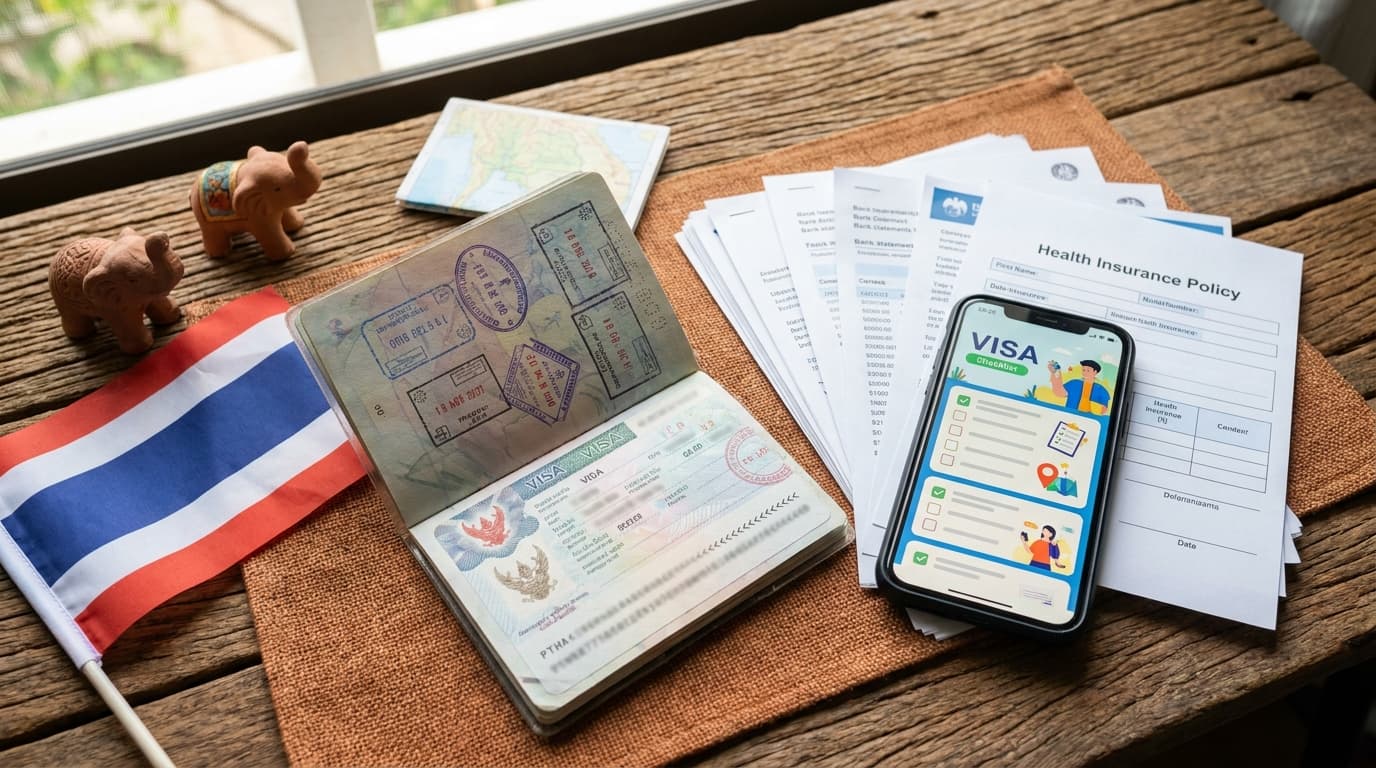
Thailand Retirement Visa (Non-Immigrant O-A)
Visa Data Sheet
- $22,000 in savings
- $140 – $200
- 24 months
The Non-Immigrant O-A is Thailand’s long-stay retirement visa. It’s for foreigners age 50 and up who want to live in Thailand for a year at a time without working and that work ban is strict.
This isn’t a tourist visa with extra paperwork. You’re applying under a different rule set, with age, health, police clearance and financial checks that tourists never face. The upside is simple, if you qualify, you can stay longer and renew instead of doing constant border hops.
Official embassy guidance still lists the main O-A route in 2026, though Thailand is also restructuring non-immigrant categories from Aug. 31, 2025, so some details may shift depending on where you apply. That makes it even more important to check the embassy or consulate that handles your jurisdiction before you file.
The basic profile is straightforward:
- Age: at least 50 years old.
- Status: no intention to work in Thailand.
- Background: no criminal record in Thailand or your home country, usually backed by a police clearance.
- Health: no prohibited diseases listed in the official medical rules.
- Jurisdiction: you apply through the Thai mission responsible for where you live or hold nationality.
The money side is also specific. Embassies commonly ask for either 800,000 THB in a Thai bank account, a monthly income of 65,000 THB or a mix of savings and income that still totals 800,000 THB. You’ll usually need bank statements and, for income-based applications, an income certificate.
Health insurance is another non-negotiable. O-A applicants must keep qualifying coverage for the full stay and the exact minimums can vary by mission, though many still use the 400,000 THB inpatient and 40,000 THB outpatient benchmark. That part can be a headache, because the published numbers aren’t always laid out the same way across official pages.
For retirees, the appeal is obvious. The tradeoff is paperwork and more of it than most people expect.
The Non-Immigrant O-A is Thailand’s long-stay retirement visa, but it’s not open to everyone. You need to be at least 50 years old on the day you apply and you must have the right to apply in the country where you submit the paperwork, either your country of nationality or your country of residence.
There’s also a hard line on conduct and health. Applicants can’t be barred from entering Thailand under immigration law, must have no criminal record in Thailand or in their home country and can’t have one of the visa’s listed prohibitive diseases, including leprosy, tuberculosis, drug addiction, elephantiasis or third-phase syphilis. In practice, that means police clearance and a medical certificate, both issued within 3 months and properly notarized or authenticated.
Employment in Thailand is not allowed on this visa. If you want to work, this is the wrong category.
Financially, you need to meet one of these routes:
- Bank deposit: At least 800,000 THB in a bank account for the last 3 months.
- Monthly income: At least 65,000 THB a month, usually shown with an original income certificate.
- Combination route: Savings plus income that total at least 800,000 THB a year.
If you use the bank deposit route, the official guidance also calls for an original bank guarantee letter. The documents are straightforward, but the rule set is strict and embassies do check the details.
You can apply either at a Thai embassy or consulate-general in your country of nationality or residence or at the Immigration Bureau in Bangkok if you’re already in Thailand on the right status. Some missions also apply their own nationality or residence limits, so don’t assume every Thai post will process every applicant. Check with the specific mission before you build travel plans around it.
Thailand’s Non-Immigrant O-A visa is still the standard one-year retirement route for applicants age 50 and up. It’s a multiple-entry visa, work is prohibited and you’ll need to keep your paperwork in order because the rules aren't light.
What you need to apply
- Passport: At least 18 months of validity, plus a copy of the bio page.
- Application form and photos: Completed visa form, 3 passport-size photos and a personal data form.
- Financial proof: Either 800,000 THB in a bank account, 65,000 THB a month in income or a combination that reaches 800,000 THB.
- Police clearance: A criminal-record verification from your country of nationality or residence, issued within the last 3 months and notarised.
- Medical certificate: A certificate from the country where you apply, also issued within the last 3 months and notarised, showing no prohibited diseases.
- Health insurance: Mandatory, with the current MFA e-visa checklist calling for at least 3,000,000 THB or $100,000 in coverage for the full stay.
- Residence proof: Proof of permanent residence in the country where you submit the application.
- Spouse documents: If you’re applying with a spouse, bring a marriage certificate.
The health insurance piece is the one that catches people out. Older embassy guidance has shown lower coverage wording, but the current MFA e-visa checklist is the safer benchmark and it’s stricter than many applicants expect.
Financial and medical rules
The money requirement is straightforward, but the paperwork around it isn’t always. The official standard is 800,000 THB in savings, 65,000 THB monthly income or a mix of the two that adds up to 800,000 THB. The MFA also wants proof at the extension stage, so this isn’t just a one-time visa hurdle.
You also need to be medically clear of the diseases listed by the Ministry of Foreign Affairs, including leprosy, tuberculosis, drug addiction, elephantiasis and third-stage syphilis. That’s blunt, but that’s the rule.
Validity and timing
The visa itself is valid for 1 year and allows a 1-year stay from first entry. After that, you can apply for a one-year extension of stay with Immigration Bureau if you still meet the financial rules. You’ll also need to report your address every 90 days.
The official portal doesn’t give a fixed processing time. Fees can vary by embassy, though the MFA PDF lists a 5,000 THB fee for multiple-entry issuance.
The Non-Immigrant O-A retirement visa isn't a cheap one-and-done sticker. The official visa fee is set at 5,000 THB for a multiple-entry visa, though some embassies collect it in local currency, so you may see a figure closer to $150 to $200+ depending on where you apply.
That fee is nonrefundable, even if the application gets knocked back. The exact amount and payment method can change by mission, so don’t assume the price you saw on one consulate website applies everywhere.
- Visa application fee: 5,000 THB or about $150 to $200+ depending on the embassy or consulate.
- Mandatory health insurance: No fixed government premium, but the policy must meet at least 400,000 THB for inpatient care and 40,000 THB for outpatient care.
- Notarisation and legalisation: Costs vary by country because they’re handled by your local notary, apostille or legalisation office.
- Certified translations: If your documents aren’t in the required format, that’s another private cost you’ll pay separately.
The insurance piece is the one that catches people off guard. Thailand doesn’t publish a standard premium because you buy the policy from a private insurer, but you do have to keep that coverage in place for the visa to work.
Document prep can add up too. Expect extra spending for a criminal record certificate, a medical certificate, notarisation and any courier or service fees your chosen embassy asks for. The official guidance doesn’t set a single price for those items, so there’s no honest way to give a fixed total.
If you use an agent or lawyer, that’s a private arrangement, not a government fee. Same goes for passport photos and bank statements, which are usually minor costs but still part of the real budget.
Bottom line, the visa fee itself is only part of the bill. For most applicants, the real cost comes from insurance and document handling and that can easily dwarf the 5,000 THB government charge.
The Non-Immigrant O-A is the retirement visa Thailand uses for people 50 and older who want a one-year stay without working. It’s a multiple-entry visa, so you can leave and re-enter while it’s still valid, but the permission you get on each trip can’t run past the visa’s expiry.
Initial applications are handled outside Thailand, usually through a Thai embassy or consulate and often through the Ministry of Foreign Affairs e-Visa system. A few government pages mention Bangkok immigration offices, but in practice the embassy route is the normal one for the first O-A visa, while in-country immigration handles extensions.
What you need before you apply
- Age: You must be at least 50 on the day you apply.
- Money: Meet one financial route, 800,000 THB in a bank account, monthly income of 65,000 THB or a combination that totals 800,000 THB over a year.
- Health insurance: Coverage is mandatory, either from an approved Thai insurer or a foreign policy with the required insurance certificate.
- Background and health: No criminal record in Thailand or your home country and no prohibited diseases under Thai rules.
- Work: You can’t work on this visa. That’s one of the blunt rules.
The financial evidence is where most applicants slow down. If you use the bank deposit route, the account normally needs to show at least 800,000 THB for the last 3 months before you apply, backed by a bank letter. If you use income instead, you’ll need proof of 65,000 THB a month. The combination route is allowed too, but the total has to reach 800,000 THB over a year.
How the application usually works
- 1. Check your embassy: Not every Thai post issues O-A visas, so confirm that your local embassy or consulate handles this category.
- 2. Start online: Most applicants register through the MFA e-Visa portal and choose Non-Immigrant O-A, long stay.
- 3. Upload documents: Passport, recent photo, visa form and your financial, insurance and personal proof.
- 4. Wait for approval: The official portal doesn’t give one fixed processing time, so don’t book tight travel around it.
The visa itself is valid for 1 year from issuance and the standard fee is 5,000 THB for multiple entries. Some embassies quote that in local currency, such as 200 USD, so check the fee page for the post you’re using. If your passport or paperwork is sloppy, expect delays. Thai consulates don’t tend to be forgiving about missing insurance or weak bank proof.
The Non-Immigrant O-A is the standard retirement visa for applicants age 50 and up. It’s a 1-year multiple-entry visa and your first entry gives you a 1-year stay in Thailand. After that, you can ask Immigration for a one-year extension of stay if you still meet the financial and other requirements.
The official fee listed on the Thai Ministry of Foreign Affairs page is 5,000 baht, which is about $139. The government page doesn’t publish a separate O-A-specific extension fee, so if you need the exact renewal cost, check with the Immigration Bureau office handling your case. The commonly used 1,900 baht extension fee for other stay extensions isn't confirmed on the O-A page itself.
What you need to keep the visa alive:
- Financial proof: 800,000 baht in a Thai bank or 65,000 baht a month in income or a mix of both that reaches 800,000 baht over one year.
- Passport validity: At least 18 months remaining.
- Reporting: 90-day reporting during your stay.
The paperwork is heavier than most retirement routes. You’ll need three visa application forms, three passport photos sized 4 x 6 cm taken within the past six months, a personal data form, a bank statement with a bank guarantee letter if you’re using savings, a criminal-record verification letter notarized and issued within the past 3 months and a medical certificate, also notarized and issued within the past 3 months. If your spouse isn’t eligible for O-A, a marriage certificate is required for consideration under Category O.
There’s no official government processing time listed on the MFA page, so don’t expect a quick turnaround. The O-A is a temporary stay option, not a direct route to permanent residence or citizenship and any longer-term status has to come through Thailand’s separate immigration processes.
The Non-Immigrant O-A visa doesn’t come with a special tax break or a separate tax regime. If you spend 180 days or more in Thailand in a calendar year, you’re treated as a Thai tax resident and the standard personal income tax rules kick in.
That 180-day test is the key line. It applies to individuals generally, not just retirees, so your visa class doesn’t change the threshold. For O-A holders, the tax question usually comes down to how long you’re physically in Thailand and where your income comes from.
Thai-source income is taxable in Thailand if you earn it here, no matter where it gets paid. Foreign-source income is more complicated. Under the post-2024 rule, income earned from 1 Jan. 1, 2024 onward by someone who stays in Thailand 180 days or more in a tax year can be taxed if it’s remitted to Thailand, even if the money arrives in a later year.
That means a foreign pension, investment income or other overseas income may be taxable once it’s brought into Thailand, if you’re already a tax resident. Income earned before Jan. 1, 2024 and remitted later isn't subject to Thai tax under the official guidance. If you’re in Thailand for fewer than 180 days, foreign-source income generally isn’t taxed in Thailand even if you later transfer it in.
Thailand uses the standard progressive personal income tax system for individuals, with rates from 0% to 35%. The Revenue Department says foreign residents file on the same annual basis as everyone else, using the usual personal income tax returns.
- Tax residency: 180 days or more in Thailand in a calendar year.
- Foreign income rule: Taxable if earned from Jan. 1, 2024 onward, remitted to Thailand and you’re a tax resident.
- Return forms: P.N.D. 90 or P.N.D. 91, depending on your income type.
Double-taxation treaties can help and foreign tax paid abroad may be credited against Thai tax if the treaty allows it. You’ll need supporting documents and those records should be in English or Thai. If your situation involves pensions, dividends or money moving across borders, don’t guess. The paperwork can get messy fast and Thai tax rules aren’t forgiving when the facts don’t line up.
Thailand Digital Nomad Guide
Cost of living, internet, healthcare, coworking, and every visa option for Thailand.
Visa rules change. We'll tell you.
Get notified about policy updates and new requirements for the Thailand Retirement Visa (Non-Immigrant O-A) and other Thailand visas.
