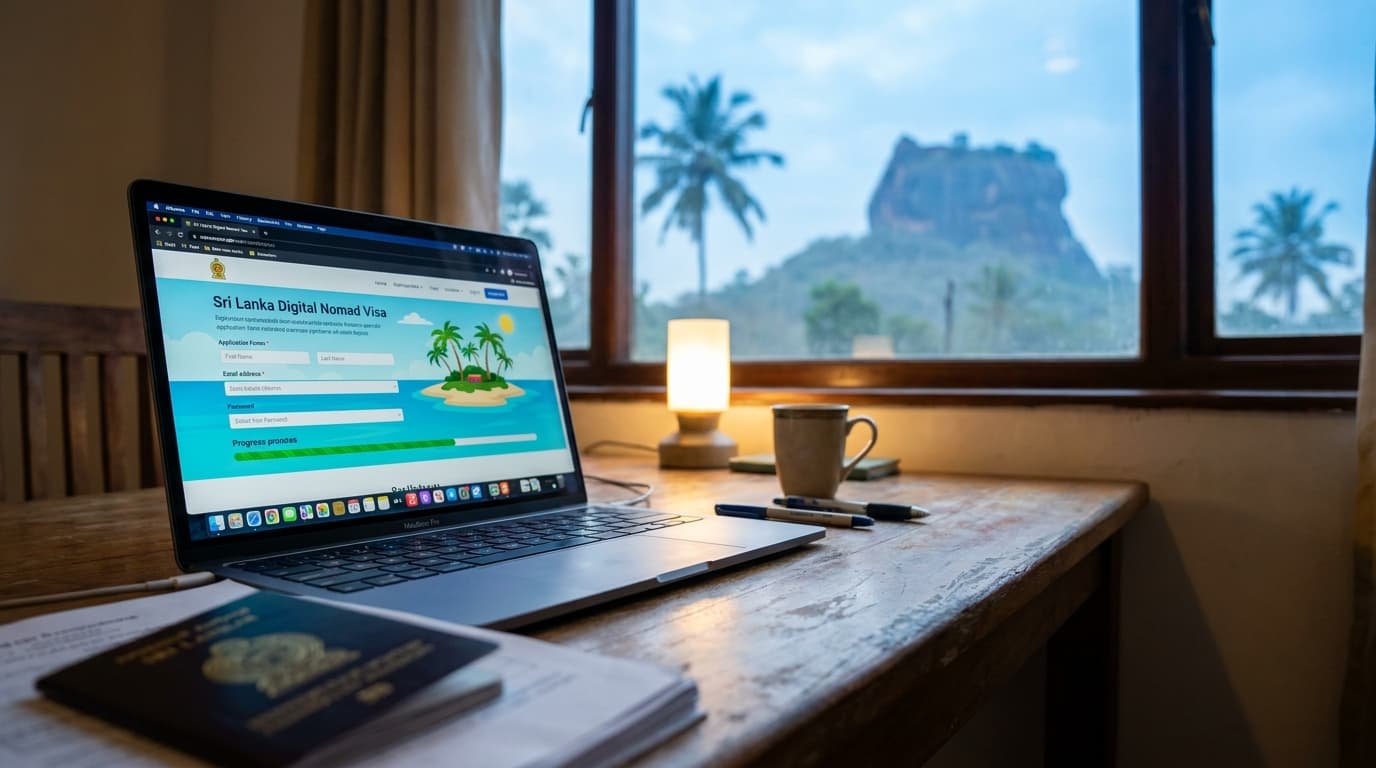
Sri Lanka Digital Nomad Visa — Sri Lanka

Visa Program Briefing

Sri Lanka Digital Nomad Visa

Sri LankaDigital Nomad Visa
Brandon Richards
Brandon Richards ·

Visa Data Sheet

Income Requirement
$2,000 / mo
Application Fee
$500
Maximum Stay
12 months
RenewableResidency PathRemote Work
The Full Briefing

Sri Lanka now has an official Digital Nomad Visa, run by the Department of Immigration and Emigration. It’s a one-year residence-type visa for foreign remote workers and it can be renewed if you still meet the conditions.

The visa is aimed at people earning foreign-sourced income, not anyone taking local work. The main applicant must be 18 or older, work remotely for clients or an employer outside Sri Lanka or own a business that isn’t registered in Sri Lanka and serves clients abroad.

The income rule is clear. You need to remit at least $2,000 a month into Sri Lanka. If you’re bringing more than two dependents, the requirement goes up by $500 a month for each extra dependent. The official factsheet also says you’ll need tax registration with Sri Lanka’s Inland Revenue Department for renewals.

This visa gives you more than a tourist stay. Holders can live in Sri Lanka legally for up to 12 months, open and maintain local bank accounts, sign rental or lease agreements and enroll dependent children in international or private schools. You can also join co-working spaces and use local internet and utility services without trying to squeeze everything through a short-stay visa.

The application is handled by the Residence Visa Division and follows a submission, evaluation and endorsement process. The official document list includes:

  • Application form: completed visa form and request letter
  • Identity documents: passport copy valid for at least 6 months and two recent passport photos
  • Family documents: marriage certificate for a spouse and birth certificates for dependents
  • Clearances: security clearance form, medical clearance report and a police clearance certificate issued within the last 3 months
  • Proof of coverage and income: international health insurance, recommendation from the Ministry of Digital Economy and proof of the required monthly remittance

The fee is $500 a year for the main applicant, spouse and each dependent. One annoyance, though, is that the public factsheet doesn’t spell out a fixed processing time, so you’ll need to work with the visa division on timing.

Rules are strict on local work. You can’t earn income from Sri Lankan sources and you’re expected to notify the department within 30 days if your employment, income or dependents change. If you want a clean, legal long stay, this is the right path. If you just want a quick visit, the tourist ETA is still the simpler option.

Sri Lanka’s Digital Nomad Visa is open to foreign nationals aged 18 and older who work outside the country. The official rule is pretty clear: you need remote employment, freelance income or ownership of a business that isn’t registered in Sri Lanka and that income has to come from foreign sources. Local jobs are off limits.

The income test is the main hurdle. The primary applicant must show at least $2,000 in monthly foreign remittances and if you bring more than two dependents, the requirement rises by $500 a month for each extra dependent. Spouse and dependents can be included under the same visa category.

There’s no nationality list in the official guidance I reviewed, so the visa appears to be open to foreign nationals generally, not just select passport holders. The government also doesn’t publish a fixed processing time in the materials I found, so don’t plan around a quick turnaround.

  • Visa fee: $500 per year for the main applicant, spouse and each dependent.
  • Validity: 1 year.
  • Renewal: Annual renewal is possible, but the extension file must include proof of tax registration through the Inland Revenue Department.

The document list is fairly long and some of it's administrative busywork. You’ll need a filled application form, request letter, passport copy valid for at least 6 months, two passport photos, marriage certificate for a spouse if applicable, birth certificates for dependents if applicable, a security clearance form, medical clearance, a police clearance certificate not older than 3 months, international health insurance, a recommendation from the Ministry of Digital Economy and proof of the required monthly remittance.

Applications go through the Department of Immigration and Emigration’s Residence Visa Division. If you’re missing the income trail or the tax registration proof for renewal, that’s where things are likely to stall.

Source 1 | Source 2

Sri Lanka’s Digital Nomad Visa now has a formal checklist and it’s more specific than the country’s older visit-visa routes. The visa is for foreign remote workers, freelancers and owners of businesses that aren’t registered in Sri Lanka, so local employment still isn’t allowed.

The main financial test is simple, but not especially cheap. You need proof of a minimum monthly remittance of $2,000 for the main applicant, sent in foreign currency into Sri Lanka. If you have more than two dependants, you’ll need an extra $500 a month for each one beyond that. There’s no separate savings threshold in the official rules.

The government’s fee schedule is also clear. It’s $500 per year for the main applicant, $500 per year for a spouse and $500 per year for each dependant. The official document doesn’t list a separate processing fee.

  • Visa application form: Duly filled out.
  • Request letter: From the applicant.
  • Passport copy: Valid for at least 6 months.
  • Photos: Two recent passport-sized photographs.
  • Civil documents: Marriage certificate for a spouse, birth certificates for dependants.
  • Security and background checks: Security clearance form and a police clearance certificate dated within the last 3 months.
  • Medical and insurance documents: Medical clearance report and international health insurance covering care in Sri Lanka.
  • Ministry recommendation: A recommendation from the Ministry of Digital Economy.
  • Income proof: Evidence of the required monthly remittance.

The police clearance timing matters. If your certificate is older than 3 months, it won’t meet the stated requirement. The official document doesn’t spell out apostille, legalization or translation rules, so don’t assume a foreign-language certificate will be accepted as-is.

Two other points are easy to miss. The main applicant must be at least 18 and the visa file is built around ongoing income, not a lump sum sitting in a bank account. In practice, that means bank transfers, contracts or payment records are likely to matter, even though the official text doesn’t lock applicants into one exact proof format.

Source 1 | Source 2

Sri Lanka’s Digital Nomad Visa has one clear government fee and it’s not cheap. The Department of Immigration and Emigration lists it at $500 per year for the main applicant, with the same fee charged for a spouse and for each dependent child.

That’s the only fixed visa cost the official category sheet gives. It doesn’t split the amount into application, processing or issuance charges and it doesn’t publish a separate biometrics fee for this visa category.

  • Main applicant: $500 per year
  • Spouse: $500 per year
  • Each dependent child: $500 per year

The fee is quoted in US dollars, not Sri Lankan rupees, so there isn’t a fixed local-currency figure to rely on. Any rupee amount will move with the exchange rate.

Budget for extra paperwork too. The visa application requires a medical clearance report, a recent police clearance certificate, international health insurance, passport photos, a passport copy and proof of remitted income, plus supporting documents for spouses and children where applicable. The immigration department doesn’t set prices for those items, so your real out-of-pocket cost will depend on the clinic, insurer and issuing authority you use.

  • Medical clearance: provider-set fee
  • Police clearance certificate: varies by country or issuing office
  • International health insurance: priced by insurer
  • Document copies and translations: variable, if needed

The visa is issued for one year and can be renewed, but the renewal also uses the same $500 per person annual fee. For extensions, the official document says applicants must also show proof of tax registration with the Inland Revenue Department. The form doesn’t list a separate tax-office fee, so any cost there would come from the registration process itself, not immigration.

On the income side, the visa also needs a minimum monthly remittance of $2,000 for the main applicant. If you’re bringing more than two dependents, you need an extra $500 per month for each additional dependent. That doesn’t change the visa fee, but it does change the budget you’ll need to qualify.

How to apply

Sri Lanka’s Digital Nomad Visa exists, but the public process is still a bit messy. The Department of Immigration and Emigration has confirmed the category as a residence visa for foreign remote workers, yet it hasn’t published a fully detailed public application page with a step-by-step form, fixed document checklist or clear filing route that works like the tourist ETA system.

That means some parts are confirmed and some are still being filled in. You should expect the application to be handled directly by the Department, with a formal request tied to your remote work status and income from outside Sri Lanka. A specific recommendation from the Ministry of Digital Economy is also part of the route.

What’s clear is the money side. The main applicant must show $2,000 a month in foreign-sourced income and the first two dependants are covered under that threshold. Each additional dependant needs another $500 a month. The government fee is $500 per applicant per year and the visa is issued for one year at a time, renewable if you still meet the rules.

  • Passport: valid for at least six months beyond your intended stay.
  • Income proof: bank statements, employment contracts or client agreements showing foreign earnings.
  • Employment proof: evidence that your employer or business is registered outside Sri Lanka.
  • Accommodation proof: a rental agreement, hotel booking or lease.
  • Health insurance: valid coverage for your stay.
  • Background checks: police clearance and medical clearance may be required.
  • Family documents: marriage certificates and birth certificates if you're applying with dependants.

How you file it still isn’t fully pinned down on the public side. The Department says new visas and extensions are processed directly by immigration, not private agents, but it hasn’t released a tidy public portal with the exact online workflow many applicants would want. If you’re planning to apply, build in time for back-and-forth and don’t assume it’ll be as simple as the ETA.

Renewals are annual and the visa doesn’t currently come with a published path to permanent residency or citizenship. If you’re trying to stay long term, that’s the part to watch closely, because the rules can still shift while the program settles in.

Duration & renewal

Sri Lanka’s Digital Nomad Visa is issued for 1 year and can be renewed annually. The official immigration material doesn’t give a separate cap on how many times you can renew it, so the clearest answer is simple, you can keep extending it year by year if you still qualify.

The annual fee is straightforward, but not cheap. The Department of Immigration and Emigration lists $500 per year for the main applicant, the spouse and each dependent, so families should budget for every person on the file, not just the primary visa holder.

  • Initial validity: 1 year
  • Renewal: annual
  • Main applicant fee: $500 per year
  • Spouse fee: $500 per year
  • Dependent fee: $500 per year, per dependent

Renewal isn’t just a fee payment. The immigration PDF says you’ll need proof of tax registration through the Inland Revenue Department, along with the same documents required for first issuance. That extra tax-registration step is the part that can trip people up if they leave it too late.

The official materials confirm that holders may live in Sri Lanka legally for up to 12 months at a time, then renew. They don’t spell out a maximum cumulative stay and they don’t publish a fixed number of renewals on the page we could verify. So while the visa is clearly built for repeat annual extensions, the long-game rules are still a little vague.

There’s also no confirmed official path from this visa to permanent residency or citizenship in the material reviewed. If you’re planning a multi-year stay, treat this as a renewable residence visa, not a stepping stone to settlement rights unless the government publishes a separate route later.

Sri Lanka’s digital nomad visa doesn’t appear to come with a special tax holiday. The tax treatment still follows the country’s general rules on residence and source of income, so the visa itself isn't a shortcut around the Inland Revenue Act.

The key split is simple. A resident is taxed on income wherever it arises, while a non-resident is taxed only on Sri Lanka-source income. The official tax materials don’t spell out a visa-based rule that automatically makes you tax resident, so holding the nomad visa alone isn’t enough to assume anything either way.

Foreign income needs a bit more care than that. The Inland Revenue Department says the old exemption for service exports and foreign-source income was removed effective 1 April 2025 and the current treatment now sits under the amended tax rules. The department also refers to a 15% treatment for certain foreign-currency receipts that are remitted through a bank to Sri Lanka, but the official guidance isn't written in a neat plain-English format.

If you’re from a country with a double tax treaty, that can change the picture. Sri Lanka has treaty arrangements with countries including Australia, Canada, China, France, Germany, India, Japan, Singapore, the U.K. and the U.S., which may help with withholding, residence tie-breaks or foreign tax credits. The exact outcome depends on your facts and your home-country rules.

  • Tax return filing: The Inland Revenue Department uses self-assessment.
  • Estimated tax statement: Due by 15 Aug. of the current year of assessment.
  • Tax return deadline: Due by 30 Nov. of the next year of assessment.
  • Registration: Taxpayers must register and file through the e-services system where applicable.

The blunt version, there’s no confirmed digital-nomad tax break here. If you plan to stay, work with the general residency rules, keep clean records of where your income comes from and don’t assume the visa status changes your tax position on its own.

Full Country Guide

Sri Lanka Digital Nomad Guide

Cost of living, internet, healthcare, coworking, and every visa option for Sri Lanka.

Stay Current

Visa rules change. We'll tell you.

Get notified about policy updates and new requirements for the Sri Lanka Digital Nomad Visa and other Sri Lanka visas.