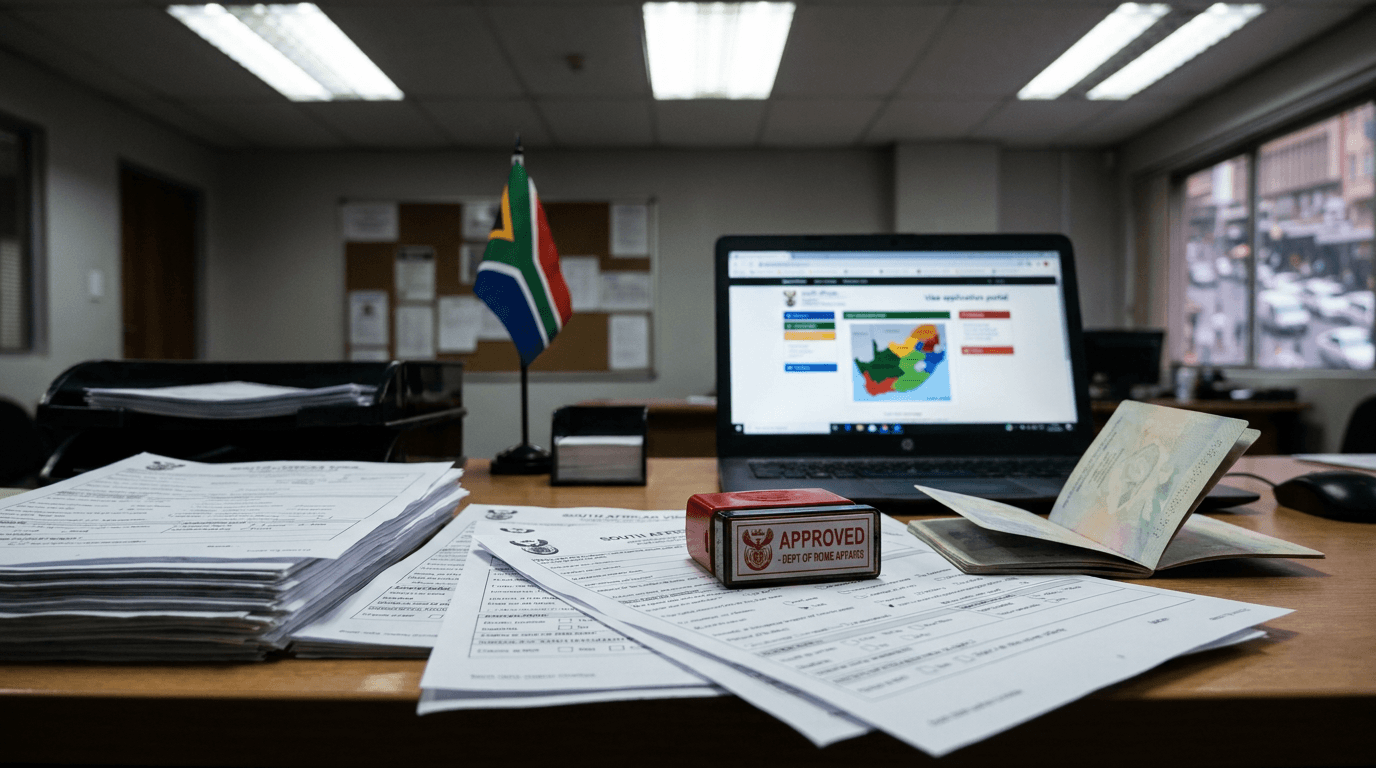
South Africa Financially Independent Permit
Visa Data Sheet
- $630,000 – $700,000 in savings
- $6,475 – $6,830
- 156 weeks
The Financially Independent Permit is South Africa’s permanent residence route for high-net-worth foreigners. It sits under section 27(f) of the Immigration Act, so this isn’t a visitor visa, a tourist stamp or a temporary work permit. If it’s approved, you get permanent residence straight away.
The financial bar is high and that’s the point. You need to prove a verifiable net worth of at least ZAR 12 million, then pay a once-off ZAR 120,000 fee to the Department of Home Affairs after approval. The permit is aimed at people who can support themselves through assets or income without relying on South African public funds.
It’s a clean fit for wealthy retirees, investors and globally mobile families who want to live in South Africa with fewer visa headaches. Spouses and dependent children can be included on the main application and they don’t have to meet the ZAR 12 million threshold on their own.
The upside is broad. Holders can live in South Africa indefinitely, work for any employer, run a business and study without needing a separate visa. The main limits are the obvious ones, you still can’t vote or get a South African passport just because you hold permanent residence.
This status is permanent, but it’s not bulletproof. It can lapse if you’re absent from South Africa for more than three consecutive years without written permission from the Department of Home Affairs and it can also be withdrawn for fraud, serious offending or other legal problems.
- Net worth: ZAR 12 million minimum, backed by documents such as bank statements, investment records, property valuations or audited financials.
- Outcome fee: ZAR 120,000, paid after approval and before the permit is issued.
- General checks: Police clearances, medical reports and radiological reports are part of the process, along with standard admissibility checks.
- Family members: Spouses and dependent children can be added to the same permanent residence application.
If you’re comparing it with South Africa’s temporary visas, the difference is simple. The Financially Independent Permit is a direct route to permanent residence, with full rights to live and work in the country, while visitor and remote-work visas are still temporary and tied to specific conditions.
The Financially Independent Permit is South Africa’s straight permanent-residence route for people who can prove real wealth, not just a healthy monthly income. The law sets one hard number: a net worth of at least ZAR 12,000,000. There’s no minimum age and no nationality restriction in the law, so any foreign national can apply if they meet the financial and general eligibility rules.
This isn’t a temporary visa and you don’t need to hold a South African permit first. If approved, you get permanent residence immediately, with the right to live, work, study and run a business in South Africa without extra authorisation. The permit can still lapse if you’re gone for too long or you break immigration or criminal laws, so “permanent” doesn’t mean bulletproof.
Family can come along. Spouses and dependent children may be included on the main application and they don’t have to prove the ZAR 12 million threshold themselves. The financial test sits entirely with the principal applicant.
What Home Affairs wants to see is proof that your wealth is real and independently verifiable. The official guidance points to documents such as:
- Bank statements: showing accessible funds and account history.
- Investment portfolios: with clear ownership and valuation.
- Property valuations: for assets you legally own.
- Audited financial statements: where you hold business interests.
- Other verifiable asset evidence: if it can be independently checked.
There’s no official monthly income requirement for this route and you don’t have to invest the money in South Africa. The key is net worth. Home Affairs also expects the usual permanent-residence basics: a valid passport, medical and chest X-ray reports, police clearances from countries where you’ve lived for 12 months or more in the past 5 years and a clean enough record that you’re not deemed prohibited or undesirable.
The fee structure isn't subtle. The main approval fee is a once-off ZAR 120,000 for the principal applicant, payable only after approval. The standard permanent-residence application fee still applies too, but the official sources don’t publish one fixed current figure for this category, so you’ll need to confirm that part before filing.
The South African Financially Independent Permit sits under Section 27(f) of the Immigration Act and the paperwork is a lot more formal than a standard visa file. DHA wants a clean paper trail that shows who you are, where your money came from and that your family links are real if they’re joining you.
The headline number is ZAR 12 million in net worth. That’s the threshold DHA uses for this permanent residence route and the application also comes with a separate permanent residence fee of R1,520. If the permit is approved, there’s a once-off Section 27(f) fee of R120,000.
The main applicant should prepare:
- DHA-947 application form: Completed online only, handwritten forms aren’t accepted.
- Passport and photo: A valid original passport and one recent passport-style full-face photograph for each applicant aged 1 and older.
- Identity documents: An unabridged birth certificate or extract from the birth record.
- Name or sex change proof: A deed poll, if applicable.
- Police clearances: Original certificates from every country where you lived for 12 months or more after age 18, issued within the past 6 months.
- Medical report: DHA medical form, not older than 6 months.
- Radiological report: Chest X-ray report, not older than 6 months, except for children under 12 and pregnant women.
Family documents matter too and DHA can be picky about them. If a spouse is joining you, bring a marriage certificate or proof of the relationship, plus divorce decrees or a death certificate if either of you was previously married. DHA also asks for proof of financial support between spouses, so don’t assume a marriage certificate is enough on its own.
For children, you’ll need proof of parental responsibilities and rights or an affidavit from the other parent or legal guardian. If only one parent is immigrating, DHA wants written consent from both parents, plus copies of the relevant ID or permanent residence documents where applicable.
There’s one more annoying bit. If you’ve travelled through a yellow fever endemic area, you may need a valid yellow fever vaccination certificate. DHA doesn't list a mandatory private health insurance document for this category, so don’t waste time trying to attach one unless your mission or VFS office asks for it separately.
The Financially Independent Permanent Residence route is still on the books, but the policy direction is muddy. The 2026 White Paper says government wants to replace or abolish it in future, so don’t assume the current rules will stay frozen for long.
Costs and fees
The one fee I could verify from official DHA material is the R120,000 once-off Home Affairs charge. It’s payable only after approval, not when you submit the application. The DHA form I reviewed doesn’t show a separate submission fee for this category, so any extra government charge you see quoted elsewhere should be treated cautiously.
Using a rough exchange range of R18.0 to R19.0 per $1, that comes out to about $6,316 to $6,667. The net-worth threshold of R12,000,000 is roughly $631,579 to $666,667 on the same basis. Those are estimates, not official conversion rates.
Budget for the usual paperwork costs too. DHA doesn’t set those prices, but most applicants still end up paying for the admin that comes with any serious residency filing.
- Police clearance certificates: from each country where you’ve lived for a year or more in the last five years
- Medical and radiology reports: including the TB-related checks required in the permanent residence process
- Translations, apostilles or notarisation: if your documents aren’t already in the right format
- Courier and copying costs: because the process is still annoyingly document-heavy
- Legal or immigration-agent help: optional, but many applicants pay for it
If you’re including a spouse or children, expect the bill to climb. The DHA form asks for dependent details and supporting documents where applicable, so family applications usually mean more paperwork and more expense.
There’s no official DHA fee published in the material I reviewed for health insurance on this route, so I wouldn’t treat that as a fixed government cost unless the mission or filing office handling your case says otherwise. The basic picture is simple, though, this isn’t an expensive filing fee with a few extras attached. It’s a high-net-worth residency route with a hefty post-approval charge and real document overhead.
How to apply
The Financially Independent Permit is a permanent residence application, not a temporary visa. You file it as a Section 27 permanent residence case through the Department of Home Affairs, usually with VFS Global or a South African mission abroad. You can’t switch into it from inside South Africa on a tourist stamp.
The money side is the big hurdle. DHA doesn’t publish a fixed net-worth figure online, but long-standing practice puts the threshold at ZAR 12 million in verifiable assets. That’s about $630,000 to $700,000, depending on the exchange rate. There isn’t a monthly income test for this route, because it’s about wealth, not salary.
- Core application form: Completed BI-947 permanent residence form.
- Passport: Valid passport with copies of the bio page and any current visas.
- Identity photos: Passport-sized photographs in the format requested by VFS or the mission.
- Police clearances: Certificates from each country where you’ve lived for 12 months or more in the last 5 years, after age 18.
- Medical checks: Medical and radiological reports, including the prescribed TB screening.
- Proof of funds: Documents showing your assets and net worth clearly.
The fee structure isn’t cheap. General permanent residence applications carry a DHA fee of about ZAR 1,520, plus a VFS service fee of about ZAR 1,550. Financially Independent cases also carry a separate once-off issuance fee of ZAR 120,000 before the permit is released. That fee is the part that catches people out.
Processing is slow. DHA doesn’t publish a firm turnaround time for this category and recent practitioner guidance puts adjudication anywhere from 24 to 36 months, with 4 to 5 years also being common. Plan for a long wait and don’t build travel plans around a quick approval.
Once approved, you get permanent residence status. That lets you live, work, study or run a business in South Africa without another visa, but you can lose the status if you stay away for more than 3 years at a time. It’s permanent residence, not a one-and-done passport stamp.
The Financially Independent Permit isn’t a temporary visa with a renewal date. It’s a permanent residence category under section 27(f) of the Immigration Act, so if you’re approved, you get indefinite residence in South Africa rather than a 1-year or 3-year clock to keep resetting.
That means there’s no normal renewal cycle and no routine re-check of your net worth. The permit is meant to last, though the Department of Home Affairs can still withdraw permanent residence if you stop meeting the rules that go with it.
What stays true after approval:
- Validity: The permit is valid indefinitely, with no fixed expiry date.
- Renewal: There isn’t a periodic renewal of the status itself.
- Fees: The once-off prescribed fee is ZAR 120,000, paid after approval and before issuance.
- Replacement: If your passport changes or the document is lost, you’d apply for a reissue or re-endorsement, not a new permit.
The real risk is absence. General permanent residence rules can be used to withdraw status after a continuous absence of about three years, though the official overview doesn’t spell that out on its short PR page. So if you plan to spend long stretches outside South Africa, don’t assume your status is safe just because it’s called “permanent.”
There’s also no maximum cumulative stay, because that’s the point of permanent residence. You don’t “extend” it the way you would a tourist or remote-work visa and there’s no official indication that you need to re-prove your assets later just to keep the permit alive.
If you eventually want citizenship, the permit can be part of that path. It doesn’t make you a citizen on its own, but it does give you permanent residence status that can support a later citizenship application once you meet the separate residence and good-conduct rules.
The Financially Independent Permit doesn’t come with a special tax break. It’s treated like any other permanent residence status for South African tax purposes, so your tax bill depends on whether SARS sees you as a South African tax resident.
If you are a tax resident, South Africa taxes you on worldwide income. If you are a non-resident, you’re taxed only on South African-sourced income. The permit itself doesn’t change that and there’s no separate FIP tax regime tucked into the immigration rules.
How SARS decides where you’re taxed
SARS applies the usual residency tests and they’re not based on your visa stamp alone. You can be a tax resident if you’re “ordinarily resident” in South Africa, which is a factual test based on where your real home is and where your life is centered. If that doesn’t apply, the physical presence test can still pull you into residency if you spend enough time in the country.
- Ordinarily resident: your settled home and main base of life is in South Africa.
- Physical presence: more than 91 days in the current tax year, more than 91 days in each of the five prior years and more than 915 days total over those five years.
- DTA override: a double-tax agreement can still treat you as non-resident if the treaty tie-breaker points to another country.
What that means for income
Residents are taxed on worldwide income, though foreign tax credits and treaty relief can reduce double taxation. South Africa also has a foreign employment income exemption for qualifying employees working outside the country, but it’s narrow and capped. Only the first **ZAR 1.25 million** of qualifying foreign employment income is exempt and you still need to meet the time-spent-abroad test.
Non-residents are taxed only on South African-source income, such as local rental income, South African employment income or income from a business carried on in the country. If you’re using the permit while spending limited time in South Africa and you stay outside the residency tests, that’s usually the cleaner outcome.
A few practical headaches
If your home country has a double-tax agreement with South Africa, don’t assume the first answer from immigration is the final one. Tax residency is a separate question and it can be messy if you split your time between countries. A cross-border tax adviser is worth paying for here, because getting it wrong can mean filing in the wrong place or owing tax twice before relief kicks in.
South Africa Digital Nomad Guide
Cost of living, internet, healthcare, coworking, and every visa option for South Africa.
Visa rules change. We'll tell you.
Get notified about policy updates and new requirements for the South Africa Financially Independent Permit and other South Africa visas.
