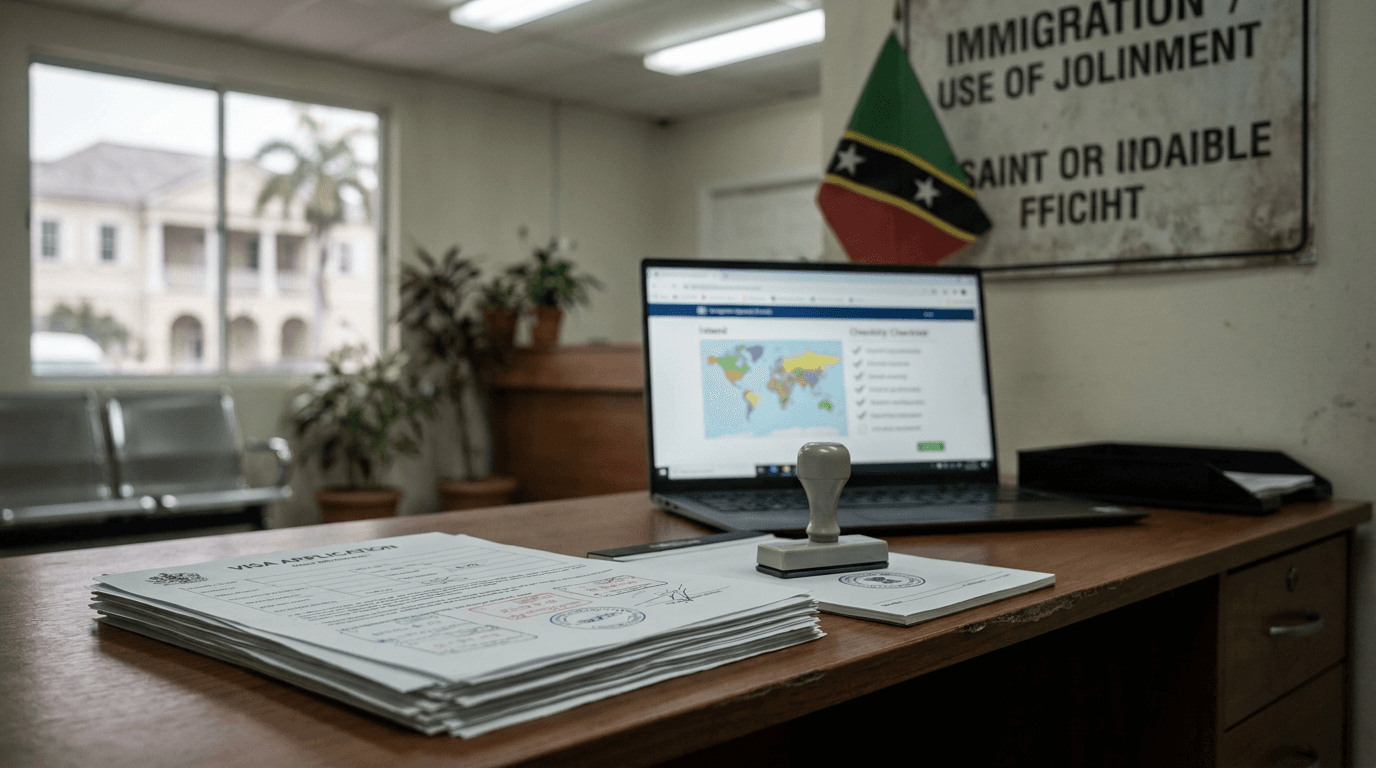
Saint Kitts and Nevis Digital Nomad Visa

Visa Data Sheet
- $9 – $100
- 2 weeks
- 3 months
Saint Kitts and Nevis doesn’t currently show a clearly confirmed, officially operating digital nomad visa on its government or immigration websites. That matters, because a lot of third-party pages talk about a “Remote Work Stay” or “Enhanced Remote Work Visa,” but the official record doesn’t back that up.
What the official sites do show is ordinary visitor entry, electronic travel and immigration forms and the usual work or residence routes. So if you’re planning a stay there, you should assume you’ll be entering as a regular visitor unless you qualify for a standard work or business category.
What this means in practice: remote workers are usually using visitor status, not a special nomad permit. Saint Kitts and Nevis also doesn’t publish a separate remote-work visa class with its own eligibility rules, fee schedule or application process on the main government channels.
- Short stays: many nationalities can enter visa-free for limited periods, depending on passport.
- Entry requirements: travelers are generally expected to have a passport with at least six months’ validity, onward or return travel, proof of accommodation and enough funds for the stay.
- Work: local employment or business activity normally points you toward business visa and work permit rules, not a digital nomad label.
There’s also a practical downside here. Because the country doesn’t publicly confirm a formal remote-work program, you can’t rely on blog posts or agent summaries as legal proof. If you’re earning from a foreign employer while visiting, that may be tolerated in practice, but it isn’t clearly blessed as a separate visa category.
Bottom line: if you’re a digital nomad, treat Saint Kitts and Nevis like a standard visitor destination unless official guidance says otherwise. Check the government portal, the Ministry of Foreign Affairs and the electronic travel form before you book anything, because that’s where the real rules show up.
There isn’t a government-run digital nomad visa for Saint Kitts and Nevis. That’s the first thing to get straight. If you want to live there while working remotely, you’re dealing with the usual visitor, eVisa and eTA rules, not a special nomad category with its own checklist.
Who can enter as a visitor
Many nationalities can enter visa-free for short stays, often up to 90 days in a six-month period, but the exact allowance depends on your passport. Travelers from countries that aren’t visa-exempt need a visitor visa, usually through the government’s eVisa system.
There’s also an eTA requirement for air and sea arrivals. The current fee is $8.50, rising to $17 from Sept. 1, 2025 and approval usually comes within 24 hours. You can apply up to three months before travel.
Who can stay while working remotely
The official government sites don’t spell out any remote-work rights for tourists, so don’t assume visitor status gives you a free pass. In practice, remote workers usually rely on foreign income and avoid local employment. Working for a Saint Kitts and Nevis company is a different matter and would need the right work authorization.
If you’re planning a longer stay, you may need a residence or work permit instead of treating a visitor stay as a long-term setup. That’s not a slick solution, but it’s the reality here because there’s no dedicated nomad framework.
What financial proof you’ll likely need
There’s no official digital nomad income threshold and the government doesn’t publish one. For visitor travel, though, you should expect to show that you can support yourself for the length of your stay.
- Passport: valid for at least 6 months beyond entry.
- Photos: two passport-size photos for visitor visa applications.
- Travel plans: round-trip or onward ticket.
- Accommodation: hotel booking or similar proof of where you’ll stay.
- Funds: bank statements or other proof of solvency.
Fees and timing
For non-exempt visitors, the standard visitor visa fee is $100 and the embassy guidance says processing takes about two weeks. That’s separate from the eTA, which is required before travel and isn't a visa.
So, who qualifies? Visitors who meet the normal entry rules, have enough money to support themselves and aren’t taking local jobs. If you were hoping for a clean digital nomad visa answer, Saint Kitts and Nevis doesn’t offer one right now.
There isn’t a dedicated, officially published digital nomad visa for Saint Kitts and Nevis. That means there’s no government-issued checklist for remote workers, no official income threshold and no published program fee for a so-called digital nomad route.
What remote workers actually use is the standard visitor system. Depending on your nationality, that can mean visa-free entry, an electronic travel authorisation, an e-visa or a regular visitor visa. The entry rules are simple on paper, but they’re not built for long-term remote work, so you need to stay inside the visitor rules and avoid local employment.
What you’ll usually need to enter
- Passport: At least six months of validity left and one blank page.
- eTA or visa: All air and sea passengers must complete the electronic travel authorisation before travel, unless their nationality follows a different entry route.
- Fee: The eTA is $8.50, rising to $17 from Sept. 1, 2025.
- Processing time: Approval is typically issued within 24 hours after online submission.
- Travel details: Return or onward ticket and a confirmed itinerary.
- Accommodation: Hotel booking, rental confirmation or host invitation.
- Funds: Recent bank statements or other proof you can support yourself. There’s no official minimum balance published.
For a visitor visa, officials commonly ask for two passport photos and a visa fee of around $100 in many cases. That’s a general visitor requirement, not a digital nomad rule. The government hasn’t published a separate document list for remote workers, so any blog claiming a fixed set of nomad papers is guessing.
If you’re planning to work for a local employer
That’s a different case. You’d normally need a work permit, not a visitor entry and the paperwork gets heavier fast. Standard work-permit requests can include a support letter from the employer, a police record from your country of residence and medical tests, including tuberculosis and syphilis screening.
What isn’t officially required for visitors
- Health insurance: Recommended, but not listed as a mandatory entry condition on the official or U.S. government guidance reviewed.
- Police certificate: Not required for ordinary short-stay visitors, though it can be required for work permits.
- Apostille or translation: No general digital nomad rule is published.
- Fixed stay length: No official digital nomad validity period exists because there’s no official digital nomad category.
If you want to stay longer, you’ll need to use the normal residence or work channels. There isn’t a separate remote-work track to extend.
Saint Kitts and Nevis doesn’t have a dedicated digital nomad visa, so there’s no official fee schedule for a remote-work stay program. If you’re working remotely from there, you’ll usually be using the normal visitor route, either visa-free if your passport qualifies or a standard visitor e-visa.
The main government fee you’re likely to face is the visitor visa itself. The official fee quoted by the Embassy of Saint Kitts and Nevis to the United States is $100 and the embassy says processing takes about two weeks. That fee is stated in U.S. dollars and the government doesn’t publish a separate digital-nomad charge.
- Visitor e-visa fee: $100 per applicant.
- Approximate local equivalent: about 270 XCD, using a rough market rate of 1 USD to 2.70 XCD.
- Visa-free entry: $0 for the visa itself, if your nationality is exempt and you stay within the allowed period.
If you need a visa, each dependent would usually need their own visitor visa too, at the same $100 fee per person. There’s no official family package, discounted dependent rate or bundled digital-nomad pricing because there isn’t a formal program to begin with.
Insurance is another real cost, even though the government doesn’t publish a minimum coverage requirement for remote workers. Most nomads buy their own international health or travel medical policy and that can run anywhere from a few hundred dollars to more than $1,000 a year depending on age and coverage. That’s a market cost, not a Saint Kitts and Nevis government fee.
Document translation, notarization and apostilles can also add up if you’re dealing with any paperwork outside a basic visitor trip. The official visitor guidance focuses on a valid passport, photos, return or onward tickets, proof of accommodation and proof of funds. It doesn’t list a separate translation fee and it doesn’t say you need extra legalization for ordinary tourist entry.
Bottom line, there’s no special digital nomad price tag here. If you qualify for visa-free entry, your direct visa cost is zero. If you need the visitor visa, plan on $100 per person, then budget separately for insurance and any document handling you may need.
There isn’t a government-backed digital nomad visa for Saint Kitts and Nevis, so there’s no special application path to follow for remote workers. If you want to stay there while working for an employer or clients abroad, you’ll need to use the standard entry route, usually visa-free entry if your nationality qualifies or a regular visitor visa if it doesn’t.
That matters because the official paperwork is for ordinary visitors, not remote workers. The government doesn’t publish a digital-nomad-specific form, fee schedule, income threshold or processing workflow and private blogs that claim otherwise aren’t backed by official sources.
How the standard application works
- Check your entry rule: first confirm whether your nationality is visa-free or visa-required through the government’s visa information pages.
- Gather the usual visitor documents: a valid passport with at least 6 months’ validity beyond your entry date, a completed online application, recent passport photos, return or onward tickets, proof of accommodation and proof of sufficient funds.
- Apply online: visa-required travelers submit their application through the official e-visa portal, not in person in Saint Kitts and Nevis.
- Pay the fee: the verified visitor e-visa fee is $100.
- Wait for a decision: the Embassy of Saint Kitts and Nevis in Washington says processing takes about two weeks.
- Travel with your approval: bring the confirmation letter, passport, return ticket and accommodation details for inspection on arrival.
You may also need to complete the electronic travel authorisation or electronic declaration through the official travel form portal or app before you fly. That’s separate from the visa process and it’s being used as the standard travel-entry system.
One thing you won’t find is a fixed minimum income requirement for remote workers. The official guidance only says you need sufficient funds for your stay, so if you were hoping for a clean digital-nomad checklist, Saint Kitts and Nevis doesn’t currently have one.
Saint Kitts and Nevis doesn’t have a clearly confirmed, currently operating digital nomad visa in official government sources, so there’s no verified renewal rule, validity period or extension path for a dedicated remote-work permit. That’s the frustrating part: private sites talk about a “Remote Work Stay” program, but the government hasn’t published a matching framework that can be checked line by line.
If you’re looking for something you can actually rely on, the country’s official visitor route is the closest fit for a short stay. Eligible visitors can stay up to 6 months visa-free, depending on nationality and everyone needs an Electronic Travel Authorisation before travel. If you want to remain longer, you have to apply for an extension with the Immigration Department and pay for it. The public guidance doesn’t give a fixed maximum extension period, so there’s no clean published cap on cumulative stay.
The other official route is a work visa and work permit tied to employment in Saint Kitts and Nevis. That route is built for people working for a local employer, not remote workers paid from abroad. Official government guidance explains the process in broad terms, but it doesn’t publish a clear validity period or renewal schedule on the page itself.
- Digital nomad visa: no officially verified duration or renewal rules are published.
- Visitor stay: up to 6 months for eligible nationalities, with extensions handled by Immigration.
- Work visa: tied to a Saint Kitts and Nevis employer, with renewal details not clearly posted in the official guidance.
On the path to longer-term status, a nomad-style stay doesn’t appear to lead anywhere automatic. There’s no official evidence that a remote-work stay, if one is being offered informally, counts toward permanent residency or citizenship. Saint Kitts and Nevis does have a separate citizenship-by-investment route, but that’s a different program entirely and it doesn’t depend on a digital nomad visa.
Saint Kitts and Nevis doesn’t charge personal income tax, so remote work income isn’t taxed locally, whether it comes from a foreign employer, freelance clients or self-employment. There’s no special digital-nomad tax regime either. If a remote-worker visa exists in practice, it doesn’t appear to come with any separate tax break or tax penalty.
That said, the country isn’t tax-free in every sense. You can still run into VAT, property tax and withholding tax on some Saint Kitts and Nevis source investment income. The standard VAT rate is 17% and that can affect your day-to-day spending, even if your salary is earned abroad.
For remote workers, the main issue is usually not local income tax. It’s your home country. Many countries tax residents on worldwide income, so you may still owe tax somewhere else even if Saint Kitts and Nevis doesn’t tax you.
What to watch for
- VAT: Applies to most goods and services.
- Property tax: Due annually if you own real estate.
- Withholding tax: Generally 15% on certain dividends, interest or royalties paid from Saint Kitts and Nevis to non-residents.
- Double-taxation treaties: The country has agreements with Canada, Denmark, Monaco, New Zealand, Norway, San Marino, Sweden, Switzerland, the United Kingdom and the United States.
There’s also a practical reporting angle. The Inland Revenue Department says individuals are only issued a tax identification number if they register for a licence or become liable for taxes it administers, such as property tax, VAT or business-related taxes. Simply living there and working remotely for foreign clients doesn’t appear to create a local income-tax filing duty on its own.
If you start renting property, running a local business or earning Saint Kitts and Nevis source income, the picture changes fast. Short-term rental income, for example, has been flagged by the tax authorities as reportable and subject to local tax treatment. That’s where getting local advice stops being optional.
How It Compares
More Saint Kitts and Nevis programs
| Program | Country | Income / month | Fee | Max stay | Renewable |
|---|---|---|---|---|---|
| Saint Kitts and Nevis Citizenship by Investment | Saint Kitts and Nevis | $250,000-800,000 saved | $10,250 | - |
Similar visas elsewhere
| Program | Country | Income / month | Fee | Max stay | Renewable |
|---|---|---|---|---|---|
| Slovenia Digital Nomad Visa | Slovenia | €3,391/mo | €50↓ | 12 mo | |
| Belize Work Where You Vacation Program | Belize | $75,000-100,000/yr | BZD 200-500 | 6 mo | |
| Kazakhstan Neo Nomad Visa | Kazakhstan | $3,000/mo | £170 | 12 mo | |
| Bahamas Digital Nomad Visa | Bahamas | - | $25↓ | 12 mo |
Saint Kitts and Nevis Digital Nomad Guide
Cost of living, internet, healthcare, coworking, and every visa option for Saint Kitts and Nevis.
Visa rules change. We'll tell you.
Get notified about policy updates and new requirements for the Saint Kitts and Nevis Digital Nomad Visa and other Saint Kitts and Nevis visas.