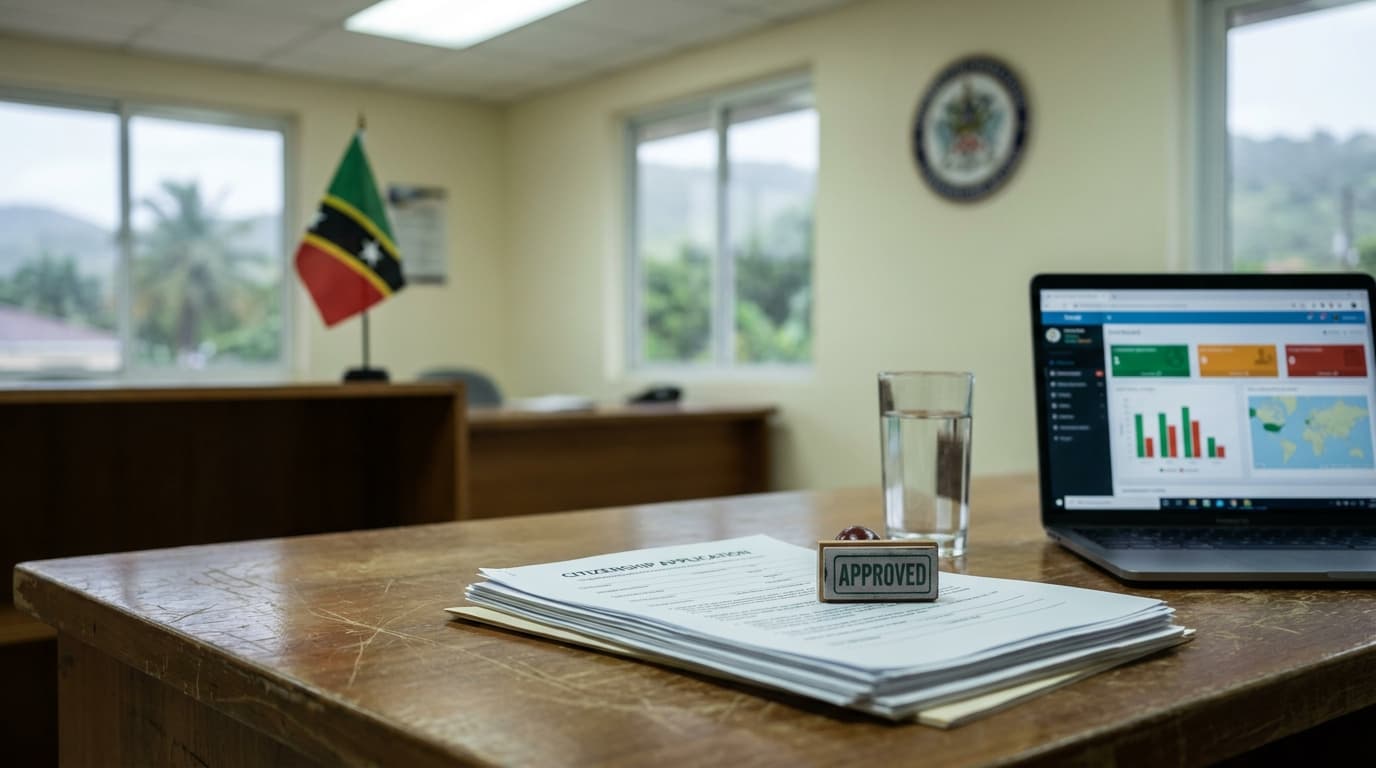
Saint Kitts and Nevis Citizenship by Investment

At a Glance
- $250,000 one-timenon-refundable SISC contribution; covers a main applicant or a family of up to four · main applicant or family of up to four
- $10,000 one-timenon-refundable due diligence fee, all options · main applicant
- 180 daysdecision or status update within 120 to 180 days of acknowledgment of a complete application
- Yesspouse and qualifying dependents
- Grants citizenship directly, for life, with no residence requirement
Last checked Oct. 8, 2026
Saint Kitts and Nevis Citizenship by Investment grants citizenship to people who make an approved investment or contribution. It is not a visa or a residence permit. The program is active and is run by the Citizenship by Investment Unit (CIU).
What it gives: Grants citizenship directly, for life, with no residence requirement.
The CIU lists these routes on its options page:
- Sustainable Island State Contribution (SISC): a non-refundable contribution of $250,000 for a main applicant or a family of up to four.
- Public Benefit Option: $250,000 in a unit of an approved public benefit project.
- Approved real estate: $325,000 per main applicant in an approved development, resaleable after 7 years.
- Private home: $600,000 for a single-family private residence.
The CIU cut both real estate minimums in late 2024 (CIU release of Oct. 29, 2024), so older figures on agent sites are out of date.
The program suits investors who want a second citizenship. Remote workers who only want to spend a few months on the islands enter as visitors instead: see remote work as a visitor.
There is no income test and no requirement to live on the islands. Eligibility turns on making a qualifying investment and passing the CIU's due diligence checks.
- Main applicant: must choose one of the approved routes and pass due diligence and an interview. The CIU says each main applicant is interviewed by an independent professional firm the Unit commissions.
- Family: Yes. A spouse and qualifying dependents can join the same application. Under the SISC, the base contribution covers a family of up to four.
- Extra dependents (SISC): $25,000 for each additional dependent under 18 and $50,000 for each additional dependent aged 18 or older.
- Interviews for dependents: dependents aged 16 or older may also be called for interview at the Unit's discretion.
The CIU can refuse any applicant who does not clear due diligence. The exact rules on which children, students and parents count as dependents are set by the CIU, so families should confirm them with an authorized agent before paying anything.
The CIU sets the forms and supporting documents, and an authorized agent assembles and submits them (SISC page). The file has to show where the investment money comes from and clear the CIU's background checks on every applicant aged 16 or older.
- Due diligence: $10,000 for the main applicant and $7,500 for each dependent aged 16 or older.
- Interview: required for each main applicant; dependents aged 16 or older may be asked to attend.
- Biometrics: since April 14, 2026, every citizen by investment, dependents and children included, must complete biometric enrollment for the new passport. The CIU home page gives the deadline.
The agent confirms the exact documents, translations and formats the Unit accepts for each family member.
All government amounts are set in US dollars (SISC, real estate and private home pages).
- SISC contribution: $250,000 one-time for a main applicant or a family of up to four, plus $25,000 per extra dependent under 18 and $50,000 per extra dependent aged 18 or older.
- Public Benefit Option: $250,000 one-time.
- Approved real estate: $325,000 per main applicant, plus a post-approval government fee of $25,000 for the main applicant.
- Private home: $600,000, with the same post-approval fee for the main applicant.
- Due diligence: $10,000 for the main applicant and $7,500 for each dependent aged 16 or older.
Agent and legal fees are set privately and are not part of the government schedule. Translations, police certificates and courier costs come on top. A written quote from the agent for the exact family and route is the only reliable all-in figure.
Applications cannot be filed directly with the government. The CIU requires the forms and documents to be submitted through an authorized agent chosen by the applicant (SISC page).
- Choose a route: SISC, Public Benefit Option, approved real estate or a private home.
- Appoint an authorized agent: the agent prepares the file and pays the due diligence fees with the submission.
- Due diligence and interview: the CIU checks every applicant aged 16 or older and interviews the main applicant.
- Decision: the CIU says it decides within 180 days of acknowledging a submission.
- Investment and citizenship: after approval the applicant completes the investment and pays any post-approval fees, then receives citizenship and can apply for a passport.
Citizenship granted under the program has no expiry date and no renewal. The CIU describes it as lifetime citizenship with dual citizenship allowed and no residency requirement, so there is no minimum number of days to spend on the islands.
- Status: citizenship for life.
- Stay: unlimited, as for any other citizen.
- Renewal: none for the citizenship; the passport is renewed as a travel document when it expires.
- Real estate investors: the property can be resold only after 7 years.
Every citizen by investment must also complete the biometric enrollment that began on April 14, 2026 to receive a new-style passport.
No personal income tax on individuals (abolished in 1980), so no day-count residence test applies to personal income. Citizenship by investment does not change that and does not create any special tax regime (SKNIS, Nov. 17, 2020).
Local taxes still apply to companies and to spending: a business run through a Saint Kitts and Nevis company is taxed as a company, and value added tax applies to most purchases. Property owners should check property tax with the Inland Revenue Department.
The larger question for most investors is their other tax home. Many countries tax residents or citizens on worldwide income, and a second passport does not end that duty. Advice in the country of residence comes first.
Frequently Asked Questions
How much does Saint Kitts and Nevis citizenship by investment cost?
The lowest routes are the Sustainable Island State Contribution at $250,000 for a main applicant or a family of up to four and the Public Benefit Option at $250,000. Due diligence adds $10,000 for the main applicant and $7,500 for each dependent aged 16 or older.
What is the minimum real estate investment?
$325,000 per main applicant in an approved development, or $600,000 for a private home. Approved units can be resold after 7 years, and a post-approval fee of $25,000 applies to the main applicant.
How long does the application take?
The CIU says it decides within 180 days of acknowledging a submission. Gathering documents before filing takes extra time.
Is there an interview?
Yes. Each main applicant is interviewed by an independent firm the CIU commissions, and dependents aged 16 or older may also be asked to attend.
Do citizens by investment have to live in Saint Kitts and Nevis?
No. Grants citizenship directly, for life, with no residence requirement.
How It Compares
More Saint Kitts and Nevis programs
| Program | Country | Income | Fee | Max stay | Renewable |
|---|---|---|---|---|---|
| Saint Kitts and Nevis Digital Nomad Visa (Not Available) | Saint Kitts and Nevis | - | - | - | - |
Similar visas elsewhere
| Program | Country | Income | Fee | Max stay | Renewable |
|---|---|---|---|---|---|
| Egypt Citizenship by Investment | Egypt | $250,000 saved | $10,000 | - | |
| Antigua and Barbuda Citizenship by Investment | Antigua and Barbuda | - | $10,000 | - | - |
| Malta Permanent Residence Programme (MPRP) | Malta | €375,000 saved | €60,000 | 60 mo | |
| Dominica Citizenship by Investment | Dominica | $200,000 saved | $1,000↓ | - |
Saint Kitts and Nevis Digital Nomad Guide
Cost of living, internet, healthcare, coworking, and every visa option for Saint Kitts and Nevis.
Visa rules change. We'll tell you.
Get notified about policy updates and new requirements for the Saint Kitts and Nevis Citizenship by Investment and other Saint Kitts and Nevis visas.