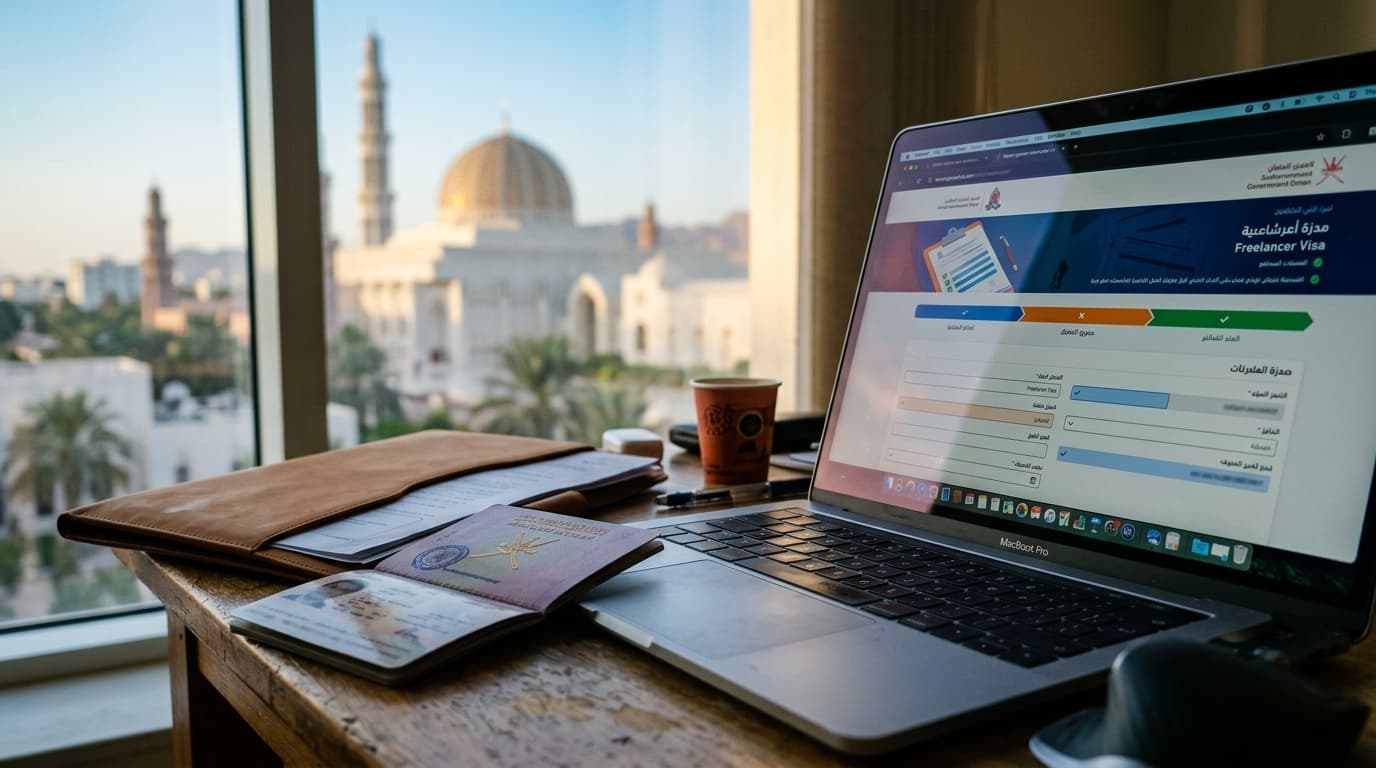
Oman Freelancer Visa — Oman

Visa Program Briefing

Oman Freelancer Visa

OmanFreelance Visa
Brandon Richards
Brandon Richards ·

Visa Data Sheet

Application Fee
$52
Maximum Stay
24 months
RenewableResidency PathRemote Work
The Full Briefing

Oman doesn’t publish a clearly defined freelancer visa for foreign nationals. That’s the main thing to understand before you start comparing agents or relocation blogs, because most of the “freelance visa” talk you’ll see online appears to be a label for existing work, residence or investor routes rather than a separate government-backed category.

On the official side, Oman’s portals deal mainly with employer-sponsored work visas, residence permissions and investment-based residency. The Royal Oman Police says work visas are issued at the request and under the responsibility of an Omani employer, so if you’re self-employed, the system doesn’t give you a neat standalone permit to point to.

That leaves three realistic paths for remote professionals:

  • Employer-sponsored work visa: tied to an Omani company and intended for people actually working for a local employer.
  • Investor or entrepreneur route: linked to business or residency structures, including Golden Residency options.
  • Private “freelance visa” arrangements: often marketed by consultants, but they don’t appear to be a separate visa class in official public rules.

That matters because the paperwork isn’t the same as a tourist visa. Work and residence permissions usually involve labour clearance, medical checks and other compliance steps and they’re meant for long-term stay and economic activity, not a quick remote-work trial run. If a provider can’t explain which official category the application sits under, be skeptical.

The official government position is pretty straightforward, even if the market language isn’t. There’s no published standalone digital-nomad or self-employment visa for foreign nationals, so any real application will almost certainly pass through existing immigration channels, not a special freelancer product.

What’s not publicly verified: fees, income thresholds, validity periods and renewal rules for a true freelancer visa. Those details may be advertised by private firms, but they aren’t clearly set out in the official immigration material, so treat them as unconfirmed unless they’re tied to a named visa category from the Royal Oman Police or another government authority.

Oman doesn’t publish a standalone freelancer visa on its official immigration or eVisa portals. That’s the plain truth, even if private agents market something under that name. In practice, foreign workers usually fall into employer-sponsored work visas or investor and entrepreneur residence routes.

That matters because the rules are different. Tourist entry through the Royal Oman Police eVisa system is one thing, but work and residence permissions involve labour clearance, medical checks and other compliance steps and they’re meant for longer-term stay and economic activity.

For a standard work visa, the official requirements are stricter than most people expect. The applicant must be at least 21 years old, the job has to match a pre-approved work permit from the Ministry of Labour and the applicant needs a valid passport plus any required medical examination.

  • Age: At least 21.
  • Job match: The role must align with the pre-approved work permit.
  • Passport: Valid passport required.
  • Medical checks: Required where applicable, with nationality-specific rules for some countries.

For people who want to work for themselves, the government’s published routes point more toward investment, business ownership or qualifying property, not a true self-employment visa. That means the deciding factor isn’t “freelancer” status, it’s whether you fit a work permit or an investment-based residence category.

There isn’t a verified official list of freelancer-specific eligibility rules, income thresholds, client restrictions or family eligibility. So if an agent promises fixed requirements for an “Oman freelance visa,” treat that carefully unless they can show you the exact government basis for it.

If you’re trying to qualify, the safest assumption is this: you’ll need to fit either a proper employer-sponsored work visa or an investment-style residence path. Anything else is marketing until the government publishes a clear category with its own rule set.

Source

Oman doesn’t publish a standalone freelancer visa for foreign nationals. What private agents call an "Oman freelance visa" appears to be a regular work or residence route, usually tied to labour clearance or an investment-linked residency path. That means the paperwork isn’t as neat as the marketing makes it sound.

For anyone coming to work, the official requirements line up with the standard work visa process through the Royal Oman Police and related authorities. The public portals don’t list a separate checklist for a self-employment visa and they also don’t give a verified freelancer-specific rule set for income, client contracts or portfolio evidence.

Documents the official work visa process asks for

  • Completed application form: Submitted electronically.
  • Passport: Valid for at least 6 months.
  • Passport-sized photos: Recent and suitable for official use.
  • Ministry of Labour work permit: Required before the visa stage.
  • Medical certificate: Needed for nationals of certain countries, with attestation from the Ministry of Health.
  • Professional approvals: Required for regulated jobs such as teaching, medical and religious roles.

If you’re looking at an investment-based route instead, the document load shifts toward proof of investment and case management through the relevant government platform. The public summary doesn’t spell out a full document list, so you’ll need to check the requirements inside the application itself.

What’s still unclear

There’s no official public source that confirms a fixed fee, income threshold, processing time or renewal rule for a freelancer-branded visa. So if a consultant gives you a neat package with exact numbers, treat it carefully unless they can show you the underlying government approval path.

That’s the annoying part. Oman may be open to remote workers and self-employed professionals, but the formal route still looks more like a standard work or residency file than a true nomad visa. If you want to apply, start by lining up the labour permit and passport documents first, because that’s where the official process begins.

Source

Oman doesn’t publish a standalone freelancer visa with its own fee sheet and that’s the first thing to keep in mind. What private agents call an "Oman freelance visa" usually appears to be a standard work or residence route or an investor and entrepreneur path processed through the Royal Oman Police and related authorities.

That means the clean, official pricing picture is thin. The government’s work-visa service page lists a 20 OMR issuance fee for a standard work visa, but it doesn’t break out separate charges for a freelancer category, nor does it publish a freelancer-specific tariff on the eVisa portal.

  • Work visa issuance fee: 20 OMR for the standard work visa route.
  • Freelancer-specific fee: not officially published.
  • Medical checks and insurance: required in the broader work and residence process, but no official fee range is listed.
  • Service or admin charges: possible, but not itemized on the public pages we could verify.

Because the published material doesn’t describe a separate freelancer program, there’s no official answer for the full cost of a self-employment setup, either. That includes things like renewal fees, dependant charges and any profession-based pricing. If a consultant gives you a neat flat rate, ask them to show exactly which visa route they’re using.

The bigger point is that Oman treats work permissions differently from tourist visas. Work and residence routes are tied to labour clearance, medical checks and compliance steps, so they’re built for longer stays and economic activity, not casual remote work on a short visitor entry.

For budgeting, the safest move is to plan around the official work-visa fee plus whatever a sponsor, agent or medical provider charges you separately. If you’re exploring an investor or entrepreneur residence instead, the public-facing material focuses more on the investment route than on a line-by-line fee list, so you’ll need a direct quote before you commit.

There isn’t a separate, officially published “freelancer visa” category for foreign nationals in Oman. What people call an Oman freelancer visa is usually a work visa, residence permit or an investor route handled through the Royal Oman Police and, in many cases, the Ministry of Labour. That means the process is less plug-and-play than the name suggests and the paperwork depends on which route you’re actually using.

If you’re trying to stay in Oman as an independent worker, don’t assume the tourist eVisa is enough. Tourist permissions are for short visits. Work and residence permissions are for longer stays and economic activity and they come with labour clearance, medical checks and other compliance steps.

How the official process works

The official work-visa route is employer-led. An Omani employer submits the work permit request, then the visa is handled through the Royal Oman Police visa system once the permit side is cleared. The government portal describes this as a submit, review and issue process, not as a standalone freelancer application.

The ROP online visa service also covers residence visa renewals. For renewals, the portal says you submit the online form, pay the fee online, print the form and present it with supporting documents at an ROP visa office. It doesn't publish a separate workflow for self-employed applicants.

  • Application path: Employer-sponsored work visa, residence renewal or an investment and residency route
  • Who applies: Usually the employer or sponsor, not the freelancer alone
  • Checks involved: Labour clearance, medical checks and other standard compliance steps

What you can’t verify from the official portals

There’s no official government page that sets out a distinct freelancer visa with its own fee schedule, income threshold, validity period or renewal rule. Private agents may advertise one, but the underlying permission still appears to be a standard work or residence visa or an investor or entrepreneur permit. So if someone quotes you a neat package price, treat it cautiously unless they can point to the actual official route being used.

If you want the cleanest path, ask which category you’re being filed under, who the sponsor is and which authority is issuing the approval. Those details matter more than the marketing name.

Oman doesn’t publish a separate, official “freelancer visa” with its own rulebook. What people call an Oman freelance visa is usually a work or residence route handled through the Royal Oman Police or an investor or entrepreneur pathway if the applicant is setting up a business. That matters, because the rules aren’t the same as a simple tourist stay.

The clearest published duration is for the standard work visa. The Royal Oman Police says it’s valid for up to two years from the date of stamping and it’s issued as a multi-entry visa. Renewal is possible, but it depends on staying compliant with labour and immigration rules. The government portal ties that visa to employer sponsorship and a work permit, so it doesn’t function like a standalone self-employment permit.

For actual freelancers, the annoying part is that the official duration, renewal cycle and fee structure for a freelance-branded visa aren’t clearly published. If an agent is selling you a “self-employment visa,” ask what the underlying legal category is. In many cases, you’re looking at a standard work visa, investor residency or another sponsored residence route, not a distinct freelancer product.

  • Work visa duration: Up to 2 years from stamping
  • Visa type: Multi-entry
  • Renewal: Allowed, subject to labour and immigration compliance
  • Freelancer-specific term: Not officially published

Longer stays are possible through investor and Golden Residency programs and those can run for up to 10 years. But those are clearly framed as investment-led residence options, not a generic freelance visa. They don’t appear to give freelancers a special shortcut to permanent residence or citizenship either.

If you’re planning to stay beyond a short visit, build your timeline around the visa category you can actually qualify for, not the label a consultant uses in marketing. For anything tied to work, expect clearance, medical checks and sponsor paperwork. The official portals don’t give freelancers a clean, separate renewal path, so you’ll want to confirm the exact status before you commit.

Source 1 | Source 2

Oman doesn’t publish a clean, standalone freelancer or self-employment visa for foreign nationals. The official immigration and eVisa portals still point most long-term work cases toward employer-sponsored work visas or investment and entrepreneur routes, so the thing private agents call an "Oman freelance visa" is usually a standard residence or work permission dressed up with better marketing.

That matters because the paperwork isn’t the same as a tourist visa. Work and residence routes normally involve labour clearance, medical checks and other compliance steps and they’re meant for longer stays tied to economic activity, not casual remote work. If an agency promises a fast, simple freelancer permit with a fixed rulebook, be skeptical. The public government pages don’t back that up.

Fees, validity periods, renewal rules and income thresholds for a true freelance category can’t be verified from official sources because no such category is clearly published. That leaves a lot of the usual sales pitch in limbo, so you should treat any quoted package price as an agent’s estimate, not an Omani government fee schedule.

What this means for tax: Oman’s visa and residence portals don’t set out a special tax regime for freelancers and they don’t publish visa-specific tax treatment for foreign-earned income. There’s no official sign of a reduced tax rate just because someone is on a freelance or self-employment route.

  • No dedicated tax perk: The public sources don’t describe a freelancer-only tax break.
  • General tax law applies: Any Omani tax obligations would likely fall under the normal tax rules, not a special visa label.
  • Double-tax rules may matter: If your home country has a treaty with Oman, that could affect what you owe, but it’s not spelled out on the visa pages.
  • Local advice is smart: A tax adviser or the relevant Omani authority should confirm residency status and reporting duties before you rely on any online promise.

If you’re planning to live in Oman while earning from abroad, don’t assume the visa category answers the tax question. It usually doesn’t and Oman’s official pages don’t give freelancers a shortcut there.

Full Country Guide

Oman Digital Nomad Guide

Cost of living, internet, healthcare, coworking, and every visa option for Oman.

Stay Current

Visa rules change. We'll tell you.

Get notified about policy updates and new requirements for the Oman Freelancer Visa and other Oman visas.