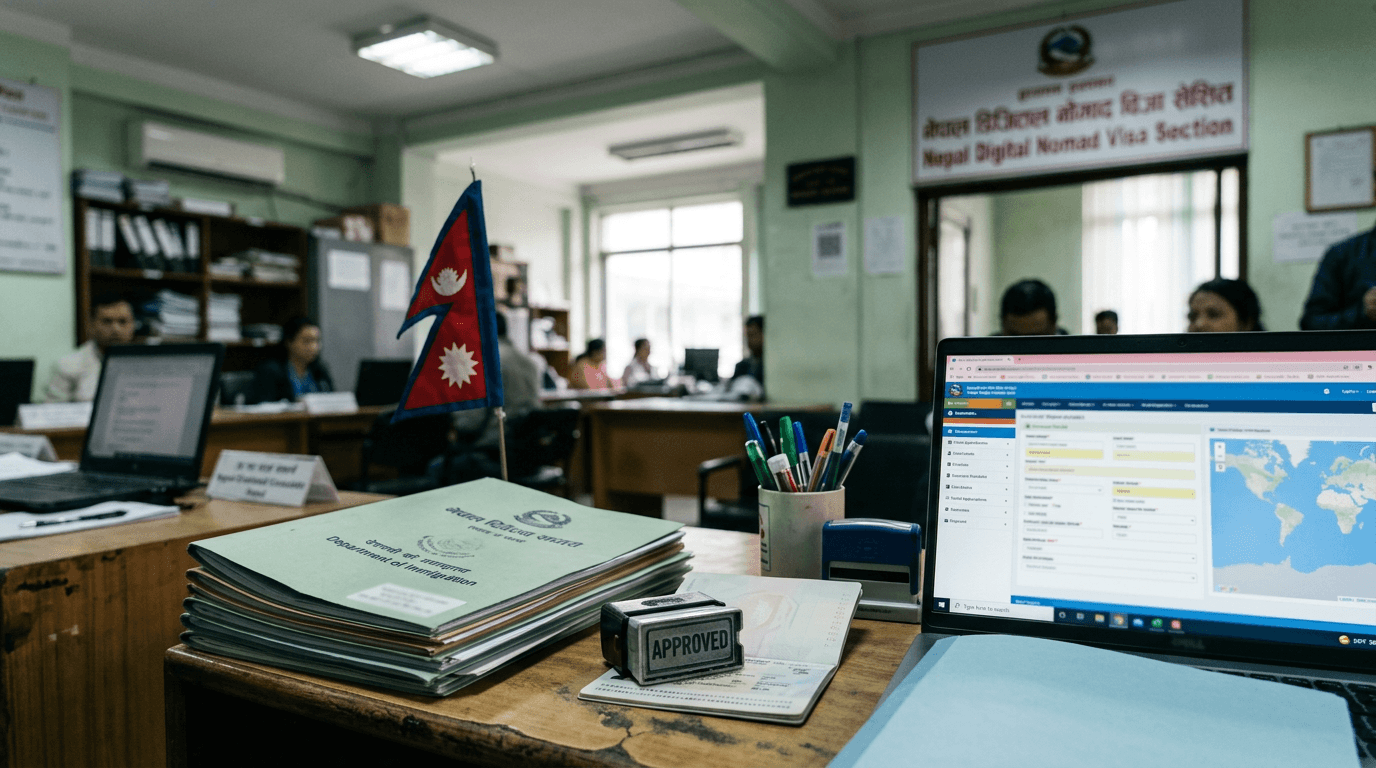
Nepal Digital Nomad Visa (Not Yet Open)

At a Glance
- Not yet open: announced in 2025 but no digital nomad visa category exists at the Department of Immigration as of Oct. 2, 2026.
- None published: the visa is not open and the Department of Immigration fee table has no nomad category.
- Nowhere yet: there is no application route. Long stays today run through the tourist visa (150 days a year) or a Residential Visa via the NepaliPort portal.
- Noonly Working Visa holders may take employment in Nepal
Nepal has no digital nomad visa. The government announced one in 2025, but as of Oct. 2, 2026 the Department of Immigration lists nine visa categories and none is for remote workers (Department of Immigration).
- Status: announced, not yet open, with no application route
- Visitors: a tourist visa covers up to 150 days in a calendar year
- Longer stays: the Residential Visa, for retirees and investors
- Local work: only Working Visa holders may take a job in Nepal
Income tests, savings amounts, validity periods and tax rates quoted online for the planned visa come from press reports of a government plan. They are not immigration rules, and no official launch date has been published.
No eligibility rules exist yet, because the visa category has not been created.
Remote workers who want to spend time in Nepal now have two official options (Department of Immigration):
- Tourist visa: issued on arrival or by a Nepali mission abroad, for up to 150 days in a calendar year in total. SAARC citizens other than Afghans get up to 30 days free on their first visit in a visa year.
- Residential Visa: open to foreigners who intend to live in Nepal without carrying on any business, are aged 60 or older or retired, and show a bank statement of USD 20,000 and a regular income of at least USD 20,000 a year. Investors in a Nepali industrial enterprise have a separate Residential Visa category.
Neither route covers employment in Nepal. Only foreign nationals holding a Working Visa may accept a job and work there, and the Working Visa needs a recommendation from a government agency.
No document list exists for a digital nomad visa.
For the non-business Residential Visa, the Department of Immigration asks for an online application receipt, a bank statement and a regular income certificate, a character certificate, a no-objection letter from the applicant's embassy, a health certificate from TU Teaching Hospital, proof of age or retirement, and copies of the passport and latest Nepali visa. A renewal adds a statement showing the required spending in Nepal (Department of Immigration).
For a tourist visa on arrival, travelers fill in the arrival card and the online tourist visa form before arrival or at kiosks at Tribhuvan International Airport, pay at the bank counter and present the form, receipt and passport at the immigration desk.
None published: the visa is not open and the Department of Immigration fee table has no nomad category.
- Tourist visa on arrival: USD 30 for 15 days, USD 50 for 30 days and USD 125 for 90 days
- Residential Visa (non-business): USD 700 to 1,200 a year depending on whether the visa is new or a renewal; the Department of Immigration confirms the current amount
Fees for a nomad visa quoted on third-party websites have no official basis (Department of Immigration fee table).
Nowhere yet: there is no application route. Long stays today run through the tourist visa (150 days a year) or a Residential Visa via the NepaliPort portal.
- Tourist visa: on arrival at Tribhuvan International Airport, or in advance from a Nepali diplomatic mission. A mission visa must be used within six months of issue. NepaliPort also offers an online Electronic Travel Authorization before arrival (NepaliPort).
- Residential Visa: online through NepaliPort. The Home Ministry must approve it; the visa is issued the next day after approval, and renewals are handled the same day (Department of Immigration).
No validity period or renewal rule exists for a digital nomad visa.
Tourist visas can be extended at the Department of Immigration up to 150 days in total per visa year, which runs from January to December. The Residential Visa is issued and charged by the year and renewed annually, with proof that the required amount was spent in Nepal (Department of Immigration).
Nepal has no tax regime for digital nomads. Reports of a reduced tax rate for remote workers describe a proposal, not law.
Tax residence is set by Nepal's Income Tax Act and applied by the Inland Revenue Department (IRD). Anyone planning to spend a large part of the year in Nepal should confirm the residence test and the treatment of foreign income with the IRD or a local tax adviser before arriving.
Frequently Asked Questions
Does Nepal have a digital nomad visa?
No. The government announced one in 2025, but as of Oct. 2, 2026 the Department of Immigration has no such visa category and no application route.
When will the Nepal digital nomad visa open?
No official launch date has been published. A new category would appear on the Department of Immigration website and the NepaliPort portal.
How long can a remote worker stay in Nepal on a tourist visa?
Up to 150 days in a calendar year in total, through an initial visa and extensions at the Department of Immigration.
Can foreigners work in Nepal on a tourist visa?
No. Only foreign nationals holding a Working Visa may accept a job and work in Nepal. The tourist visa is for visiting.
Who can get a Nepal Residential Visa?
It is open to foreigners who intend to live in Nepal without carrying on any business, are aged 60 or older or retired, and show a bank statement of USD 20,000 and a regular income of at least USD 20,000 a year. The fee is USD 700 to 1,200 a year depending on whether the visa is new or a renewal; the Department of Immigration confirms the current amount.
How It Compares
Similar visas elsewhere
| Program | Country | Income | Fee | Max stay | Renewable |
|---|---|---|---|---|---|
| Seychelles Workcation Program | Seychelles | - | €10 | 12 mo | - |
| Namibia Digital Nomad Visa | Namibia | $2,000/mo | NAD 3,300 | 6 mo | |
| Andorra Digital Nomad Residence Permit | Andorra | €56,472/yr | €225 | 24 mo | |
| Montserrat Remote Worker Stamp | Montserrat | XCD 189,000/yr | XCD 1,350 | 12 mo |
Nepal Digital Nomad Guide
Cost of living, internet, healthcare, coworking, and every visa option for Nepal.
Visa rules change. We'll tell you.
Get notified about policy updates and new requirements for the Nepal Digital Nomad Visa (Not Yet Open) and other Nepal visas.