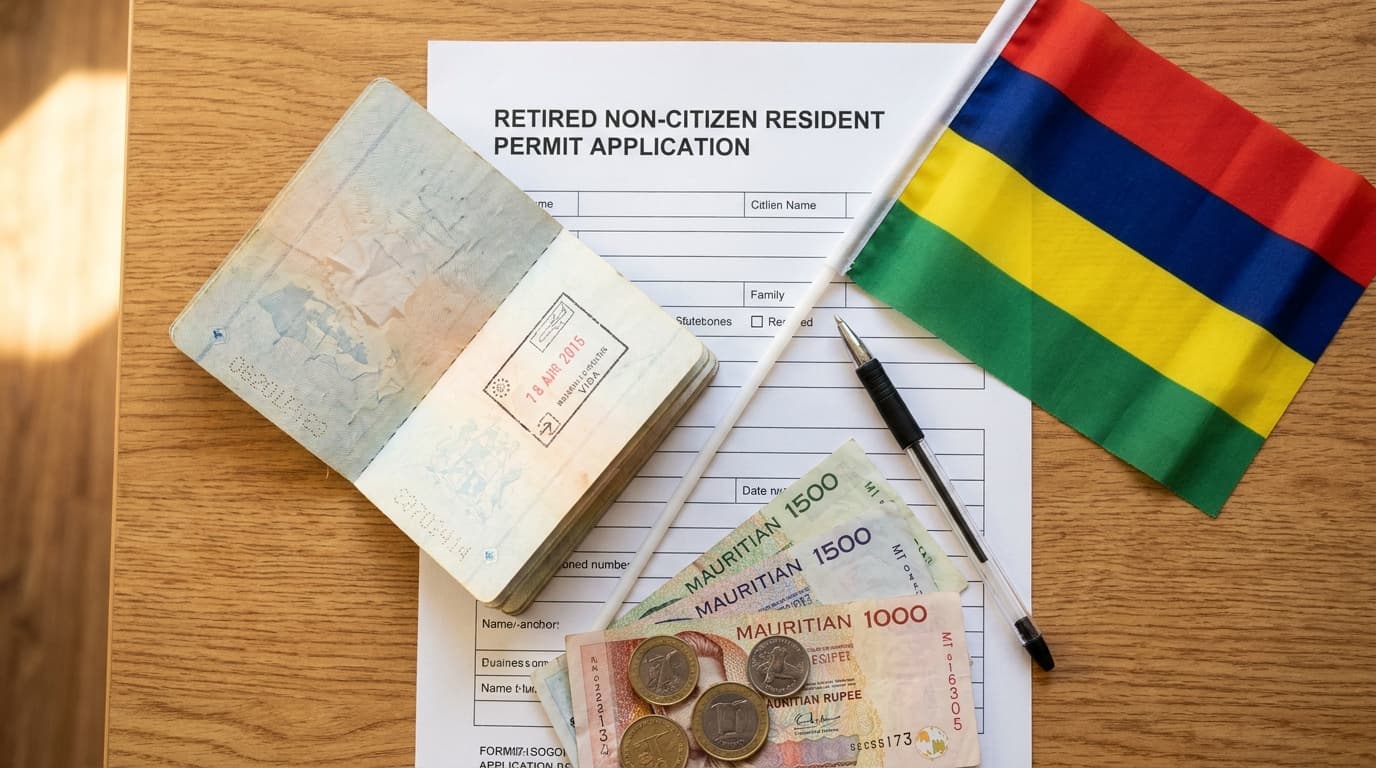
Mauritius Retired Non-Citizen Permit

At a Glance
- $2,000 a monthan initial USD 2,000 into a local bank within 60 days of the permit, then USD 2,000 a month or USD 24,000 a year · main applicant
- $1,000 one-timestatutory permit fee to the Government; applying through the National E-Licensing System (NELS) is free and EDB charges no processing fee · main applicant
- 10 yearsvalid 10 years from issue · main applicant and dependents
- Renewable on evidence that USD 24,000 a year has been transferred into the holder's local bank accountEDB portal renewal condition · main applicant
- Online through the National E-Licensing System (NELS) on the EDB business portal; no need to travel to Mauritius to applyImmigration Act 2022 s.10(2) as rewritten by the Finance Act 2025; EDB portal · all applicants
- No gainful employment; holders may invest in a business if they are not employed by it and draw no salary or employment benefits from itImmigration Act 2022 s.10(7) as rewritten by the Finance Act 2025; same wording on the EDB portal · permit holder
- Yesdependants (spouse, common-law partner, parents and unmarried children not in employment) get a residence permit for the same duration as the main holder · dependents
- A 20-year Permanent Residence Permit after at least five years as a retired non-citizen permit holder, with transfers totalling at least USD 200,000 over the five years before applyingEDB Act First Schedule Part IV item 4 (Finance Act 2025); EDB portal · permit holder
Mauritius grants a residence permit of 10 years to retired non-citizens aged 50 or older who move a steady income into a Mauritian bank account. The Finance Act 2025, published Aug. 9, 2025, reset the conditions.
- Status: active
- Age: 50 or older
- Transfers: $2,000 a month or $24,000 a year into a local account
- Permit: 10 years, renewable
- Permit fee: $1,000
- Family allowed: Yes
Lower transfer thresholds applied before Aug. 9, 2025. The requirement is a transfer into a Mauritian bank account, not savings held abroad.
- Age: 50 or older, according to the EDB's residency portal.
- Means: a certified bank statement from the country of origin or residence showing $24,000 a year or a guaranteed income of $2,000 a month.
- Transfers after approval: an initial $2,000 into a local bank within 60 days of the permit, then $2,000 a month or $24,000 a year, under the Finance Act 2025.
- Work: No gainful employment; holders may invest in a business if they are not employed by it and draw no salary or employment benefits from it.
Dependents get a residence permit for the same period as the main holder. The EDB counts a spouse or common-law partner, parents and unmarried children who don't work as dependents, and their applications are decided by the Passport and Immigration Office.
The EDB's checklist has two stages. For the approval in principle:
- A birth certificate, in English or French or with a certified translation.
- The passport's bio data page.
- Police clearance covering the last ten years, less than six months old.
- Three recent passport photos, 3.5 cm by 4.5 cm.
- A signed undertaking.
- Copies of any existing permits.
After the approval in principle:
- A Mauritian bank statement.
- Marriage or divorce certificates, in the original or with a certified translation.
- A medical certificate and reports less than six months old.
- The pages with the last visa entries.
- Payment of the fee, and any further documents requested.
- Permit fee: $1,000, according to the EDB.
- Application fee: $50, non-refundable, for retired residence permit applications made since Dec. 1, 2025, according to an EDB notice.
- Documents: police clearance, a medical certificate and certified translations add to the cost.
The transfers aren't fees: the money stays the holder's, but $2,000 a month or $24,000 a year has to reach a Mauritian account.
Where to apply: Online through the National E-Licensing System (NELS) on the EDB business portal; no need to travel to Mauritius to apply.
- Apply on the National E-Licensing System (NELS) and upload the first set of documents.
- After the approval in principle, open a Mauritian bank account and submit the second set of documents with the fee.
- Transfer the initial $2,000 within 60 days of the permit, then keep up the monthly or yearly transfers.
No official processing time is published.
The permit is valid for 10 years.
Renewal: Renewable on evidence that USD 24,000 a year has been transferred into the holder's local bank account. The EDB says holders can renew for another 10 years. Renewal needs a certificate of morality covering three years in Mauritius, the passport bio data page, a Mauritian bank statement, new photos, a copy of the current permit and the fee.
Permanent residence
A 20-year Permanent Residence Permit after at least five years as a retired non-citizen permit holder, with transfers totalling at least USD 200,000 over the five years before applying.
The official sources checked set no special tax regime for retirement permit holders. Under the Mauritius Revenue Authority's (MRA) test, a person is tax resident after 183 days or more in an income year (July 1 to June 30), 270 days or more in aggregate over that year and the two before it, or through domicile in Mauritius.
Residents are taxed on income derived in Mauritius or remitted to it, and the MRA counts pensions as foreign income. Because the permit requires regular transfers into Mauritius, retirees should check how their pension will be taxed, including under any tax treaty with their home country.
Frequently Asked Questions
How much must retirees transfer to Mauritius?
$2,000 a month or $24,000 a year into a Mauritian bank account, starting with $2,000 within 60 days of the permit, under the Finance Act 2025.
What is the minimum age for the retirement permit?
50, according to the EDB.
How long is the permit valid?
10 years, renewable on evidence of the yearly transfers. The route to permanent residence: A 20-year Permanent Residence Permit after at least five years as a retired non-citizen permit holder, with transfers totalling at least USD 200,000 over the five years before applying.
Can retirement permit holders work in Mauritius?
No. They may invest in a business, but not be employed by it or draw a salary or employment benefits from it.
What does the permit cost?
The permit fee is $1,000. The EDB also charges a non-refundable $50 application fee on retired residence permit applications.
How It Compares
More Mauritius programs
| Program | Country | Income | Fee | Max stay | Renewable |
|---|---|---|---|---|---|
| Mauritius Premium Visa | Mauritius | $1,500/mo | - | 12 mo |
Similar visas elsewhere
| Program | Country | Income | Fee | Max stay | Renewable |
|---|---|---|---|---|---|
| Suriname Residence Permit for Retirees | Suriname | - | $150↓ | 24 mo | |
| Honduras Pensionado Visa | Honduras | $1,500/mo | $300↓ | 60 mo | |
| Indonesia Retirement KITAS (E33F and E33E) | Indonesia | $3,000/mo | IDR 7,000,000 | 12 mo | |
| Madagascar Retirement Residence Permit | Madagascar | - | - | - |
Mauritius Digital Nomad Guide
Cost of living, internet, healthcare, coworking, and every visa option for Mauritius.
Visa rules change. We'll tell you.
Get notified about policy updates and new requirements for the Mauritius Retired Non-Citizen Permit and other Mauritius visas.