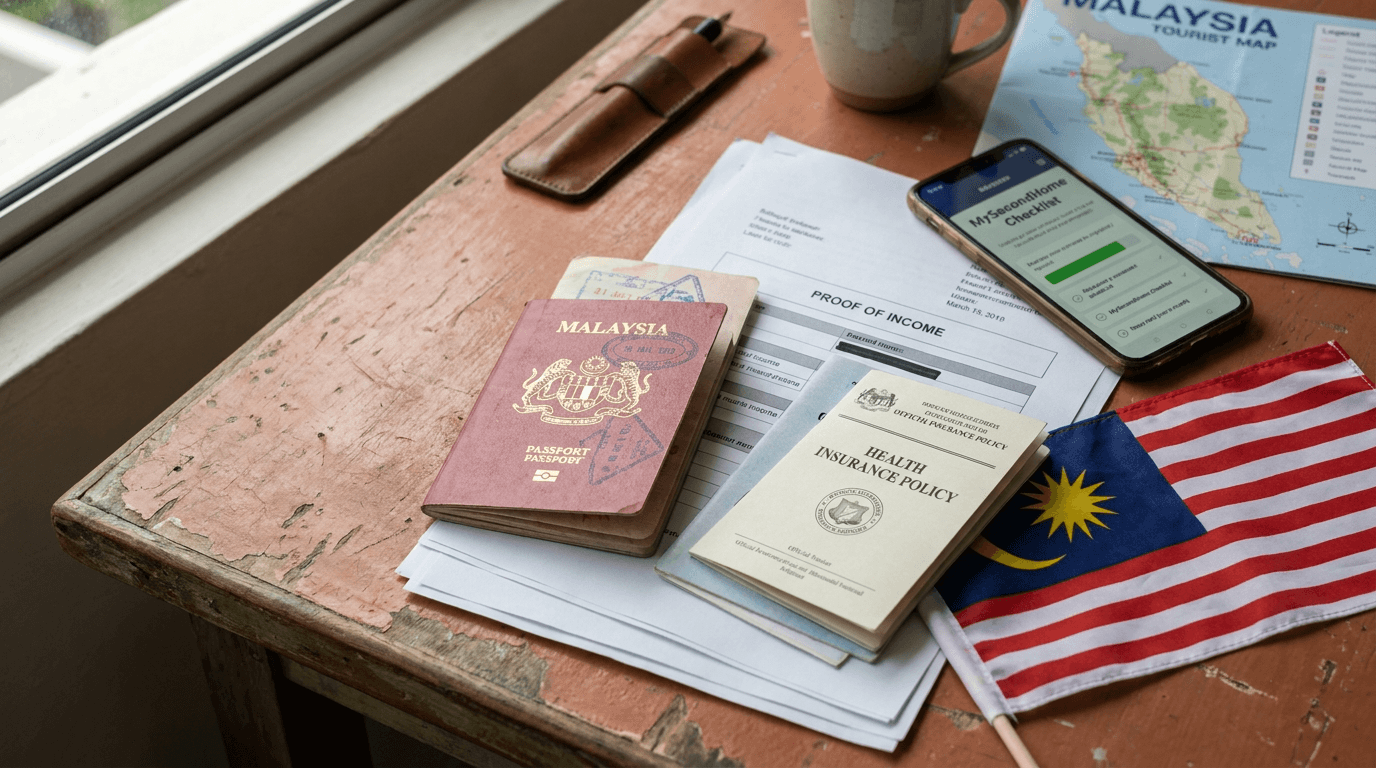
Malaysia My Second Home (MM2H)

At a Glance
- None: the offshore income requirement was dropped for every categoryall categories
- MYR 5,000 one-timePrincipal applicant, all categories
- MYR 2,500 one-timeEach dependent, all categories
- Renewable: after the category's full term the pass renews for 5 years at a time on a valid passport, latest medical report and health insurance; during the term the sticker is renewed with the passportall categories
- Through a MOTAC-licensed MM2H operator (agent), which files with the One Stop Centre MM2H at MOTAC, Putrajaya, via the MM2H information system; final immigration approval rests with the Immigration Department (Ministry of Home Affairs)all categories
- YesSpouse, children, disabled children, parents and parents-in-law
Malaysia My Second Home (MM2H) is a long-term social visit pass for foreigners who want to live in Malaysia for years at a time. The Ministry of Tourism, Arts and Culture (MOTAC) runs it through the One Stop Centre MM2H (OSC MM2H), while the Immigration Department issues the pass and makes the final approval.
There are four categories: Platinum, Gold, Silver and Special Economic Zone/Special Financial Zone (SEZ/SFZ). Every category requires a fixed deposit in a Malaysian bank plus a home purchase. The pass comes with a Multiple Entry Visa and runs for a set term:
- Platinum: fixed deposit of $1,000,000; pass for 20 years
- Gold: fixed deposit of $500,000; pass for 15 years
- Silver: fixed deposit of $150,000; pass for 5 years
- SEZ/SFZ: fixed deposit of $65,000 at ages 21 to 49 or $32,000 at 50 and above; pass for 10 years; home in Forest City, Johor
No category has an income test. MOTAC's materials describe a renewable pass but no route to permanent residence or citizenship.
MM2H is open to nationals of sovereign countries that have diplomatic relations with Malaysia. The minimum age is 25 for Platinum, Gold and Silver and 21 for SEZ/SFZ.
- Income requirement: None: the offshore income requirement was dropped for every category
- Fixed deposit: held at a Malaysian financial institution licensed under the Financial Services Act 2013 or the Islamic Financial Services Act 2013. MOTAC encourages holding it in ringgit, equal in value to the US dollar amount.
- Home purchase: compulsory after approval, at a minimum price of MYR 2,000,000 for Platinum, MYR 1,000,000 for Gold and MYR 600,000 for Silver. These participants have one year from pass endorsement to complete the purchase. The home can't be sold for a decade except to trade up to a more expensive one.
- SEZ/SFZ home: Must buy a home in Forest City, Johor, directly from the developer and before pass endorsement; floor price set by Johor state property policy; no sale for 10 years
- Minimum stay: 90 days a year, cumulative, for participants under 50; the principal or dependents can meet it. Participants 50 and above have no minimum.
Dependents can include:
- Spouse: husband or wife
- Children: biological, step or adopted children under 21 (or 21 to 34 if unmarried and not working while in Malaysia); children with disabilities at any age
- Parents: parents and parents-in-law
- Foreign maid: Platinum only
Only Platinum participants may run a business, invest or take up a career in Malaysia. Gold, Silver and SEZ/SFZ participants can't; MOTAC's terms tell Gold and Silver participants to request the relevant pass.
MOTAC's application checklist asks for:
- Application form: the immigration pass application form for MM2H (IM.12)
- Passports: copies of the biodata page for the principal and each dependent
- Family relationship: proof for each dependent
- Good conduct: a letter of good conduct or police certificate for the principal and each dependent aged 18 and above, issued by the country of origin or residence only and valid for at least six more months
- Other documents: anything else the case needs
All documents must be translated into English and certified by a Malaysian mission abroad or by Malaysia's Ministry of Foreign Affairs. Only complete applications are accepted.
The Royal Malaysian Police screen every application. A MOTAC notice of May 28, 2025 adds random police interviews. A false statement is an offense under section 56(1)(f) of the Immigration Act 1959/63, punishable by a fine of up to MYR 10,000, up to five years in prison or both.
After approval, the principal and dependents take a medical check-up at a clinic or hospital on MOTAC's panel. Renewals need a valid passport, the latest medical report and health insurance.
The pass sticker's validity follows the passport. When a passport expires before the pass, the security sticker moves to the new passport.
MOTAC lists these fees separately:
- Processing fee: MYR 5,000 for the principal and MYR 2,500 for each dependent
- System processing fee: MYR 500 per application, excluding SST, charged since Aug. 1, 2025 for applications through the MM2H information system
- Participating fee: one-off, principal only: Platinum MYR 200,000; Gold MYR 3,000; Silver MYR 1,000; SEZ/SFZ MYR 1,000
- Pass fee: MYR 500 a year when the sticker is renewed, plus a visa fee of MYR 0 to MYR 50 depending on nationality
- Renewal fee after the full term: Platinum MYR 5,000; Gold MYR 3,000; Silver MYR 1,500; SEZ/SFZ MYR 300, for the principal and dependents
MOTAC doesn't explain how the two processing fees relate. Medical check-ups at MOTAC's panel clinics, health insurance for renewals and certified translations add to the bill.
Fixed deposit withdrawals
Up to 50% of the fixed deposit principal may be withdrawn for buying a home, education, medical care or tourism in Malaysia. MOTAC's category pages allow this after approval, but its MM2H guide says withdrawals start from the second year.
A MOTAC notice of May 28, 2025 also allows the withdrawal toward a home bought before the pass is endorsed: within two years before endorsement for Platinum, Gold and Silver; within six months for SEZ/SFZ. The home must still meet the category's minimum price.
- Where to apply: Through a MOTAC-licensed MM2H operator (agent), which files with the One Stop Centre MM2H at MOTAC, Putrajaya, via the MM2H information system; final immigration approval rests with the Immigration Department (Ministry of Home Affairs)
- Agent: applications must be submitted and completed through an MM2H tour operating business licensed by MOTAC under the Tourism Industry Act 1992
- System: new applications have gone through the MM2H information system since Aug. 1, 2025
- Screening: the Royal Malaysian Police screen every application; only complete files are accepted
- After approval: medical check-ups at a MOTAC panel clinic, then pass endorsement. Platinum, Gold and Silver participants have one year from endorsement to buy their home, while SEZ/SFZ participants must buy before endorsement.
MOTAC doesn't publish a processing time for new applications.
- Platinum: 20 years
- Gold: 15 years
- Silver: 5 years
- SEZ/SFZ: 10 years
Renewable: after the category's full term the pass renews for 5 years at a time on a valid passport, latest medical report and health insurance; during the term the sticker is renewed with the passport. Renewals go to OSC MM2H or the Immigration Department.
If the principal dies, the pass transfers to the next of kin among the registered dependents.
MOTAC states that participants are exempt from tax on foreign funds or income, such as their fixed deposit. MOTAC's overview table adds that there is no tax on foreign funds, foreign income or fixed deposit profits in Malaysia.
MOTAC isn't the tax authority. The Inland Revenue Board of Malaysia (LHDN) decides tax residence mainly by days in the country: 182 days or more in a calendar year, with further tests for linked and repeated stays. Participants with other income, including Platinum holders who work in Malaysia, should confirm their position with LHDN.
Frequently Asked Questions
How much money does MM2H require?
A fixed deposit of $1,000,000 for Platinum, $500,000 for Gold or $150,000 for Silver. SEZ/SFZ applicants deposit $65,000 at ages 21 to 49 or $32,000 at 50 and above. Every category also requires buying a home in Malaysia.
Does MM2H still require offshore income?
No. MOTAC dropped the offshore income requirement for every category. Applicants qualify through the fixed deposit and the home purchase instead.
When can MM2H participants withdraw part of their fixed deposit?
Up to 50% of the fixed deposit principal may be withdrawn for buying a home, education, medical care or tourism in Malaysia. MOTAC's guide says withdrawals start from the second year after approval. A May 28, 2025 notice also allows the withdrawal for a home bought up to two years before the pass is endorsed (six months for SEZ/SFZ).
Can MM2H participants work in Malaysia?
Only Platinum participants may run a business, invest or take up a career. Gold, Silver and SEZ/SFZ participants may not.
How long does the MM2H pass last?
The pass runs 20 years for Platinum, 15 years for Gold, 5 years for Silver and 10 years for SEZ/SFZ. After the full term it can be renewed.
How It Compares
More Malaysia programs
| Program | Country | Income | Fee | Max stay | Renewable |
|---|---|---|---|---|---|
| Malaysia DE Rantau Nomad Pass | Malaysia | $24,000-60,000/yr | MYR 540-1,080↓ | 24 mo | |
| Malaysia Professional Visit Pass | Malaysia | - | MYR 1,296↓ | 12 mo | |
| Malaysia Short-Term Social Visit Pass | Malaysia | - | $7-35↓ | 3 mo |
Similar visas elsewhere
| Program | Country | Income | Fee | Max stay | Renewable |
|---|---|---|---|---|---|
| Liechtenstein Financially Independent Residence Permit | Liechtenstein | CHF 2,600/mo | CHF 1,060↓ | 12 mo | |
| Italy Elective Residence Visa | Italy | €31,000/yr | €116↓ | 12 mo | |
| Dominican Republic Pensionado / Rentista | Dominican Republic | $1,500/mo | $200↓ | 12 mo | |
| Lebanon Income-Based Residency Permit | Lebanon | LBP 50,000,000/mo | LBP 18,000,000 | 12 mo | - |
Malaysia Digital Nomad Guide
Cost of living, internet, healthcare, coworking, and every visa option for Malaysia.
Visa rules change. We'll tell you.
Get notified about policy updates and new requirements for the Malaysia My Second Home (MM2H) and other Malaysia visas.