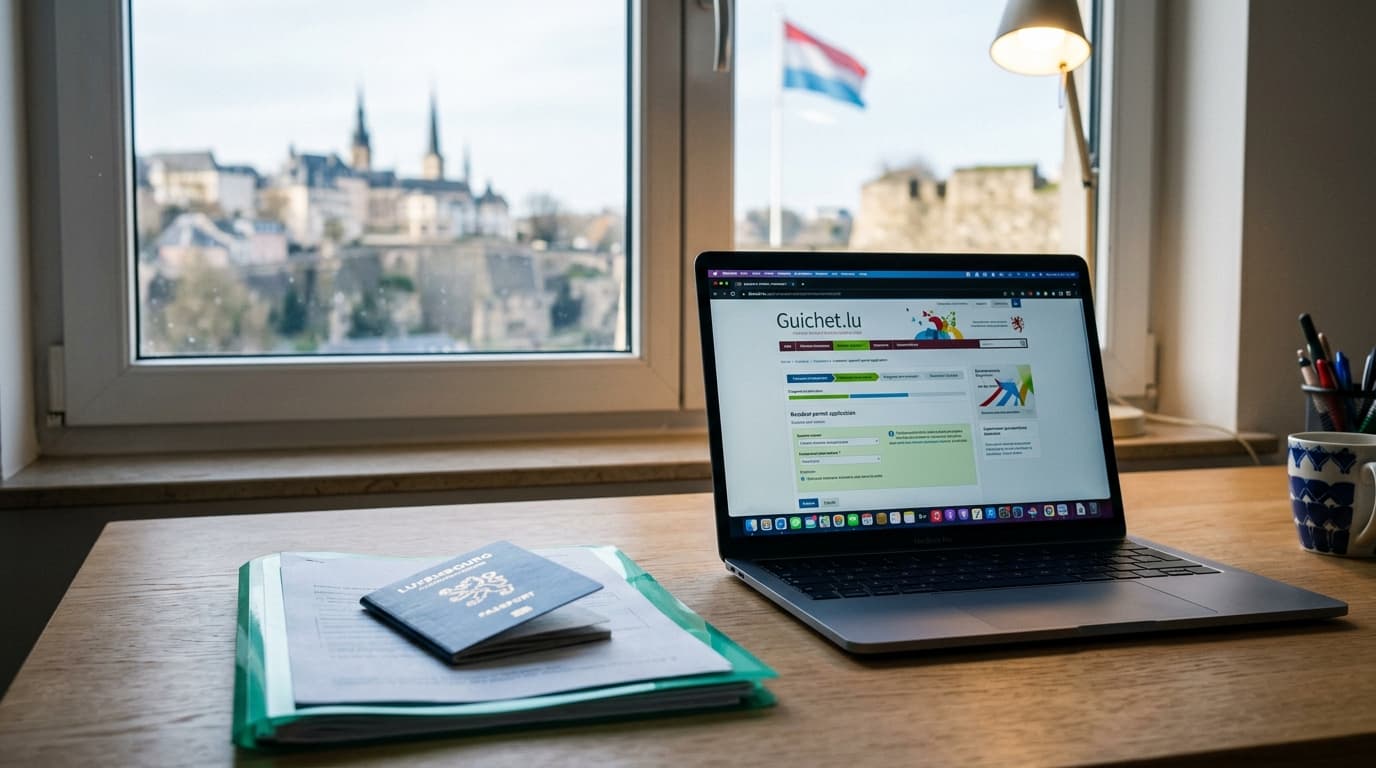
Luxembourg Self-Employed Worker Residence Permit

At a Glance
- No fixed amount. Applicants prove adequate economic resources for the business project with bank statements or a detailed financial portfolio, plus a business and financing plan.
- €80 one-time
- 3 yearsup to 3 years from the declaration of arrival in the commune
- Renewable on request for up to 3 years at a time while the conditions are met. File in the 2 months before the permit expires; EUR 80 fee.
- Step 1 (since Oct. 1, 2026): apply for a long-stay visa D for a self-employed residence permit at the Luxembourg embassy or consulate in the country of origin or residence, or a neighboring country, or at a Belgian embassy where Luxembourg has none. Applications from inside Luxembourg are inadmissible. Step 2: declare arrival at the commune within 3 days, pass the medical check and apply to the General Department of Immigration (online via MyGuichet.lu or by post) at the latest 3 months before the visa D expires.
- 3 monthsup to 3 months, in principle; no reply in that time counts as a refusal
- Yesself-employed activity in Luxembourg only, within the approved activity
- After 5 years of lawful, uninterrupted residence, the holder can apply for long-term resident status.
Last checked Oct. 5, 2026
Luxembourg has no digital nomad visa. The self-employed residence permit is for nationals of countries outside the EU, the EEA and Switzerland who want to live in Luxembourg and work there for themselves, by setting up or taking over a business or practicing a liberal profession (Guichet.lu). The activity has to serve Luxembourg's economic, social or cultural interest and need the holder's presence, so remote work for foreign clients alone does not fit.
New since Oct. 1, 2026: first-time applicants apply for a long-stay visa D at a Luxembourg embassy or consulate, or a Belgian one where Luxembourg has no visa service, instead of the old temporary authorization to stay filed with the immigration directorate (Ministry of Foreign and European Affairs).
- First permit: up to 3 years
- Money: No fixed amount. Applicants prove adequate economic resources for the business project with bank statements or a detailed financial portfolio, plus a business and financing plan.
- Fees: €50 for the visa D at Luxembourg embassies and €80 for the residence permit
- Decision on the visa D: 3 months at most, in principle
- Self-employed work in Luxembourg: Yes, in the approved activity
Short visits and other routes are covered in the Luxembourg country guide.
Who qualifies: Third-country nationals who prove the qualifications for the activity, meet any legal access rules for crafts, trade, industry or liberal professions, show adequate resources for the activity and show the activity serves Luxembourg's economic, social or cultural interest (economic need, viability, job creation, investment) and needs their presence to run the business day to day. (Guichet.lu)
Commerce, crafts, industry and liberal professions also need a business permit (autorisation d'établissement) from the Ministry of the Economy before the activity starts.
Money: No fixed amount. Applicants prove adequate economic resources for the business project with bank statements or a detailed financial portfolio, plus a business and financing plan.
Family: spouses, partners and children of permit holders apply under Luxembourg's family reunification rules, which have their own conditions.
The visa D file for a self-employed permit (Guichet.lu):
- A complete copy of a valid passport
- A CV
- A criminal record extract less than 3 months old from the current country of residence, for adults, or a sworn statement where an extract can't be obtained
- A business plan and a financing plan
- Proof of the money needed for the business project, such as bank statements or a detailed financial portfolio
- For a business takeover, balance sheets and profit and loss accounts for the last 3 years
- Travel health insurance valid across the Schengen area for the length of the visa, covering medical repatriation
Documents not in German, French or English need a certified translation by a sworn translator.
After arrival, the residence permit application needs the declaration of arrival from the commune, the medical certificate and proof that the €80 fee was paid (Guichet.lu).
- Visa D: €50 at Luxembourg embassies (Luxembourg embassy in Moscow). Belgian embassies that issue the visa for Luxembourg may charge a different fee.
- Residence permit: €80, paid as part of the application (Guichet.lu)
- Renewal: the same €80 fee each time
The larger costs sit around the permit: travel health insurance for the visa period, sworn translations, any business permit and social security contributions once the activity starts.
Since Oct. 1, 2026, the route has two stages: a visa D from abroad, then the residence permit in Luxembourg (Guichet.lu).
- Apply for the visa D at the Luxembourg embassy or consulate in the country of origin or residence, or in a neighboring country, or at a Belgian embassy where Luxembourg has no visa service. Applications filed from inside Luxembourg are not accepted.
- Wait for the decision: 3 months at most, in principle. If approved, the visa D is valid for 6 months (Guichet.lu).
- Within 3 days of arrival, declare arrival at the commune of residence. The permit's validity normally runs from this date.
- Take the medical check with an authorized doctor in Luxembourg.
- Apply for the residence permit online via MyGuichet.lu or by post, no later than 3 months before the visa D expires, and pay the €80 fee (Guichet.lu).
- Give biometric data by appointment, then collect the card about a week later. The card includes the authorization to work.
- First permit: up to 3 years, counted from the declaration of arrival at the commune
- Renewal: Renewable on request for up to 3 years at a time while the conditions are met. File in the 2 months before the permit expires; EUR 80 fee.
- Long-term residence: After 5 years of lawful, uninterrupted residence, the holder can apply for long-term resident status.
These rules come from the Guichet.lu page in force before Oct. 1, 2026 (archived Guichet.lu page). The reform changed the entry step, and the new pages do not restate validity or renewal.
The self-employed permit carries no special tax regime. Under Luxembourg tax law, a person is resident if their tax domicile or habitual abode is in Luxembourg. Residents are taxed on worldwide income and nonresidents only on income from Luxembourg (Administration des contributions directes).
A residence permit does not automatically make someone tax resident, and a person whose center of vital interests stays abroad is in principle treated as a nonresident. Tax treaties decide cases where two countries both claim residence.
Self-employed residents also register for social security, and renewal files ask for tax returns and proof of social security affiliation, so records matter from the start (archived Guichet.lu page).
Frequently Asked Questions
Is this a digital nomad visa?
No. It is for people who will run a business or liberal profession in Luxembourg that serves the country's interests and needs their presence. Luxembourg has no digital nomad visa.
How do first-time applicants apply since the reform?
Since Oct. 1, 2026, they apply for a long-stay visa D at a Luxembourg embassy or consulate, or a Belgian embassy where Luxembourg has none. The visa D is valid 6 months.
Is there a minimum income?
No fixed amount. Applicants prove adequate economic resources for the business project with bank statements or a detailed financial portfolio, plus a business and financing plan.
What does it cost?
€50 for the visa D at Luxembourg embassies and €80 for the residence permit, paid again at each renewal.
How long does the permit last?
Up to 3 years at first. Renewable on request for up to 3 years at a time while the conditions are met. File in the 2 months before the permit expires; EUR 80 fee.
How It Compares
Similar visas elsewhere
| Program | Country | Income | Fee | Max stay | Renewable |
|---|---|---|---|---|---|
| Kuwait Freelance Residency (Announced, Not Launched) | Kuwait | - | - | - | |
| Sweden Self-Employed Residence Permit | Sweden | SEK 200,000 saved | SEK 2,000 | 24 mo | |
| Finland Startup Permit | Finland | €1,210/mo | €650 | 24 mo | |
| Belgium Professional Card | Belgium | - | €140 | 24 mo |
Luxembourg Digital Nomad Guide
Cost of living, internet, healthcare, coworking, and every visa option for Luxembourg.
Visa rules change. We'll tell you.
Get notified about policy updates and new requirements for the Luxembourg Self-Employed Worker Residence Permit and other Luxembourg visas.