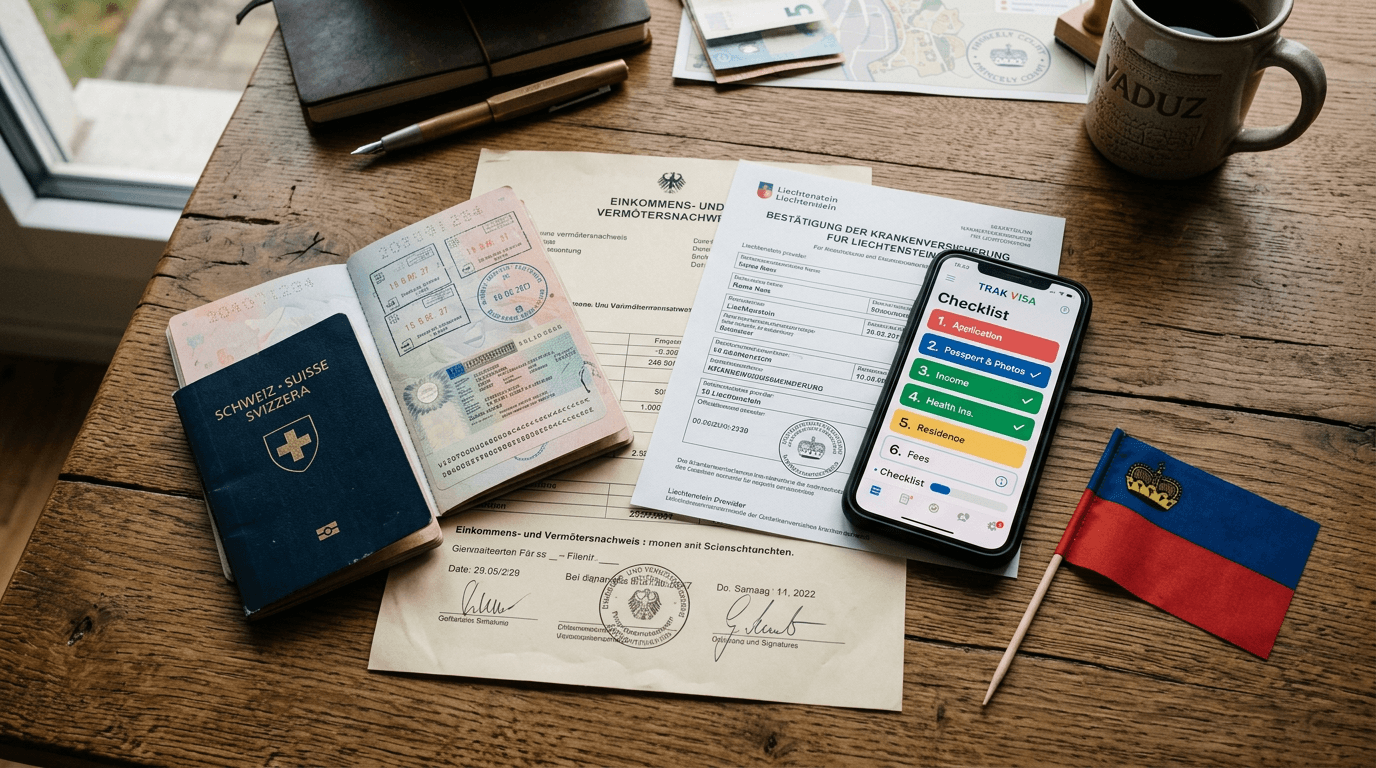
Liechtenstein Financially Independent Residence Permit

At a Glance
- CHF 2,600 a monthor more, from ongoing social insurance or private-law entitlements (pensions, maintenance, rental contracts with a five-year minimum term); alternative to the bank guarantee · main applicant, all nationalities (third-country nationals must also meet the special-interest test)
- CHF 156,000 one-timeunconditional, irrevocable bank guarantee in the original, five-year term; alternative to the CHF 2,600 monthly income · EEA and Swiss nationals: bank based in an EEA state; third-country nationals: bank based in Liechtenstein
- CHF 1,060 one-timeCHF 60 assurance of permit + CHF 1,000 new residence permit issued by the government, per person; CHF 80 advance due on filing; a refusal costs CHF 80 · per person, applications decided by the government
- CHF 50 one-timeCHF 30 biometric capture + CHF 20 card production · per person
- CHF 100 one-timeCHF 100 for the preliminary draw, plus CHF 500 for those who take part in the final draw (fee ordinance Art. 11) · each EEA national entering the preliminary draw; those admitted to the final draw pay a further CHF 500
- 1 yearthird-country nationals: normally one year (AuG Art. 26(3)); EEA nationals: up to five years (PFZG Art. 19(1))
- Third-country nationals renew yearly if the integration agreement is kept and no revocation ground exists; file at least two weeks before expiry; CHF 60. EEA nationals: proof of funds may be checked after two years.
- Migration and Passport Office (Auslaender- und Passamt, APA), Vaduz, online form "Wohnsitznahme ohne Erwerbstaetigkeit"; third-country nationals wait abroad for the assurance or visa authorization
- 3 monthsas a rule, within three months of a complete application; the government decides non-employed applications once per quarter
- Noany gainful activity in Liechtenstein is prohibited and can lead to revocation
- Yesthird-country holders: spouse or registered partner and unmarried children under 18, with housing, health cover and funds for the family; EEA holders: spouse or partner, descendants under 21 or dependent, dependent ascendants
- Third-country nationals: settlement permit (C) after five uninterrupted years with a residence permit, a civics test, German and sufficient means. EEA nationals: permanent residence permit (D) after five uninterrupted years.
Last checked Oct. 11, 2026
Liechtenstein has no digital nomad visa. The closest route is the residence permit (B) without gainful employment ("Wohnsitz ohne Erwerbstaetigkeit"), which the Migration and Passport Office (APA) in Vaduz handles for people who live on their own means (Foreigners Act).
The route works very differently by nationality. EEA nationals compete for a small annual quota of 16 permits, half of them allotted by public draw (APA draw page). Non-EEA nationals have no quota route: the Foreigners Act allows the permit only for people of special interest to the country, so money alone doesn't qualify.
Any gainful activity in Liechtenstein is banned. For EEA nationals admitted through the draw, the APA states that employment abroad is permitted (APA draw page). For non-EEA applicants the published rules don't settle whether ongoing remote work for a foreign employer fits the permit, and the APA checklist counts pensions, maintenance payments, long-term rental income or a bank guarantee as the means of support rather than a salary, so they should confirm with the APA before applying.
- Permit: residence permit (B) without gainful employment
- Funds: CHF 2,600 a month in ongoing income, or a bank guarantee of CHF 156,000
- First permit: 1 year for non-EEA nationals; EEA nationals can receive up to five years
- Local work allowed: No
Non-EEA nationals
Article 20 of the Foreigners Act (AuG) lets the APA grant the permit to a person who doesn't work only when all of these hold:
- The person is of special interest to Liechtenstein. The implementing ordinance describes this as significant cultural, scientific or economic standing (ZAV, Art. 14).
- Suitable housing is available.
- Statutory health insurance covering all risks in Liechtenstein is in place.
- There is enough money that no social assistance will be needed, backed by a guarantee from a bank based in Liechtenstein.
- There is no criminal record for a felony or misdemeanor.
The law allows exceptions only for serious personal hardship or important public interests (AuG Art. 21).
EEA nationals
At least 16 permits a year go to EEA nationals who are not economically active. Half are allotted by public draw and the rest are granted by the government. Swiss and UK nationals can't enter the draw (APA draw page). Selected applicants still have to show the same funds as everyone else.
Family
- Family can join: Yes
- Non-EEA holders can bring a spouse or registered partner and unmarried children under 18, with suitable housing, health cover and funds for the whole family. A spouse living abroad needs basic German (AuG Art. 33).
- EEA holders can bring a spouse or partner, children under 21 or still dependent, and dependent parents.
The APA checklist and the Foreigners Act set out the core documents (APA checklist, AuG Arts. 20 and 23):
- A valid passport and, for nationalities that need one, authorization for an entry visa.
- Proof of means: at least CHF 2,600 a month from ongoing social insurance or private entitlements such as pensions, maintenance payments or rental contracts with a minimum five-year term, or an unconditional, irrevocable bank guarantee of CHF 156,000 with a five-year term, in the original.
- For the guarantee, EEA and Swiss nationals may use a bank based in any EEA state; non-EEA nationals need a bank based in Liechtenstein.
- Proof of suitable housing, such as a lease or purchase contract.
- Proof of statutory health insurance covering all risks in Liechtenstein.
- A current criminal record extract from the country of origin, which the APA may ask for in the original.
- For non-EEA nationals, evidence of the special interest to Liechtenstein described under eligibility.
Applications that are incomplete, illegible or unsigned are sent back with a single 30-day deadline. A file not completed in that time counts as withdrawn (AuG Art. 23). Rules on translations and apostilles aren't published for this category, so ask the APA before submitting foreign documents.
The fee ordinance sets the charges in Swiss francs (Ausl-GebV):
- Government decision, per person: CHF 1,060 (CHF 60 for the assurance plus CHF 1,000 for the new permit), with an advance of CHF 80 due on filing
- Permit card: CHF 50 (biometric capture and card production)
- Refusal: CHF 80
- Yearly renewal: CHF 60
EEA nationals pay CHF 100 to enter the preliminary draw, and those who reach the final draw pay a further CHF 500 (APA draw page, fee ordinance, Art. 11). The APA opens the next participation form in February 2027.
Health insurance premiums, translations, certified copies and any legal advice are paid to private providers and vary.
- Where to apply: the APA in Vaduz, through its online form "Wohnsitznahme ohne Erwerbstaetigkeit" (APA online form).
- Non-EEA nationals: must wait abroad for the permit assurance or the authorization to issue a visa, including anyone who entered Liechtenstein first and applied afterward (AuG Art. 24).
- EEA nationals: enter the draw with the APA, usually online, and file the full documentation only if selected. The draw takes place twice a year (APA draw page).
Complete applications for a residence permit are normally decided within 3 months of receipt (AuG Art. 23). The government decides non-employed applications once a quarter, according to the APA checklist.
A positive decision comes as an assurance of the permit, normally valid for three months (AuG Art. 24). In that window the applicant finishes any visa formalities, moves in and collects the biometric permit card. No one may take up residence before the assurance or visa is issued.
- First permit: 1 year for non-EEA nationals (AuG Art. 26). EEA nationals can receive a permit for up to five years when the stay is planned to last more than a year.
- Renewal: Third-country nationals renew yearly if the integration agreement is kept and no revocation ground exists; file at least two weeks before expiry; CHF 60. EEA nationals: proof of funds may be checked after two years.
- Longer term: Third-country nationals: settlement permit (C) after five uninterrupted years with a residence permit, a civics test, German and sufficient means. EEA nationals: permanent residence permit (D) after five uninterrupted years.
A residence permit is issued only for a stay expected to last more than a year, and an extension can run at most to one month before the passport expires (AuG Art. 26). Taking up gainful activity in Liechtenstein or losing the means of support can lead to revocation.
The Liechtenstein country guide covers living costs, taxes and daily life.
A person with a domicile or habitual abode in Liechtenstein is taxed without limit on worldwide wealth and income (Tax Act, Art. 6). Habitual abode means a continuous stay of more than 6 months, counted from the first day.
The Tax Act also offers taxation based on spending. People who take up residence for the first time (or after at least 10 years away), are not Liechtenstein citizens, do no gainful work in the country and live on investment income or payments from abroad can apply to the Tax Administration to pay 25% of their total spending instead of wealth and income tax. The Tax Administration decides each application, and Liechtenstein real estate stays subject to wealth tax (SteG Arts. 30 to 33).
Treaty relief depends on the other country of residence or citizenship. Get advice covering both countries before moving.
Frequently Asked Questions
Can non-EEA nationals get this permit just by showing enough money?
No. The Foreigners Act requires non-EEA applicants to be of special interest to Liechtenstein, such as significant cultural, scientific or economic standing. Funds of CHF 2,600 a month or a bank guarantee of CHF 156,000 are an extra test, not a route on their own.
Can a permit holder keep working remotely for a foreign employer?
Any gainful activity in Liechtenstein is banned. EEA nationals admitted through the draw may keep working for an employer abroad, the APA says. For non-EEA nationals the rules don't clearly allow it, and the APA counts pensions, maintenance, rental income or a bank guarantee as means of support, so they should confirm with the APA before applying.
How do EEA nationals apply?
Through the public draw for the quota of 16 permits a year, half of which are drawn. Only selected applicants file the full documentation. Swiss and UK nationals can't enter the draw.
How much does the permit cost?
For a government decision, CHF 1,060 per person plus CHF 50 for the permit card. A refusal costs CHF 80.
How long does a decision take?
Complete applications are normally decided within 3 months. The government decides these cases once a quarter.
How It Compares
Similar visas elsewhere
| Program | Country | Income | Fee | Max stay | Renewable |
|---|---|---|---|---|---|
| Italy Elective Residence Visa | Italy | €31,000/yr | €116↓ | 12 mo | |
| Dominican Republic Pensionado / Rentista | Dominican Republic | $1,500/mo | $200↓ | 12 mo | |
| Lebanon Income-Based Residency Permit | Lebanon | LBP 50,000,000/mo | LBP 18,000,000 | 12 mo | - |
| Monaco Residency (Financial Means) | Monaco | - | €80↓ | 12 mo |
Liechtenstein Digital Nomad Guide
Cost of living, internet, healthcare, coworking, and every visa option for Liechtenstein.
Visa rules change. We'll tell you.
Get notified about policy updates and new requirements for the Liechtenstein Financially Independent Residence Permit and other Liechtenstein visas.