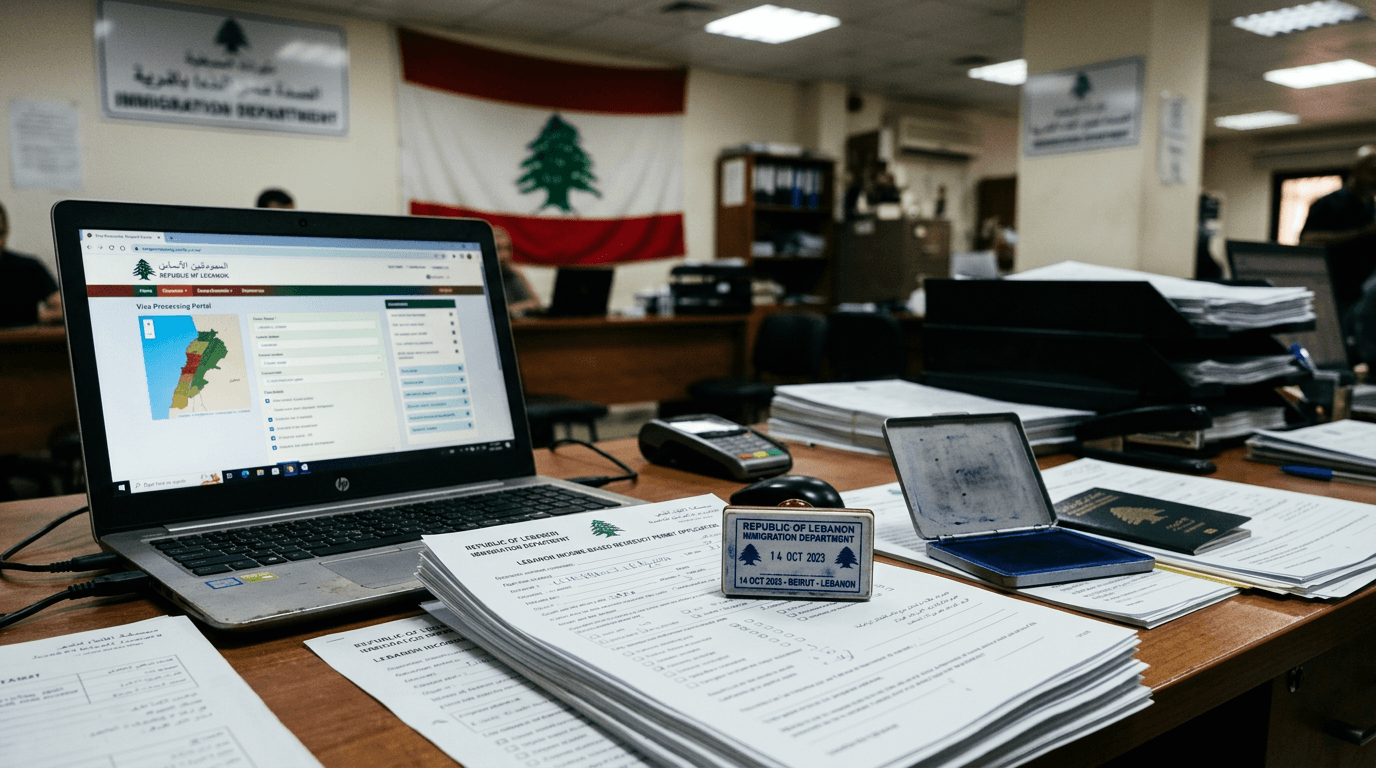
Lebanon Income-Based Residency Permit
Visa Data Sheet
Lebanon doesn’t have a branded digital nomad visa. The main long-stay option for financially independent foreigners is an income-based residence permit handled by the General Directorate of General Security. It’s aimed at retirees, people living off foreign income or savings and family members who qualify under the same file, not people planning to work locally.
The logic is pretty straightforward, even if the paperwork isn’t. You show that you can support yourself without taking a job in Lebanon, usually through a monthly income from abroad or a blocked bank deposit. The official framework also covers annual and permanent residence categories, so this isn’t just a short tourist extension dressed up as residency. It’s a real residence route, with residency rights that go beyond a visitor stay.
One recent change makes the process a bit less predictable. In 2024, General Security moved some bank-guarantee cases toward cash security deposits paid to the Lebanese Treasury, which suggests tighter financial controls rather than a softer system. The official instructions don’t give a neat, one-size-fits-all formula for every applicant, so the exact route depends on the category you’re applying under and how you prove your means.
What this route is for
- Main use: Long-term residence for people living on foreign income or savings.
- Typical applicants: Retirees, financially independent foreigners and qualifying family members.
- Core commitment: You agree not to work in Lebanon.
- Key requirement: Proof of independent means, either through income abroad or a blocked deposit.
Don’t expect special tax treatment just because you hold this permit. The research doesn’t show any separate expat tax regime tied to the income-based residence route, so Lebanon’s normal tax-residence rules still apply. That matters, because a residency permit and tax residence aren’t the same thing.
This is also not a flexible workaround for remote work. If your plan is to keep freelancing for overseas clients while living in Beirut, the legal line still runs through the no-work undertaking. If you can live off passive or external income and want a proper residence status, this is the closest thing Lebanon has to a nomad-friendly long stay.
Lebanon’s income-based residence is built for people who can support themselves without taking a local job. It’s handled by the General Security Directorate, not through a separate digital nomad program and it’s really aimed at retirees, financially independent applicants and family members who’ll live here without working in Lebanon.
There are two main financial routes. For annual residence, General Security says you can qualify with a blocked account in Lebanon of at least 1,000,000,000 LBP, monthly income of 50,000,000 LBP or a joint blocked account of 2,000,000,000 LBP. For the three-year permanent residence route, you need to show a frozen savings account of at least 4,500,000,000 LBP held in a Lebanese bank for more than three months.
- Annual residence: blocked account of 1,000,000,000 LBP, monthly income of 50,000,000 LBP or a joint blocked account of 2,000,000,000 LBP.
- Permanent residence: frozen savings account of 4,500,000,000 LBP in a Lebanese bank for more than three months.
- Work restriction: applicants must sign a notarized undertaking not to work in Lebanon.
Family eligibility is broader under the annual income-based category. The applicant’s family is generally granted residency through the main file, though adult males are reviewed individually and still need to submit the no-work undertaking. Minors are fee-exempt and applicants aged 64 or older don’t have to provide the non-working attestation.
The official guidance doesn’t set out nationality-specific limits for the financial-based route and it doesn’t spell out every possible reason for refusal. What does matter is simple enough, if annoying, you need to prove the money, keep it tied up the way General Security asks and stick to the promise not to work locally. If any of that falls apart, the application or renewal can fall apart with it.
For the permanent route, the paperwork is a bit heavier. Beyond the income or bank balance, applicants need a lease or property title, a notarized commitment not to work in Lebanon and the usual residence application documents.
Lebanon’s income-based residency route runs through the General Security Directorate, not a separate digital nomad program. It’s aimed at people who can live off foreign income or bank savings and the paperwork is built around that idea, not local employment. That means you’ll be signing a promise not to work in Lebanon.
There are two main versions of this permit. The annual category is for applicants who can show either a blocked bank account or a monthly income from abroad, while the longer-term category is for people with larger frozen funds and a stronger passport validity window. The official pages don’t frame this as a tax perk and they don’t mention any special expat tax treatment tied to the permit.
Annual income-based residence
- Application form: Completed and signed.
- Passport: Valid for at least 1 year, plus two copies.
- Photos: Three identity photos, 4.5 x 3.5 cm.
- Non-work pledge: A notarized attestation that you won’t work in Lebanon.
- Financial proof: Either a blocked account with at least LBP 1,000,000,000 frozen for 3 months or monthly income of LBP 50,000,000 or the foreign-currency equivalent.
- Housing proof: A lease deed or title deed.
- Joint accounts: The statement needs to show at least LBP 2,000,000,000.
Permanent residence under income or frozen funds
- Application form: Completed.
- Passport: Valid for at least 3 years, plus two copies.
- Photos: Three recent photos.
- Financial proof: A savings passbook showing at least LBP 4,500,000,000 frozen for more than 3 months.
- Non-work pledge: A notarized promise not to take jobs in Lebanon.
- Housing proof: A lease or property title.
- Extra filing step: The photocopy of the passbook has to be signed and ratified by the General Security department chief.
Passport validity matters a lot here. The official rules tie the permit length to the passport’s remaining validity, so don’t assume a nearly expired passport will fly. The portal doesn’t clearly list health insurance, medical exams or foreign police clearances for these income-based categories, so don’t treat those as automatic requirements unless your local General Security office asks for them.
One practical headache, some foreign documents may need legalization or translation under local administrative practice, even though the official pages don’t spell that out. If your file includes civil documents or anything issued abroad, check with the regional General Security office before you show up with an unprepared stack of papers.
Lebanon’s income-based residency isn’t cheap and the fee picture is a bit messy. The country doesn’t publish a polished digital-nomad price list, so you’re dealing with the General Security Directorate’s residence categories, not a tailored remote-work program.
For the permanent residence route, the official fee listed for an applicant with a monthly income or a frozen bank account is 54,000,000 LBP. That same fee applies to the Arab businessman or investor category under permanent residence. The annual residence page is less helpful, because the fee field for the monthly income or bank statement category shows placeholder zeros, so there isn’t a clean official annual figure to quote from the source material.
That’s only part of the bill. In May 2024, General Security said applicants relying on bank guarantees for annual or permanent residence would need to replace the old bank-statement guarantee with a cash deposit to the Lebanese Treasury. The announced security amounts were 1.5 billion LBP for a one-year residency card and 4.5 billion LBP for a three-year card. That’s a serious cash commitment and it sits on top of any government fee.
- Permanent residence fee: 54,000,000 LBP for monthly-income or frozen-account applicants.
- Permanent residence fee for Arab businessman or investor: 54,000,000 LBP.
- Cash security for one-year residency card: 1.5 billion LBP for some bank-guarantee cases.
- Cash security for three-year residency card: 4.5 billion LBP for some bank-guarantee cases.
The official sources don’t break out extra costs like legal fees, translation, notarization or health insurance, but you should expect them. They also don’t point to any special tax break tied specifically to this residency route, so Lebanon’s normal tax-residence rules still matter. If you’re budgeting for this permit, don’t just look at the headline residency fee. The blocked funds or Treasury deposit can dwarf everything else.
Lebanon doesn’t have a branded digital nomad visa. For income-based residency, you deal with the General Directorate of General Security and the process is handled inside Lebanon, usually through a central or regional department. The official paperwork points to an annual route and a three-year route, both meant for people living off foreign income or savings and not taking local jobs.
The setup is a bit old-school. You’ll need to show that you can support yourself, sign an undertaking that you won’t work in Lebanon and provide local housing documents. Official guidance also points to a blocked bank account or proof of monthly income from abroad. Since 2024, some residence categories have shifted away from bank-guarantee arrangements and toward cash security deposits paid to the Lebanese Treasury, so don’t assume the same banking setup you read about last year still applies.
What to prepare
- Application form: Submitted to the competent General Security department.
- Passport and copies: Your residence card is tied to passport validity, so don’t try this with a nearly expired passport.
- Photos: Bring recent passport-size photos.
- Financial proof: Bank statements, savings passbook or other proof of independent means or income from abroad.
- Notary undertakings: You’ll need the non-employment declaration and any other sworn pledges requested by General Security.
- Housing proof: A lease or property title in Lebanon.
Once you file, General Security reviews the request and, if approved, issues a residence card. The official pages don’t spell out a fixed processing time and they don’t clearly say you can start the application from abroad. In practice, the instructions are framed around applying in person in Lebanon.
Fees are set separately for one-year and three-year residence cards, but the official documents don’t give a simple, single fee you can rely on without checking the category you’re using. Renewals work the same way in spirit, you file again with updated documents and pay the current fee before the card expires.
This route is aimed at retirees, financially independent residents and family members who can meet the money requirements and stay out of the local job market. There’s no special tax deal attached to it, just Lebanon’s ordinary tax-residence rules.
Lebanon’s income-based route isn’t a branded digital nomad visa. It’s a residency permit handled by the General Security Directorate for people who can show independent means, usually through a blocked bank account or provable income from abroad. The target group is pretty specific, retirees, financially independent applicants and family members and the deal comes with a clear condition: you’re expected not to work in Lebanon.
There are two main versions of this stay. The annual residence can be issued on the basis of monthly income or a bank statement and its validity matches your passport if the passport has more than six months left but less than one year remaining. In practice, that makes it a renewable up-to-one-year permit tied to your passport’s expiry date. The permanent-residence category is the longer option, with a three-year residence card that’s possibly renewable for foreign or Arab citizens who meet the conditions.
Passport timing matters here more than most people expect. If your passport has between two years and six months and three years of validity left, the residence is issued in line with that passport validity instead of giving you the full three years. The official instructions don’t spell out a special route to citizenship or a separate long-term track beyond these renewable permits.
Renewal is where things get a little dull and a little annoying. The official guidance says you’ll need to keep meeting the financial threshold, whether that’s the blocked-account route or proof of income and you still have to honor the non-employment undertaking. The exact renewal steps and any hard limit on how many times you can renew aren’t clearly set out in the public instructions.
- Annual residence: Valid for up to one year, but tied to passport validity when the passport has more than six months and less than one year left.
- Permanent residence: Three-year residence card, possibly renewable, subject to eligibility.
- Financial proof: Blocked bank account or monthly income from abroad.
- Work restriction: You’re expected not to work in Lebanon.
- Recent change: Some annual and permanent categories now use cash security deposits paid to the Lebanese Treasury instead of older bank-guarantee arrangements.
There’s no official sign of a special tax break attached to this permit. Lebanon’s general tax-residence rules still apply, so don’t assume residency alone gets you a softer tax deal.
Lebanon’s income-based residence route is a residency category, not a tax deal. The General Security Directorate uses it for foreigners with independent means, usually retirees and financially self-sufficient applicants and the paperwork is built around a promise not to work in Lebanon.
The permit can be issued as an annual or three-year residence, sometimes described as permanent residence in the immigration rules. The official residency instructions focus on income and deposits, not tax perks and they don’t spell out any special tax treatment for holders of this permit.
The main financial requirement is still the hard part. Applicants need to show either a blocked bank account in Lebanon or provable monthly income from abroad and some categories now use cash security deposits paid to the Lebanese Treasury instead of older bank-guarantee setups. The exact deposit structure depends on the residence category and the General Security pages don’t give a simple one-size-fits-all breakdown.
- Residency basis: Independent means, foreign income or bank deposits.
- Work restriction: You commit not to take employment in Lebanon.
- Family angle: This route can cover families, not just solo applicants.
- Fee and deposit rules: They vary by category and some cases now use Treasury cash deposits.
Tax is a separate question. Lebanese immigration rules don’t set a special tax regime for income-based residents, so you don’t get a tax break just because your residence permit came through General Security.
General Lebanese tax law is what matters. Separate tax guidance says people usually become tax-resident if they spend more than 183 days in Lebanon in a calendar year and resident individuals are generally taxable on Lebanese-source income. How foreign-source income is treated depends on the tax rules and any double-taxation agreement that applies.
That means the permit can be useful for staying legally long term, but it won’t shield you from tax residency if you spend enough time in-country. It also doesn’t remove filing or record-keeping duties under Lebanese tax law.
Before you lock in the residency route, talk to a Lebanese tax adviser or the Ministry of Finance. The immigration office won’t give you the answer you need on tax and that gap can get expensive if you guess wrong.
Lebanon Digital Nomad Guide
Cost of living, internet, healthcare, coworking, and every visa option for Lebanon.
Visa rules change. We'll tell you.
Get notified about policy updates and new requirements for the Lebanon Income-Based Residency Permit and other Lebanon visas.
