Kuwait Freelance Residency (Announced, Not Launched)

At a Glance
- Announced Feb. 16, 2026, not launched. No freelance residence category exists in the Residency Law's executive regulations or among the Interior Ministry's residency servicesall foreign nationals
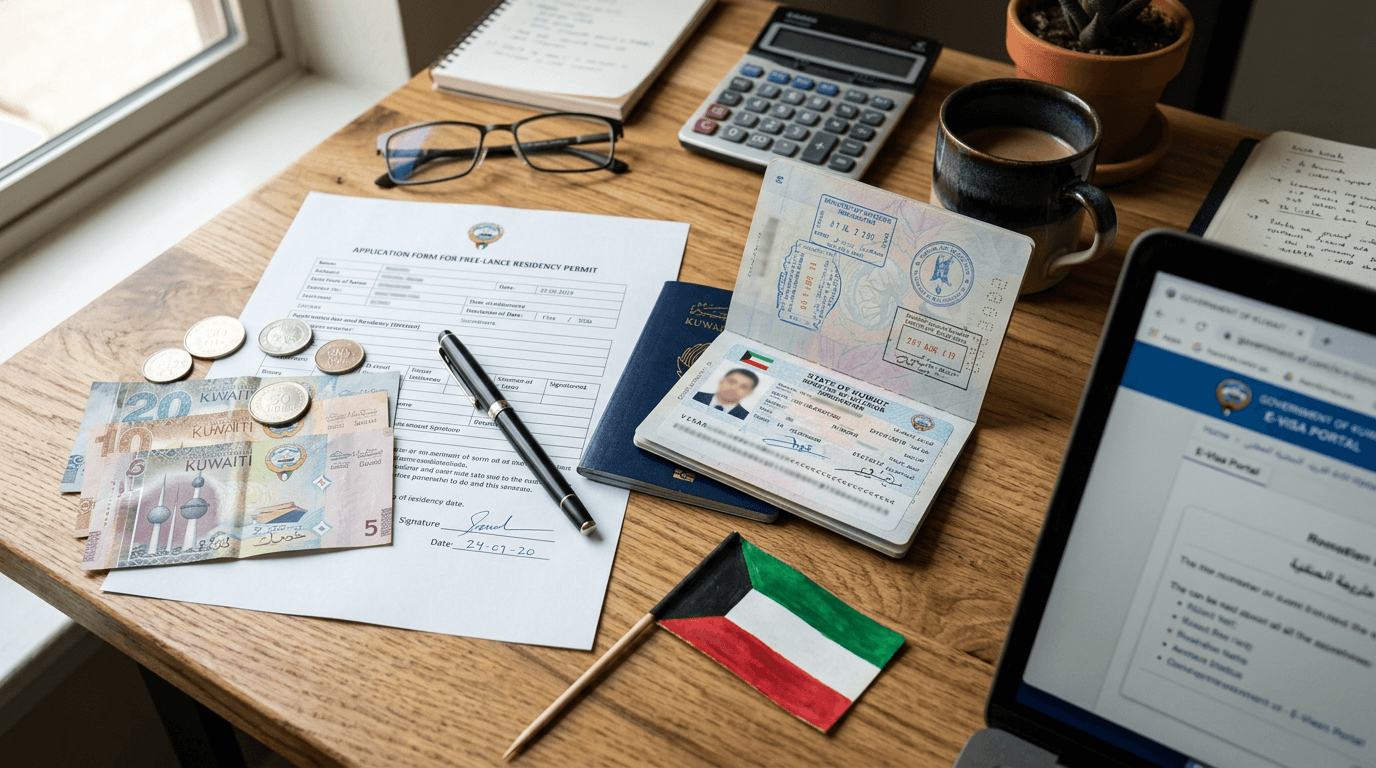
Kuwait's freelance residency permit doesn't exist yet. First Deputy Prime Minister and Interior Minister Sheikh Fahad Al-Yousef announced it on Feb. 16, 2026, as a residence for freelance work that would let foreigners work independently, without being tied to a single employer under the kafala system.
As of Sept. 23, 2026, no law, ministerial decision or Interior Ministry service creates it, so nobody can apply. The details below describe the announced proposal, not confirmation that applications are open.
The government has said the planned permit is part of a wider effort to cut down on visa trading and move payments into the official system. No eligibility rules, application steps or official fee have been published.
The announced proposal:
- Status: Announced Feb. 16, 2026, not launched. No freelance residence category exists in the Residency Law's executive regulations or among the Interior Ministry's residency services.
- Purpose: Residence for independent work in Kuwait.
- Target group: Skilled expatriates who want to open small businesses, as reported by Kuwait Times; no eligibility criteria have been published.
- Sponsorship: No traditional employer sponsor under the kafala system.
- Fee: KWD 750 to 1,000 a year, according to the minister's remarks as reported by Al-Rai; Kuwait Times reported KWD 800 to 1,000. No law or decision has enacted it.
Before planning a move or paying an intermediary, confirm the current eligibility rules, fees and application process directly with the Ministry of Interior. Existing residency services should not be assumed to be an application route for the announced freelance permit.
The two-month implementation estimate came from reports of the announcement in February 2026. That estimate has passed and should not be read as a new countdown from this page's update date. Check the Ministry of Interior's residency services for official application information.
Nobody qualifies for the freelance residence yet, because it doesn't exist. The announcement came with no published eligibility rules.
Foreigners who want to live in Kuwait without being hired by a local employer can use these routes, all set out in the Residency Law's executive regulations, Ministerial Decision 2249 of 2025:
- Residence without work (Article 24): Ordinary residence, without work, for a foreigner who proves a source of support for the whole stay. The Residency Affairs director general sets the conditions and may allow work on a letter from a government body. The Interior Ministry's Article 24 procedure lists the documents.
- Foreign partner in a licensed business (Article 19): residence for a foreigner who is a partner in a commercial or industrial activity, granted on the activity's license from the competent authority. The Interior Ministry publishes an Article 19 renewal procedure.
- Foreign investor (Article 21): residence for an investor licensed by the Kuwait Direct Investment Promotion Authority (KDIPA), granted on a KDIPA letter confirming the investor meets criteria set by the Cabinet. KDIPA publishes its investment licensing steps.
Employees hold work residence under Article 18, granted on a work permit. A freelance business license is no workaround for foreigners: Kuwaiti nationals only. The founder-manager of the one-person freelance company must be a Kuwaiti; the license runs four years.
The Kuwait country guide covers living costs and daily life for residents.
There's no document list for the freelance residence because there's no application.
The existing routes have their own Interior Ministry checklists. For first-time residence under Article 24, the ministry asks for a signed application form, a good-conduct certificate, two photos on a blue background, the applicant's original passport, birth certificates for children aged 21 or younger and health insurance.
Renewing Article 19 residence takes a work permit from the Public Authority for Manpower and a copy of the company's incorporation contract from the Ministry of Commerce and Industry, along with the application form, photos, passport and a health insurance certificate.
No fee is in force because the residence isn't. The minister's remarks put the planned fee at KWD 750 to 1,000 a year, according to Al-Rai's report of the announcement. Kuwait Times reported KWD 800 to 1,000 from the same remarks. No law or ministerial decision has set any figure.
Annual residence fees for the routes open today, from the executive regulations:
- Residence without work (Article 24): KWD 500 a year for the main applicant; KWD 100 a year for each dependent.
- Foreign partner (Article 19): KWD 50 a year; KWD 40 a year for each dependent.
- Foreign investor (Article 21): KWD 50 a year; KWD 40 a year for each dependent.
Applications aren't possible. As of Sept. 23, 2026, the Interior Ministry's list of residence services covers residence under Articles 14, 17, 18, 19, 20, 22, 23 and 24 and has no freelance category. Do not treat the February 2026 announcement or its two-month implementation estimate as confirmation that applications are now open.
People who need residence now must use an existing category through the Ministry of Interior's General Directorate of Residency. The ministry also lists Article 19 residence for a commercial or industrial activity, profession or craft, but that existing service should not be assumed to implement the newly announced permit.
Before applying for any residence, obtain official confirmation of the category, eligibility, required documents, fee, submission channel and whether the application can be made from inside Kuwait. This page does not provide an unverified application form or processing deadline.
The original two-month estimate was reported in February 2026. It has passed; it is not a current promise of a launch within the next two months. This review could not establish a replacement official launch date.
No length or renewal rule exists for the freelance residence. Reports of the announcement described a yearly fee but no permit term.
For the routes open today, the executive regulations limit ordinary residence to five years for most foreigners. Property owners and children of Kuwaiti mothers can get 10 years; foreign investors who meet the Cabinet's criteria can get up to 15 years. Residence can be renewed on application.
- Personal income tax: None. Kuwait's income tax applies only to bodies corporate doing business in Kuwait (15% of net taxable income); individuals are not taxpayers.
The rule comes from Kuwait's income tax law and holds under any residence route. Home-country tax rules may still reach income earned while living in Kuwait.
Frequently Asked Questions
Can foreigners apply for Kuwait's freelance residency permit?
No. The interior minister announced a freelance residence on Feb. 16, 2026, but as of Sept. 23, 2026, no law, ministerial decision or Interior Ministry service creates it, so there's nothing to apply for.
How much will Kuwait's freelance residency cost?
No fee has been set. The minister's remarks put it at KWD 750 to 1,000 a year, according to Al-Rai, but no law or decision has enacted that figure.
How can a foreigner live in Kuwait without being hired by a local employer?
Through an existing route: residence without work on proof of means under Article 24 (KWD 500 a year), residence as a foreign partner in a licensed business under Article 19 (KWD 50 a year) or investor residence through KDIPA under Article 21 (KWD 50 a year).
Can a foreigner get a freelance business license in Kuwait?
No. Kuwaiti nationals only. The founder-manager of the one-person freelance company must be a Kuwaiti; the license runs four years.
What personal income tax does Kuwait charge?
None. Kuwait's income tax applies only to bodies corporate doing business in Kuwait (15% of net taxable income); individuals are not taxpayers.
How It Compares
Similar visas elsewhere
| Program | Country | Income | Fee | Max stay | Renewable |
|---|---|---|---|---|---|
| Sweden Self-Employed Residence Permit | Sweden | SEK 200,000 saved | SEK 2,000 | 24 mo | |
| Finland Startup Permit | Finland | €1,210/mo | €650 | 24 mo | |
| Belgium Professional Card | Belgium | - | €140 | 24 mo | |
| Hong Kong Quality Migrant Admission Scheme (QMAS) | Hong Kong | - | HKD 600 | 36 mo |
Kuwait Digital Nomad Guide
Cost of living, internet, healthcare, coworking, and every visa option for Kuwait.
Visa rules change. We'll tell you.
Get notified about policy updates and new requirements for the Kuwait Freelance Residency (Announced, Not Launched) and other Kuwait visas.