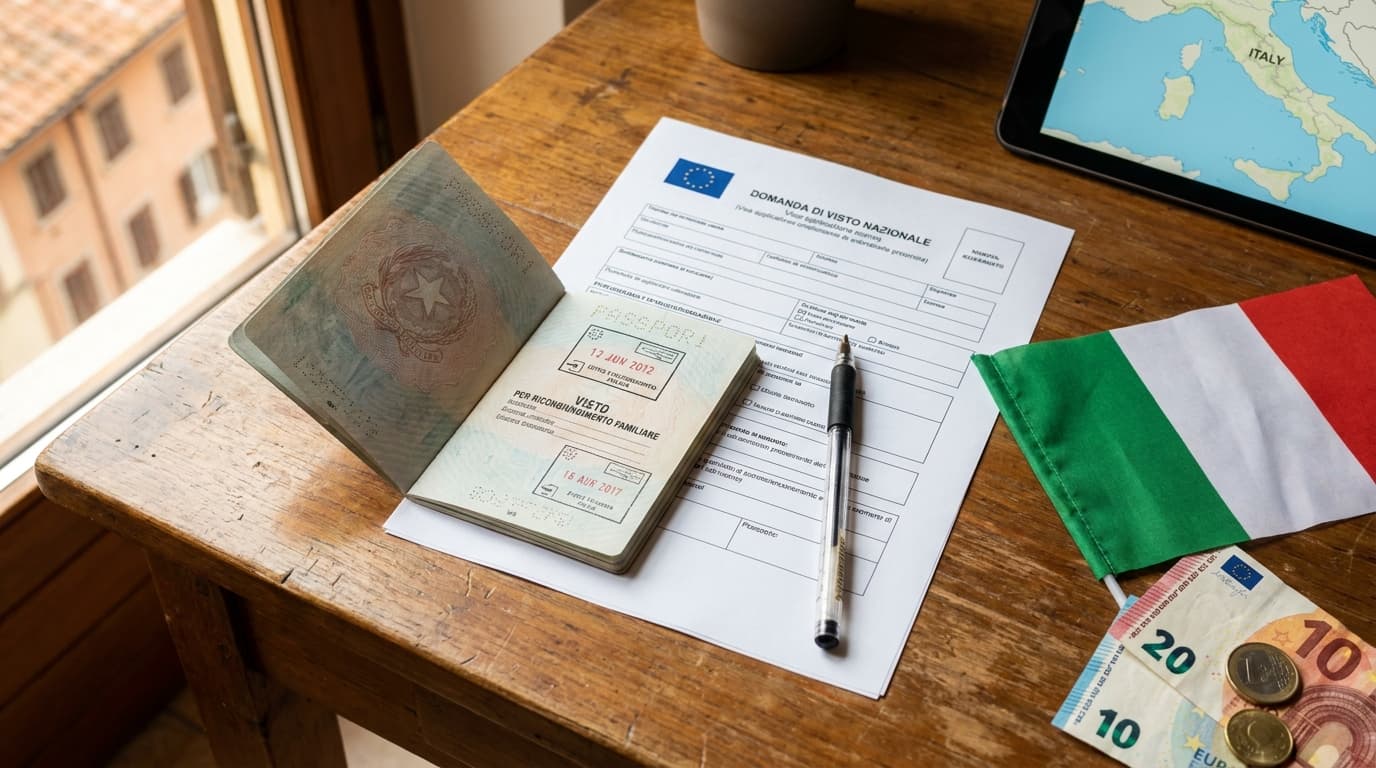
Italy Family Reunification Visa
Visa Data Sheet
- $11,500 / yr
- $125
- 60 months
Italy’s family reunification visa or ricongiungimento familiare, is the route for certain non-EU family members to join a foreigner who already lives legally in Italy. It’s not a tourist visa and it’s not meant for short visits. The whole point is family unity, then a residence permit that lets the holder live in Italy long term, work and study.
There’s also a newer national visa channel for family reasons for non-EU family members of Italian or EU citizens, used for settlement in Italy. That shift matters because the rules are getting a little tighter, not looser and some sponsors now face a stricter residence-duration requirement before they can apply.
For the standard non-EU family reunification path, the sponsor in Italy usually needs:
- Status: a long-term residence permit or a permit valid for at least one year.
- Income: adequate yearly gross income to support the family member or members.
- Housing: accommodation that meets the official standards.
Eligible family members are limited to close relatives. That typically means a spouse, unmarried minor children, dependent adult children with serious health problems and dependent parents who meet the legal conditions. This isn’t a broad family visa. Italy keeps it fairly narrow.
The process is also fixed and bureaucratic. The sponsor applies online for a nulla osta from the Sportello Unico per l’Immigrazione, then the family member applies for the entry visa at the Italian consulate abroad. After arrival, the family member must apply for the residence permit for family reasons within 8 days.
The permit is tied to the sponsor’s permit, can be renewed if the conditions still hold and gives access to employment and education. After 5 years of continuous legal residence, it can be converted into long-term residence if the income, housing and public-order checks are still in order.
That makes this visa very different from a Schengen tourist stay. A tourist visa is capped at 90 days in any 180-day period and doesn’t lead to residence. Family reunification is the path for actually living in Italy with your relative and the paperwork reflects that.
Italy’s family reunification visa, usually called the “visto per motivi familiari” or “ricongiungimento familiare”, is for non-EU family members joining a sponsor who’s already living legally in Italy. The sponsor can be a non-EU resident and in some cases an Italian or EU citizen, though those EU-based cases follow separate rules.
This isn’t a casual visitor visa. It’s a long-stay Type D visa and the family relationship has to fit the law. In plain terms, Italy is looking for close dependents, not extended relatives.
- Spouse or civil union partner: Must be over 18 and not legally separated.
- Children under 18: Including adopted children and children born outside marriage, with the right parental consent or court order where needed.
- Adult children: Only if they’re totally dependent because of a permanent disability.
- Dependent parents: Usually only if they have no other children able to support them in the home country or if serious health issues make that impossible.
Other relatives, such as siblings, nieces, nephews and in-laws, normally don’t qualify. Same-sex civil partners can qualify where the civil union is recognized under Italian law.
The sponsor also has to meet a residence test. For classic reunification, that usually means holding a valid Italian residence permit for at least 1 year and actually living in Italy. Since 2024, some prefectures have also been asking for 2 years of continuous legal residence for sponsors who aren’t protected-status holders, so don’t assume the older rule will be enough everywhere.
The money side is strict and it gets harder with each person you want to bring. The required income is tied to the annual INPS social allowance and the legal rule is the allowance plus half that amount for each family member reunited.
- 1 family member: about €10,504.46 a year.
- 2 family members: about €14,005.95 a year.
- 3 family members: about €17,507.44 a year.
- 4 family members: about €21,008.93 a year.
Those figures are based on the confirmed 2025 INPS social allowance of €7,002.97 a year. The 2026 amount should be slightly higher, but the official figure needs to be checked with the local Sportello Unico per l’Immigrazione before you file.
The Italy family reunification visa is a national visa route, so the paperwork starts before you reach Italy and gets finished again after you land. The legal sequence is straightforward, even if the forms are a pain, first the family reunification authorization or nulla osta, then the visa at the Italian consulate, then the residence permit within 8 days of arrival.
What you need for the visa application
- Completed long-stay visa form: Filled out for the family reasons visa.
- Passport photo: One recent passport-style photo.
- Passport or travel document: Valid for at least 3 months beyond your planned stay.
- Nulla osta: Issued no more than 6 months earlier.
- Proof of family relationship: Usually a marriage certificate or birth certificate.
- EU or EEA family member documents: A copy of the family member’s ID or passport plus their declaration.
- For minor children: Written permission from the other parent.
At the visa stage, the Italian consulate in New York says you should bring originals and photocopies of everything. It can also ask for extra documents, so don’t assume the checklist ends there.
What proves the family link
The consulate wants administrative proof, not a casual explanation. A marriage certificate or birth certificate is the usual starting point and if the document is foreign, expect to present it in original form and as a photocopy.
Requirements for the nulla osta
Before the visa, the sponsor has to apply online for the family reunification authorization. The EU Immigration Portal says the sponsor must show adequate income and accommodation, while UNHCR Italy says the online filing needs a SPID digital identity and two €16 tax stamps, one for the application and one affixed to the nulla osta itself.
There isn’t a single nationwide income figure listed on the official portal I checked. The threshold is tied to the sponsor’s income and family size and prefectures may spell out the details differently, so don’t rely on a random forum number.
Fees and timing
- Visa fee: The EU Immigration Portal gives a general visa cost of €116, but the Toronto consulate says the national family-reasons visa is free in some cases.
- Residence permit fee: €40 for 3 to 12 months, €50 for 12 to 24 months or €100 for long-term permits.
- Extra permit costs: €30 for the postal kit, €16 tax stamp and €30.46 issuance cost.
Once you’re in Italy, file for the residence permit within 8 days. The permit’s length matches the sponsor’s permit and after 5 years of continuous legal residence, family permit holders can usually move toward long-term residence if they still meet the rules.
The family reunification visa or motivi familiari national visa, is a Type D visa, so it’s for stays of more than 90 days. The official fee picture is annoyingly uneven, because Italy doesn't publish one single nationwide consular price for every post. The consulate that handles your application sets the exact payment amount and you’ll usually need to pay it in the local currency or exact euro equivalent the post asks for.
There is one clear exception. If you’re the family member of an EU citizen, the visa is free of charge. The official guidance also separates other family members covered under Article 3 of Decree 30/2007, whose applications are facilitated but still paid. So don’t assume every family-based case gets the same treatment.
- Consular visa fee: Required for ordinary non-EU family reunification, but the official sources don’t give one Italy-wide number.
- EU citizen family members: Free of charge.
- Residence permit fee after entry: You still have to apply within eight working days, but the official portal I checked doesn’t print the current permit-kit amount.
- Marca da bollo: A €16 revenue stamp appears in some nulla osta processes, but I couldn’t confirm that it applies to every family-reunification case.
The money test is also less tidy than applicants would like. The Ministry of Foreign Affairs says the Ministry of Interior’s economic-means rules usually apply, but the official pages I reviewed don’t give one fixed 2026 income figure for all family cases. In practice, that means the consulate or local immigration office will look at the relevant household threshold and your documents, so check the post you’re applying through before you file.
For the paperwork, budget for more than just the visa itself. The consulate pages call for the visa form, one passport photo, a passport valid at least three months beyond the planned stay, proof of the family relationship, and, where relevant, the EU citizen’s ID or declaration, plus parental consent for minors. The Boston consulate also says the nulla osta must be no more than six months old and documents should be brought in original and copy.
Italy’s family reunification visa is a two-step process and the first step happens in Italy, not at the consulate. The sponsor, meaning the family member already living legally in Italy, applies online for a nulla osta or entry clearance, through the Ministry of Interior’s Immigration One-Stop Shop. After that’s approved, the relative abroad applies for a long-stay visa for family reasons, then files for a residence permit after arrival.
The sponsor has to meet a few baseline conditions before the application goes anywhere. They need a valid Italian residence permit that’s usually valid for at least one year, suitable housing certified by the municipality and enough income to support the family member joining them. In many regions, the sponsor also needs to have lived legally in Italy for at least two continuous years before applying, though international protection holders are treated differently.
Income threshold for 2026: the benchmark is the annual social allowance of €7,101.12. For one additional family member, the required income rises to €10,651.68, then €14,202.24 for two family members. If the request covers two or more children under 14, the minimum is also €14,202.24.
To start the nulla osta request, the sponsor logs in to the Ministry portal and uploads the file online. The One-Stop Shop then calls them in for an appointment, where officials check the originals, the housing certificate and the family relationship. If everything lines up, they issue the nulla osta, which consulates usually require to be no more than 6 months old.
- Sponsor residence permit: copy of the valid permesso di soggiorno.
- Identity documents: passport copies for the sponsor and the family member.
- Family proof: marriage or birth certificates, translated into Italian, sworn and legalized or apostilled as needed.
- Housing proof: certificato di idoneità alloggiativa from the municipality.
- Income proof: payslips, tax returns, employment contracts or similar records.
Once the nulla osta is issued, the family member books an appointment at the competent Italian consulate or embassy abroad and applies in person for the type D visa for family reasons. After entering Italy, they’ll still need to apply for the residence permit. The official portals don’t give a fixed processing time for every case and that’s typical of Italian bureaucracy, so expect some waiting.
The family reunification or family reasons, national visa is issued for 365 days and allows multiple entries. That gives family members a full year to enter Italy and sort out the next step, but it doesn’t replace the residence permit you need after arrival.
Once you get to Italy, you must apply for a residence permit within 8 days. That deadline matters. The visa gets you in, but the permit is what keeps you legal while you live with your sponsor.
Renewal rules
This route doesn’t really use a special “extension” process. Instead, the residence permit is renewed through the normal police headquarters and post office kit system and the request has to be filed before the permit expires. The European Union migration guidance says the family reunification permit normally matches the sponsor’s permit, so your stay rises and falls with theirs.
The police guidance for renewal also confirms a €16 revenue stamp is part of the standard package. The official snippets we could retrieve don’t give a fixed processing time for renewal, so don’t assume it’ll be quick. Italian paperwork rarely is.
What to prepare for renewal
- Residence-permit kit: The normal issue or renewal packet from the post office.
- Supporting documents: The police ask for documents tied to the family-reasons status.
- Family-member declaration: An official police document for family-reasons renewals mentions this requirement.
- Revenue stamp: €16 for the renewal filing.
The consular checklist we could verify for the visa itself is straightforward, but still a little fussy. You’ll need the application form, a passport valid for at least 3 months beyond the intended stay, a passport photo, an invitation letter from the Italian or EU family member and civil-status documents proving the relationship, translated and legalized or apostilled as required.
The official pages we retrieved don’t confirm a special maximum stay for this route, because the permit is tied to the sponsor’s permit and then renewed through the usual process. They also don’t show a separate long-term residence shortcut for family reunification alone. If you want to stay in Italy long term, you’ll need to keep renewing on time and then qualify under a separate residence category later.
Taxes & considerations
The Family Reunification Visa doesn’t come with any special tax break. It’s an immigration status, not a tax regime, so once you’re in Italy, the normal resident and non-resident rules apply.
If you become Italian tax-resident, Italy taxes your worldwide income. If you stay non-resident, Italy taxes only Italian-source income. That distinction matters a lot, because family reunification can put you in Italy long enough to trigger tax residency even if you didn’t mean to settle there permanently.
Italian tax residency is based on whether, for more than 183 days in the tax year, you have your civil-law residence or domicile in Italy or you’re physically present in the country. Since 2024, physical presence is an independent test and the meaning of “domicile” now leans heavily on where your family and personal ties are centered. Registration with the local registry office can still matter, but it’s only a rebuttable presumption.
- If you become resident: your foreign income can be taxed in Italy, with foreign tax credits and treaty relief where applicable.
- If you stay non-resident: Italy taxes only income tied to Italy.
- Foreign assets: residents may have to report overseas bank accounts, investments and real estate through Italian tax monitoring rules.
There’s no visa-linked flat tax for family reunification holders. Any special regime would have to be claimed separately and only if you fit that regime’s own conditions. Don’t assume the visa gives you a shortcut, because it doesn’t.
Italy also has tax treaties with many countries, so the final bill depends on where your income comes from and what your home country treaty says. If you’re moving with a spouse or children and keeping income abroad, getting cross-border tax advice before your first full year in Italy is a smart move. The paperwork gets messy fast and the penalties for missed reporting aren’t friendly.
Italy Digital Nomad Guide
Cost of living, internet, healthcare, coworking, and every visa option for Italy.
Visa rules change. We'll tell you.
Get notified about policy updates and new requirements for the Italy Family Reunification Visa and other Italy visas.
