Hong Kong Quality Migrant Admission Scheme (QMAS)

At a Glance
- No minimum income. Applicants must show they can support themselves and dependents without public assistance; an annual income of HK$1 million or more is one of 12 optional General Points Test criteria.
- HK$600 one-timeNon-refundable application fee under the specified-scheme fee structure; paid by the principal applicant and by each dependant, for entry and for each extension · principal applicant and each dependent
- 36 monthsGeneral Points Test entrants; Achievement-based Points Test entrants normally get eight years
- First extension after 36 months requires proof of steps to settle, such as taking a job or setting up a business; later extensions require a contribution to Hong Kong through graduate, specialist or senior-level employment with stable income or a business of reasonable size.
- Online with the Hong Kong Immigration Department; successful applicants get an e-Visa. Applicants first meet the prerequisites, then choose the General Points Test or the Achievement-based Points Test.
- 3 weeksAbout two to three weeks once all documents and the fee are received; applies to extension of stay, no official figure for first applications · extension of stay applications
- Yes
- Yes
- Right of abode (permanent residence) after at least seven years of continuous ordinary residence.
The Quality Migrant Admission Scheme (QMAS) lets highly skilled or talented people settle in Hong Kong without a local job offer. It is active, and selection is by merit in regular selection exercises: meeting the pass mark does not guarantee approval.
- Income: No minimum income. Applicants must show they can support themselves and dependents without public assistance; an annual income of HK$1 million or more is one of 12 optional General Points Test criteria.
- Assessment: the General Points Test, with a pass mark of 6 out of 12 criteria, or the Achievement-based Points Test for people with exceptional achievements.
- First stay: 36 months under the General Points Test and 8 years under the Achievement-based Points Test.
- Work: stay is granted on time limitation only, so entrants can take a job or run a business.
- Permanent residence: possible after seven years of continuous ordinary residence.
Hong Kong has no digital nomad visa; the Hong Kong guide compares the main routes.
Every applicant must meet four prerequisites before being scored:
- Age: 18 or above when applying.
- Financial means: able to support and house themselves and any dependents without public assistance.
- Good character: no criminal record or adverse immigration record in Hong Kong or elsewhere.
- Education: normally a first degree from a recognized university or tertiary institution. Good technical qualifications, proven professional abilities or documented experience and achievements may be considered in special circumstances.
The scheme is not open to nationals of Afghanistan, Cuba or North Korea.
Applicants who meet the prerequisites then choose a route. The General Points Test scores 12 criteria, including age, education, work experience, language ability, income and business ownership; the current pass mark is 6. The Achievement-based Points Test is for people with an exceptional achievement, such as a major international award.
Dependents: a spouse or recognized civil partner and unmarried dependent children under 18 can join, if the applicant can support them without public assistance.
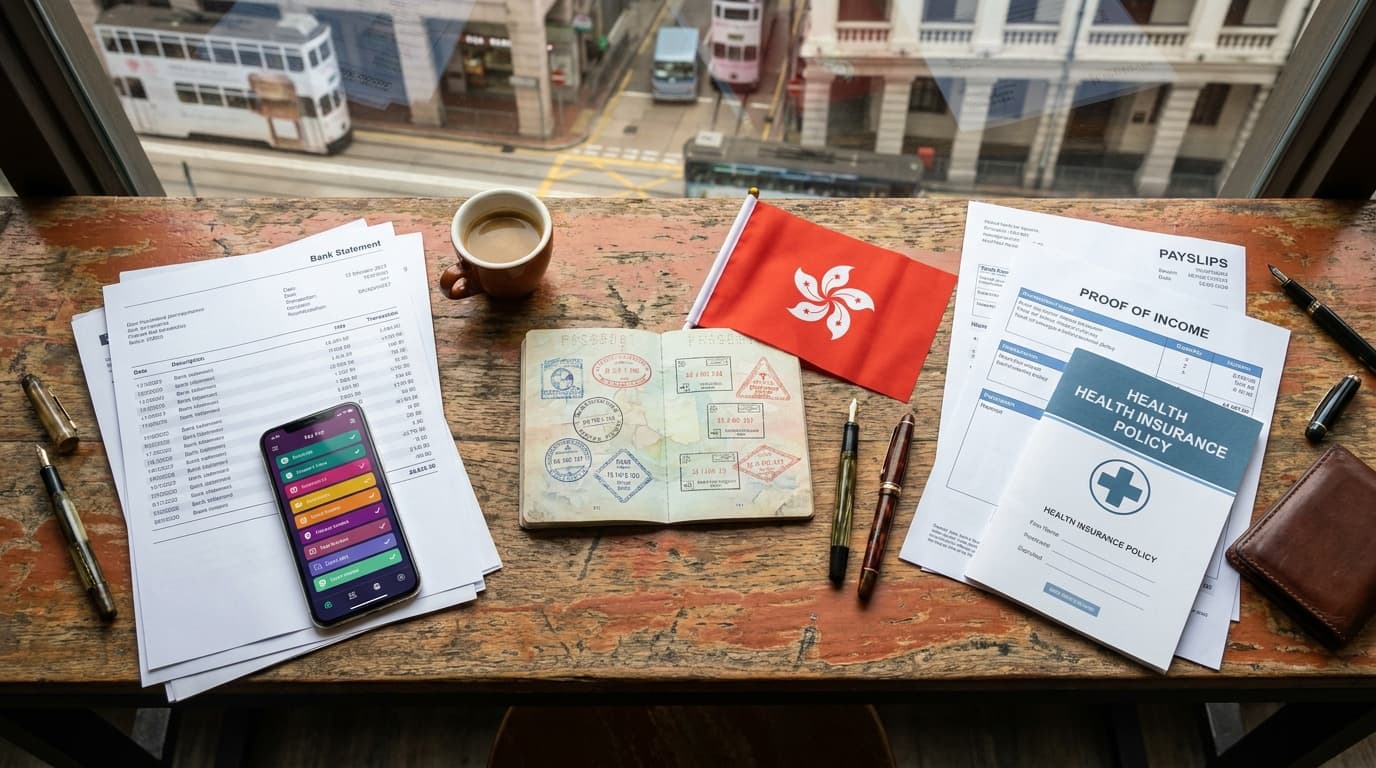
The application is made online, with supporting documents for each prerequisite and each points criterion claimed:
- a valid passport or travel document;
- degree certificates and other proof of qualifications;
- evidence of financial means, such as bank, investment or property statements;
- proof for each points criterion claimed, such as employer letters for work experience or test results for language ability;
- proof of relationship for any dependents.
The Immigration Department refuses an application at once if the documents do not show that every prerequisite is met, so the file has to be complete when submitted.
The Immigration Department charges each applicant twice, once on applying and once when the visa is issued:
- Application fee: HK$600 per person, for the principal applicant and each dependent, non-refundable. This fee level applies since Feb. 26, 2025.
- Visa fee: HK$1,300 per person for a grant of more than 180 days. A lower fee applies to grants of 180 days or less.
Both fees are charged again for each extension of stay.
Other costs, such as degree verification, certified translations and professional help, are charged by third parties and vary by provider.
Online with the Hong Kong Immigration Department; successful applicants get an e-Visa. Applicants first meet the prerequisites, then choose the General Points Test or the Achievement-based Points Test.
- Prerequisites: the applicant shows they meet the four basic requirements.
- Assessment route: the applicant is scored under the General Points Test or the Achievement-based Points Test.
- Selection exercise: applications are considered in regular rounds, and those meeting more criteria are viewed more favorably. The Director of Immigration may take advice from a high-level Assessment Panel.
- e-Visa: successful applicants receive an e-Visa to enter Hong Kong.
There is no published timeline for first applications. The Immigration Department says an application should be regarded as under processing until the applicant is notified of the result.
General Points Test entrants normally get a first stay of 36 months. Achievement-based Points Test entrants normally get 8 years.
Extensions: First extension after 36 months requires proof of steps to settle, such as taking a job or setting up a business; later extensions require a contribution to Hong Kong through graduate, specialist or senior-level employment with stable income or a business of reasonable size.
After the first 36 months, extensions normally follow a 3+2 year pattern. Entrants who have stayed at least two years and had assessable income for salaries tax of at least HK$2 million in the previous year of assessment normally get a single five-year extension instead.
Achievement-based entrants who need an extension must show they can support themselves and their dependents from their own resources.
Timing: apply within the three months before the current stay expires and at least six weeks before it ends. Extension decisions normally take about 3 weeks once the Immigration Department has every document and the fee. Unless the Director of Immigration approves otherwise, people must leave Hong Kong before their stay expires, even while an extension is pending.
Permanent residence: Right of abode (permanent residence) after at least seven years of continuous ordinary residence.
QMAS carries no special tax regime. Hong Kong taxes income by source, not by residence: salaries tax applies to employment income arising in or derived from Hong Kong, and profits tax applies to profits from a business carried on in Hong Kong. Income sourced outside Hong Kong generally falls outside both, whatever visa the person holds.
The day count that appears in tax discussions is narrower than it looks. The Inland Revenue Department issues certificates of resident status under double tax agreements to individuals who ordinarily reside in Hong Kong or who stay more than 180 days in a year of assessment or more than 300 days over two consecutive years. That test decides treaty residence; it does not decide whether salaries tax is due.
The income figures in the QMAS rules are immigration tests, not tax bands: the income criterion in the points test and the salaries tax assessment used for the five-year extension simply show the applicant's earnings.
Frequently Asked Questions
Is there a minimum income for QMAS?
No minimum income. Applicants must show they can support themselves and dependents without public assistance; an annual income of HK$1 million or more is one of 12 optional General Points Test criteria.
What score is needed to pass the General Points Test?
The current pass mark is 6 out of 12 criteria. Passing makes an applicant eligible for selection but does not guarantee approval.
Does QMAS require a job offer?
No. Applicants need no offer of local employment before applying or entering Hong Kong.
How long is the first stay?
36 months under the General Points Test and 8 years under the Achievement-based Points Test.
Can QMAS lead to permanent residence?
Right of abode (permanent residence) after at least seven years of continuous ordinary residence.
How It Compares
More Hong Kong programs
| Program | Country | Income | Fee | Max stay | Renewable |
|---|---|---|---|---|---|
| Hong Kong New Capital Investment Entrant Scheme (New CIES) | Hong Kong | HKD 30,000,000 saved | HKD 600 | 24 mo |
Similar visas elsewhere
| Program | Country | Income | Fee | Max stay | Renewable |
|---|---|---|---|---|---|
| Sweden Self-Employed Residence Permit | Sweden | SEK 200,000 saved | SEK 2,000 | 24 mo | |
| Finland Startup Permit | Finland | €1,210/mo | €650 | 24 mo | |
| Belgium Professional Card | Belgium | - | €140↓ | 24 mo | |
| Botswana Work Permit (Self-Employed and Investors) | Botswana | - | - | - |
Hong Kong Digital Nomad Guide
Cost of living, internet, healthcare, coworking, and every visa option for Hong Kong.
Visa rules change. We'll tell you.
Get notified about policy updates and new requirements for the Hong Kong Quality Migrant Admission Scheme (QMAS) and other Hong Kong visas.