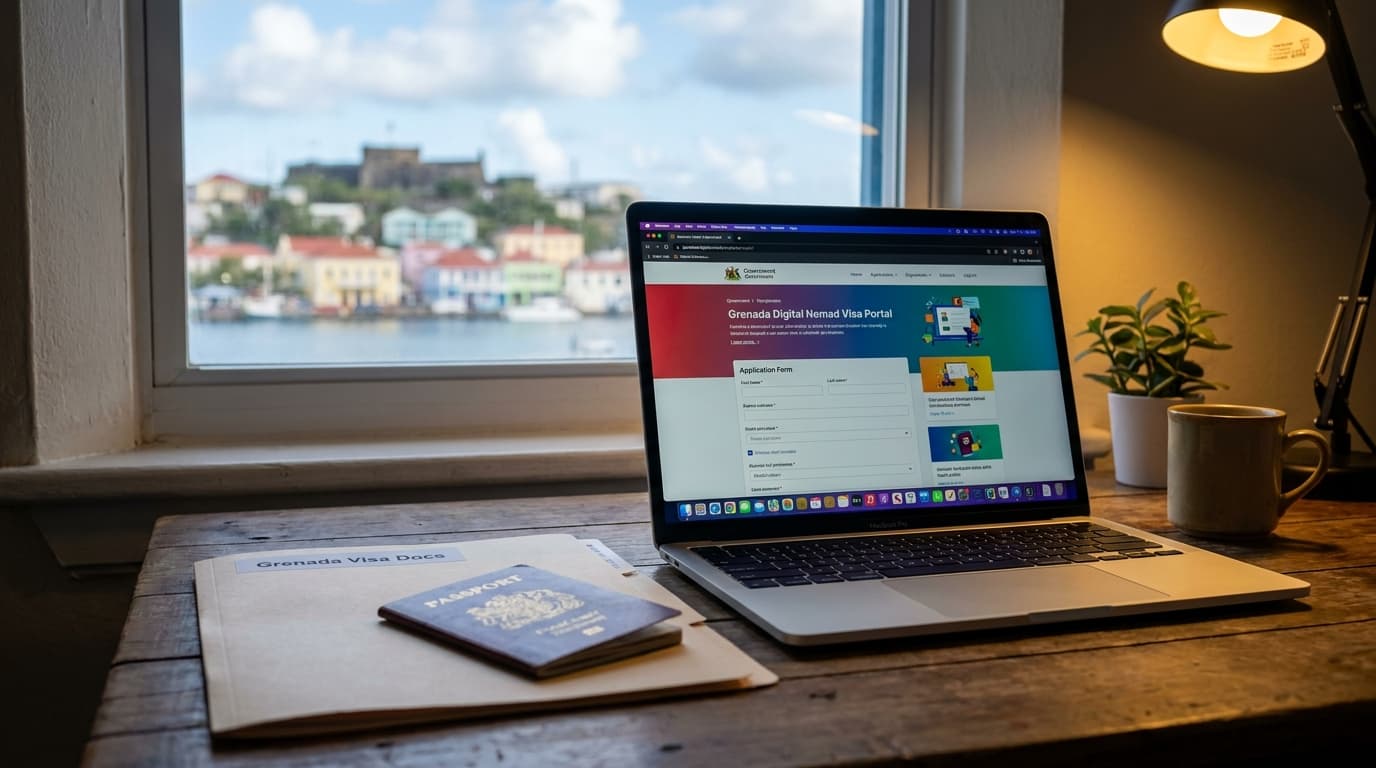
Grenada Digital Nomad Visa

Visa Data Sheet
- $37,037 / yr
- $1,500
- 24 months
Grenada does have a real remote-work permit, created under the Remote Employment Act 2021. It’s the closest thing the country has to a digital nomad visa, though there isn’t a single official web page that markets it cleanly or walks you through every step. In practice, you have to piece the details together from the law and consular practice.
The permit is meant for non-nationals who want to live in Grenada while working remotely for clients or employers outside the country. It’s not a back door into the local job market. The law says the work has to originate and relate solely to matters outside Grenada and permit holders can’t take local employment or offer paid services to people or businesses in Grenada.
There are some clear eligibility rules. You need proof of an actual annual income of at least EC$100,000 (about US$37,000) generated outside Grenada, plus proof that the income will continue during the permit period. You also need valid health insurance for the full stay and police certificates from each country where you lived in the 12 months before applying. The permit can cover dependants too, including a spouse, children, parents and some other family members.
Fees and validity are fixed in the Act:
- Individual application: US$1,500
- Individual plus up to 3 dependants: US$2,000
- Each additional dependant: US$200
- Individual renewal: US$1,400
- Renewal for individual plus up to 3 dependants: US$1,900
- Validity: up to 1 year, with a renewal of up to 1 more year
The tax treatment is a big draw. Income generated outside Grenada under the permit isn’t subject to Grenadian income tax. The law also allows conditional customs duty relief for personal household effects up to EC$75,000 CIF value and one personal motor vehicle.
There’s a tradeoff, though. This route doesn’t lead to permanent residence or voting rights and dependants can’t enroll in public schools while on the permit. If you want to switch into local employment later, you’d need to apply separately for a standard work permit.
Who qualifies
Grenada’s remote-work permit is written into the Remote Employment Act, 2021 and it’s aimed at non-nationals working for employers or clients outside Grenada. In plain English, that means you can live on the island while keeping your foreign job or freelance work, but you can’t use the permit to take a local position or sell services to Grenadian customers.
The law is also clear about who doesn’t qualify. You must not be a citizen of Grenada or a citizen of Antigua and Barbuda, Dominica, Saint Kitts and Nevis, Saint Lucia or Saint Vincent and the Grenadines. Everyone else can apply in principle, though you still need whatever entry visa Grenada normally requires for your passport.
To be eligible, you need to show at least EC$100,000 a year in income generated outside Grenada, which works out to about $37,037. The income also has to be expected to continue for the full permit period. The law doesn’t lock applicants into one exact proof format, but you should expect to show documents such as contracts, bank statements or employer letters.
The permit covers family members too, but they’re not just passengers on your application. Recognized dependants include a spouse, children under 18, legal wards, parents and grandchildren. Each dependant still needs their own passport, health insurance and, if they’re over 16, a police certificate.
There are a few hard limits that matter. Dependants can’t enroll in public schools while the permit is active and no one on the permit can work for a Grenadian employer, run a local business or provide paid services to people or companies in Grenada. If you lose your foreign job, the permit can be revoked.
- Validity: 1 year
- Application fee: $1,500 for an individual
- Family fee: $2,000 for an applicant plus up to 3 dependants
- Extra dependant fee: $200 each
- Renewal fee: $1,400
The official law exists, but the processing picture is messy. There’s no clear government portal for 2025 to 2026 applications, so don’t assume the permit is actively being issued just because the law is on the books. Check with a Grenadian embassy or the Chief Immigration Officer before you build travel plans around it.
Grenada’s official remote-work route is the Remote Employment Permit under the Remote Employment Act, 2021. It’s built for people earning money outside Grenada and the bar is clear, not subtle, your foreign-earned income needs to be at least EC$100,000 a year, which works out to roughly $37,000.
The permit is valid for up to one year and can be renewed for another year. The catch is that the paperwork has to be tidy and the government wants specific proof, not a vague freelancer story.
- Application form: Schedule I.
- Passport: A certified biodata page valid for the permit period.
- Entry visa proof: Only if your nationality needs a visa to enter Grenada.
- Income proof: Evidence that you earn at least EC$100,000 a year outside Grenada and that it’s expected to continue.
- Health insurance: Coverage valid for the full permit period.
- Police certificate: Required from the relevant country or countries.
- Fee: The prescribed application fee.
The police certificate has a specific meaning in the Act. It has to come from the national law-enforcement authority in each country where you lived during the 12 months before you apply. If your documents aren’t in English, Grenada’s labour guidance says you’ll need an English translation with the translator’s full details and a statement that the translation is true and correct.
Dependants need their own passport, visa proof if required, health insurance and the fee. You’ll also need to prove the family relationship. If a dependant is over 16, a police certificate is required too. For renewals, apply at least 30 calendar days before expiry and show that your foreign income still meets the EC$100,000 threshold.
- Individual: US$1,500 or EC$4,050.
- Individual plus up to 3 dependants: US$2,000 or EC$5,400.
- Each additional dependant: US$200 or EC$540.
- Individual renewal: US$1,400 or EC$3,780.
- Individual plus up to 3 dependants renewal: US$1,900 or EC$5,130.
- Each additional dependant renewal: US$200 or EC$540.
The Act doesn’t set a fixed processing time, so don’t plan around a promised turnaround that isn’t actually in the rules. It also doesn’t create a direct path to permanent residence or citizenship, which is a letdown if you were hoping this permit was a back door.
Grenada’s remote-work permit sits under the Remote Employment Act, 2021 and the fee schedule in the law is still the cleanest official reference. There isn’t a current government page that clearly confirms whether the program is actively being issued in 2026, so treat the figures below as the legal fees in the Act, not a promise that every application is being accepted on those exact terms.
The core costs are straightforward and the law says there aren’t any extra government service charges layered on top.
- Individual application: $1,500 or EC$4,050
- Individual plus up to 3 dependants: $2,000 or EC$5,400
- Each additional dependant: $200 or EC$540
- Individual renewal for up to 1 more year: $1,400 or EC$3,780
- Individual plus up to 3 dependants renewal: $1,900 or EC$5,130
- Each additional dependant renewal: $200 or EC$540
These fees are non-refundable. That matters, because you’ll want your paperwork in order before you pay anything.
The permit also comes with a few built-in cost savers. Foreign income earned outside Grenada isn’t taxed under the regime and the law allows conditional customs relief on personal household effects up to EC$75,000 CIF value. It also provides 100% duty remission on one motor vehicle imported under the stated conditions, which can take a big bite out of relocation costs.
Then there are the expenses the law requires but doesn’t price for you. You need health insurance valid for the full permit period and Grenada doesn’t publish a government premium cap. You also need police certificates from each country where the main applicant lived during the previous 12 months and dependants over 16 need them too. Those fees depend on the issuing country, so there’s no single official total.
That’s the annoying part of this permit, the official fee is clear, but the surrounding costs are all over the place. If you’re applying with family, the main thing to budget for is the application fee plus insurance, background checks and any notarization or translation work your documents need.
Grenada’s remote-work permit is the country’s digital nomad route and it’s open for applications under the Remote Employment Act, 2021. It’s built for non-nationals who work for employers or clients outside Grenada. The permit can run for up to one year and can be renewed once for another year if you still qualify.
What you need before you apply
The paperwork isn’t complicated, but it's picky. You’ll need to show that you earn at least EC$100,000 a year outside Grenada and that income has to continue through the permit period.
- Passport: A certified copy of the biodata page, valid for the full permit period.
- Visa evidence: Proof of a visa grant or visa application, if you need a visa for Grenada.
- Income proof: Evidence of annual income of at least EC$100,000 from outside Grenada, plus proof it will continue.
- Health insurance: Coverage valid for the full permit period.
- Police certificates: One from each country where you lived in the 12 months before applying.
- Fee payment: The prescribed application fee.
If you’re bringing dependants, you’ll also need proof of the relationship. Dependants over 16 need police certificates too. The permit doesn’t allow them to enroll in public schools and everyone on it has to keep valid health insurance.
How the application works
The official government sources don’t publish a single, clear online portal, so the process appears to run through the Immigration Department and, in some cases, Grenadian missions abroad. The law includes a standard application form in its schedule, but the exact submission route isn’t spelled out cleanly on the public-facing material.
- Step 1: Check that you meet the nationality and income rules.
- Step 2: Gather the documents listed in the Act.
- Step 3: Pay the correct fee for your category.
- Step 4: Submit the application through the Immigration Department or a Grenadian mission, depending on the route available to you.
- Step 5: If approved, keep your income, insurance and immigration status in order for the full permit period.
Fees
- Individual application: $1,500.
- Individual plus up to 3 dependants: $2,000.
- Each additional dependant: $200.
- Individual renewal: $1,400.
- Individual plus up to 3 dependants renewal: $1,900.
- Each additional dependant renewal: $200.
Don’t expect the permit to turn into residency later. The law treats permit holders as not resident for immigration and citizenship purposes, so if you want a longer-term status, you’ll need to switch into another category.
Grenada’s remote-work permit is issued for up to 1 year under the Remote Employment Act, 2021. That first permit can’t run longer than 12 months and the exact expiry date is set on the permit itself.
Renewal is possible, but you have to move early. The law says you must apply at least 30 calendar days before your current permit expires and the request has to be made in writing to the Chief Immigration Officer. The renewal application can cover the main applicant and dependants.
- Renewal period: up to 1 additional year per renewal
- Renewal timing: at least 30 calendar days before expiry
- Renewal fee for one applicant: $1,400 or EC$3,780
- Renewal fee for an applicant with up to 3 dependants: $1,900 or EC$5,130
- Each additional dependant: $200 or EC$540
You’ll need to show that you still meet the program rules. That means a passport valid for the extra period, proof of a valid visa if you need one for Grenada, proof of health insurance for the renewal period and proof that you earned at least EC$100,000 outside Grenada during the current permit year, with income continuing into the next renewal period.
The open question is how many times you can renew. The Act does not set a hard cap on renewals, so there’s no fixed maximum stay written into the law. Still, this permit doesn’t lead to permanent residency or citizenship and time spent under it doesn’t count as residence for those purposes.
That’s the part some applicants miss. Grenada’s remote-work permit is a temporary stay arrangement, not a back door to long-term status. If you want permanent residence or citizenship, you’ll need a different immigration route.
Grenada’s tax rules don’t give digital nomads a magic carveout, at least not in the official material I could verify. The Inland Revenue Division says a person is a tax resident if they spend more than 183 days a year in Grenada, so your stay length matters a lot more than the visa label on your passport stamp.
The same tax office uses G-TAX for registration, filing, payments, refunds, tax-clearance requests and account updates. If you become a taxable person, that portal is where the paperwork lives and the government says you’re expected to keep records for 7 years.
What the official guidance does and doesn’t say
Here’s the annoying part, the government pages I found don't clearly say that the Digital Nomad Visa creates a special tax status or an exemption for foreign income. I also couldn’t verify a DNV-specific tax holiday, reduced rate or separate residency test.
The Inland Revenue Division does confirm ordinary tax administration, including personal income tax collection through PAYE for employee payments. But it doesn’t spell out, in the sources reviewed, whether foreign-earned income for DNV holders is exempt, taxed or treated some other way. So if someone tells you “remote work income is tax-free in Grenada,” treat that as unconfirmed unless you get written advice.
Treaties, reporting and admin
Grenada says it participates in CRS and FATCA information exchange and its tax portal confirms a Model 1B FATCA arrangement. The official material also says all individuals and businesses get a TIN when they register with the Inland Revenue Division.
- Tax residence trigger: more than 183 days in Grenada in a year
- Filing and payments: handled through G-TAX
- Record retention: keep tax records for 7 years
- Penalties: late or missing filing and payment can bring penalties and interest
- Information exchange: CRS and FATCA are both in play
There is a confirmed double-taxation arrangement with the UK, but I couldn’t verify a full official treaty list from the Grenadian sources reviewed. If you expect to stay close to or beyond the 183-day mark, get local tax advice before you assume the visa protects you from filing duties.
How It Compares
More Grenada programs
| Program | Country | Income / month | Fee | Max stay | Renewable |
|---|---|---|---|---|---|
| Grenada Citizenship by Investment | Grenada | - | $1,500 | - |
Similar visas elsewhere
| Program | Country | Income / month | Fee | Max stay | Renewable |
|---|---|---|---|---|---|
| Georgia Digital Nomad Program (Remotely from Georgia) | Georgia | - | - | - | |
| Kyrgyzstan Digital Nomad Status | Kyrgyzstan | - | - | 12 mo | |
| Kenya Class N Permit | Kenya | - | $200↓ | 24 mo | |
| Nepal Digital Nomad Visa (Not Yet Open) | Nepal | - | - | - |
Grenada Digital Nomad Guide
Cost of living, internet, healthcare, coworking, and every visa option for Grenada.
Visa rules change. We'll tell you.
Get notified about policy updates and new requirements for the Grenada Digital Nomad Visa and other Grenada visas.