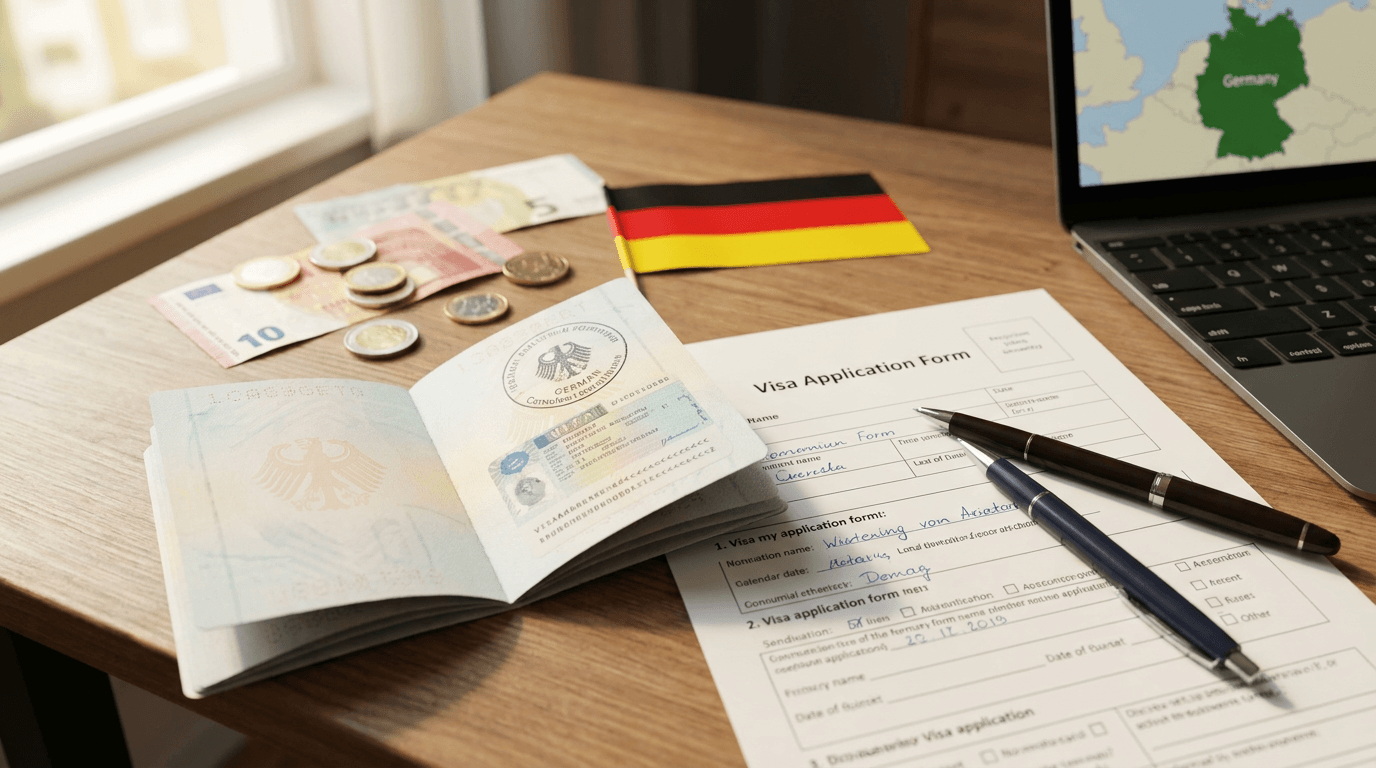
Germany Opportunity Card (Chancenkarte)
Visa Data Sheet
- $14,150 in savings
- $140 – $190
- 4 weeks
- 36 months
Germany’s Opportunity Card or Chancenkarte, is a residence permit for qualified non-EU nationals who want to come to Germany first and look for skilled work on the ground. It’s not a tourist visa and it’s not a remote-work loophole. The point is job search and in some cases qualification or recognition measures tied to that job search.
The permit sits under sections 20a and 20b of the German Residence Act and grew out of Germany’s Skilled Immigration Act reforms. Official guidance describes it as a new residence title for people coming to Germany to find qualified employment. That’s the big difference from a Schengen stay, which allows short visits but not a proper job hunt with local work rights.
There are two main ways in. The first is for people who already count as skilled workers under German law, usually because their foreign or German degree or vocational qualification is recognized or comparable. The second is the points-based route for applicants with state-recognized training abroad, basic German or good English and enough points to qualify.
- Typical validity: Up to 1 year initially.
- Work allowed: Secondary employment up to an average of 20 hours a week.
- Trial work: Up to 2 weeks per employer in a qualified role.
- Extension: It can be extended by up to 2 more years if the search leads toward a qualified job and the Federal Employment Agency approves it.
That limited work permission matters. You can’t treat it like a full work permit, but you’re not stuck doing nothing either. Germany also allows the card to be used for recognition-related qualification measures, which can help if your foreign credentials still need some German paperwork before they’re accepted.
The catch is livelihood. Official guidance says you have to show you can support yourself for the stay, either from your own funds or a declaration of commitment. The federal sources don’t give one fixed nationwide amount in the material reviewed here, so don’t assume a blog’s blocked-account figure is automatically the rule.
Once you land a suitable job, you can usually switch into a regular work residence title, such as the EU Blue Card or another skilled-worker permit, if you meet the conditions. That’s why the Opportunity Card is useful. It gives you a legal way to search locally without having a contract lined up before you arrive.
The Germany Opportunity Card or Chancenkarte, is built for non-EU, non-EEA and non-Swiss nationals who want to come to Germany and look for skilled work. It’s a 1-year residence permit under section 20a of the Residence Act. It’s not a loose “come try your luck” permit and it doesn’t replace a work visa once you land a job.
You qualify in one of two ways. The first route is the cleaner one: you’re already a skilled worker with a foreign vocational or academic qualification that’s fully recognized in Germany or you earned a vocational qualification or degree in Germany. If that’s you, you don’t need to go through the points system.
The second route is for applicants whose qualification isn’t fully recognized yet. In that case, your vocational or academic training must be officially completed, recognized in the country where you earned it and, for non-academic vocational training, last at least 2 years. Then you need at least 6 points under Germany’s system.
- Financial means: You need proof of €1,091 per month or €13,092 for 12 months.
- Language: Option 2 requires at least German A1 or English B2. Option 1 has no mandatory language rule, though German helps.
- Age points: 2 points if you’re 35 or younger, 1 point if you’re 35 to 40.
- Work experience: Extra points are available for post-qualification experience, especially in shortage occupations.
- Other boosts: Partial recognition of your qualification, previous legal stays in Germany and a spouse or life partner who also qualifies can all add points.
The money side is where a lot of applications get stuck. The official options include a blocked account, bank statements from the last 3 months, a formal declaration of commitment or a part-time German work contract of up to 20 hours a week. No official source gives a fixed USD equivalent, because the amount moves with the exchange rate.
The permit is meant for job hunting, but it isn’t passive. You can take part-time work in Germany for up to 20 hours a week and do job trials of up to 2 weeks per employer. The official guidance also says you may become self-employed, though it doesn’t spell out a separate self-employment route here.
There isn’t a fixed nationality list or quota. If you’re a non-EU applicant, the real question is whether your credentials, language level and funds get you to the threshold.
The Chancenkarte or Opportunity Card, is a 1-year residence title for qualified non-EU nationals who want to come to Germany to look for work. The paperwork is fairly specific. You’ll need to show formal qualifications, meet the language or skilled-worker route and prove you can support yourself without leaning on the German system.
The money side is the part that trips people up. The official 2026 threshold is €1,091 per month or €13,092 for a full year. Germany accepts a blocked account, a declaration of commitment from a sponsor in Germany or recent bank statements showing enough funds. A part-time work contract in Germany, up to 20 hours a week, can also count if it covers the requirement.
For the visa file, the core documents usually include:
- Application form: Fully completed and signed, plus any required declaration.
- Passport photo: One recent biometric photo that meets German standards.
- Passport: Valid for at least 3 months beyond your stay, issued within the last 10 years and with at least two blank pages.
- Proof of legal residence: Required if you apply outside your home country, depending on the mission’s rules.
- Proof of qualifications: Your vocational or academic credentials, plus recognition documents if you’re using the skilled-worker route.
- Proof of language skills: German A1 or English B2 if you’re applying through the points system.
- Proof of funds: Blocked account, bank statements, sponsorship letter or qualifying part-time contract.
- Health insurance: Coverage for your stay, since you can’t just show up with vague travel insurance and call it done.
The visa fee for a national long-stay visa is €75, usually payable in local currency at the consulate’s rate. The official portal doesn’t give a fixed processing time and that’s annoying but normal for Germany. Missing documents can slow things down or get the file bounced back entirely.
Two routes exist. The first is the skilled-worker route, for people with a fully recognised qualification or a qualification earned in Germany. The second is the points system, which requires at least 6 points and a mix of qualifications, language ability, age, experience and other factors. If you get the card, you can work part-time for up to 20 hours a week and do job trials of up to 2 weeks per employer while you search.
The Opportunity Card isn’t cheap, but the headline number is only part of the bill. The direct visa fee is usually €75 for the national D visa at the German mission, then you’ll pay a separate fee once the residence permit is issued in Germany.
That local permit fee depends on how it’s issued. Berlin’s official fee schedule lists €100 for an electronic residence permit after entry on a national D visa or €56 if it’s issued as a passport sticker. Some local offices may vary slightly, so check your Ausländerbehörde before you budget tightly.
The bigger cost is the money you need to prove you can support yourself. The official checklist requires €1,091 a month or €13,092 for one year. That’s not a fee, but you do need to show it through a blocked account, recent bank statements, a formal obligation or a German part-time work contract covering up to 20 hours a week.
- Visa fee: usually €75 paid at the German mission
- Residence permit fee: usually €100 for an electronic card or €56 for a sticker in Berlin
- Proof of funds: €13,092 minimum, held or shown in acceptable form
- Health insurance: required for entry and the whole stay, with premiums set by the insurer
Health insurance can add a noticeable monthly cost and Germany doesn’t publish a fixed price for it. Market rates for job-seeker style coverage often run around €40 to €100 a month, but that depends on age, length of stay and the policy you pick. You’ll also need to budget for certified translations, recognition checks and, if you use one, legal or relocation help.
Those extra costs are where the application gets annoying. They’re not set by the government and they can stack up fast if your documents need translation into German or you need a Statement of Comparability from the Central Office for Foreign Education. If you’re applying with family, ask your local German mission about each dependent’s fee, because there isn’t a clear Chancenkarte-specific family fee table in the official materials.
The Chancenkarte is Germany’s one-year residence permit for non-EU nationals who want to enter the country and look for qualified work or do certain recognition measures. If things go well, it can be extended for up to two more years in specific cases, so the total can reach three years.
You can apply in two ways. If you’re outside Germany, you usually start online in the Federal Foreign Office’s Consular Services Portal and then finish the process at the German embassy or consulate that handles your place of residence. If you’re already legally in Germany with another valid residence title, you apply at your local foreigners’ authority, the Ausländerbehörde.
How the application works
- Step 1: Run the official self-check first. It helps you see whether you likely meet the qualification, language, points and financial rules.
- Step 2: Create an account in the Consular Services Portal and start the national visa application online.
- Step 3: Upload scanned copies of your documents, then wait for the mission to review your file for completeness.
- Step 4: Book your in-person appointment once you get the go-ahead. At the appointment, they verify your identity, take biometrics and keep your passport and originals for review.
- Step 5: Pay the visa fee at the mission. The standard fee for a German national visa is €75 ($81), usually paid in local currency at the mission’s rate.
The money side is straightforward, if not cheap. For 2026, you need to show €1,091 net per month ($1,180) in a blocked account or through a formal declaration of commitment. For a full 12-month stay, that comes to €13,092 ($14,150).
Processing times aren’t fixed by a central portal, which is annoying but typical for German bureaucracy. One mission says applications need a minimum of 4 weeks and the official guidance says timing can vary by embassy workload. Don’t assume you’ll get it fast.
Who can apply
The card is aimed at non-EU, non-EEA and non-Swiss nationals who either have a vocational or academic qualification recognized in Germany or have a foreign qualification plus language skills and at least 6 points in the points system. Once approved, the permit lets you work up to 20 hours a week and do job-trial placements of up to 2 weeks per employer.
The Opportunity Card isn’t a forever permit and it doesn’t turn into permanent residency on its own. It’s a temporary residence title under Section 20a of the Residence Act, meant to get you into Germany so you can search for work, then switch into a regular skilled-worker permit if things go well.
The initial search phase is issued for up to 12 months if you can prove your living costs are covered for that period. The official guidance allows a shorter stay too, so don’t assume you’ll get the full year. In practice, the immigration office can set a shorter validity if your finances only cover part of the period.
- Initial validity: Up to 12 months for the job-search phase.
- Work allowed during this phase: Part-time work up to 20 hours per week and job trials of up to two weeks per employer.
- Purpose: Job search or recognition-related measures for a foreign qualification.
There’s no open-ended renewal path for the pure job-search card. If your year runs out and you still haven’t landed a qualified job offer, you generally can’t just extend it and keep looking. That’s the annoying part, but it’s also how the system is written.
The main follow-on route is the so-called follow-up Opportunity Card. It can be granted for up to 24 more months, but only if you already have an employment contract or binding job offer for qualified work and you still don’t meet every condition for a standard work residence title.
- Follow-up card: Up to 24 additional months.
- Main trigger: A qualified job offer or contract already in hand.
- Typical use case: You’re close to qualifying for a regular work permit, but need more time for recognition or experience.
Put together, the Opportunity Card can cover a maximum of 36 months under this legal route, counting the initial year and the follow-up period. After that, there’s no further extension under Section 20a. If you want to stay longer, you’ll need to switch into a standard work residence title and that’s the real bridge to permanent residency and, later, citizenship.
Official guidance doesn’t spell out a nationwide break period for reapplying after you’ve used up the card. So if you’re planning around a second application, don’t guess, check the current rules with the competent immigration office before you leave the country.
The Chancenkarte doesn’t get you a tax break. Holders are taxed under Germany’s normal income-tax rules and the visa itself doesn't create a special rate or a reduced regime. What matters is your tax residency, not the sticker in your passport.
If you register an address and actually live in Germany, you’ll usually be treated as a German tax resident with unlimited tax liability. In plain English, that means Germany can tax your worldwide income, subject to the usual double-taxation treaty rules. The Opportunity Card is meant for up to one year in Germany, so most holders will trip the residence test pretty quickly.
There’s no separate filing system for Chancenkarte holders, either. If you earn income while in Germany, you may need to file a German tax return, especially if you have foreign income, self-employment income or want to claim treaty relief and deductions. Germany’s tax office looks at where you live and where the income comes from, not whether you entered on an Opportunity Card.
- Tax residency: Based on Wohnsitz or habitual abode in Germany, not visa type.
- Foreign income: Usually taxed under Germany’s double-taxation treaties, either through exemption with progression or a foreign tax credit, depending on the treaty.
- Reporting: Residents often need to file an annual income-tax return if they have foreign income, self-employment income or want treaty relief.
The part people miss is the money proof for the visa itself. To get the Opportunity Card, you must show €1,091 per month or €13,092 per year, through a blocked account, bank statements, a formal obligation letter or a part-time job contract. That’s an immigration requirement, not a tax rate and it doesn’t stop Germany from taxing income once you’re resident.
There’s also no official guidance carving out a lighter tax treatment for Opportunity Card holders. So if you’re planning to do remote work, freelance or earn from abroad while staying in Germany, assume the standard rules apply and check the treaty between Germany and your home country before you file anything.
Germany Digital Nomad Guide
Cost of living, internet, healthcare, coworking, and every visa option for Germany.
Visa rules change. We'll tell you.
Get notified about policy updates and new requirements for the Germany Opportunity Card (Chancenkarte) and other Germany visas.
