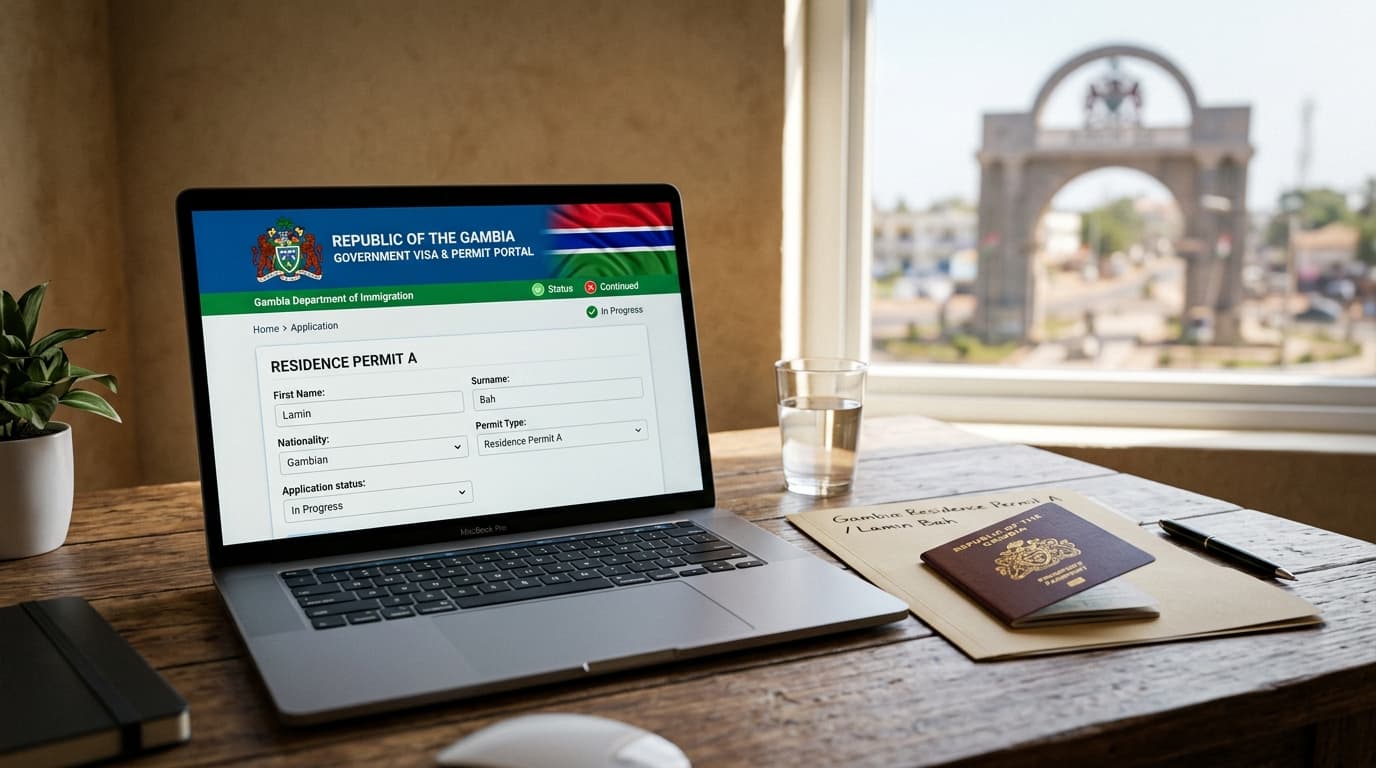
Gambia Residence Permit A

At a Glance
- No fixed amount published; applicants must show they can support themselves without working in The GambiaGID lists no income threshold for Permit A; the entry requirements page asks for visible means of sustenance
- GMD 5,700 one-timeGID prescribed non-refundable fee; includes D2,500 for the Alien Card issued to non-ECOWAS residents · non-ECOWAS nationals aged 18 and over
- GMD 3,100 one-timeGID prescribed non-refundable fee · ECOWAS nationals aged 18 and over
- Renewable; a renewal application includes the prior year residential permitGID required documents list
- In The Gambia after admission, at a GID issuing center: forms and receipts from VISTA Bank at the center, the form countersigned by a Justice of the Peace, then an interview and biometric enrollmentGID processing cycle for residence permits
- NoPermit A is for residence without gainful employment; working needs Permit B
- YesChildren and direct dependents of a valid permit holder are covered by the permit; on reaching adulthood they need a permit in their own category
Last checked Oct. 9, 2026
Residence Permit A is The Gambia's residence permit for foreigners who intend to live in the country without taking any gainful employment there. The Gambia Immigration Department (GID) says it usually goes to foreign students, retirees and people on a short business visit or mission.
- Status: active; GID lists it with a current fee schedule
- Type: a biometric residence card for residents aged 18 and over; non-ECOWAS nationals also receive an Alien Card
- Work: not allowed; living and working in The Gambia needs Residence Permit B
- Re-entry: a valid holder may not need a visa to return after leaving the country
GID lists no permit for remote workers and does not say how remote work for an employer abroad is treated. Entry rules, costs and places to live are covered in the guide to The Gambia.
GID issues Permit A on application to the Director General by a person who declares an intention to reside in The Gambia without gainful employment (GID).
Waiting period: non-ECOWAS nationals must reside in The Gambia for up to 56 days after admission before a permit can be issued. ECOWAS nationals become eligible after up to 90 days (GID).
Means: No fixed amount published; applicants must show they can support themselves without working in The Gambia. GID's entry rules ask visitors for visible means of sustenance (GID entry requirements).
Local work allowed: No. GID says it is an offense for a non-citizen to take up gainful employment without a residence and work permit.
Family: Yes. Children and direct dependents of a holder are covered by the permit; once they become adults, they must apply for a permit in their own category (GID).
GID lists these documents for residential permits (GID):
- A passport.
- A document establishing status and identity.
- An attestation from an embassy or high commission.
- For renewals, the prior year residential permit.
GID does not say which documents prove status and identity or what the attestation must contain, so applicants should confirm both with the issuing center and their embassy. The application form itself comes from the bank at the issuing center (see the application steps).
- Non-ECOWAS nationals: GMD 5,700, which includes GMD 2,500 for the Alien Card (GID).
- ECOWAS nationals: GMD 3,100.
GID calls these fees nonrefundable and subject to change. They are paid in dalasi through VISTA Bank at the issuing center, and GID publishes no dollar price. Travel to the issuing center, document attestation and any legal help come on top.
The application is made in The Gambia after admission, at a GID issuing center. GID describes no online application and no application from abroad (GID).
- Get the application form and pay at the VISTA Bank outlet in the issuing center; the bank collects the fees for the government and issues forms and receipts.
- Have the form countersigned by a Justice of the Peace appointed by the Ministry of Justice.
- Attend an interview with approving officers, who confirm nationality and check the details against the supporting documents. They can ask for more proof.
- Once approved, give fingerprints, photographs and other personal data for enrollment.
- Collect the card from the local station; cards are printed centrally in Kanifing.
A visitor whose first permitted stay ends before the permit can be issued must apply for an extension of stay at a designated immigration office. Overstaying is an offense. GID publishes no processing time.
- Validity: GID does not publish a validity period. Its renewal checklist asks for the prior year residential permit, so holders should plan to renew every year (GID).
- Renewal: Renewable; a renewal application includes the prior year residential permit.
- Longer residence: GID describes no path from Permit A to permanent residence or citizenship.
- Dependents: children covered by a holder's permit need their own permit once they become adults.
No special tax regime for permit holders; residents of The Gambia are liable to employment income tax on employment income earned outside the country, subject to the foreign source rule (Gambia Revenue Authority).
The Gambia Revenue Authority treats an individual who resides in The Gambia for at least 183 days during the tax year as resident (GRA withholding tax guide).
The GRA brochure does not explain the foreign source rule, so holders with income from abroad should confirm their position with the GRA or a tax adviser in The Gambia.
Frequently Asked Questions
Does Residence Permit A allow work in The Gambia?
No. Permit A is for residence without gainful employment. Working in The Gambia needs Residence Permit B.
How much does Residence Permit A cost?
GMD 5,700 for non-ECOWAS nationals, including the Alien Card, and GMD 3,100 for ECOWAS nationals. GID says the fees are nonrefundable.
Can the permit be applied for from abroad?
GID describes only an in-country process. Non-ECOWAS nationals must first reside in The Gambia for up to 56 days after admission.
Is there a minimum income?
No fixed amount published; applicants must show they can support themselves without working in The Gambia.
How long is the permit valid?
GID publishes no validity period. Renewal applications include the prior year residential permit, so holders renew every year.
How It Compares
Similar visas elsewhere
| Program | Country | Income | Fee | Max stay | Renewable |
|---|---|---|---|---|---|
| Liechtenstein Financially Independent Residence Permit | Liechtenstein | CHF 2,600/mo | CHF 1,060↓ | 12 mo | |
| Italy Elective Residence Visa | Italy | €31,000/yr | €116↓ | 12 mo | |
| Dominican Republic Pensionado / Rentista | Dominican Republic | $1,500/mo | $200↓ | 12 mo | |
| Lebanon Income-Based Residency Permit | Lebanon | LBP 50,000,000/mo | LBP 18,000,000 | 12 mo | - |
Gambia Digital Nomad Guide
Cost of living, internet, healthcare, coworking, and every visa option for Gambia.
Visa rules change. We'll tell you.
Get notified about policy updates and new requirements for the Gambia Residence Permit A and other Gambia visas.