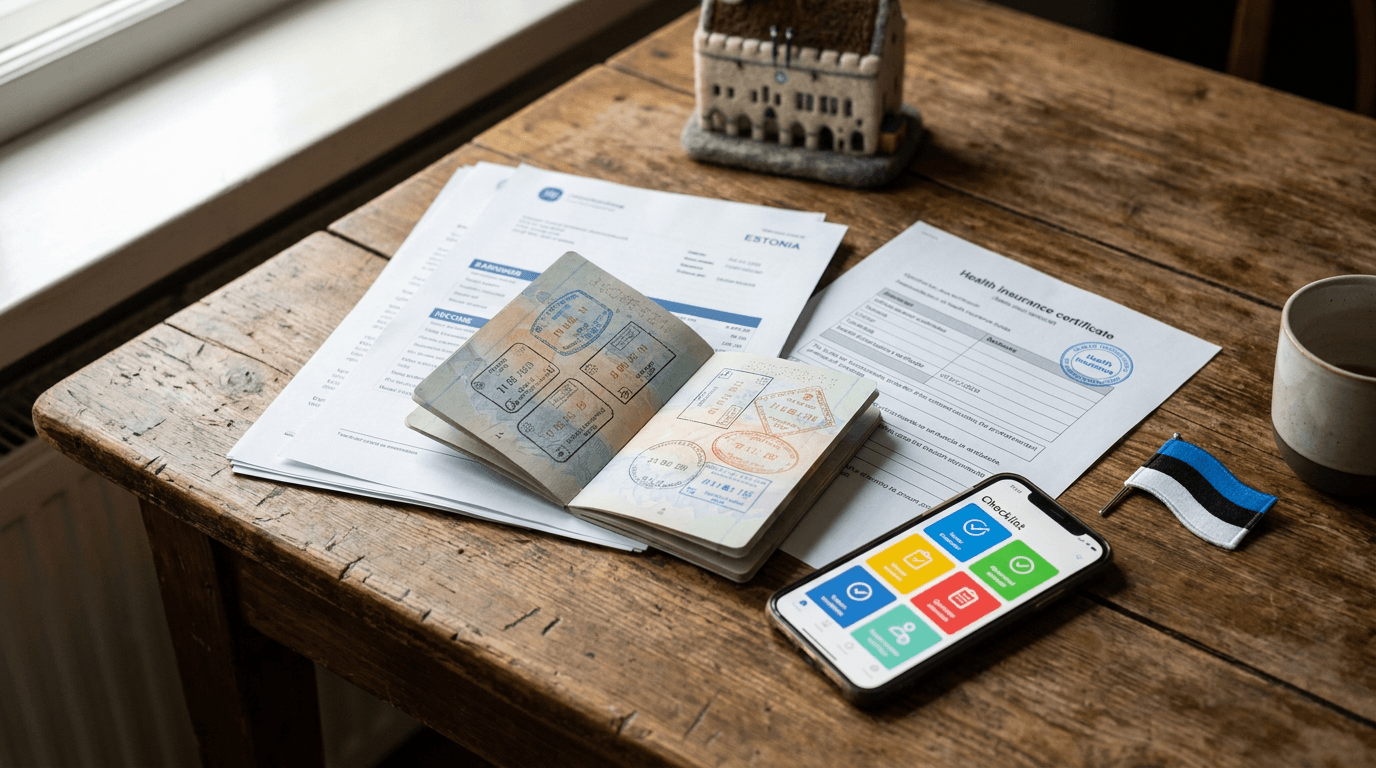
Estonia Startup Visa
Visa Data Sheet
- $872 / mo
- $131
- 13 weeks
- 180 months
Estonia’s Startup Visa is built for non-EU founders and startup team members who want to move to Estonia and build an innovative company with international growth potential. It’s not a tourist permit with startup branding attached. The visa is tied to a real business and the company has to clear an expert review before you can use the route.
The program sits between short-term entry and full business residence. In practice, you usually start with a long-stay D-type Startup Visa, then move into a temporary residence permit for business if the startup keeps qualifying. That’s the part people care about, because it gives you a legal base to actually work on the company in Estonia instead of just visiting and making plans.
Eligibility is narrow on purpose. The route is for non-EU, non-EEA and non-Swiss nationals who are founders or early employees of a startup that’s innovative, scalable and built for international growth. Conventional local businesses usually don’t fit. A café, corner shop or small agency with no real growth model isn’t what this program is for.
The first gate is the Startup Committee, an expert body under the Ministry of the Interior. Your startup has to be positively evaluated unless it’s already on the list of pre-approved startups, which is a nicer path, but not something most applicants get to rely on.
- Startup evaluation: The company is reviewed first and the committee typically issues a decision within 10 working days once the application is complete.
- Startup Visa: After approval, founders and team members can apply for a long-stay D-type visa to enter and live in Estonia while working on the startup.
- Residence permit: For a longer stay, startup entrepreneurs can apply for a temporary residence permit for business, which can be granted for up to 5 years.
The official Startup Visa process is handled through Estonia’s government-backed startup channels, then supported by the Police and Border Guard Board for residence matters. The paperwork is real, the committee review is real and the route is meant for people building something that can grow, not just people who want a cheaper place to sit with a laptop.
Who qualifies
Estonia’s startup-visa route is for non-EU, non-EEA and non-Swiss founders and startup team members. If you’re a citizen of an EU member state, Iceland, Liechtenstein, Norway or Switzerland, this permit path isn’t for you.
The business itself has to pass muster too. The company must be registered in the Estonian Business Register and positively evaluated by the expert committee, unless you’re exempt from that step. You also need a holding in the company, so this isn’t meant for passive advisors or people with no real stake in the startup.
Financially, the bar is clear but not especially generous. You need income equal to four times the subsistence level in Estonia and you need medical insurance. The official portal says you confirm sufficient income by signing the application, so the paperwork trail is lighter than some other visa routes, but the underlying income test still applies.
After approval, the move is real, not symbolic. You’re expected to come to Estonia and register your place of residence in the Population Register.
- Nationality: Only applicants who aren't citizens of the EU, Iceland, Liechtenstein, Norway or Switzerland need this residence permit.
- Company status: The startup must be registered in Estonia and positively evaluated by the expert committee, unless exempt.
- Ownership: You need a holding in the company.
- Income: You must show income at four times the subsistence level.
- Insurance: You need a medical insurance policy.
The official application package is pretty specific about the paperwork, but the portal doesn’t publish every number in the same place. For example, the exact euro amount tied to the subsistence-level test isn’t listed in the retrieved official sources, so it’s safer to work from the formula than guess at a figure.
Timing is more predictable than the money side. The expert committee gives its opinion within 10 working days after it receives a complete application, the Police and Border Guard Board says you should get a decision within 2 months and the residence card is issued within 30 days after approval.
- Application form: Temporary residence permit application form.
- Identity details: Biographical data, details of close relatives and family members, an additional form and an identity document.
- Photo and fee proof: Digital photo and document certifying payment of the state fee.
- Startup review: The expert committee application number.
- Business plan: In Estonian or English, with the sole proprietor’s details, a description of the business idea, financial forecasts for the next 2 financial years, the CV and a justification for settling in Estonia for business.
This is a temporary residence permit, not a one-off stamp. It can be valid for up to 5 years and can be extended for up to 10 years at a time.
Estonia’s Startup Visa starts with a committee decision, then moves into the visa or residence-permit stage. For the long-stay D visa, you’ll need the standard national visa package plus the Startup Committee’s confirmation letter. The paperwork is manageable, but it’s picky and missing one item can slow everything down.
What you need for the D visa
- Passport: Issued within the past 10 years, with at least two blank pages and validity for at least three months after the visa expires.
- Visa application form: Completed online, then printed and signed as instructed.
- Startup Committee confirmation letter: This is the approval that shows your startup meets Estonia’s criteria.
- Photo: One color photo, 35 x 45 mm.
- State fee receipt: Proof of payment for the €120 D-visa fee.
- Health insurance: Valid for Estonia or the Schengen area, with at least €30,000 in coverage for the full stay.
- Proof of funds: At least €800 per month.
- Accommodation: Confirmation of planned housing in Estonia.
- Travel booking: Evidence of your trip to Estonia.
- Personal forms: Biographical data, family details and any other form requested by the embassy or Police and Border Guard Board.
- Criminal-record certificate: A certificate of no criminal conviction or punishment from foreign countries where you’ve lived.
The criminal-record certificate can’t be older than 6 months when you submit it. Children under 14 don’t need one. If the document was issued abroad and isn’t in Estonian or English, it has to be translated by a sworn translator. Foreign documents also need to be legalised or apostilled unless a treaty says otherwise.
The official checklist doesn’t spell out a single universal format for proving funds. In practice, embassies usually want bank statements or similar documents that clearly show you’ve got the required monthly amount, but the mission handling your application gets the final say on how that evidence should look.
What to expect after approval
Once the Startup Committee has signed off, the visa stage is a normal government process with startup-specific paperwork added on top. If you’re applying for a temporary residence permit for business at a startup instead of the D visa, the rules change and the Police and Border Guard Board will give you the residence-permit checklist separately.
The short version: get the approval letter first, then make sure your passport, insurance, money and background documents are all clean and current. The process isn’t complicated, but it does punish sloppy paperwork.
Costs & fees
The startup visa isn’t cheap, but the pricing is straightforward. The official long-stay D visa application fee is €120 for the main applicant and the decision usually comes within 30 days after the application is accepted. The visa can be valid for up to 12 months, with up to 365 days of stay in 12 consecutive months.
Children aged 6 to 11 pay €60. Children under 6 don’t pay the application fee.
- Application fee: €120 for the main applicant
- Child fee, ages 6 to 11: €60
- Children under 6: Free
- Processing time: Usually 30 days after acceptance
There are other costs too and they can add up fast. The government doesn’t publish a fixed price for health insurance, sworn translations or legal help, so those depend on the provider you choose. Foreign public documents also need to be legalized or apostilled, which can mean another round of fees before you even file.
For the startup route, the official financial means figure is €880 per month for the applicant and €704 per month for a spouse. That’s the number the embassy lists, so don’t build your budget around a lower estimate. If family members are joining you, the paperwork gets heavier too, since family data has to be submitted with the application.
- Applicant funds: €880 per month
- Spouse funds: €704 per month
- Translation: Sworn translation into Estonian or English required for foreign public documents
- Legalization: Apostille or legalization required for foreign public documents
One small relief, the process isn’t a black box. The official documents list is clear: signed application form, one color photo, valid travel document, valid insurance, purpose-of-stay proof, fee payment proof, bank statements or proof of legal income, family-member details, biographical data and the additional form. For startup founders, the key piece is the Startup Committee decision letter confirming that the business qualifies.
Estonia’s Startup Visa starts with a committee review, not an embassy appointment. First, your startup has to be approved by the Startup Committee, then you apply for either a long-stay D-visa or a temporary residence permit for business. They’re related, but they’re not the same thing.
Step 1, get the startup approved
Submit the startup evaluation application first. Work in Estonia says the initial response comes within 14 days, while the Police and Border Guard Board says the expert committee gives an evaluation within 10 working days after it gets a complete application. In practice, that means you should plan for roughly two weeks before you can move on.
If the committee says yes, you’ll get a confirmation letter. You’ll need that letter for the visa or residence permit stage.
Step 2, choose the visa or permit track
The Startup D-visa is the faster, simpler route if you want to come for up to 365 days. It can be extended once for up to 183 more days, so the total stay can reach about 18 months. You can file it at an Estonian embassy or consulate abroad or at the Police and Border Guard Board if you’re already legally in Estonia.
The temporary residence permit for business is the longer-term option. It’s issued for up to 5 years at first and it can later be extended for up to 10 years at a time. This route takes longer, so don’t choose it unless you actually need the extra time.
What you need to submit
- Passport: issued within the past 10 years, with at least two blank pages and valid for 3 months past the visa expiry date.
- Startup Committee confirmation: the approval letter from the startup evaluation stage.
- Photo: one color photo, 35 x 45 mm.
- Funds: proof of at least €800 ($872) per month for the full stay or €9,600 ($10,464) for a 12-month visa.
- Health insurance: coverage of at least €30,000 ($32,700) for the whole stay.
- Accommodation and travel: proof of where you’ll stay in Estonia and a travel booking.
- Criminal record certificate: not older than 6 months, from each country where you’ve lived.
Foreign documents usually need an apostille or legalization and a sworn translation into Estonian or English. Embassies can ask for extra paperwork, so check the specific mission before you book.
Fees and timing
The Startup D-visa state fee is €120 ($131). The startup evaluation itself is free. For the temporary residence permit, the official startup page doesn’t list a fixed fee, so you’ll need to check the current state fee before applying.
For the residence permit, PBGB says you should get a decision within 90 days and the card is issued within 30 days after approval. That part of the process is slow, so if you need to move fast, the D-visa is usually the cleaner option.
The Estonian Startup Visa isn’t really a single visa so much as a short-term entry route that can turn into a residence permit. In practice, that matters a lot, because the rules for staying a few months and the rules for building a longer life in Estonia aren't the same.
If you come in on the startup D-visa, the stay is generally up to 12 months. That’s enough time to get the company moving, but it’s not meant to be a forever fix. Estonia’s Border Guard says a D-visa stay can be extended by up to 90 days only in exceptional cases, usually force majeure or serious personal or professional reasons that came up after arrival.
The cleaner path is the temporary residence permit for business for start-up entrepreneurs. That permit can be issued for up to 5 years at a time. Once you’ve got it, the state gives a response within 90 days and the residence permit card follows within 30 days.
What happens when the permit runs down
Renewal is possible and the official rule is fairly generous on paper. A temporary residence permit may be extended for up to 10 years at a time. The startup route doesn’t have a separate renewal track with its own special shortcut, so you still have to keep meeting the basic conditions.
- Shareholding: You still need an ownership stake in the company.
- Registration: The company must stay in the Estonian Business Register.
- Startup status: The business needs a positive expert-committee evaluation, unless you fall under an official exemption.
- Income: You must have sufficient income, set at four times the subsistence level.
- Health insurance: You need a qualifying insurance contract under the Aliens Act.
- Residence: After getting the permit, you’re expected to register your place of residence in Estonia.
There’s no published startup-specific cap on how many times you can extend a temporary residence permit, but that doesn’t mean the path is automatic. If the business stops qualifying, the permit route gets shaky fast. If you stay in Estonia long enough and meet the general residence and language rules, you can later move toward long-term resident status and, eventually, citizenship.
Estonia’s Startup Visa doesn’t come with its own tax holiday, lower rate or special founder carve-out. If you qualify for the visa, your tax bill still follows Estonia’s normal resident and non-resident rules and the Estonian Tax and Customs Board is the office that matters.
The big line is residency. You become an Estonian tax resident if your place of residence is in Estonia or you stay in the country for at least 183 days in any period of 12 consecutive calendar months. That rule applies no matter what visa you hold, so a Startup Visa doesn’t shield you from it.
Once you’re a tax resident, Estonia taxes you on worldwide income. That means salary, dividends and other foreign-earned income can fall into the Estonian tax net, with foreign tax credit relief available under domestic rules and treaties. For 2026, professional summaries based on current law state that the personal income tax rate is 22%.
If you stay under the residency threshold and don’t otherwise establish residence, you’re treated as a non-resident. In that case, Estonia taxes only Estonian-source income, such as local salary, business profits tied to an Estonian permanent establishment or rental income from Estonian property. Foreign income generally stays outside Estonian tax while you remain a non-resident, unless a treaty shifts the rules for a specific type of income.
That treaty layer matters. Estonia has double-taxation agreements with dozens of countries and the Ministry of Finance says it has concluded comprehensive agreements with 70 countries, with 66 currently in force. In practice, that can reduce or eliminate double tax, but you still need to file correctly and keep records if you have income in more than one country.
- No Startup Visa tax break: none confirmed by the government.
- Resident status: 183 days in 12 consecutive months or a place of residence in Estonia.
- Resident tax scope: worldwide income.
- Non-resident tax scope: Estonian-source income only.
- Headline resident rate: 22% personal income tax.
If you’re splitting time between countries, don’t guess. Your visa status and your tax residency aren't the same thing and Estonia doesn’t give Startup Visa holders a free pass on either one.
Estonia Digital Nomad Guide
Cost of living, internet, healthcare, coworking, and every visa option for Estonia.
Visa rules change. We'll tell you.
Get notified about policy updates and new requirements for the Estonia Startup Visa and other Estonia visas.
