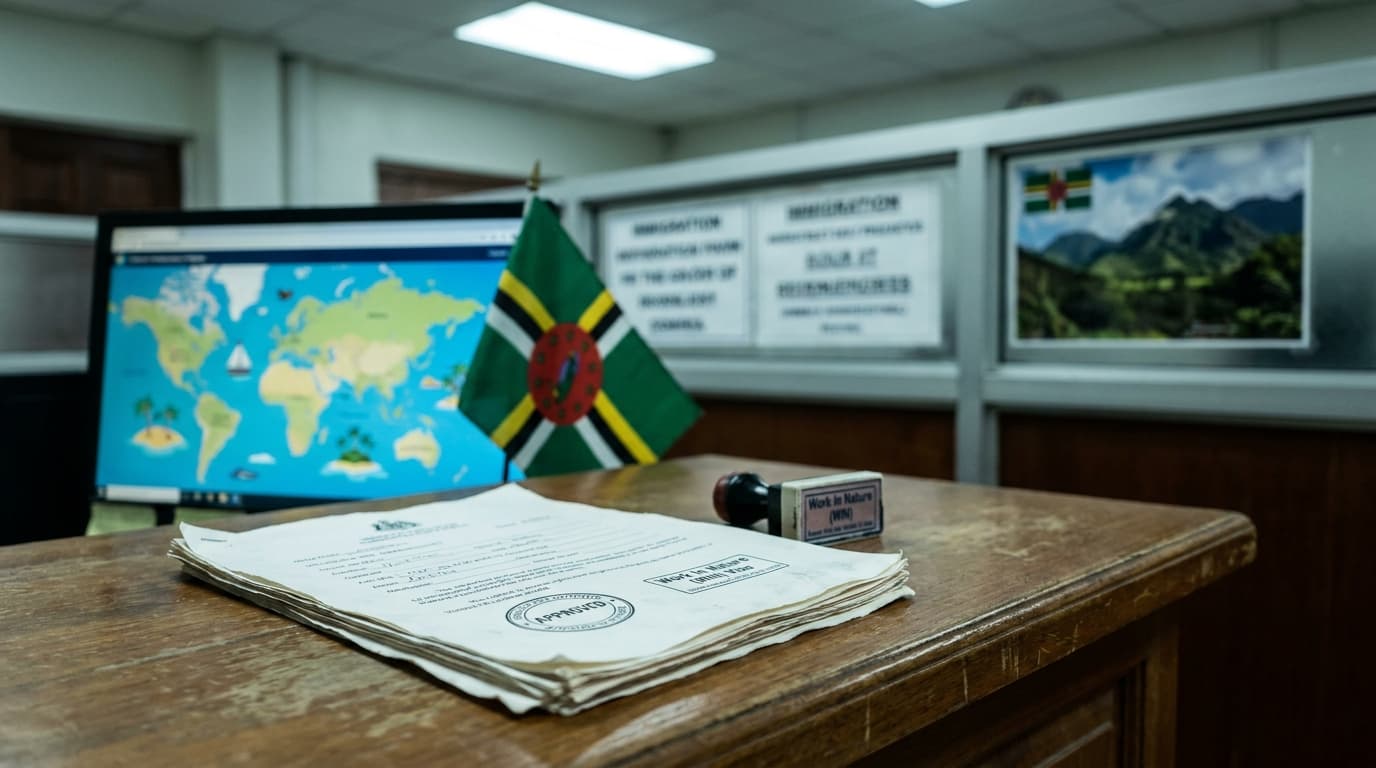
Dominica Work In Nature (WIN) Visa

Visa Data Sheet
Dominica’s Work In Nature or WIN, Visa is the country’s official extended-stay option for remote workers and their families. It’s designed for people who work for employers or clients outside Dominica and the official rules say that work has to be something you can do remotely for companies or individuals not registered in Dominica.
This isn’t a tourist visa with a longer clock attached. It’s a formal, fee-based program with eligibility screening, supporting documents and an approval process through the official WIN portal. Once approved, applicants pay a separate visa fee and then travel to Dominica.
The main draw is the stay length. Official government sources still describe the WIN Visa as allowing stays of up to 18 months, which is longer than most standard visitor permissions. The program is also open to families, not just solo remote workers.
There’s a tax angle too and it’s one of the clearest parts of the program. Income earned from remote work under the WIN Visa is described as tax-waived in Dominica, while holders are still expected to remain tax-resident in their normal country of residence or tax domicile. That makes the setup workable for some people, but it also means this isn’t a clean break from your home-country tax obligations.
The official portal lays out the application, eligibility, fees and processing steps, but it doesn’t publish every detail in one place. If you’re planning around this visa, expect to apply online first, wait for approval and only then make travel plans. It’s a structured process, not an informal permission slip.
- Who it’s for: Remote workers and families living outside Dominica
- Work type allowed: Remote work for non-Dominica employers or clients
- Stay length: Up to 18 months
- How it works: Online application, approval first, then travel and fee payment
- Tax treatment: Remote-work income under the program is described as tax-waived in Dominica, while tax residency stays tied to your normal country
The WIN Visa is built for remote workers, not job seekers. You need to be 18 or older, in good standing and able to work from anywhere while earning from a source outside Dominica.
The income bar isn't vague. Official guidance says you should expect income of US$50,000 or more over the next 12 months or have enough money to support yourself and any family members coming with you. You also have to make the required financial contribution, though the official portal is the place to check the current amount and payment setup.
Applicants can’t have a criminal record. The program also says holders can lose the visa later if they don’t comply with the rules or if their conduct brings disrepute to Dominica. That’s a real downside, not just legal boilerplate.
Family eligibility is fairly broad, but not unlimited. You can include a spouse or partner, children or stepchildren under 18 and other relatives who are wholly dependent because of age or infirmity.
The official sources don’t list a nationality restriction for the WIN Visa itself. Separate entry-visa rules for Dominica can still apply, so don’t assume your passport clears you for entry just because you meet the WIN criteria.
- Age: 18 or older
- Character: Good character, with no criminal record
- Work setup: Able to work remotely for non-Dominica employers or clients
- Income or savings: Expecting at least US$50,000 in income over the next 12 months or enough resources to support yourself and dependents
- Family members: Spouse or partner, children or stepchildren under 18 and fully dependent relatives because of age or infirmity
The program is also tied to tax residency rules. WIN Visa holders are still expected to remain tax-resident in their normal country of residence or tax domicile, while remote-work income earned under the program gets an income-tax waiver in Dominica.
The WIN visa asks for more than a passport scan and a form. The online application includes screening for the main applicant and, where relevant, family members and the official portal wants supporting documents uploaded up front.
Here’s the core list the application calls for:
- Passport: a valid bio-data page for the main applicant and any dependants.
- Proof of relationship: for accompanying family members.
- Police record: for the applicant and all family members over 18, from every jurisdiction where they’ve lived in the past 5 years.
- Bank reference letter: required for the main applicant.
- Employment letter: required for the main applicant.
- Bank statement: recent statement for the main applicant.
- Financial standing documents: a certificate of good standing and/or credit report if your income isn’t from a regular salary.
- Photos: passport-sized photos for applicants and family members over 18.
- Entry visa: a visa to Dominica, if your nationality needs one for entry.
- Health insurance: coverage valid in Dominica for all family members.
Documents not in English have to be translated and certified. The official pages don’t spell out any apostille or legalization requirement, so don’t assume one exists unless the portal or authorities ask for it directly.
The biggest annoyance here is the police record requirement. It applies not just to the main applicant, but to adult family members too and it has to cover every place lived in during the past 5 years. That can take time if your records are spread across several countries.
The program also keeps the paperwork tied to family status and income type. If you’re not paid through a regular salary, the portal expects extra financial proof, which makes sense, but it does mean freelancers and business owners have a heavier document load than salaried remote workers.
The official materials don’t list a fixed number of documents by category and they don’t give a shortcut version for dependants. So the safest move is to treat the upload checklist as complete, not flexible.
The WIN Visa isn’t a cheap add-on to a tourist trip. It’s a formal application with two separate government charges and the official portal says the first one, the non-refundable application fee, is US$100.
If you’re approved, you then pay the visa fee. That fee depends on how you apply:
- Single applicant: US$800
- Family application: US$1,200
- Business application for 4 or more employees: US$800 for the main applicant, plus US$500 for each additional employee
The official pages don’t list any extra government processing fees beyond those amounts. That’s helpful, but it also means you shouldn’t assume the total cost stops there, because the government doesn’t standardize every expense connected to the application.
Things like insurance, document translation and legal or agent help aren’t set by the government on the official pages, so those costs can vary. If you’re applying with family, the family fee is the only place the official materials indirectly account for dependents. There isn’t a separate public fee schedule for each child or spouse.
One more practical point, the WIN Visa is tied to remote work income earned outside Dominica and the official program still describes the stay as lasting up to 18 months. So if you’re budgeting, think in terms of the application fee, the visa fee and whatever outside costs your own file will trigger. The paperwork may be straightforward enough, but it’s not free.
The WIN Visa application is handled online through the official portal and you’re expected to wait for approval before you travel. That part matters, because this isn’t a simple tourist stamp you sort out on arrival.
Here’s the basic flow. You submit the WIN application form, pay the US$100 application fee, then the file goes through a review for completeness, recommendation and due diligence before it reaches the National Security and Home Affairs Department. The final call sits with the Minister for National Security and Home Affairs, who approves or disapproves the application.
- Submit the online application: Start on the WIN portal and complete the form from abroad.
- Pay the application fee: The fee is US$100 when you submit.
- Wait for review and decision: The application is checked for completeness, then goes through recommendation, due diligence and ministerial review.
- Pay the visa fee after approval: If approved, you get an approval letter and must pay the visa fee online within 30 days.
- Travel within the deadline: After payment, you have 90 days to enter Dominica, where the WIN Visa Stamp is issued on arrival.
The official page says you can ask for a 30-day extension to the visa-fee payment deadline and it may be granted if approved. It doesn’t give a fixed processing time, so don’t build travel plans around a quick turnaround.
The program is set up for people who want the approval in hand before they land. If you miss the payment window or the 90-day travel period, you’ll have a problem and the portal’s instructions are pretty clear about that.
The WIN Visa is built for a fixed stay, not an open-ended one. The official visa stamp is valid from arrival in Dominica for up to 18 months, so that’s the ceiling under the program’s current published rules.
There’s one timing detail that matters before you book flights. After approval and payment, applicants have 90 days to arrive in Dominica. If you miss that window, the approval won’t help much, because the program ties the visa to arrival within that period.
What the official portal doesn’t give you is just as important. It doesn’t publish a separate extension or renewal path beyond the 18-month validity and it doesn’t state a maximum cumulative stay after that term. So if you’re hoping to keep rolling the visa forward year after year, the public guidance doesn’t back that up.
It also doesn’t turn into permanent residence or citizenship. Those are separate processes. Dominica’s permanent-residence page points to different criteria, including residence or employment on the island for five years, which is a very different track from the WIN Visa.
If you’re planning around the WIN Visa, assume this is a one-term stay unless the government publishes a new rule or process. That makes the start date and end date important from day one.
- Visa validity: Up to 18 months from arrival in Dominica.
- Arrival window: 90 days after approval and payment.
- Renewal path: Not published on the official portal.
- Long-term status: The WIN Visa doesn't state a route to permanent residence or citizenship.
The WIN Visa gives remote workers a clear tax break, but it doesn't make them tax-free everywhere. Official WIN guidance says income tax is waived on remote-work income earned while you’re in Dominica under the program, yet you’re still expected to pay income tax in your normal country of residence or tax domicile.
That split matters. The visa is designed for people working for non-Dominica employers or clients, so Dominica isn’t trying to tax that remote income under WIN. But the program doesn’t say you get a special reduced tax rate and it doesn’t spell out any WIN-specific treaty benefit or reporting rule beyond the waiver itself.
Dominica’s Inland Revenue Division also has its own residency rules. It says resident individuals file income-tax returns by March 31 and it includes people physically present in Dominica for more than 183 days continuously among resident filers.
- WIN tax treatment: Income tax on remote-work earnings is waived under the program.
- Home-country tax: You still need to meet tax obligations in your normal country of residence or tax domicile.
- Local filing rules: The Inland Revenue Division says resident individuals file by March 31.
- Residency trigger: People present in Dominica for more than 183 days continuously are treated as resident filers.
If you’re planning a longer stay, don’t assume the WIN waiver settles everything. It helps with Dominica-side income tax on remote work, but you may still have residency, filing or reporting duties back home and those rules can be a headache if you ignore them.
There isn’t a separate WIN tax regime published on the official portal, so if your situation is unusual, you’ll need to check both your home-country tax rules and Dominica’s residency rules before you move.
How It Compares
More Dominica programs
| Program | Country | Income / month | Fee | Max stay | Renewable |
|---|---|---|---|---|---|
| Dominica Citizenship by Investment | Dominica | - | $1,000 | - |
Similar visas elsewhere
| Program | Country | Income / month | Fee | Max stay | Renewable |
|---|---|---|---|---|---|
| Slovenia Digital Nomad Visa | Slovenia | €3,391/mo | €50↓ | 12 mo | |
| Belize Work Where You Vacation Program | Belize | $75,000-100,000/yr | BZD 200-500 | 6 mo | |
| Kazakhstan Neo Nomad Visa | Kazakhstan | $3,000/mo | £170 | 12 mo | |
| Bahamas Digital Nomad Visa | Bahamas | - | $25↓ | 12 mo |
Dominica Digital Nomad Guide
Cost of living, internet, healthcare, coworking, and every visa option for Dominica.
Visa rules change. We'll tell you.
Get notified about policy updates and new requirements for the Dominica Work In Nature (WIN) Visa and other Dominica visas.