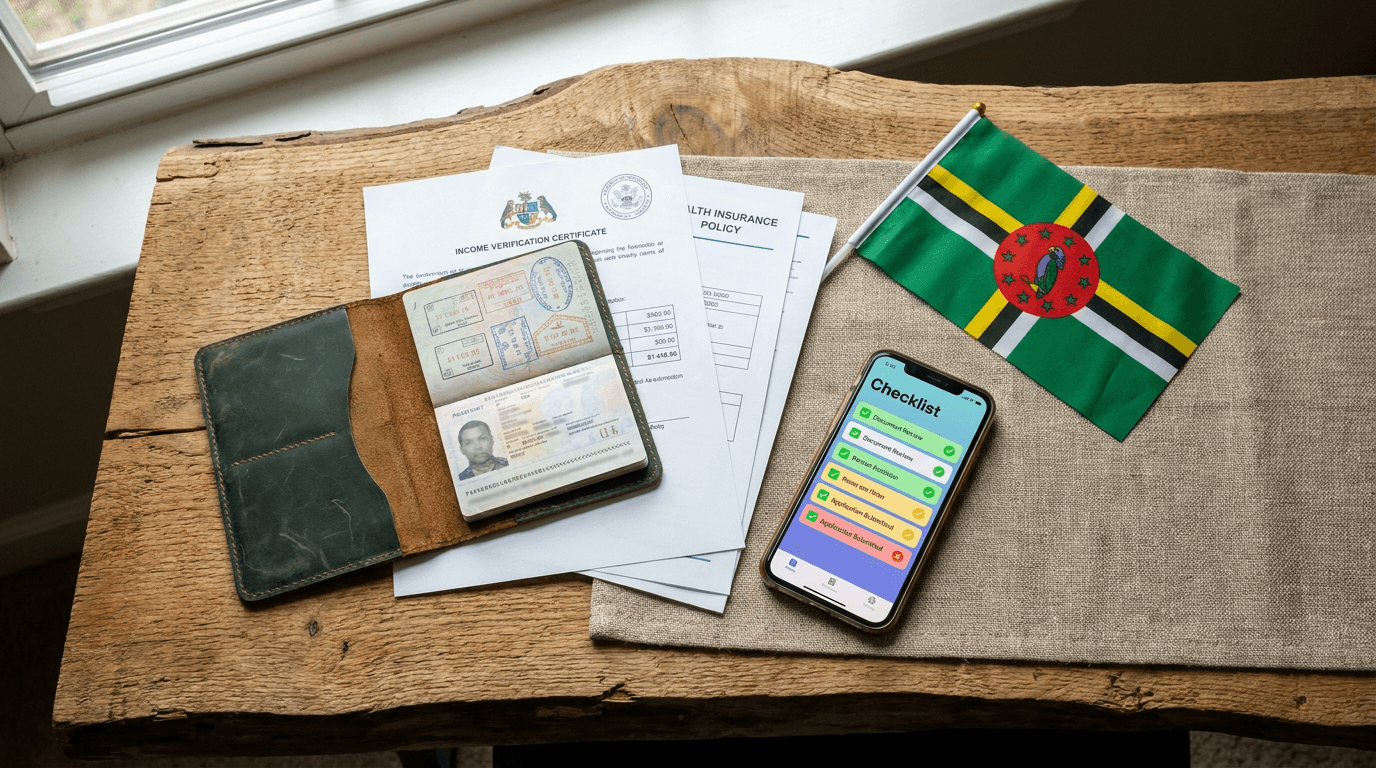
Dominica Citizenship by Investment — Dominica

Visa Program Briefing

Dominica Citizenship by Investment

DominicaGolden / Investor Visa
Brandon Richards
Brandon Richards ·

Visa Data Sheet

Minimum Savings
$200,000 in savings
Application Fee
$10,000
Processing Time
14 weeks
RenewableResidency PathRemote Work
The Full Briefing

Dominica’s Citizenship by Investment program is a direct path to full Dominican citizenship, not a long-stay visa with a few extra privileges. If you’re approved, you get citizenship for life under Dominican law, along with the passport that comes with it. That’s the big difference and it’s why this route sits in a different category from tourist entry, visitor visas or the Work in Nature visa.

The program exists to bring foreign capital into the country through two main routes, a contribution to the Economic Diversification Fund or an investment in government-approved real estate. It’s aimed at foreign investors and families who can meet the financial and due-diligence tests set out in the 2024 Citizenship by Investment Regulations. The Citizenship by Investment Unit, which sits under the Ministry of Finance, handles the process through authorized agents and licensed promoters.

What makes it different from a tourist visa

  • Status: CBI grants citizenship, not temporary entry.
  • Investment: It requires a qualifying financial commitment, not just travel documents and entry fees.
  • Rights: Successful applicants can hold a Dominican passport and keep citizenship for life, subject to revocation rules in the regulations.
  • Mobility: The program is built for people seeking a second citizenship, not a short holiday or business trip.

The legal basis is unusually solid. Dominica’s CBI framework runs under Section 101 of the Constitution, sections 8 and 9 of the Citizenship Act and the 2024 regulations, which replaced earlier CBI rules. The program has been around since 1993, so it’s not some brand-new scheme with a thin paper trail.

Official pages don’t publish a full current fee schedule in the material reviewed here, so don’t rely on old agent brochures for exact numbers. The government’s own message is clearer than that, the rules can change, eligibility is checked carefully and applicants should verify details directly with the CBIU before filing anything.

Dominica’s Citizenship by Investment program is for people who want full citizenship, not a temporary stay or residence permit. If you qualify, the citizenship is for life and Dominica recognizes dual citizenship. It also gives you the same right to live, work and study there as any other citizen.

The basic eligibility bar is straightforward, but it isn’t loose. You must be at least 18, have a clean criminal record, be in good health and have the funds to make the required investment or contribution. Applicants also have to agree in writing not to change or seek to change their name, other than through marriage, for 5 years after naturalization.

Nationality matters too. The official program lists explicit bans, limitations or enhanced due diligence for nationals of Belarus, Iran, Northern Iraq, North Korea, Russia, Yemen and Sudan. There are also broader disqualifiers that can knock an application out, including a criminal record other than a minor offense, a criminal investigation you knew about and didn’t disclose, a prior denial of citizenship in another country or a visa refusal from the EU or the UK.

You can also be refused if you’ve been denied a visa to a country that Dominica allows visa-free travel to and you haven’t later obtained that country’s visa or residence permit. False statements, security concerns and any activity that could bring disrepute to Dominica can also sink the file. That’s a blunt system, but it does cut down on guesswork.

Financially, there’s no set income test. The program isn't salary-based, so the official question is whether you can cover the minimum qualifying investment and related fees. The two main routes both start at $200,000:

  • Economic Diversification Fund: a nonrefundable government contribution starting at $200,000 for a single applicant.
  • Real estate: a government-approved property purchase worth at least $200,000, held for 3 years or 5 years if it’s being sold to another CBI applicant.
  • Interview fee: $1,000 per interview for each applicant aged 16 or older, usually conducted virtually.

The public CBI portal doesn’t publish a fixed, full fee schedule for every case, so the total cost depends on the route and how many family members you include. Processing also moves in stages, with approval in principle typically taking around 3 months. Once granted, the citizenship is permanent and the passport is generally valid for 10 years for adults and 5 years for children under 16.

Source 1 | Source 2

Dominica’s Citizenship by Investment program isn’t a visa. It’s a path to full citizenship, which means there’s no renewal clock to worry about once it’s approved. The tradeoff is paperwork and quite a lot of it.

Only licensed authorized agents can file an application. You can’t submit directly to the Citizenship by Investment Unit and the process usually moves in four steps, document collection, submission and due diligence, investment after approval in principle, then naturalisation.

Core forms and identity records

  • Form 12: Application for naturalisation, submitted in two notarized copies for each applicant.
  • Form D1: Citizenship by Investment Disclosure Form for all applicants.
  • Form D2: Fingerprint and photograph verification form for applicants 16 and older.
  • Form D3: Medical questionnaire, completed by a registered medical practitioner, with blood and urine tests plus HIV testing for applicants 12 and older.
  • Form D4: Investment Agreement for the EDF route only.
  • Passport-size photos: Eight per applicant.
  • Identity records: Certified and apostilled copies of all passports held, driver’s licence, national ID cards and any military service or discharge papers, if relevant.

Civil status, family and support documents

  • Birth certificate: Certified and apostilled.
  • Marriage or divorce records: Certified and apostilled, if applicable.
  • Name-change evidence: Full paper trail for any legal name change outside marriage.
  • Educational records: Certified copies of university or college diplomas.
  • Dependant support: Affidavit of support for each dependant 18 or older, except a spouse.
  • School or university letters: Recommendation letters for children 12 to 18 and transcripts or enrolment letters for dependants 18 to 30.

Background checks and money requirements

Applicants 16 and older need police clearance from their country of citizenship, current residence and any country where they’ve lived for more than six months in the past 10 years. Those records have to be recent, valid for three months. The CBIU also requires proof that you have lawful funds to cover the investment and fees, not an income threshold.

  • EDF minimum: $200,000 for a single applicant or $250,000 for a main applicant plus up to three dependants.
  • Real estate minimum: $200,000 in a government-approved project.
  • Processing fee: $1,000 per application.
  • Due diligence fee: $7,500 for the main applicant, $4,000 for a spouse and $4,000 for dependants 16 and older.
  • Interview fee: $1,000 for each applicant 16 and older.
  • Naturalisation certificate: $500 per person.

Documents not in English need translation and legalisation and government-issued records must be certified and apostilled. That part is tedious, but skipping it usually means a delay or a rejected file.

Source 1 | Source 2

Dominica’s Citizenship by Investment programme is priced in U.S. dollars and that’s the number that matters. The government doesn’t publish a separate Eastern Caribbean dollar schedule and if you pay in euros or pounds, the converted amount still has to meet the U.S. dollar minimum.

The base investment is only the start. On top of that, you’re paying government fees, due diligence charges and, if you use the real estate route, a separate set of property-related government fees.

Official investment amounts

  • Economic Diversification Fund: $200,000 for a single applicant or $250,000 for a main applicant plus up to three dependants.
  • Additional dependants under 18: $25,000 each.
  • Additional dependants 18 or older: $40,000 each.
  • Approved real estate: $200,000 minimum, held for at least 3 years or 5 years if it’s resold to another CBI applicant.

Government fees you still need to budget for

  • Processing fee: $1,000 per application.
  • Due diligence: $7,500 for the main applicant, $4,000 for a spouse and $4,000 for each dependant aged 16 or older.
  • Mandatory interview: $1,000 for each applicant aged 16 and over.
  • Certificate of Naturalisation: $500 per person.
  • Passport fee: $500 per passport.

The real estate route carries its own government fees and they’re not small. For a main applicant, the charge is $75,000. For a main applicant plus up to three dependants, it rises to $100,000, with the same extra dependant charges of $25,000 under 18 and $40,000 for dependants 18 or older.

Some costs are real, but not fixed. Authorized agent fees, notarisation, legalisation and certified translations vary by provider and country, so the government doesn’t publish a standard price. The official guide also doesn’t set a mandatory health insurance premium, though you’ll still need to satisfy the medical requirements tied to the application.

That makes the headline number misleading if you stop at the investment amount. A single applicant on the donation route is looking at the $200,000 contribution plus at least $10,000 in core government fees before any agent or document costs are added.

Dominica’s Citizenship by Investment program isn’t a visa and you can’t apply for it on your own. The government only accepts applications through licensed Authorised Agents, who file everything with the Citizenship by Investment Unit or CBIU. There’s no need to travel to Dominica to start or finish the process.

The program has two main routes. The Economic Diversification Fund requires a non-refundable contribution of $200,000 for a single applicant or $250,000 for the main applicant plus up to three dependants. The real estate route also starts at $200,000, but the property has to be in an approved project and held for at least three years or five years if it’s sold to another CBI applicant.

Fees stack up quickly and that’s where a lot of applicants get caught off guard. The standard government charges include:

  • Due-diligence fee: $7,500 for the main applicant, $4,000 for a spouse and $4,000 for each dependant aged 16 or older
  • Processing fee: $1,000 per application
  • Interview fee: $1,000 for each applicant aged 16 or older
  • Certificate of Naturalisation: $500 per person
  • Passport fee: $500 per passport

If you buy real estate, there are separate government fees on approval, starting at $75,000 for a single applicant and rising to $100,000 for a main applicant plus up to three dependants. Professional fees from the agent are extra and the CBIU doesn’t publish those.

The paperwork is heavy. The CBIU’s process guide calls for forms such as Form 12, the disclosure form, fingerprint and photo verification, a medical questionnaire and, for real estate, a sales and purchase agreement. Applicants aged 16 or older also go through an interview and may face enhanced due diligence if the profile or nationality calls for it.

There’s no official income minimum, so don’t look for one. What the government does want is proof that your funds are legal and available. Expect to show a notarised affidavit of source of funds, 12 months of bank statements and supporting financial or employment documents.

Timing is decent, but not fast. Document collection usually takes 2 to 6 weeks, submission and approval take 3 to 4 months, the investment must be completed within 90 days of approval in principle and naturalisation usually follows in 3 to 6 weeks. Once approved, you get citizenship for life, not a temporary status and then you can apply for your Dominican passport.

Dominica’s Citizenship by Investment program doesn’t work like a visa at all. Once you’re approved, you become a Dominican citizen for life, so there’s no expiry date, no maximum stay and no residency permit to renew.

The official process ends with a Certificate of Naturalisation, which is permanent proof of citizenship. After that, you can live, work and study in Dominica like any other citizen and you don’t need to keep a foot on the island to preserve that status.

The part you do renew is the passport. The government says adult Dominican passports are generally valid for up to 10 years, while passports for children under 16 are valid for five years. If yours expires or runs out of blank pages, it can be renewed through the Passport and Immigration Department in Dominica or through a Dominican consulate.

  • Citizenship status: Permanent, with no expiry.
  • Passport validity: Up to 10 years for adults, five years for children under 16.
  • Renewal route: Passport and Immigration Department or a Dominican consulate.
  • Travel requirement: You don't need to travel to Dominica just to renew a passport.

The CBIU doesn't publish a fixed passport renewal fee in the material reviewed here, so you’ll need to check directly with the Passport and Immigration Department or a Dominican consulate for current costs. The same goes for any service charges tied to consular handling.

There’s also no separate “path” from CBI status to permanent residency, because citizenship is already the endpoint. The only catch is tied to the investment route you used. If you applied through real estate, the government says you can still renew your passport after selling the property, as long as you held it for the required minimum period after citizenship was granted.

That holding period is three years or five years if you sell to another CBI applicant. So the investment doesn’t lock you in forever, but it does need to stay in place long enough to satisfy the rules.

Dominica’s citizenship by investment passport doesn’t give you a separate tax class. If you hold CBI citizenship but live elsewhere, your tax position depends on where you actually live and where your income comes from, not on the passport itself.

The Inland Revenue Division treats tax residence as a real status, not a citizenship perk. It says individuals who are physically present in Dominica for more than 183 days continuously are considered resident for tax purposes and residents are required to file returns. Simply put, CBI citizenship on its own doesn’t make you a Dominican tax resident.

For people who stay non-resident, the practical takeaway is straightforward. Dominica taxes Dominican-source income, while foreign-earned income normally stays outside the picture unless you become tax resident or earn income from activity in Dominica. The official materials don’t spell out every edge case, so if you have multiple income streams, get local tax advice before you assume anything.

Dominica doesn’t have capital gains tax, wealth tax or inheritance tax and that applies generally, not just to CBI holders. If you do become tax resident, the Inland Revenue Division says residents get a resident allowance of XCD 30,000 and can claim other deductions. The public guidance doesn’t clearly set out every rule on foreign income, though the citizenship unit says Dominica can offer tax credit relief for foreign tax paid where a Dominican tax resident has already been taxed abroad.

That means there’s no special reduced tax regime tied to CBI citizenship. You’re taxed under the same rules as anyone else, based on residence and source of income. If you’re used to thinking of CBI as a tax move, that’s the wrong lens.

Dominica also refers to the Caribbean Community Double Taxation Agreement and the tax authority points readers to that framework. But don’t assume Dominica has a broad network of bilateral treaties with the United States, United Kingdom, Canada or EU countries. The official guidance doesn’t support that assumption and the old UK arrangement is no longer treated as active for current periods.

  • 183 days: a key tax-residence trigger in Dominica.
  • XCD 30,000: the resident allowance mentioned by the tax authority.
  • No special CBI tax status: citizenship alone doesn’t change your tax treatment.

Full Country Guide

Dominica Digital Nomad Guide

Cost of living, internet, healthcare, coworking, and every visa option for Dominica.

Stay Current

Visa rules change. We'll tell you.

Get notified about policy updates and new requirements for the Dominica Citizenship by Investment and other Dominica visas.