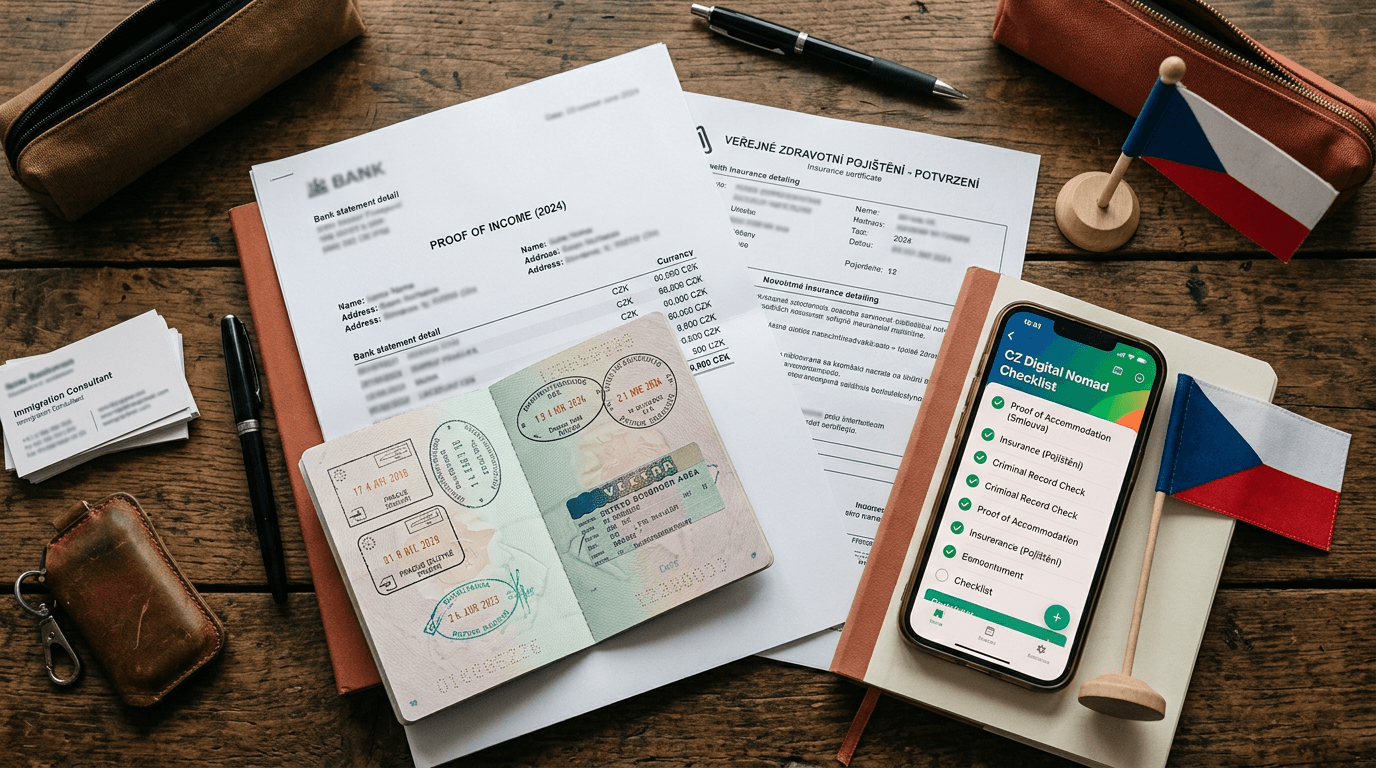
Czech Republic Digital Nomad Visa

At a Glance
- CZK 73,823 a month1.5 times the average gross annual salary announced by the Ministry of Labour and Social Affairs (590,580 CZK for May 1, 2026 to April 30, 2027), spread per month; resets every May 1 · main applicant (employee of a foreign employer or freelancer)
- CZK 2,500 one-timeconsular fee for a long-term visa (type D); employees of a foreign employer apply for a long-term visa for other purposes · employees of a foreign employer; some nationalities pay less or nothing under bilateral agreements (for example Japan)
- CZK 5,000 one-timeconsular fee for a long-term visa for the purpose of doing business · freelancers (trade license holders) in the program
- 1 yearlong-term visa valid up to 1 year · main applicant and family
- Before the visa expires, employees must first get MPO to extend their program inclusion (with a Czech tax domicile certificate), then apply to the Ministry of the Interior for a long-term residence permit for other purposes. Freelancers apply for a long-term residence permit for business. Long-term residence permits are usually issued for up to 2 years and can be extended repeatedly.program sections 5.2, 5.4 and 6.2; ipc.gov.cz long-term residence general information · main applicant; family members move to family reunification permits
- Two steps: apply to the Ministry of Industry and Trade for inclusion in the program (by email to digitalnomad@mpo.gov.cz); freelancers first declare a trade at a Czech Trade Licensing Office. With the inclusion confirmation, apply in person at a Czech embassy or consulate abroad on the date it assigns; freelancers also attend a mandatory interview.program section 6.1 · main applicant and family (family apply at the same time)
- 45 daysMinistry of the Interior decides within 45 days of a complete embassy application; MPO inclusion step comes first and is not timed · program participants
- Noemployees stay employed by the foreign employer and do not enter a Czech employment relationship; freelancers may trade under their Czech license in IT or marketing · employee route
- Yesspouse, registered partner and minor or adult dependent children, applying together with the main applicant · family members
- General rule: permanent residence after 5 years of continuous temporary residence in the Czech Republic. The program itself does not promise it.Aliens Act permanent residence after 5 years · long-term residents
Last checked Sept. 25, 2026
The Czech Republic has no stand-alone digital nomad visa. Its Digital Nomad Program, run by the Ministry of Industry and Trade (MPO), is a fast track into an ordinary long-term visa for a narrow group: IT and marketing specialists from 13 countries (MPO).
- Status: active, running since July 1, 2023
- Nationalities: Australia, Brazil, India, Israel, Japan, Canada, South Korea, Mexico, New Zealand, Singapore, the United Kingdom, the United States and Taiwan only
- Work: IT or marketing, as an employee of a foreign employer or as a freelancer with a Czech trade license
- Income: at least CZK 73,823 a month from May 1, 2026 to April 30, 2027
- Length: a long-term visa of up to 1 year, then renewable residence permits
- Decision: within 45 days of the embassy application
Other nationalities and other professions can look at the Czech business visa for trade license holders, which has no nationality list. The Czech Republic guide compares both routes.
- Nationality: the main applicant must be a citizen of Australia, Brazil, India, Israel, Japan, Canada, South Korea, Mexico, New Zealand, Singapore, the United Kingdom, the United States and Taiwan (MPO).
- Occupation: Highly skilled IT or marketing specialists only: employees of a foreign employer with at least 50 staff worldwide, or freelancers holding a Czech trade license for IT or marketing services. IT specialists need a STEM degree or at least 3 years of IT experience; marketing specialists need a degree of at least 3 years in marketing or a related field.
- Income: at least CZK 73,823 a month. The program sets the floor at 1.5 times the average gross annual wage announced by the Ministry of Labour and Social Affairs (program document), so it resets every May 1. The current figure applies from May 1, 2026 to April 30, 2027 (MPO notice).
- No recent Czech long stay: on the application date and in the year before it, the applicant must not have held a Czech long-term visa or long-term residence permit.
Family allowed: Yes. A spouse, registered partner and children can be included if they apply at the same time as the main applicant, and they need not hold one of the 13 nationalities.
There is no legal right to a place in the program. MPO assesses each application.
The program needs two sets of papers: one for MPO and one for the embassy.
For MPO: a completed application form and the documents listed in MPO's step-by-step guide for employees or for freelancers, which show the qualifying work, qualifications and income (MPO). Freelancers declare their trade at a Czech Trade Licensing Office first.
For the embassy: every document the law requires for a long-term visa, even papers already sent to MPO. For the business visa used by freelancers, the Ministry of the Interior lists (Ministry of the Interior):
- The application form and a photograph.
- A valid travel document.
- Proof of accommodation.
- Proof of funds for the stay.
- A confirmation of registration in the trade register.
- A criminal record certificate from the country of citizenship, and on request from other countries where the applicant lived for six months in the last three years.
Documents must be originals or notarized copies no older than 180 days, except the travel document and registry documents. Before the visa is issued, the applicant shows travel medical insurance.
- Long-term visa for employees: CZK 2,500 consular fee (Ministry of Foreign Affairs fee schedule). Some nationalities pay less or nothing under bilateral agreements.
- Business visa for freelancers: CZK 5,000 consular fee.
- Trade license: CZK 1,000 to declare a first trade (Administrative Fees Act).
- Residence permit in the Czech Republic: CZK 2,500 administrative fee for the business permit (Ministry of the Interior).
Translations, notarized copies and insurance add to the cost and vary by country.
Two steps: apply to the Ministry of Industry and Trade for inclusion in the program (by email to digitalnomad@mpo.gov.cz); freelancers first declare a trade at a Czech Trade Licensing Office. With the inclusion confirmation, apply in person at a Czech embassy or consulate abroad on the date it assigns; freelancers also attend a mandatory interview.
- Email the MPO application and documents to digitalnomad@mpo.gov.cz (MPO).
- With the inclusion confirmation, apply in person at the Czech embassy or consulate on the assigned date. Employees apply for a long-term visa for other purposes; freelancers apply for a long-term visa for business.
- The Ministry of the Interior decides within 45 days of the embassy application. The MPO step comes first and has no set deadline.
- Collect the visa with proof of travel medical insurance, then register with the Foreign Police within three business days of arriving (Ministry of the Interior).
Some embassies cap long-term visa applications, so check the mission's rules before booking.
The long-term visa lasts up to 1 year (Ministry of the Interior).
Staying longer: Before the visa expires, employees must first get MPO to extend their program inclusion (with a Czech tax domicile certificate), then apply to the Ministry of the Interior for a long-term residence permit for other purposes. Freelancers apply for a long-term residence permit for business. Long-term residence permits are usually issued for up to 2 years and can be extended repeatedly.
A residence permit extension is filed no earlier than 120 days before the current permit expires and no later than its last day of validity (Ministry of the Interior).
Permanent residence. General rule: permanent residence after 5 years of continuous temporary residence in the Czech Republic. The program itself does not promise it. Source: Ministry of the Interior.
No special tax regime. Employees extending their stay must show MPO a certificate of Czech tax domicile, so the program expects participants to become Czech tax residents.
Under the Income Tax Act, a person who stays at least 183 days in a calendar year, continuously or in several periods, or who has a permanent home in the country, is a Czech tax resident (Act No. 586/1992 Coll., section 2). Residents are taxed on worldwide income, subject to tax treaties.
Freelancers with a trade license fall under the ordinary rules for self-employed people. Anyone with income in more than one country should check the treaty between that country and the Czech Republic.
Frequently Asked Questions
Which nationalities can join the Czech Digital Nomad Program?
Only citizens of Australia, Brazil, India, Israel, Japan, Canada, South Korea, Mexico, New Zealand, Singapore, the United Kingdom, the United States and Taiwan. Family members of other nationalities can join a qualifying applicant.
How much income does the Czech Digital Nomad Program require?
At least CZK 73,823 a month from May 1, 2026 to April 30, 2027. The figure is 1.5 times the national average gross wage and resets every May 1.
Can a remote worker outside IT or marketing apply?
No. The program is limited to highly skilled IT and marketing specialists. Other self-employed people can apply for the Czech business visa with a trade license.
How long does a decision take?
The Ministry of the Interior decides within 45 days of the embassy application. The earlier MPO inclusion step has no set deadline.
Can the stay be extended beyond the first visa?
Yes. After the visa of up to 1 year, participants apply in the Czech Republic for a long-term residence permit, usually issued for up to 2 years and extendable.
How It Compares
More Czech Republic programs
| Program | Country | Income / month | Fee | Max stay | Renewable |
|---|---|---|---|---|---|
| Czech Republic Zivno (Trade License) Visa | Czech Republic | CZK 156,500 saved | CZK 5,000 | 12 mo |
Similar visas elsewhere
| Program | Country | Income / month | Fee | Max stay | Renewable |
|---|---|---|---|---|---|
| Georgia Digital Nomad Program (Remotely from Georgia) | Georgia | - | - | - | |
| Kyrgyzstan Digital Nomad Status | Kyrgyzstan | - | - | 12 mo | |
| Kenya Class N Permit | Kenya | - | $200↓ | 24 mo | |
| Nepal Digital Nomad Visa (Not Yet Open) | Nepal | - | - | - |
Czech Republic Digital Nomad Guide
Cost of living, internet, healthcare, coworking, and every visa option for Czech Republic.
Visa rules change. We'll tell you.
Get notified about policy updates and new requirements for the Czech Republic Digital Nomad Visa and other Czech Republic visas.