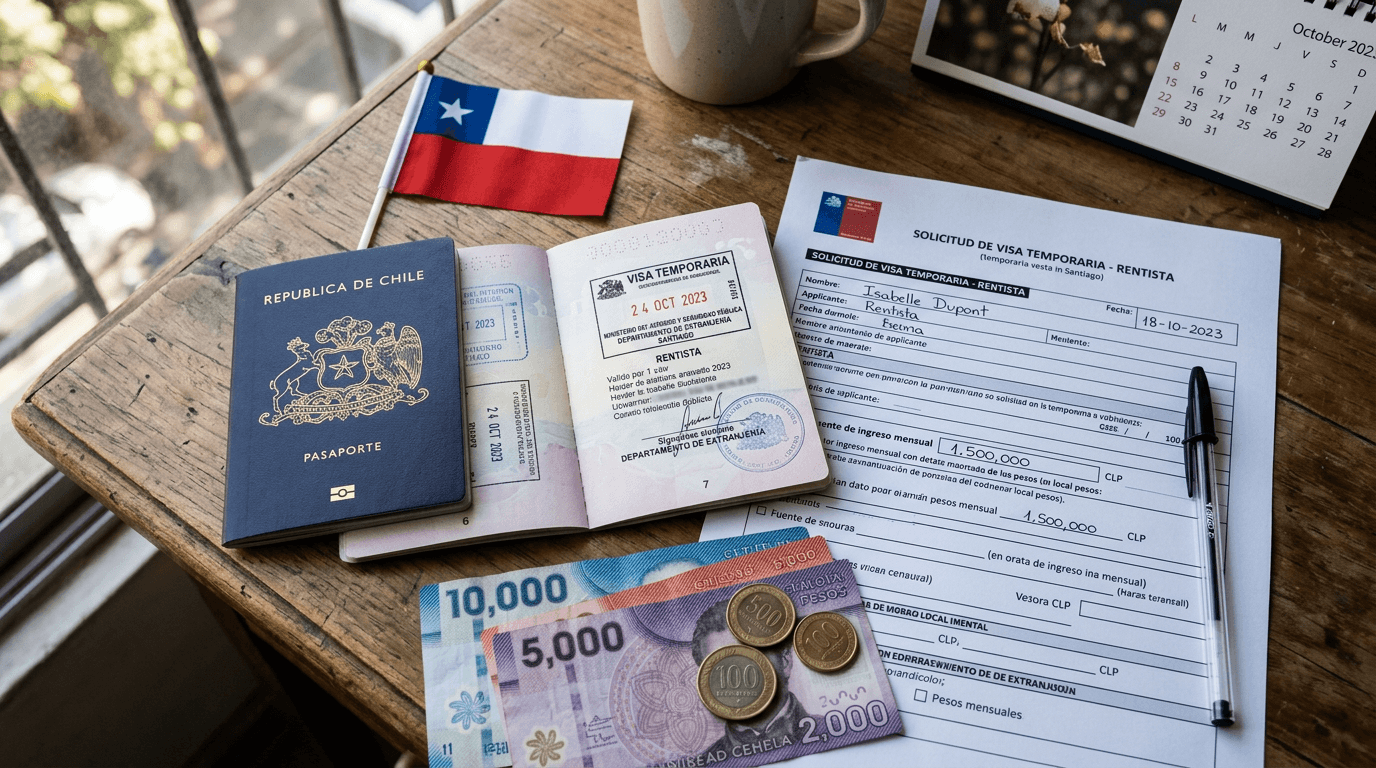
Chile Rentista Temporary Residence Visa

At a Glance
- No fixed amount: the pension or passive income must cover at least basic needs, judged against indicators from the Ministry of Social Development and Family.basic needs per Ministerio de Desarrollo Social y Familia indicators · main applicant
- Set by nationality in US dollars and paid in Chilean pesos at the official dollar rate; examples: USD 82 (United States), USD 85 (United Kingdom), USD 100 (Germany, Canada), USD 250 (Australia).varies by nationality (Resolucion Exenta 129194, "visa temporaria" column)
- $15 one-timeflat fee for dependents; minors exempt · dependents (children and adolescents exempt)
- 2 yearsup to 2 years; SERMIG sets the exact term case by case
- Renewable for successive periods of up to 2 years by proving the holder is still a retiree or rentier with enough income to cover living costs in Chile.
- Online from outside Chile through SERMIG's Portal de Tramites Digitales (personal account or ClaveUnica). Holders of the paid-activities temporary residence may apply from inside Chile.
- Nono express work right attached to this subcategory
- Yesdependents under Law 21.325 art. 74, numerals 1 and 2
- Yes. After at least 24 months of temporary residence the holder can apply for Residencia Definitiva; SERMIG can cut this to 12 months when the applicant has income or pensions available. Definitiva fee: CLP 142,726.
Last checked Oct. 2, 2026
Chile's rentista route is a subcategory of Residencia Temporal (temporary residence) for retirees and for people who live on steady passive income. Its Spanish name is "extranjeros jubilados y rentistas". It sits under the 2021 Migration Law (Law 21.325) and Decreto 177 of 2022, and the Servicio Nacional de Migraciones (SERMIG) runs it (SERMIG).
- Income test: No fixed amount: the pension or passive income must cover at least basic needs, judged against indicators from the Ministry of Social Development and Family.
- Validity: up to 2 years, renewable
- Where to apply: online, from outside Chile
- Local work: no work right is attached to this permit
Chile has no digital nomad visa, and salary from remote work is not a listed basis for this permit. Visitor stays and the other residence routes are covered in the Chile country guide.
Retirees with a pension granted under the rules of their country of residence, or rentiers with constant income from real estate or financial assets, received regularly and enough to cover at least basic needs during the stay in Chile.
- Retirees: a pension granted under the rules of the country of residence
- Rentistas: regular income from real estate or financial assets
- Income level: SERMIG judges the amount case by case against basic-needs indicators from the Ministry of Social Development and Family; no peso figure is published
- Family: Yes, for dependents covered by Law 21.325 art. 74, numerals 1 and 2. A dependent's permit cannot outlast the main holder's, and dependents may take paid work (Decreto 177).
Decreto 177 attaches no work right to this subcategory, unlike the permits for family reunification, students and dependents. Paid work in Chile needs the temporary residence permit for lawful paid activities instead (SERMIG).
Every Residencia Temporal application filed from abroad needs two general documents (SERMIG):
- A passport valid for at least one year from the application date
- A criminal record certificate from the country of origin or any country of residence in the past five years, issued no more than 60 days earlier (applicants 18 and older)
Retirees add a pension certificate showing the amount and duration, plus proof of the latest pension payment, both legalized or apostilled (SERMIG).
Rentistas add proof of ownership and of the income it produces:
- Property owners: a certificate of ownership (not needed for property in Chile), the lease showing regular payments to the applicant and proof of the rental income
- Owners of financial assets: a certificate of ownership (not needed for assets earning in Chile) and documents showing the income the assets produce
Documents not in Spanish or English need an official translation, and foreign documents must be apostilled or legalized. Papers from private entities must be uploaded within 30 days of issue and papers from public bodies within 60 days, unless the document states otherwise.
The Residencia Temporal fee depends on nationality. It is set in US dollars and paid in Chilean pesos at the official dollar rate, and SERMIG lists the amounts on its migration fees page. Applicants should check the row for their own nationality before filing.
- Dependents: $15 one-time per person; residence permits for children and adolescents carry no fee (fee resolution)
- Permanent residence: a separate fee applies when the holder later applies for Residencia Definitiva
- Private costs: translations, apostilles and certificates come on top and vary by country
Online from outside Chile through SERMIG's Portal de Tramites Digitales (personal account or ClaveUnica). Holders of the paid-activities temporary residence may apply from inside Chile.
- Log in to the portal, choose Residencia Temporal and the jubilados y rentistas subcategory, then complete the form and upload the documents.
- Wait for SERMIG's review. It can ask for updated or extra documents.
- After approval, download the Estampado Electrónico (the electronic visa stamp). An applicant abroad then has 90 days to enter Chile, and the permit runs from the date of entry (SERMIG).
SERMIG publishes no processing time for this subcategory.
The permit is valid for up to 2 years, counted from the date of entry for applications made abroad. Renewable for successive periods of up to 2 years by proving the holder is still a retiree or rentier with enough income to cover living costs in Chile.
Retirees renew by proving they still draw the pension and can cover their living costs; rentistas renew with current documents showing the income continues (SERMIG).
Path to permanent residence: Yes. After at least 24 months of temporary residence the holder can apply for Residencia Definitiva; SERMIG can cut this to 12 months when the applicant has income or pensions available. Definitiva fee: CLP 142,726. (SERMIG)
The permit carries no special tax regime. Tax status follows Chile's Income Tax Law, applied by the Servicio de Impuestos Internos (SII).
- Residence test: a stay of more than 183 days in Chile within any 12-month period makes a person tax resident
- Newcomers: A foreigner who becomes resident or domiciled in Chile is taxed only on Chilean-source income for the first three years after entry, then on worldwide income.
Holders with pensions, rents or investment income abroad should check how Chile and the source country tax that income, including any tax treaty between them, with the SII or a tax adviser (SII Circular 63).
Frequently Asked Questions
Is there a minimum income for Chile's rentista visa?
No fixed amount: the pension or passive income must cover at least basic needs, judged against indicators from the Ministry of Social Development and Family. SERMIG reviews each case against those indicators.
Can rentista permit holders work in Chile?
No work right is attached to this permit. Paid work in Chile needs the temporary residence permit for lawful paid activities. Dependents of the holder may take paid work.
Can the rentista permit be requested from inside Chile?
Online from outside Chile through SERMIG's Portal de Tramites Digitales (personal account or ClaveUnica). Holders of the paid-activities temporary residence may apply from inside Chile.
How much does the rentista permit cost?
The fee depends on nationality. It is set in US dollars, paid in Chilean pesos and listed on SERMIG's migration fees page. Dependents pay $15 one-time.
Does the rentista permit lead to permanent residence?
Yes. After at least 24 months of temporary residence the holder can apply for Residencia Definitiva; SERMIG can cut this to 12 months when the applicant has income or pensions available. Definitiva fee: CLP 142,726.
How It Compares
Similar visas elsewhere
| Program | Country | Income | Fee | Max stay | Renewable |
|---|---|---|---|---|---|
| Liechtenstein Financially Independent Residence Permit | Liechtenstein | CHF 2,600/mo | CHF 1,060 | 12 mo | |
| Italy Elective Residence Visa | Italy | €31,000/yr | €116 | 12 mo | |
| Dominican Republic Pensionado / Rentista | Dominican Republic | $1,500/mo | $200 | 12 mo | |
| Lebanon Income-Based Residency Permit | Lebanon | LBP 50,000,000/mo | LBP 18,000,000 | 12 mo | - |
Chile Digital Nomad Guide
Cost of living, internet, healthcare, coworking, and every visa option for Chile.
Visa rules change. We'll tell you.
Get notified about policy updates and new requirements for the Chile Rentista Temporary Residence Visa and other Chile visas.