Cayman Certificate of Permanent Residency (Investment) — Cayman Islands

Visa Program Briefing

Cayman Certificate of Permanent Residency (Investment)

Cayman IslandsGolden / Investor Visa
Brandon Richards
Brandon Richards ·

Visa Data Sheet

Minimum Savings
$2,400,000 in savings
Application Fee
$120,600
Processing Time
20 weeks
Maximum Stay
120 months
RenewableResidency PathRemote Work
The Full Briefing

The Cayman Islands’ Certificate of Permanent Residence for Persons of Independent Means is the top-tier investment route for people who want to live in Cayman indefinitely. It’s not a tourist permission and it’s not a short stay dressed up with nicer branding. It gives approved applicants permanent residence, subject to the rules attached to the certificate.

This route is aimed at high-net-worth applicants who can park serious money in local real estate and support themselves without taking a local job. The investment must be in developed Cayman Islands real estate and the current threshold is commonly treated as CI$2 million after a 2017 regulatory change. The research doesn’t show a newer official figure, so that’s the number most applicants are still working from.

There are a few practical catches. The certificate doesn’t give you an automatic right to work in Cayman, although the legislation allows a variation application in some cases. You can also include qualifying dependants, but they don’t get an automatic work right either.

Compared with a normal visitor stamp, this is a different world altogether. A tourist can visit for a limited time, usually with no settlement rights and no investment requirement. A permanent residence holder can stay long term, keep property in Cayman and, if they later meet the separate requirements, may move toward British Overseas Territories citizenship and Caymanian status.

  • Status: Permanent residence, not a temporary visa
  • Main investment: Developed local real estate, currently treated as CI$2 million
  • Work rights: No automatic right to work
  • Family: Dependants can usually be included
  • Policy fit: Built for wealthy long-term residents, not nomads or short-term remote workers

It’s also different from Cayman’s other residency options. The 25-year certificate for persons of independent means is renewable and aimed more at long-term residence, while this certificate is the permanent version from the start. In practice, it’s the route people look at when they want Cayman to be home for good, not just for a few seasons.

The Certificate of Permanent Residence for Persons of Independent Means is the Cayman route for wealthy non-Caymanians who can buy their way into long-term residence with developed local real estate. It’s a permanent status, though it can still be revoked in some cases and it can later be varied to add a right to work. It can also be a stepping stone toward naturalisation and Caymanian status.

There’s no nationality blacklist for this category in the law. The real test is whether you meet the money, character and health thresholds and can satisfy the Director of Workforce Opportunities and Residency Cayman, known as WORC.

  • Investment: You need at least CI$2 million in developed real estate in the Cayman Islands.
  • Funds: You still have to show you have enough private resources to support yourself and any dependants without taking local work.
  • Character and health: Expect a clean criminal record, good health and proof that you won’t become a charge on public funds.
  • Compliance: You must be in good standing under Cayman immigration law and not fall into any category the Act treats as undesirable.

The property piece is where most applicants stumble. The investment is generally treated as needing to be unencumbered or close to it, so a heavily mortgaged purchase usually won’t help much. Law firms that work with these applications also describe the property as needing to be developed, meaning completed and habitable, not raw land.

The regulations don’t publish a clean income threshold for this certificate, which is a bit annoying if you want a simple checklist. Instead, the file is judged on the size and quality of the real estate holding plus the overall financial picture. Proof usually includes title documents, the purchase paperwork, a valuation and bank evidence showing the funds are real and available.

  • Application filing fee: CI$500, non-refundable.
  • Grant fee: Sources report a CI$200,000 approval fee for this route, plus CI$1,000 per dependent, but the government hasn't published a simple public fee table online.

Family members can be included, but they’re not automatic. They have to fit the same basic health and character expectations and the dependent fees add up fast. If you’re considering this path, don’t treat it like a paperwork exercise. It’s a high-value residency route for people who are already financially solid and are comfortable tying up a serious amount of capital in Cayman property.

Source 1 | Source 2

The Certificate of Permanent Residence for Persons of Independent Means, often called the R42 route, is the Cayman Islands’ permanent residency-by-investment option. It gives you a lifetime right to live in Cayman if you buy the right real estate and can show you’ve got enough money to support yourself and your dependants without local work.

The big money test is straightforward, though the paperwork isn’t. You need to have invested at least CI$2 million in developed real estate in the Cayman Islands. Bare land doesn’t qualify. The government also expects proof that your financial resources are enough to maintain you and any dependants, but it doesn’t publish a fixed income floor for this category.

What you’ll need to show

  • Passport: A valid passport for the main applicant and any dependants.
  • Real estate evidence: Documents showing at least CI$2 million invested in developed property in Cayman.
  • Proof of funds: Bank statements, references or other records showing you can support yourself without local employment.
  • Dependency documents: If you’re including family members, expect to document their relationship to you.

WORC doesn’t publish a neat public checklist for R42, so the exact packet can vary by file. In practice, applicants usually need to prove both the property investment and the broader financial picture, then keep meeting those conditions after approval.

Fees and costs

  • Application fee: CI$500, nonrefundable.
  • Issuance fee: CI$100,000 for the main applicant.
  • Dependant fee: CI$1,000 per approved dependant on grant, then CI$1,000 per dependant each year.

Processing time isn’t published as a fixed number. If your file is clean and complete, several months is a realistic expectation, but there’s no official service standard to lean on.

The certificate itself doesn’t expire like the 25-year residency route. You still have to keep the investment in place, stay financially self-sufficient and keep up with any annual declarations or dependant fees. By default, it doesn’t give you the right to work, though you can apply for a variation if you later want that.

Costs & fees

The price tag for the Certificate of Permanent Residence for Persons of Independent Means is steep and the government charges are only part of it. The core immigration fee structure is a CI$500 non-refundable application fee, then a much larger grant fee if you’re approved. Professional Cayman sources consistently quote that grant fee at CI$100,000, but that figure should still be confirmed directly with Workforce Opportunities & Residency Cayman before you file.

The investment rule is separate from the fee bill. Under the regulations, you need to invest CI$2 million in developed real estate in the Cayman Islands, so this is very much a high-capital route rather than a paper application with a few forms attached.

  • Application fee: CI$500, non-refundable, paid when you submit the application.
  • Grant or issuance fee: commonly quoted at CI$100,000, payable on approval before the certificate is issued.
  • Dependant fee: CI$1,000 per dependant on grant, with some professional guidance also describing a recurring annual dependant fee of CI$1,000.

That last point is the one to double-check. The dependant charge shows up in Cayman immigration guidance, but the public fee table isn’t easy to read from the official regulations, so don’t rely on hearsay if you’re budgeting for a spouse or children.

There are also the usual side costs that don’t appear in the immigration schedule but will still hit your budget. You’ll likely need medical exams, police clearances, certified or translated documents if anything isn’t in English and local legal help if you want the process handled cleanly. None of those prices are fixed by the government, so they vary by country and by provider.

The real estate purchase brings its own expenses too. Cayman property transfers commonly carry stamp duty of around 7.5% for most transactions, plus conveyancing and due diligence fees. Add health insurance on top of that, because long-term residents and dependants need to keep approved private coverage in place.

Source 1 | Source 2

The permanent route is filed with Workforce Opportunities and Residency Cayman, usually through a lawyer or relocation specialist if you don’t want to wrestle with the paperwork yourself. This certificate is tied to a KYD 2 million investment in developed real estate and it doesn’t have a fixed expiry date. In practice, the file can sit for several months, so don’t expect a quick stamp-and-go result.

What you’ll need

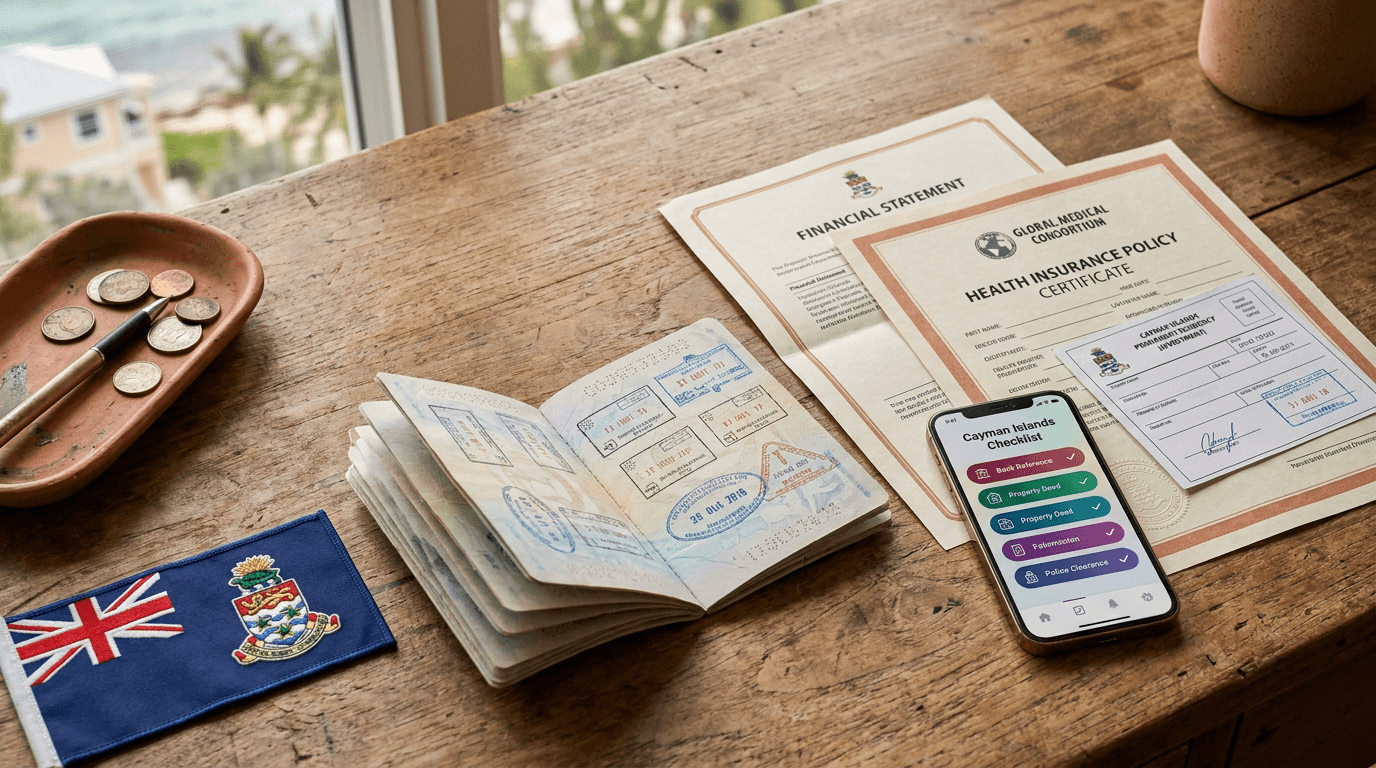
The document stack is more annoying than the average residency filing. WORC’s R5 form and current practice call for identity records, police checks, medicals and proof that the money is really where you say it's.

  • Application form: Completed Form R5 for the Certificate of Permanent Residence for Persons of Independent Means.
  • Identity documents: Certified passport bio page for the main applicant and each dependent, plus certified birth and marriage certificates where relevant.
  • Photos: Passport-size full-face and profile photos for the applicant and each dependent.
  • Police clearance: A police certificate or letter of record from your last place of residence, issued within 6 months, for adults.
  • Character references: Three sealed references from unrelated people who’ve known you for at least 3 years.
  • Medical and insurance: Medical questionnaire, HIV and VDRL lab results and health insurance accepted in Cayman.
  • Investment proof: Title documents, land register records, transfer papers or share registers showing the KYD 2 million real estate investment.
  • Financial evidence: Bank references and financial statements showing you can support yourself and dependants without local employment.

Fees and timing

The fees are steep and the grant fee is the part that stings. The current professionally accepted schedule is a KYD 500 application fee, a KYD 100,000 grant fee if approved and KYD 1,000 for each dependent on grant. Those fees are nonrefundable, so a sloppy file gets expensive fast.

Processing usually takes about 4 to 6 months once the application is complete, though WORC doesn’t publish a hard service standard for this category. If your ownership structure is messy or the paperwork on the property isn’t clean, expect delays.

How the filing works

Start by getting the property and finance documents in order, then submit the full package to WORC. If anything is missing, the file tends to stall instead of moving forward and that’s usually where people lose time.

Once the application is accepted, WORC reviews your background, health, finances and investment position before issuing a decision. If approved, you pay the grant fee and the certificate is issued with indefinite validity.

Duration and renewal

The Cayman Certificate of Permanent Residence for Persons of Independent Means is now issued for an initial 10-year period. That’s a change from the older, indefinite framing, but it still sits inside Cayman’s permanent residence system rather than a time-limited visitor route.

What happens after those 10 years is straightforward in law, if not always simple in practice. The certificate may be renewed indefinitely, provided you still meet the investment and fee conditions and the real estate remains fully paid up at the time of renewal.

  • Initial grant: 10 years
  • Renewal: Indefinitely, with application and prescribed fee
  • Investment test: The paid-up real estate investment must still meet the prescribed sum
  • Presence rule: No clear current statutory day-count could be verified for this category

The law doesn’t set a maximum number of renewals, so there’s no built-in cutoff date if you keep meeting the conditions. That said, the certificate can still be lost under Cayman’s general revocation rules if you fall out of compliance, stop maintaining the investment or run into character issues.

This route also has a longer-term payoff. Once the certificate has been renewed indefinitely and you’ve held that renewed status for at least one year, you can apply for naturalisation or registration under the British Nationality Act 1981. After that, Caymanian status becomes a separate step, not an automatic result of the investment certificate.

One thing that’s still a little messy is the paperwork side. Official materials don’t give a clean public schedule for the post-2025 renewal fee in the sources reviewed, so applicants should expect WORC to handle renewal details administratively rather than by a simple published one-size-fits-all rule.

The Cayman Islands is one of the simpler places in the region from a tax angle, but that doesn’t mean the paperwork disappears. Holders of the Certificate of Permanent Residence for Persons of Independent Means don’t pay Cayman personal income tax, capital gains tax, inheritance tax or wealth tax. The local rate is effectively 0% for individuals.

That said, the real question isn’t what Cayman taxes. It’s what your home country taxes and how it treats you once you’ve moved. Cayman doesn’t have a published individual income-tax residency test, so there’s no local 183-day rule to game or worry about. Your immigration status, including the presence conditions attached to permanent residence, doesn’t create a Cayman income-tax bill.

  • Local tax on salary or remote income: None.
  • Local tax on capital gains, dividends or pensions: None.
  • Special tax rate for PR holders: None, because there’s no personal income tax to begin with.

That clean setup comes with a catch. Cayman’s tax neutrality doesn’t shield you from tax rules in the United States, the UK or wherever else you’re tied in. If your home country taxes you on worldwide income, citizenship or residence, that issue stays with you after you land in Grand Cayman.

There’s also a reporting side to this. Cayman uses tax information exchange agreements, FATCA and the Common Reporting Standard, so financial institutions may report account information to foreign tax authorities. That doesn’t mean Cayman taxes you, but it does mean your banking activity can still be visible to other governments.

  • Double-tax treaties: Cayman has very limited treaty coverage, with a notable UK arrangement and far more reliance on information exchange agreements.
  • Indirect taxes and fees: You may still deal with import duties, stamp duty on property and government fees.
  • Work rights: Permanent residence doesn’t automatically give you the right to work, so any employment permission has to be handled separately.

For the permanent-residency-by-investment route, that’s the main tax story. It’s attractive because the system is simple, not because it creates a special tax break. If you’re buying the certificate for tax reasons alone, the better question is whether your other tax ties actually change.

Full Country Guide

Cayman Islands Digital Nomad Guide

Cost of living, internet, healthcare, coworking, and every visa option for Cayman Islands.

Stay Current

Visa rules change. We'll tell you.

Get notified about policy updates and new requirements for the Cayman Certificate of Permanent Residency (Investment) and other Cayman Islands visas.