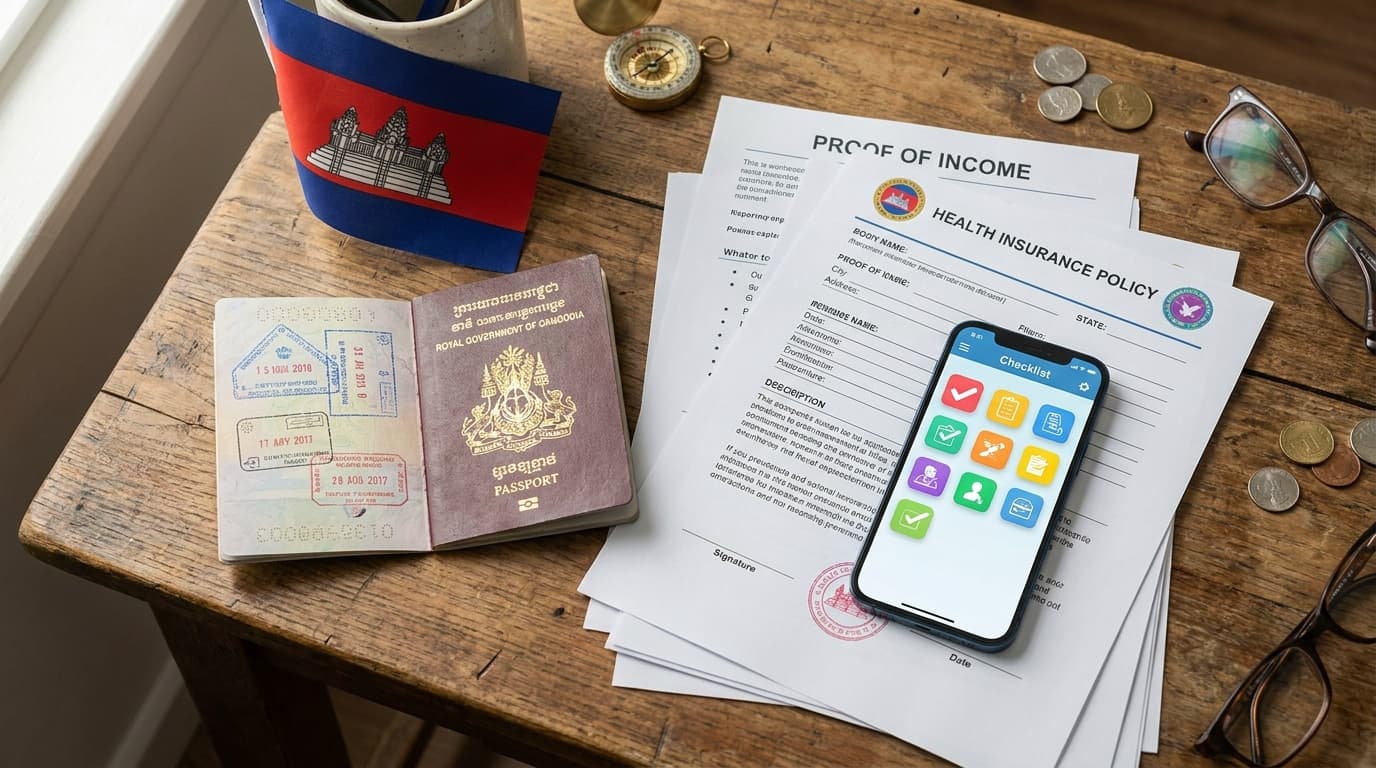
Cambodia Citizenship by Investment — Cambodia

Visa Program Briefing

Cambodia Citizenship by Investment

CambodiaGolden / Investor Visa
Brandon Richards
Brandon Richards ·

Visa Data Sheet

Minimum Savings
$1,000,000 – $3,000,000 in savings
Processing Time
9 weeks
RenewableResidency PathRemote Work
The Full Briefing

Cambodia doesn’t have a standard, officially branded citizenship by investment visa. What it does have is a nationality law with two investment-linked paths to Khmer nationality and both sit inside the naturalization system, not the tourist visa system.

The first route can waive the usual seven-year residence requirement if a foreigner has a CDC-authorized investment of at least 1,250,000,000 riels and the project has actually been implemented. The second allows an application after a cash donation of at least 1,000,000,000 riels to the national budget for economic restoration or rebuilding, assuming the other personal conditions are met.

This is aimed at investors and donors, not ordinary short-term visitors. It’s also not automatic, which matters a lot. The nationality law says naturalization isn't a right of the applicant, so the state can still reject the file.

How this differs from the tourist visa

Don’t confuse this with Cambodia’s tourist e-Visa. That’s a single-entry visitor visa for tourism, valid for 3 months with a 1-month stay and the official fee is $30. Approval is typically issued in about 3 business days.

The investment-linked nationality route is a completely different legal track. If it works, you’re applying for Cambodian nationality, not just a longer stay. That’s a much bigger step and it comes with far more discretion on the government side.

What applicants should expect

  • Investment route: A CDC-authorized project with at least 1,250,000,000 riels invested and implemented.
  • Donation route: A cash donation of at least 1,000,000,000 riels to the national budget.
  • Legal status: Naturalization, not a tourist or residency visa.
  • Decision-making: The state can approve or reject the application.

There isn’t a confirmed official 2026 replacement or redesign for this nationality-law route in the sources reviewed. The official e-Visa portal still describes the tourist e-Visa service, not a separate citizenship by investment program.

Who qualifies

Cambodia doesn’t have a clean, branded “citizenship by investment” program with a public fee sheet. What it does have is a fast-track naturalization route built into the nationality law, then tightened by Sub-Decree No. 225. The big takeaway is simple, if expensive: you need either major investment capital or a large donation and the government hasn’t published every practical detail people usually want before applying.

Two paths are spelled out in the latest rules. The investment route calls for 4 billion riel, which is roughly $1 million, placed into a legitimate project in a priority sector approved by the competent authority, usually the Council for the Development of Cambodia. The donation route is higher, at 12 billion riel or about $3 million, paid into the national budget or humanitarian sector through the Ministry of Economy and Finance.

That money has to be yours and it has to come from a lawful, documented source. The law also points to stable economic activity and general fitness to become a citizen, so this isn’t just a wire transfer and a passport pickup.

  • Investment route: 4 billion riel in an approved Cambodian project
  • Donation route: 12 billion riel to the national budget or humanitarian sector
  • Source of funds: Must be lawful and clearly documented
  • Income floor: No official monthly or annual minimum is published

There’s no official government income threshold and no public checklist that says you need to earn a certain amount each month. Private agents may quote their own numbers, but those figures don’t appear in the law or the implementing sub-decree. That’s a red flag if someone tries to sell you certainty that isn’t actually on paper.

Applicants also need to clear the usual nationality checks. That means good conduct, a clean criminal record and, in practice, proof that you can live in Cambodia without becoming a burden on the state. The government hasn’t published a full English document list for these fast-track cases, so the process still has a lot of discretion baked into it.

One final wrinkle, the law sets review deadlines, but not a neat, guaranteed finish date. The initial review is meant to happen within 45 working days, incomplete files can be sent back for corrections and successful applicants still have to take an oath before citizenship is final.

Source

Cambodia doesn’t publish a neat, public checklist for citizenship by investment. The law gives the framework, but a lot of the file requirements are handled case by case, so any document list you see online is only a guide, not the official final word.

The legal route is citizenship by naturalisation, granted by Royal Decree after the government’s proposal. Recent reporting on the 2025 sub-decree says the economic thresholds were raised to **4 billion riel** for personal capital invested in an approved project, about **$1 million** or **12 billion riel** for a personal cash donation, about **$3 million**.

What the law clearly asks for

The Nationality Law sets the broad conditions. For ordinary naturalisation, applicants generally need proof of good conduct from their commune chief, a clean criminal record, legal residence, Khmer language ability and the capacity to integrate into Cambodian society. For investors and donors, the residency requirement can be waived, but the grant still isn’t automatic.

  • Good conduct certificate: Issued by the local commune chief where you live.
  • Police clearance: Proof of no criminal conviction.
  • Legal source of funds: Bank records and supporting financial documents showing the money is clean.
  • Investment or donation proof: Evidence the required capital was placed through the approved channel.
  • Health evidence: A medical certificate is commonly requested, though the law doesn’t publish a fixed format.

Documents commonly requested in practice

Specialist firms report a fairly standard packet, even though Cambodia doesn’t publish an official English-language checklist. You’ll usually be asked for a completed application form, a valid passport, passport photos, police certificates, bank statements and a health report. Many advisers also say non-Cambodian documents should be notarized, legalized or apostilled, then translated into Khmer.

  • Passport: Usually with at least 6 to 12 months’ validity.
  • Photos: Passport-size photos, often in 40 x 60 mm format with a white background.
  • Application forms: Personal data and biographical forms.
  • Civil records: Marriage and birth certificates, if relevant.
  • Project papers: Company registration and CDC or government approval for investment cases.

One thing is clear, the government cares about the source of money. If your funds look murky, the application is likely dead on arrival.

Source 1 | Source 2

Cambodia does have a formal citizenship by investment route, but the money piece is a lot less tidy than most private firms make it sound. The government has set the main economic thresholds in law, yet it hasn't published a public fee sheet for citizenship applications, dependents or passport issuance. So if an agent gives you a neat all-in package price, that’s their quote, not a government schedule.

The core costs are the ones written into the nationality rules. For the investment route, a foreigner needs a personal investment of at least 4 billion riel, about $1 million, in an approved priority-sector project with the right permit. For the donation route, the minimum is 12 billion riel, about $3 million, paid to the national budget or a humanitarian sector. Those are the big numbers that matter. Everything else is extra.

  • Investment route: 4 billion riel, about $1 million
  • Donation route: 12 billion riel, about $3 million
  • Official application fee: Not publicly listed
  • Dependent fees: Not publicly listed
  • Passport or certificate issuance fee: Not publicly listed

That missing fee table is the annoying part. Cambodia’s public materials explain the legal route and review process, but they don’t give a verified riel or dollar amount for the citizenship application itself. The same goes for spouse and child processing fees. If you’re budgeting, assume the legal threshold is only the start, then add document prep, translations, legalisation, police certificates and any advisor or intermediary charges.

Those side costs vary by country and by how messy your paperwork is. You may need certified Khmer translations of civil records, legalisation or apostille steps, criminal record certificates and, in some cases, medical checks. None of those prices are set by a Cambodian immigration portal, so there’s no single number you can rely on.

Processing time is also not fully pinned down in public-facing materials. The review stage under Sub-Decree No. 225 is described as 45 working days, but that’s only part of the route, not a guaranteed door-to-passport timeline. In practice, the total cost of getting to citizenship can be high and the official government fee component is still frustratingly opaque.

Cambodia does allow nationality by investment or donation, but there isn’t a neat, public step-by-step citizenship portal you can follow online. The legal framework exists, the process is discretionary and the exact government fee schedule still isn’t fully published in English, so don’t trust agent brochures that promise a fixed, all-in price.

The clearest official path sits under Sub-Decree No. 225. It sets two main routes for direct naturalisation: a personal investment of KHR 4 billion or a cash donation of KHR 12 billion to the national budget or humanitarian sector. The investment has to go into approved priority sectors or projects and the donation must come from a legal source.

How the application is handled

  • Start with the right route: investment, donation or another nationality category the state recognises.
  • Prepare proof of source of funds: the authorities want the money trail to be clean.
  • Legalise foreign documents: the rules say foreign-issued papers need to be legalised before submission.
  • Submit through the government review process: applications are reviewed by the General Department of Identification.
  • Take the oath if approved: naturalisation is completed only after an oath of allegiance before the Supreme Court of Cambodia.

The timeline is more concrete than the paperwork. The initial review is supposed to take 45 working days. If something is missing, you get 30 working days to fix it, then the file is reviewed again within 15 working days after resubmission.

The annoying part is what the public record doesn’t spell out. There’s no official English checklist for the investment file and the government hasn’t posted a clean line-item fee schedule for nationality by investment. That means passport, birth certificate, police clearances and supporting investment papers are likely to come up, but you should treat any exact document list from an agent as provisional until the ministry confirms it.

CM2H is separate. It’s a residence-by-investment program with a $100,000 minimum investment and a 10-year visa and holders may become eligible to apply for citizenship after five years. That’s not the same thing as direct nationality by investment and the government hasn’t fully clarified how the two tracks overlap.

Source

Cambodia doesn’t have a separate, time-limited “citizenship visa.” The direct citizenship by investment route is a naturalisation process under the Law on Nationality, so if it succeeds, you become a Cambodian citizen by Royal Decree and there’s no visa to renew after that.

That’s the cleanest answer for duration. Citizenship is permanent, so there’s no expiry date, no maximum stay and no recurring immigration filing tied to the original investment. The one admin task that does continue is ordinary passport renewal, which applies to all Cambodian citizens and follows the normal passport validity rules.

Direct citizenship by investment

The catch is that this route isn’t a guaranteed, pre-set visa program. The available legal material says investors or donors may apply for naturalisation, but approval is discretionary. In other words, the investment can open the door, but it doesn’t lock in a fixed timeline or a renew-by-this-date system.

  • Status: Permanent, if approved
  • Renewal: None for citizenship itself
  • Travel document: Cambodian passport, renewed separately when it expires

There’s also no official public rule laying out a probationary visa period before citizenship is granted. In practice, applicants usually hold another Cambodian visa while the naturalisation process is pending, but the government materials don’t publish a standard “hold this for X years, then renew it” framework for the citizenship route.

CM2H’s 10-year residence track

If you want the investment route with a clearer long-stay structure, Cambodia My 2nd Home or CM2H, is the better-known option. It’s a 10-year golden visa and the programme materials say it’s renewable, but they don’t publish a detailed renewal schedule or fee structure for what happens after the first 10-year term.

  • Initial validity: 10 years
  • Entry rights: Multiple entry during the visa term
  • Renewal: Described as renewable, but the exact process isn’t clearly codified in the public materials
  • Passport route: Eligible to apply after 5 years, if you still meet the programme conditions

So the practical split is simple. Direct investment-based citizenship is a one-time status change with no renewal cycle. CM2H is a long-term residence visa with a stated 10-year term and a possible path to citizenship after 5 years, but the post-10-year renewal mechanics are still hazy.

Cambodia doesn’t hand out any special tax break just because you’re on CM2H or a citizenship-by-investment path. The official immigration materials describe those programs as residence and citizenship routes, not tax incentive schemes, so your tax treatment falls back on ordinary Cambodian rules.

The big question is residency. Cambodia’s tax authority, the General Department of Taxation, publishes filing guidance and e-tax materials, but the cleanest official English statement I could verify for a residency trigger wasn’t available in the retrieved pages. The commonly cited test is 182 days or more in a 12-month period, but treat that as something to confirm directly in the current tax code or with a local adviser before you rely on it.

For income, the picture is mixed but not mysterious. Cambodian tax materials indicate that foreign-source income can sometimes get foreign tax credit treatment if tax was already paid abroad, though that depends on the documents you can produce and the limits in the relevant rules. I couldn’t verify a blanket exemption for foreign-earned income from official text, so don’t assume offshore income is automatically ignored.

If you stay long enough to become a tax resident, the source of the income matters. Cambodian-source income is the area that usually draws the most attention, while foreign-source income may be handled through credits or treaty relief rather than a straight exemption. The GDT also publishes treaty forms for relief under double-tax agreements, so if you’ve got salary, consulting income or investment income from another country, paperwork matters.

  • Tax residency: commonly cited at 182 days in a 12-month period, but not fully confirmed in the retrieved official English text.
  • Foreign tax credit: available in some cases for foreign-source income if you can prove tax was paid abroad.
  • Treaty relief: Cambodia does have double-tax treaty materials and forms through the GDT.
  • Filing: the GDT expects periodic filing through its e-tax system.

The practical takeaway is simple. CM2H or citizenship-by-investment doesn’t give you a tax halo and Cambodia won’t magically wipe out your reporting duties. If you plan to spend real time in-country, talk to a tax professional who can check your residency status, income source and treaty position before you settle into a routine.

Full Country Guide

Cambodia Digital Nomad Guide

Cost of living, internet, healthcare, coworking, and every visa option for Cambodia.

Stay Current

Visa rules change. We'll tell you.

Get notified about policy updates and new requirements for the Cambodia Citizenship by Investment and other Cambodia visas.