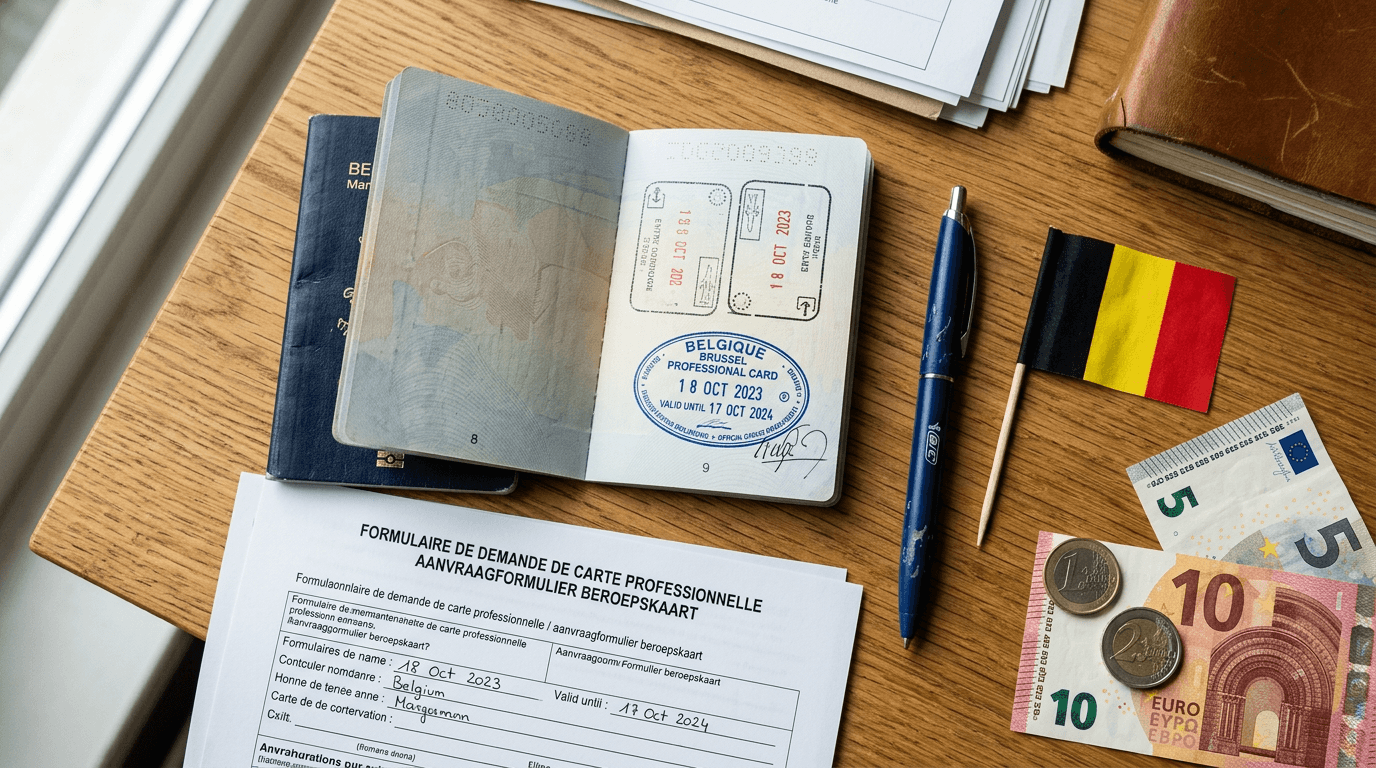
Belgium Professional Card

At a Glance
- Net means of at least 110% of the guaranteed average minimum monthly income (GGMMI) in Flanders; Brussels and Wallonia set no fixed amount and assess each casenet means of at least 110% of the guaranteed average minimum monthly income (GGMMI, CAO 43) · applicants for a card in the Flemish Region
- €22,838 one-timeor more; amount can be indexed; on a financial account in the applicant's own name · Flanders applicants for an activity with economic added value
- €140 one-timedue on every application (first, renewal, change), whatever the decision · all regions
- 2 yearsusual first card in Brussels (probationary); Flanders grants 1 to 3 years by added value; legal maximum per card 5 years
- Renewable while the activity still meets the conditions; each card runs up to 5 years (Brussels) or 1 to 3 years (Flanders); in Flanders apply online through the WSE-loket at least 60 days before expiry (EUR 140 plus EUR 90 per year)
- From abroad: in person at the Belgian embassy or consulate in the country of legal residence. Already legally resident in Belgium: through an approved enterprise counter (guichet d'entreprises / ondernemingsloket) or, in Flanders, online via the WSE-loket. The region where the activity is based decides (Brussels Economy and Employment, Flemish Department of Work, Walloon Public Service).
- 120 daysup to; legal decision deadline after the file is accepted, extendable; card deemed granted if no decision · Flanders applications
- Yesonly the self-employed activity named on the card
- EU long-term resident status after 5 years of legal and continuous residence, with stable resources and health insurance
Last checked Oct. 8, 2026
Belgium has no digital nomad visa. Non-EU nationals who want to work for themselves in Belgium need a professional card, the permit for self-employed foreigners. The route is active.
The card is issued by the region where the activity is based: Flanders, Wallonia or Brussels. It covers only the self-employed activity named in the application (royal decree), and a card issued in Flanders is also recognized in the other regions (Flemish Government).
Since Sept. 1, 2026, Flanders Investment & Trade has called the Flemish procedure the "Innovation & Startup Permit." It offers a fast track to non-EU self-employed applicants who include a signed letter showing they are mentored by, or working with, an innovator, incubator or knowledge institution in Flanders. The conditions of the card itself have not changed (Flemish Government).
Applicants who live abroad also need a long-stay D visa. The card is released once the visa is confirmed.
The card is for non-EU nationals. Citizens of EEA countries and Switzerland do not need one, and Flanders also exempts recognized refugees and Ukrainians with temporary protection (Flemish conditions).
Every region checks that the activity is useful to the region and that the applicant meets any rules for the profession. Brussels, for example, assesses the project's value to Brussels and requires valid residence rights (Brussels Economy and Employment).
Flemish conditions
- Means of subsistence: Net means of at least 110% of the guaranteed average minimum monthly income (GGMMI) in Flanders; Brussels and Wallonia set no fixed amount and assess each case.
- Start capital: at least €22,838 on a financial account in the applicant's own name, for an activity with economic added value. The amount can be indexed.
- Education: at least a diploma at qualification level 4 (secondary level).
- Business plan: covering the target market, market size, competition, a SWOT analysis and the marketing strategy.
- Compliance: registration in the Crossroads Bank for Enterprises (KBO), tax obligations met and no threat to public order.
Applicants already in Belgium must hold legal residence when they apply. The card covers only the holder; whether family members can join depends on federal family reunification rules, which the regional card pages do not cover.
Each region publishes its own checklist. Brussels asks for (be.brussels):
- the completed application form
- a copy of the criminal record
- a copy of the identity document and two photos
- a business plan of up to 20 pages, plus any supporting documents
Flanders asks for identity documents, a criminal record extract, diplomas, proof of means of subsistence and a business plan (Flemish Government).
For the D visa, applicants 18 or older applying from abroad first pay the Immigration Office contribution of €242 by bank transfer (Belgian Embassy in Japan). Belgian embassies and consulates publish their own D visa checklists, and these differ by post.
The card fees are the same in every region (royal decree):
- Application fee: €140, due on every application (first, renewal or change) whatever the decision.
- Card fee: €90 for each year of validity, charged when the card is issued. A part year counts as a full year.
- Immigration Office contribution: €242 for applicants 18 or older applying from abroad. The amount is updated each year.
- Consular visa fee: varies by post; check the checklist of the Belgian embassy or consulate that handles the file.
Translations, legalization of foreign documents, health insurance and any help with the business plan are extra and depend on the applicant's situation.
From abroad: in person at the Belgian embassy or consulate in the country of legal residence. Already legally resident in Belgium: through an approved enterprise counter (guichet d'entreprises / ondernemingsloket) or, in Flanders, online via the WSE-loket. The region where the activity is based decides (Brussels Economy and Employment, Flemish Department of Work, Walloon Public Service).
- Regional decision: in Flanders, the decision comes within 120 days after the file is declared admissible. If no decision is taken within that period and any extension, the card is deemed granted. An incomplete file gets 30 days to add the missing documents (Flemish Government).
- D visa: applicants abroad then apply for the long-stay D visa at the Belgian post.
- Card: in Flanders, residents download the card through the WSE-loket after payment; applicants abroad receive it at the enterprise counter they chose once the visa is confirmed.
Appeals: Flanders accepts an appeal within 30 days of a refusal. In Brussels, an appeal goes to the employment minister within 30 days, then to the Council of State within 60 days (be.brussels).
In Brussels, a first card is usually issued for 2 years on a probationary basis (be.brussels). Flanders sets the validity per file. The card stays valid only while the holder keeps a right of residence.
Renewal: Renewable while the activity still meets the conditions; each card runs up to 5 years (Brussels) or 1 to 3 years (Flanders); in Flanders apply online through the WSE-loket at least 60 days before expiry (EUR 140 plus EUR 90 per year) (Flemish Government).
Renewal is not automatic: the region checks again that the activity is still useful and that tax and social security obligations are met.
Long-term residence: EU long-term resident status after 5 years of legal and continuous residence, with stable resources and health insurance (EU Directive 2003/109/EC). The card itself does not grant permanent residence.
The professional card carries no special tax regime. No official source found for this page shows a tax break for card holders.
Tax residence: Resident if the domicile (actual home) or seat of wealth is in Belgium; anyone in the National Register is presumed resident unless proven otherwise; no day-count test (OECD summary of Belgian rules). A card holder who registers with a commune is therefore presumed resident.
Flanders makes compliance with tax obligations a condition of the card, and renewals check it again (Flemish conditions). Card holders should confirm how foreign income, social security contributions and VAT apply to their activity with the Belgian tax administration or an adviser.
Frequently Asked Questions
Does Belgium have a digital nomad visa?
No. Non-EU nationals who want to work for themselves in Belgium apply for a professional card, which covers only the self-employed activity named on the card.
How much does the Belgian professional card cost?
The application fee is €140 and the card costs €90 for each year of validity. Applicants abroad also pay the €242 Immigration Office contribution and a consular visa fee that varies by post.
How much money is needed for a professional card in Flanders?
Net means of at least 110% of the guaranteed average minimum monthly income (GGMMI) in Flanders; Brussels and Wallonia set no fixed amount and assess each case. For an activity with economic added value, Flanders also asks for start capital of at least €22,838 in the applicant's own account.
How long does a decision take?
Flanders decides within 120 days after the file is declared admissible, and a card is deemed granted if no decision comes in time. The D visa step adds more time.
Can the professional card lead to permanent residence?
Yes, indirectly: EU long-term resident status after 5 years of legal and continuous residence, with stable resources and health insurance.
How It Compares
Similar visas elsewhere
| Program | Country | Income | Fee | Max stay | Renewable |
|---|---|---|---|---|---|
| Kuwait Freelance Residency (Announced, Not Launched) | Kuwait | - | - | - | |
| Sweden Self-Employed Residence Permit | Sweden | SEK 200,000 saved | SEK 2,000 | 24 mo | |
| Finland Startup Permit | Finland | €1,210/mo | €650 | 24 mo | |
| Hong Kong Quality Migrant Admission Scheme (QMAS) | Hong Kong | - | HKD 600 | 36 mo |
Belgium Digital Nomad Guide
Cost of living, internet, healthcare, coworking, and every visa option for Belgium.
Visa rules change. We'll tell you.
Get notified about policy updates and new requirements for the Belgium Professional Card and other Belgium visas.