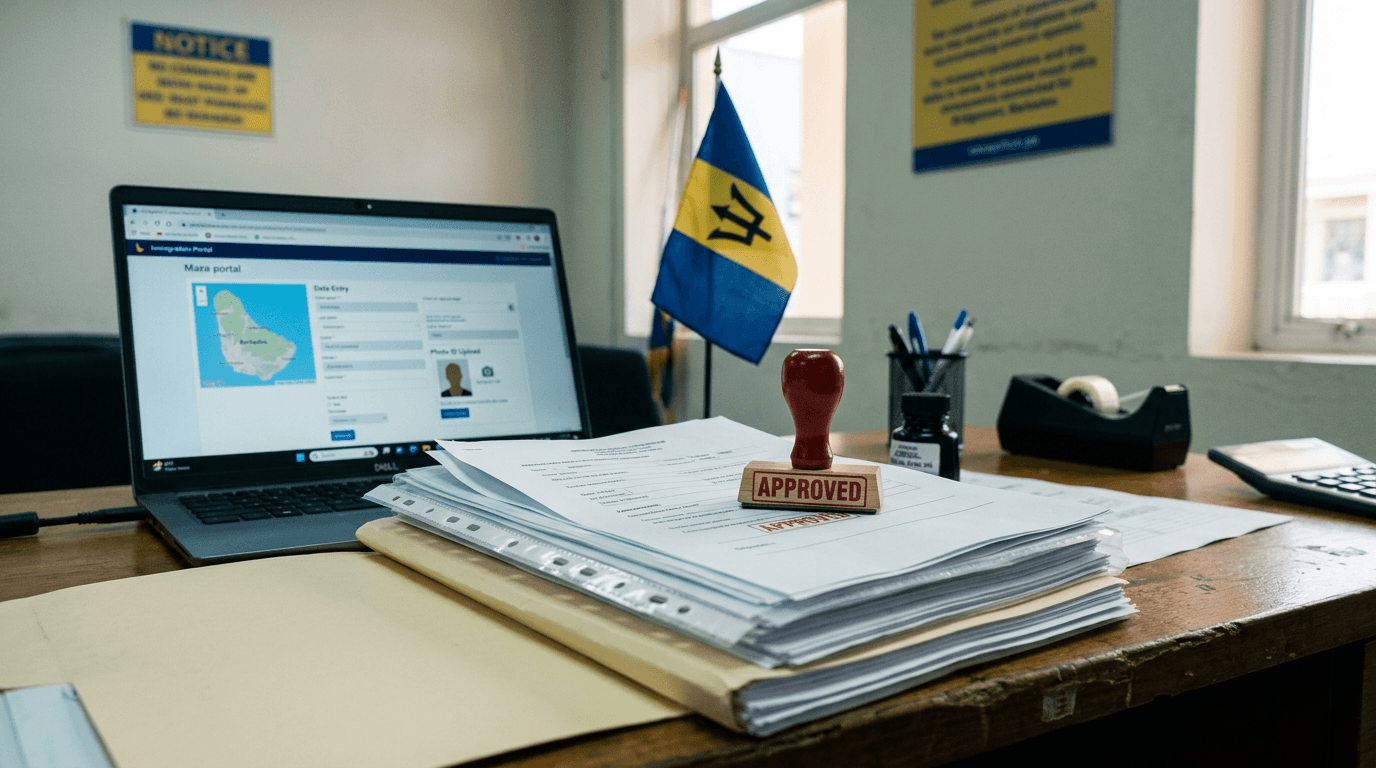
Barbados Digital Nomad Visa

Visa Data Sheet
- $50,000 / yr
- $2,000 – $3,000
- 1 week
- 24 months
Barbados’ digital nomad visa is the 12-month Barbados Welcome Stamp, a remote-work permit created under the Remote Employment Act 2020. It’s designed for non-nationals who work for employers or businesses outside Barbados and it lets you live on the island for up to 12 months while keeping your foreign income flowing.
This isn’t a standard tourist stamp dressed up with nicer branding. The whole point is remote work and the law treats Welcome Stamp holders as non-resident for Barbadian income-tax purposes. The government also makes clear that this visa is for remote work only, so local jobs are off limits.
Who it’s for
The program is open to individuals and families whose work is location-independent. That includes remote employees, freelancers and business owners with clients or companies outside Barbados. School-aged children can attend school in Barbados on the Welcome Stamp, so families don’t need to sort out a separate student visa for them.
Core requirements
- Income: The official portal says you must expect to earn at least $50,000 USD over the 12 months you plan to stay.
- Work location: Your employment or business must be based outside Barbados.
- Health insurance: You need valid coverage for the full period of the stamp.
- Documents: Expect to provide passport biodata pages for the main applicant and dependants, plus birth certificates and proof of relationship for family members.
- Photo and entry visa: The official guidance also asks for passport-sized photos and, where relevant, an entry visa for nationals who need one to enter Barbados.
Fees and validity
The Welcome Stamp is granted for 12 months only. If you want to stay longer, you can reapply, but the official materials don’t promise automatic renewal. Current public guidance lists the non-refundable fee at $2,000 USD for an individual and $3,000 USD for a family bundle, payable after approval.
One extra benefit is tax treatment. Under the law, Welcome Stamp holders are deemed non-resident for Barbados income tax. They still pay local VAT on goods and services, so this visa doesn’t make Barbados a tax-free bubble. It just keeps your foreign earnings out of Barbadian income tax while you’re there.
The Barbados Welcome Stamp is open to most nationalities, but it’s not a free-for-all. You still need to meet Barbados’ normal entry rules if your passport requires a separate short-stay visa and the government expects you to be working remotely for someone outside Barbados.
The main bar is income. You must declare that you expect to earn at least $50,000 over the 12 months you plan to stay and that income has to come from outside Barbados. The official portal doesn’t publish a fixed list of acceptable financial documents, so be ready to upload proof such as contracts, invoices or bank records if they ask for it.
Core eligibility
- Remote work only: You need to be employed by or run a business based outside, Barbados.
- Income threshold: At least $50,000 in expected annual income.
- Valid passport: Your passport needs to cover your full stay.
- Health insurance: You must have coverage for the full period you’re in Barbados.
- Family applications: You can apply as an individual or include eligible dependants under the family bundle.
That family option isn’t just marketing fluff. The official guidance allows dependants to be included and school-aged children approved under the Welcome Stamp can enroll in school without a separate student visa. The public guidance doesn’t spell out every edge case, though, so if you’re applying with an adult child or an unmarried partner, expect to ask for clarification.
There’s no official minimum age listed beyond the obvious passport and application requirements and there’s no published upper age limit either. The government also doesn’t post a clean disqualifying list, but if you can’t prove the income, can’t satisfy entry rules or have a serious criminal issue, your application is likely to hit a wall.
If you do qualify, the process is straightforward but not cheap. Applications are filed online, decisions usually come back in about 5 to 7 working days and fees are paid only after approval.
- Individual fee: $2,000
- Family bundle fee: $3,000
- Validity: 12 months, with the option to reapply if you want to stay longer
The Barbados Welcome Stamp is the island’s 12-month remote-work visa, created under the Remote Employment Act, 2020 and handled online through the official government process. It’s built for people who earn outside Barbados, not for anyone looking to take a local job while they’re there.
To qualify, you need to expect to earn at least $50,000 over the 12 months covered by the stamp and that income has to come from outside Barbados. The official sources are clear on the threshold, but they don’t list a fixed set of income documents like bank statements or tax returns. Instead, you make an income declaration in the application and upload the required identity documents.
The core documents are straightforward, though the family paperwork can get a little tedious if you’re bringing dependents. The official schedule and Welcome Stamp page call for:
- Passport bio-data page: For the principal applicant and any spouse, partner, children or dependents included in the application.
- Passport-sized photo: For the principal applicant and family group members over 18.
- Birth certificate: For the applicant and any dependents.
- Proof of relationship: Such as a marriage certificate, birth certificate or adoption documents, if you’re applying with dependents.
- Entry visa, if needed: Only if your nationality requires one for Barbados entry.
You’ll also need to confirm that your work is based outside Barbados and that you have health insurance for the stay. The official materials don’t spell out a separate minimum savings balance, so don’t assume a cash reserve will replace the income requirement. It won’t.
Fees are quoted two ways, but they line up because the Barbados dollar is pegged to the U.S. dollar. The application fee is $2,000 for an individual or $3,000 for a family bundle and the fee is non-refundable. The government says approval usually comes through in about 5 to 7 business days, then you have 28 days to pay.
The Welcome Stamp is valid for 12 months from arrival. The official portal includes a renewal option, so extensions are possible, but the government doesn’t publish a clear limit on how many times you can renew or a separate renewal fee in the materials reviewed here. If you want to stay longer, you’ll need to use the official renewal process, not guess your way through another visa cycle.
Costs & fees
The Barbados Welcome Stamp is simple on paper, but it isn’t cheap. The official fee is $2,000 for an individual and $3,000 for a family bundle and the government says payment is due within 28 days of approval.
There doesn’t appear to be a separate published government charge beyond that Welcome Stamp fee. The official portal refers to the charge as the non-refundable fee, but it doesn’t break it into application and processing parts.
- Individual fee: $2,000
- Family bundle fee: $3,000
- Payment window: 28 days after approval
- Approval time: usually within 7 business days
The income rule is the other big number to plan around. You need to show annual income of at least $50,000 over the 12 months you want the travel stamp for. The official page lists that threshold in U.S. dollars only, so there’s no government-published Barbados-dollar equivalent to rely on.
Family applications are handled as a bundle and the official page asks for a passport-sized photo, passport bio-data page and proof of relationship for the principal applicant and family-group members. If you’re applying with dependents, that’s the main place where your paperwork and costs can grow.
- Passport-sized photo: required for the principal applicant and family-group members over 18
- Passport bio-data page: required for the principal applicant and family-group members
- Proof of relationship: required for family-group applications
One thing the official pages don’t spell out clearly is a separate health insurance cost, a translation fee or an agent fee. You might still choose to pay for those if your documents need extra work or you want help with the application, but those costs aren’t officially published by Barbados.
The good news is that the process is fairly quick. Applications are typically approved within 7 business days, so once your documents are ready, you’re mainly waiting on the decision and then the payment window.
The Barbados Welcome Stamp is a 12-month remote-work visa and the whole application is handled online. Most complete applications are decided in about 7 business days, though the official portal says your file starts moving within 2 days of receipt and can be confirmed or denied within 5 working days.
The basic rule is simple. You need to expect at least $50,000 in annual income over the 12 months you plan to stay and that income has to come from outside Barbados. The government asks for an income declaration, not a pile of bank statements.
What you need
- Passport bio-data page: for the main applicant and any family members included in the application.
- Passport-sized photo: for the main applicant and all family members over 18.
- Proof of relationship: for a spouse, partner or children joining you.
- Income declaration: confirming you expect to earn at least $50,000 over the year.
- Birth certificates: listed in official guidance as supporting documents for the applicant and family members.
If you’re from a country that normally needs a standard entry visa for Barbados, you may need that too. The Welcome Stamp doesn’t replace ordinary border rules, so don’t assume the remote-work visa solves everything.
How the process works
- 1. Apply online: start the Welcome Stamp form from the official portal before you travel.
- 2. Wait for a decision: most applications are handled in about a week if everything is in order.
- 3. Pay after approval: the fee is due only once you’re approved.
- 4. Travel within the approval window: your 12 months begins when you arrive in Barbados.
The fee is $2,000 for one person or $3,000 for a family bundle. Those fees are non-refundable and you’ll need to pay within 28 days of approval. There isn’t a separate official processing fee listed on the public guidance.
The visa is for remote work only. You can live in Barbados and work for an employer or business outside the country, but you can’t take local employment under this program. If you like the island enough to stay longer, you can reapply, but that’s a fresh application, not a guaranteed renewal.
The Welcome Stamp gives you 12 months in Barbados, starting from your arrival date. You also have to land within 12 months of approval for the visa to kick in, so don’t sit on the approval letter for too long.
If you want to stay longer, you can reapply for another 12-month period. The official guidance says you can “easily reapply,” but it doesn’t spell out a guaranteed renewal. In plain English, that means it’s a fresh application, not an automatic extension and you still need to meet the program’s rules again.
- Renewal method: Reapply through the Welcome Stamp system before your current 12 months runs out.
- Eligibility: You still need to qualify as a remote worker and meet the income requirement of $50,000 a year.
- Fees: The official fee schedule remains $2,000 for an individual and $3,000 for a family bundle. The government doesn’t publish a separate renewal fee.
The official sources are clear on the 12-month validity, but they’re less clear on how many times you can renew. There’s no published cap on consecutive renewals and no official cool-off period between stamps, but there’s also no promise that you can keep renewing forever. Approval still sits with immigration.
One more thing. The Welcome Stamp doesn’t lead to permanent residency or citizenship on its own. If you’re thinking long term, you’ll need a different status route entirely, not just another year on the nomad visa.
Taxes & considerations
The Barbados Welcome Stamp is unusually clear on tax. If you’re granted the 12-month visa, Barbados treats you as non-resident for income-tax purposes, so your remote-work earnings aren’t subject to Barbados income tax while you’re on the Stamp. That holds even if you’re physically on the island for up to a year and even if your home country would normally count those days differently.
That tax treatment comes from the Remote Employment Act, 2020. It was built to let non-nationals live in Barbados and keep working for employers or clients outside the country without getting pulled into the local income-tax system.
- Income tax: Not payable in Barbados on income covered by the Welcome Stamp.
- Residency status: You’re deemed not resident in Barbados for income-tax purposes during the Stamp period.
- Local work: You can’t take employment in Barbados or do work for Barbadian clients under this visa.
That last point matters. The Welcome Stamp is for remote work only, for companies and individuals outside Barbados. If you start doing local work outside the scope of the visa, that income wouldn’t sit under the Stamp exemption and could be taxable in Barbados under the normal rules.
Barbados also says Welcome Stamp holders stay on the hook for VAT on local purchases. The official tourism guidance puts the standard rate at 17.5%, so your groceries, meals out and services on island still carry local tax.
There’s no special reduced-tax band here. It’s a full income-tax exemption for qualifying Stamp income, not a partial break or remittance-based system. Barbados does have tax treaties with other countries, but those mainly matter for how your home tax authority treats you. The visa itself doesn’t override your home-country tax rules, so you may still owe tax there depending on where you’re resident.
The practical downside is simple: Barbados is easy on your island income, but it doesn’t solve your tax life everywhere else. If your home country taxes you on worldwide income or counts you as resident based on other ties, you’ll want to get that sorted before you arrive.
How It Compares
Similar visas elsewhere
| Program | Country | Income / month | Fee | Max stay | Renewable |
|---|---|---|---|---|---|
| Georgia Digital Nomad Program (Remotely from Georgia) | Georgia | - | - | - | |
| Kyrgyzstan Digital Nomad Status | Kyrgyzstan | - | - | 12 mo | |
| Kenya Class N Permit | Kenya | - | $200↓ | 24 mo | |
| Nepal Digital Nomad Visa (Not Yet Open) | Nepal | - | - | - |
Barbados Digital Nomad Guide
Cost of living, internet, healthcare, coworking, and every visa option for Barbados.
Visa rules change. We'll tell you.
Get notified about policy updates and new requirements for the Barbados Digital Nomad Visa and other Barbados visas.