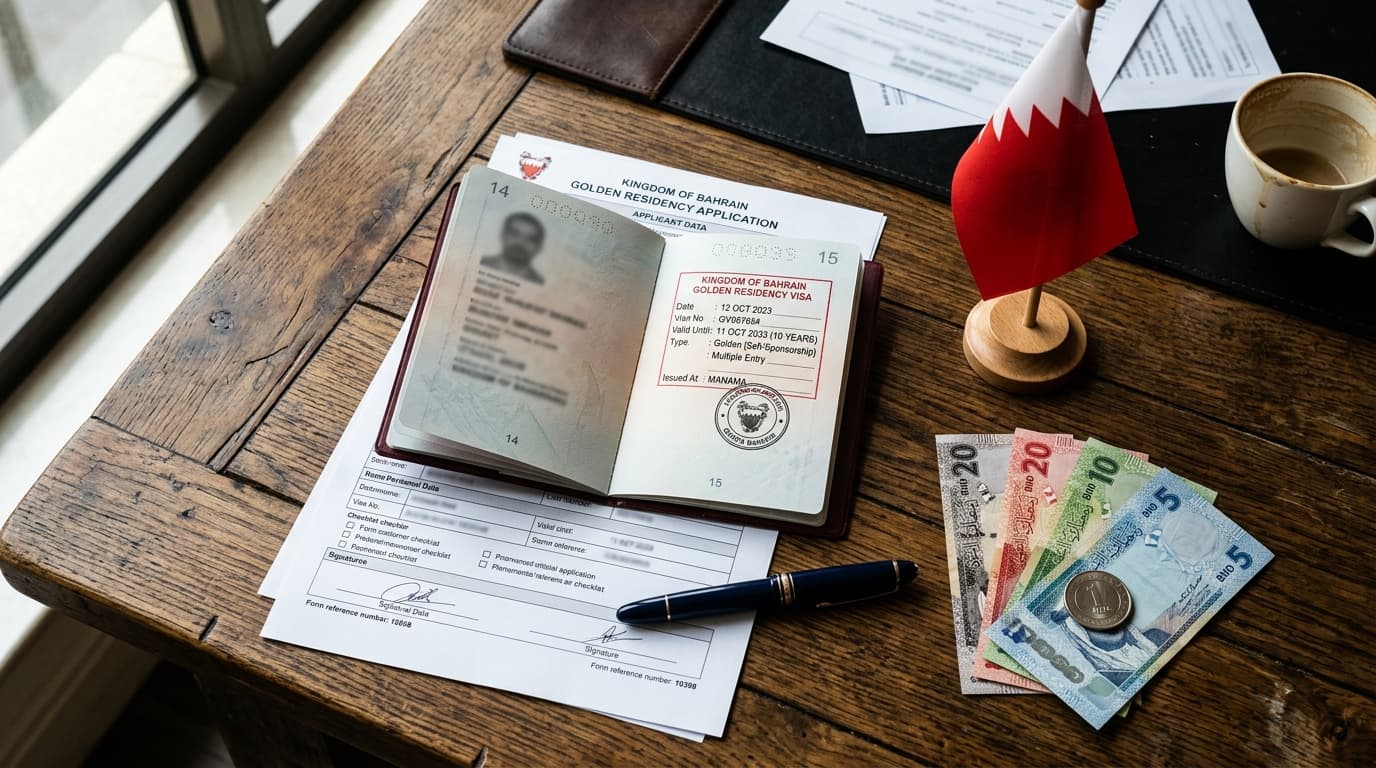
Bahrain Golden Residency Visa

At a Glance
- BHD 2,000 a monthaverage basic salary of BHD 2,000 or more over the past 5 years of residence in Bahrain · foreign employees who have lived in Bahrain for at least 5 years
- BHD 130,000 one-timetotal value of one or more properties owned in Bahrain · property owners
- BHD 5 one-timeper person, non-refundable · each applicant, including family members
- 10 yearsrenewable for the same period
- Renewable for another 10 years at the same BHD 300 fee as long as the holder still meets the conditions
- Online through the Golden Residency eService on the Bahrain National Portal (bahrain.bh), run by the Nationality, Passports and Residence Affairs (NPRA)
- Yes
- Yesspouse, children and parents
- The Golden Residency is itself Bahrain's long-term residence: the official page calls it the opportunity to live permanently in Bahrain, renewed every 10 years. No route to citizenship is stated.
Last checked Oct. 5, 2026
Status: active since Feb. 7, 2022. The Golden Residency is Bahrain's long-term residence permit for property owners, long-serving residents, retirees and highly talented people. It runs 10 years at a time and is renewed on the same terms (Bahrain National Portal).
It is not a digital nomad visa. Three routes are open to people who have never lived in Bahrain: owning property worth at least BHD 130,000, a pension from abroad of at least BHD 4,000 a month and the talent route. The other two routes are for people who already live and work in Bahrain.
The national portal lists four benefits: the chance to live in Bahrain permanently, Golden Residency for a spouse, children and parents, the right to work in Bahrain and unrestricted multiple entry.
Applicants qualify through one of five routes (Bahrain National Portal, Ministry of Interior):
- Property owners: one or more properties in Bahrain with a total value of at least BHD 130,000. The Ministry of Interior cut the threshold to this level on Nov. 26, 2025; some portal pages still show the older, higher figure.
- Resident employees: at least five years living in Bahrain and an average basic salary of BHD 2,000 a month or more over those five years. Only basic salary counts.
- Retirees living in Bahrain: at least 15 years of work in Bahrain and an average pension of at least BHD 2,000 a month.
- Retirees from abroad: an average pension of at least BHD 4,000 a month.
- Highly talented individuals: documents that prove the talent. No threshold is published, and each case is assessed on its merits.
Family: Yes. A spouse, children and parents of the main holder can get their own Golden Residency once the main permit is issued.
Every applicant sends clear copies of the following (Bahrain National Portal):
- A passport valid for more than six months.
- Proof of previous residence in Bahrain, if any.
- Bank statements for the latest six months.
- A valid health insurance certificate for Bahrain.
Each route adds its own proof:
- Property owners: the property deed or deeds.
- Resident employees and retirees: proof of the average basic salary or pension.
- Retirees from abroad: proof of the monthly pension.
- Highly talented individuals: documents proving the talent.
Relatives need the main holder's Golden Residency, a copy of their own passport and proof of the relationship.
Government fees are charged per person (Bahrain National Portal):
- Application fee: BHD 5, non-refundable.
- Issuance fee: BHD 300, paid after approval.
Each relative pays both fees again, so a couple with two children pays four sets. The issuance fee is charged again at each renewal.
The property route also needs real estate worth at least BHD 130,000, which is a qualifying asset rather than a fee. Health insurance, translations and any adviser fees come on top and vary by provider.
Where to apply: Online through the Golden Residency eService on the Bahrain National Portal (bahrain.bh), run by the Nationality, Passports and Residence Affairs (NPRA).
- Choose the route that fits: property, resident employee or retiree, retiree from abroad or talent.
- Upload the general documents and the route documents, then pay the non-refundable application fee of BHD 5.
- After approval, pay the issuance fee of BHD 300.
- Once the permit is issued, the main holder receives an email with a link to the relatives application page for a spouse, children or parents.
NPRA has not published a processing time that could be confirmed for every route, so applicants should allow for some waiting time before travel or property plans depend on the permit.
The permit is valid for 10 years and allows unrestricted multiple entry (Bahrain National Portal).
Renewal: Renewable for another 10 years at the same BHD 300 fee as long as the holder still meets the conditions (NPRA).
Long term: The Golden Residency is itself Bahrain's long-term residence: the official page calls it the opportunity to live permanently in Bahrain, renewed every 10 years. No route to citizenship is stated.
Some advisers mention a minimum yearly stay in Bahrain. No official text confirming one was found, so holders who plan long absences should check with NPRA.
Bahrain has no personal income tax, so the permit brings no income tax on salary, pensions or foreign income; employees in Bahrain pay social insurance contributions (PwC Worldwide Tax Summaries).
The Golden Residency carries no tax rules of its own. Holders who keep a home, income or family ties in another country may still be tax resident there, so the home country's rules decide what is owed.
Frequently Asked Questions
Is the Bahrain Golden Residency a digital nomad visa?
No. It is a long-term residence permit for property owners, long-serving residents, retirees and talented people. It runs 10 years and is renewable.
How much property is needed for Golden Residency?
Property in Bahrain with a total value of at least BHD 130,000, the threshold the Ministry of Interior set on Nov. 26, 2025. Several properties can be combined.
What does the Golden Residency cost?
Each person pays an application fee of BHD 5 and an issuance fee of BHD 300 after approval. Family members pay the same fees.
Can retirees from abroad apply?
Yes. Retirees who do not live in Bahrain need an average pension of at least BHD 4,000 a month.
Do Golden Residency holders pay income tax in Bahrain?
Bahrain has no personal income tax, so the permit brings no income tax on salary, pensions or foreign income; employees in Bahrain pay social insurance contributions.
How It Compares
Similar visas elsewhere
| Program | Country | Income | Fee | Max stay | Renewable |
|---|---|---|---|---|---|
| Egypt Citizenship by Investment | Egypt | $250,000 saved | $10,000 | - | |
| Antigua and Barbuda Citizenship by Investment | Antigua and Barbuda | - | $10,000 | - | - |
| Malta Permanent Residence Programme (MPRP) | Malta | €375,000 saved | €60,000 | 60 mo | |
| Dominica Citizenship by Investment | Dominica | $200,000 saved | $1,000 | - |
Bahrain Digital Nomad Guide
Cost of living, internet, healthcare, coworking, and every visa option for Bahrain.
Visa rules change. We'll tell you.
Get notified about policy updates and new requirements for the Bahrain Golden Residency Visa and other Bahrain visas.