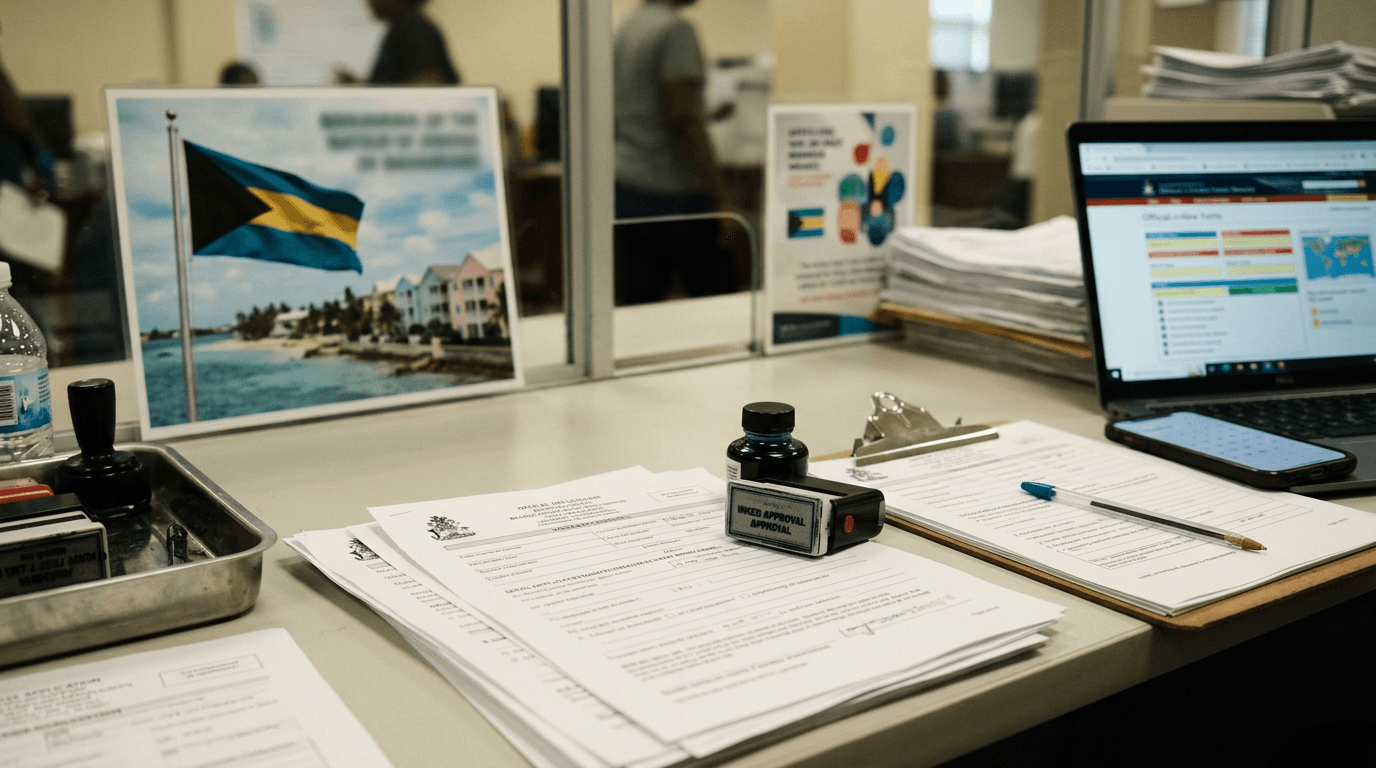
Bahamas Digital Nomad Visa

Visa Data Sheet
- $1,025
- 1 week
- 36 months
The Bahamas’ digital nomad option is the Bahamas Extended Access Travel Stay or BEATS. It’s a one-year residence permit for remote workers and students and it can be renewed annually for up to three years total. This isn't a tourist stamp. It’s the government’s formal way to let you live in the country while working or studying online without taking a local job.
BEATS is aimed at two groups. Remote professionals need to show they work for a non-Bahamian employer or that they’re self-employed. Students need to be enrolled in an accredited institution abroad and studying online from The Bahamas. Everyone on the application needs a valid passport and medical insurance, including dependents.
The appeal is pretty simple: you get a legal base in the islands without the mess of a standard work permit. The downside is just as clear, you can’t use BEATS to join the local labor market. If you want to work for a Bahamian employer, that’s a different process.
What you need to apply
- Professionals: A job letter from your employer or proof of self-employment.
- Students: Proof of enrollment at an accredited school and proof of sufficient funds for living costs and return travel.
- Everyone: A valid passport and medical insurance for you and any dependents.
Fees and timing
- Application fee: $25 per applicant, including dependents.
- Permit fee for professionals: $1,000 for the main applicant, plus $500 per dependent.
- Permit fee for students: $500.
- Processing time: About five business days, according to the official program materials.
The process is handled online through the immigration portal. If you’re approved, you’ll get an email with payment instructions, then a QR code confirmation to show when you arrive. The Bahamas says citizens of the U.S., Canada, the EU and Britain don’t need an extra travel permit for BEATS, but other nationalities still need to check the normal entry rules first.
Who qualifies
The BEATS program is The Bahamas’ remote-work permit for people who live outside the country and want to work or study online while they’re there. It’s a one-year annual residence permit and renewals can be considered for up to three years total. There’s no official minimum income published for BEATS, which is nice in theory, but it also means you need to show you can actually support yourself.
Two groups fit the core eligibility rules: remote professionals and remote students. Professionals must be employed or self-employed outside The Bahamas and students must be enrolled in an accredited institution and studying remotely. BEATS doesn't authorize local Bahamian employment, so if you’re planning to take a job with a local company, this isn’t the right permit.
Nationality usually isn’t the deciding factor for BEATS itself. The program materials don’t name any passport holders as excluded, but your entry rules still depend on your nationality, so some travelers may need a separate visitor visa to get into the country before they can use BEATS.
- Valid passport: Required for all applicants.
- Medical insurance: Required for the primary applicant and all dependants.
- Proof of remote work: A job letter from an overseas employer or proof of self-employment.
- Proof of enrollment: Students need evidence that they’re enrolled in an accredited institution.
- Proof of funds: Students must show enough money for living costs and return travel and that can include parents’ financial documents.
The fee structure is straightforward, if not exactly cheap. For professionals, the application fee is $25 and the permit fee is $1,000 for the main applicant, plus $500 for each dependant. Students pay $25 for the application and $500 for the permit. The official processing estimate is five days, though that’s still an estimate, not a promise.
One more detail matters: BEATS is temporary by design. The permit expires after 12 months and while renewals are possible, the official program doesn’t give you a direct route to permanent residency.
The Bahamas Extended Access Travel Stay, better known as BEATS, is the country’s digital nomad route for remote workers and students. It runs for one year and the application is filed online through the Bahamas immigration system, so there’s no embassy shuffle if your paperwork is clean.
What you need to apply
The official BEATS pages keep the checklist pretty short. For the online application, have these ready in digital form:
- Valid passport data page: the biographical page from your passport.
- Medical insurance card: required for all applicants.
- Proof of employment: for remote workers.
- Student ID: for remote students.
The fact sheet adds a little more detail. Remote workers should have a job letter from a current employer or proof of self-employment. Students should show proof of enrollment in an accredited institution. Students also need proof of sufficient funds to cover living expenses and return travel. The portal doesn’t publish a formal income threshold for remote workers, so don’t expect a neat monthly number from the government.
Passport, funds and entry documents
BEATS pages call for a valid passport, but they don’t spell out a special passport-validity rule for the permit itself. For general Bahamas entry, the government says passports should have more than 6 months remaining, so that’s the safest standard to use.
You should also be ready to show a return or onward ticket, the address of where you’ll stay and proof of funds to support your visit. The official materials don’t define how much money is enough, which is annoying but typical. Keep bank statements, a work contract or client payments handy so you can show you’re not planning to work locally.
Fees and what the permit costs
- Application fee: $25 per applicant.
- Work Remotely permit fee: $1,000 for the main applicant and $500 for each dependent.
- Study Remotely permit fee: $500 per applicant.
The Bahamas prices these in Bahamian dollars, which are pegged to the U.S. dollar, so the numbers work out the same. The official site says applications are handled online and the process is usually quick, but it doesn’t publish a fixed processing time for every case. If your file is incomplete, expect delays. The government also doesn’t publish BEATS-specific apostille or translation rules, so check directly with Bahamas Immigration if your documents aren’t already in English or need legalization.
The BEATS fee structure is straightforward and it’s not cheap for professionals. The government lists everything in U.S. dollars and because the Bahamian dollar is pegged 1:1 to the U.S. dollar, those numbers work the same in local currency.
- Professional applicant: $25 application fee plus a $1,000 permit fee, for a total of $1,025.
- Dependent of a professional: $25 application fee plus a $500 permit fee, for a total of $525 per dependent.
- Student applicant: $25 application fee plus a $500 permit fee, for a total of $525.
For families, the math adds up quickly. Each dependent on a professional application pays the same $25 application fee and $500 permit fee, while married couples who both want to work remotely need to file separate applications, though only one of them has to list the shared dependents.
Students get a lower permit fee, but the official BEATS materials don’t give a separate dependent fee schedule for student applicants. If that applies to you, you’ll need to confirm the total directly with Bahamas Immigration before you pay.
The application fee is also the processing fee, so there isn’t a separate government surcharge hiding in the system. Official guidance says applications are usually processed in about 5 business days, then you get an approval email with instructions to pay the permit fee and receive a QR code for arrival.
Other costs to budget for
- Medical insurance: Required for the main applicant and all dependents, but the government doesn’t set a minimum premium or coverage amount.
- Translations and legal help: Not required by the BEATS rules and no official fee is listed.
- Optional student add-ons: The University of The Bahamas lists separate fees for some services, including a $300 technology fee, $20 ID card, $125 library fee, $690 Bahamian Cultural Experience course, $50 application fee, $500 miscellaneous fee and $100 student activity fee.
Those university charges aren’t immigration fees and they only matter if you opt into those services. If you want the cleanest budget estimate, stick to the official BEATS fees first, then add insurance and any private paperwork costs on top.
The BEATS application is done online through the immigration portal and you can apply from outside the Bahamas. If the Bahamas Immigration Office approves you, it sends an email with payment instructions, then issues a confirmation QR code for arrival.
Processing is usually quick. The official BEATS FAQ gives an estimated turnaround of 5 days and the permit is valid for 12 months from the date it’s issued. Annual renewals can be considered for up to 3 years total, but BEATS itself isn’t a shortcut to permanent residency or citizenship.
How to apply
- 1. Complete the BEATS form online. Start with the official application in the immigration portal.
- 2. Upload your documents. The required files depend on whether you’re applying as a professional or student.
- 3. Wait for approval by email. If you’re approved, you’ll get payment instructions.
- 4. Pay the permit fee. After payment is received, the QR code confirmation is issued.
- 5. Keep the QR code for arrival. You’ll show it to immigration when you land.
Fees and documents
For professionals, the official fee total is $1,025, made up of a $25 application fee and a $1,000 permit fee. Each dependent also pays a $25 application fee plus a $500 permit fee. For students, the total is $525, which includes the same $25 application fee and a $500 permit fee.
The official portal doesn’t list a minimum income requirement. It says applicants need to show they can support themselves and students need proof of enough funds for living costs and return travel. If you were hoping for a published salary floor, there isn’t one in the official BEATS material I could verify.
- Valid passport: Required for the primary applicant and dependents.
- Medical insurance: Required for the primary applicant and all dependents.
- Job letter or self-employment proof: Needed for remote workers, if applicable.
- Enrollment proof: Required for students at an accredited learning institution.
- Financial proof: Students must show enough funds for living expenses and return travel. Parental financials can be used.
Married couples need separate applications if both spouses plan to work remotely from the Bahamas. If you’re filing for mutual dependents, only one applicant needs to submit on their behalf. That part keeps the process from becoming a paperwork mess, which is rare enough to appreciate.
BEATS starts with a 12-month permit. It’s issued as a one-year residency permit and the clock runs from the date it’s issued, not from the day you land. That matters if you’re timing flights or trying to stretch your stay to the edge of the calendar.
The permit can be renewed annually, but only up to a total of three years. That means you can usually get the initial year plus up to two more annual renewals, if Bahamas Immigration approves each one. Renewal isn’t automatic and the official wording is pretty plain about that, applications “will be considered,” which is a polite way of saying approval is still discretionary.
- Initial validity: 12 months from the date of issue
- Maximum BEATS stay: Up to 3 years total
- Renewal status: Not automatic, each year must be approved
The official FAQ gives one processing estimate for BEATS applications, about 5 days. It doesn’t separate first-time applications from renewals, so don’t assume renewals take longer or shorter unless the portal tells you otherwise. The fee structure also isn’t broken out into a special renewal price, so the safest reading is that each annual permit follows the same fee setup.
- Professional application fee: $25 per applicant
- Professional permit fee: $1,000
- Dependent application fee: $25 per dependent
- Dependent permit fee: $500 per dependent
- Student application fee: $25
- Student permit fee: $500
BEATS doesn’t lead to permanent residency or citizenship on its own. The program is framed as a temporary, renewable remote-work or study permit, not a settlement path, so if you want to stay longer than the three-year cap, you’ll need to look at a separate Bahamian residence option. That part isn’t built into BEATS.
The Bahamas keeps the tax side pretty simple, which is part of the appeal of the BEATS permit. The country has no personal income tax and that applies to foreign- and Bahamas-source employment income for individuals. BEATS doesn’t create a special tax break or a separate tax category. It’s just a residence permit, not a tax regime.
That means your remote salary or freelance income isn’t taxed by the Bahamian government while you’re living there under BEATS. The catch is that your home country may still tax you, depending on where you’re resident for tax purposes. If you’re a U.S. citizen, for example, you’re still taxed on worldwide income, even if you’re sitting on a beach in Nassau.
The Bahamas also doesn’t have an income-tax residency system like the 183-day rules you see elsewhere, because there’s no personal income tax to attach it to. The government does use residency in other contexts, especially exchange control, where being resident can affect reporting and financial rules. That’s separate from income tax, though and BEATS itself doesn’t appear to trigger any special tax-resident status.
There’s no double-tax treaty network to lean on either. So if your home country taxes you, any relief usually comes from your own country’s foreign tax credit rules or exclusions, not from a Bahamas treaty.
Other taxes can still bite you:
- VAT: The standard rate is 10%.
- Import duties: These are a major part of the tax system and can make imported goods expensive.
- Property taxes and stamp duty: These can apply if you buy real estate, regardless of your immigration status.
If you’re planning to work for a Bahamian employer or run a licensed local business, you may also run into National Insurance and business licensing rules. Those aren’t income taxes, but they’re still part of the bill. BEATS doesn’t change any of that.
The practical takeaway is simple. Bahamas tax law is friendly for remote workers because there’s no personal income tax, but your real tax exposure usually follows you home.
How It Compares
More Bahamas programs
| Program | Country | Income / month | Fee | Max stay | Renewable |
|---|---|---|---|---|---|
| Bahamas Permanent Residence by Investment | Bahamas | $1,000,000 saved | $20,210-25,210 | 1200 mo |
Similar visas elsewhere
| Program | Country | Income / month | Fee | Max stay | Renewable |
|---|---|---|---|---|---|
| Georgia Digital Nomad Program (Remotely from Georgia) | Georgia | - | - | - | |
| Kyrgyzstan Digital Nomad Status | Kyrgyzstan | - | - | 12 mo | |
| Kenya Class N Permit | Kenya | - | $200↓ | 24 mo | |
| Nepal Digital Nomad Visa (Not Yet Open) | Nepal | - | - | - |
Bahamas Digital Nomad Guide
Cost of living, internet, healthcare, coworking, and every visa option for Bahamas.
Visa rules change. We'll tell you.
Get notified about policy updates and new requirements for the Bahamas Digital Nomad Visa and other Bahamas visas.