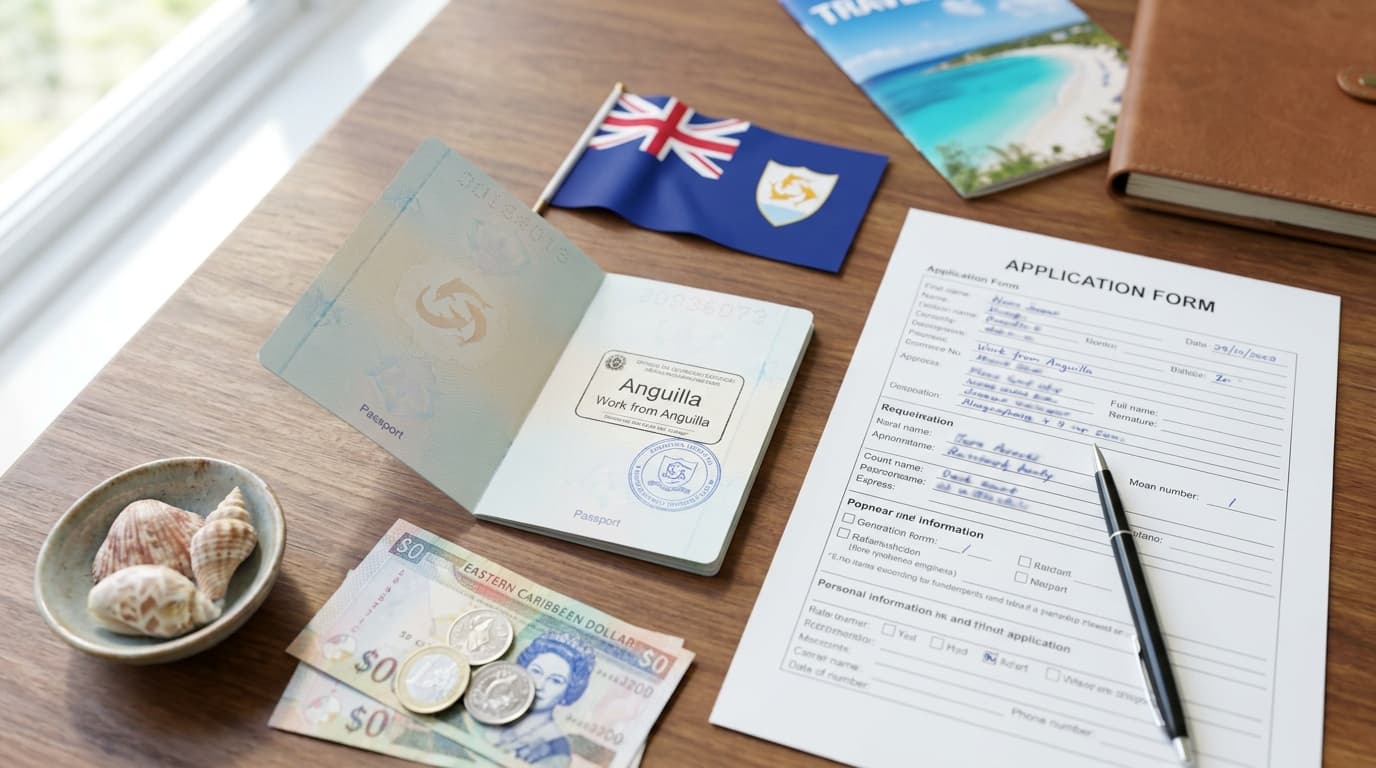
Anguilla Work from Anguilla Stamp

Visa Data Sheet
- $2,000 – $3,000
- 2 weeks
- 12 months
The Anguilla Work from Anguilla Stamp sits in a messy spot: the government pages I could verify don’t show a dedicated, live programme page with a full rule set. What the official material does show is the broader residence-stamp framework, plus immigration guidance that points applicants to forms at the main office or online.
That means the basic shape of the programme is clear, but some of the details people usually want aren't. I could confirm that Anguilla’s residence-stamp system covers categories including work-permit holders, relatives of work-permit holders, retired persons with property or leases in Anguilla and people married to an Anguillian or Belonger. The official paperwork also asks for supporting documents such as a passport, birth certificate, marriage certificate, divorce decree, work-permit certification, lease copy, alien land holding licence and photographs, depending on the category.
The fee side is less tidy. The official form says the charge is set under the Immigration and Passport (Fees for Permits) Regulations 1998, but the page I found doesn’t publish a WFA-specific fee on the spot. The government material I reviewed also doesn’t give a fixed processing time, a formal income threshold or a published tax treatment summary for this route.
Non-government and Anguilla-linked summaries describe the Work from Anguilla Stamp as a remote-work option launched in August 2020 for people who want to stay longer than a normal visitor entry allows. Those summaries say it can cover a stay of 3 to 12 months, with foreign employment or an overseas business relationship, plus mandatory health insurance and programme fees. I can’t verify those figures from the official pages I accessed, so treat them as claims from secondary sources, not confirmed government guidance.
For an applicant, the practical takeaway is simple. Don’t rely on casual summaries alone, because the official pages available right now are incomplete on the branded WFA route. If you’re planning to apply, check the current forms and ask for the exact document list, fee and stay length before you make travel plans.
The Anguilla Work from Anguilla Stamp is aimed at non-Anguillans who want to live in Anguilla while working remotely for people or businesses based outside the island. Local work isn't part of the deal and the programme isn't meant for anyone trying to take jobs or clients in Anguilla.
Officially linked summaries say you may qualify if you’re employed by a foreign employer, own or run a business incorporated outside Anguilla or are a student doing online study. That’s the core test, not a fixed salary figure. The available research doesn't confirm a minimum income threshold from an official Anguilla source.
Families can apply together in some cases. The guidance cited in the research points to family applications of up to four people, usually the main applicant, a spouse and up to two dependent children under a stated age, with an extra fee for each additional dependent. The official pages I could verify don’t spell out those family rules on a dedicated WFA page, so treat that as guidance, not a fully published government checklist.
Applicants also need to show they can support themselves and meet the paperwork requirements tied to their status. The research points to valid health and travel insurance, a recent police certificate and proof of legitimate remote work. People with serious criminal histories are likely to be turned down, but the official material I could verify doesn’t publish a neat list of automatic bans.
There’s no official age band published in the sources I found. The programme appears to be built for adults, though students are included in the broader eligibility picture and dependent children can be covered through a family application.
- Who it’s for: Non-Anguillans working remotely, running an outside-Anguilla business or studying online.
- Who it’s not for: People looking for local employment or local clients in Anguilla.
- Family coverage: Possible for up to four people under one application, with extra dependents allowed for an added fee.
- Other checks: Valid insurance, a clean police record and proof of remote-work status.
The official Anguilla pages I could verify don’t publish a clean, stand-alone document checklist for the Work from Anguilla Stamp. What they do show is the broader residence-stamp framework, plus the kinds of papers Anguilla asks for when someone is applying under related categories.
For the Work from Anguilla Stamp itself, the safest approach is to expect a standard remote-work file, then be ready to add whatever the application asks for. The government materials I could access don’t give a single fixed list or a special fee sheet for this stamp, so don’t assume a shortcut just because a guide online says one exists.
- Passport: A valid passport is required. Secondary sources tied to the original programme materials say it should be valid for at least six months beyond the planned stay.
- Proof of remote work or study: This usually means an employment letter, contract, business ownership documents for a company registered outside Anguilla or proof of enrollment if you’re a student.
- Financial proof: Recent bank statements or similar evidence of funds are commonly cited. The official materials I could verify don’t publish a minimum income or savings figure.
- Police clearance: A recent police record or police clearance certificate is often required for the applicant and sometimes for adult family members too.
- Health insurance: Proof of comprehensive health and travel insurance valid in Anguilla for the full stay is commonly referenced.
- Accommodation proof: A lease, villa booking or hotel reservation covering at least part of the stay is usually expected.
- Photos and online forms: Passport-style photos and a completed online application are also commonly mentioned, though I couldn’t verify the live portal instructions directly.
Anguilla’s official residence-stamp form also points to supporting documents such as a passport, birth certificate, spouse’s birth certificate, marriage certificate, divorce decree, work-permit certification, lease copy, alien land-holding licence and photographs, depending on the category. That doesn’t mean every Work from Anguilla applicant needs all of them. It does mean the government may ask for more than the usual remote-worker paperwork if your situation overlaps with a residence category.
The fee is another weak spot in the public information. The official form ties charges to the Immigration and Passport (Fees for Permits) Regulations 1998, but the government page I could verify doesn’t show a current WFA-specific amount. So if you’re budgeting, don’t rely on a blog post alone.
The biggest headache with the Work from Anguilla Stamp is that the official government pages I could verify don’t publish a clean, live fee sheet for the programme. So if you want the plain-government answer, it isn’t there in one neat place.
What the available research does show is that secondary sources consistently put the application fee at $2,000 for an individual and $3,000 for a family, usually defined as up to four people. Each extra dependent is listed at $250. Those sources also say the fee is non-refundable and has to be paid in full when you apply.
- Individual application fee: $2,000
- Family application fee: $3,000, usually for up to 4 people
- Extra dependent: $250 each
- Refund policy: Non-refundable
- Payment timing: Paid in full with the application
That fee is described as a combined programme and processing charge, not a clearly broken-out government fee plus service fee. The official pages I found don’t give a separate breakdown, so don’t expect much transparency there.
You should also budget for insurance. The programme requires health and travel insurance for the full stay, but Anguilla’s published materials don’t set a price cap or fixed cost, so what you pay will depend on your age, health and coverage level.
- Mandatory insurance: Health and travel insurance for the full stay
- Price: Not set by Anguilla in the published rules
- Your cost will depend on: Age, health and coverage level
There can be smaller out-of-pocket costs too. The official residence-stamp form points to supporting documents like a passport, birth certificates, marriage or divorce papers where relevant, work permit certification, a lease copy, alien land holding licence and photographs, so you may end up paying for police clearance, translations, notarisation or professional help if your paperwork isn’t already in order.
One more thing, the government pages I could access don’t publish a fixed processing-time fee structure for this programme, so anyone promising a precise official total is probably guessing. The safe move is to treat the application fee as just one part of the bill and leave room for the extra admin costs that come with a picky immigration file.
The official Anguilla government pages I could verify don’t show a live, dedicated Work from Anguilla application page, so the cleanest reading is a little frustrating: the public route isn’t fully visible from government sources right now. The old application process appears to have run through the Anguilla tourism portal, with applicants completing an online form, uploading documents and paying the programme fee before review.
If you’re checking how to apply, here’s the process described in secondary summaries of the official system:
- Start online: Select the Work from Anguilla or digital nomad category on the application form.
- Upload supporting files: Scanned copies of the required documents are submitted with the form.
- Pay the fee: The programme fee is paid online and is non-refundable.
- Wait for review: Anguillan authorities review the application and issue a decision by email if approved.
- Travel and entry: Approved applicants travel to Anguilla and receive the stamp or permit on arrival.
The document list cited in those summaries is straightforward, though not tiny. It includes a passport, proof of remote work or business activity, police record, proof of funds, health insurance and proof of accommodation. Some accounts also mention work-related supporting documents like a lease or property paperwork, but the official pages I could access don’t publish a current, fixed checklist for the Work from Anguilla stamp.
Two things remain unclear on the government material I could verify. First, the official portal doesn’t publish a current WFA-specific fee on the pages available to me, even though older descriptions say the payment is made online. Second, it doesn’t give a firm processing time for the Work from Anguilla route. Secondary sources usually put review at about two weeks, while Anguilla’s standard e-visa system says 8 to 10 business days, but that’s not the same thing as an official WFA timeline.
If you’re applying, don’t assume the remote-work page still works exactly as older guides describe it. The safest move is to check the latest Immigration or tourism instructions before you gather documents, because the government pages I found don’t fully spell out the current process.
The Work from Anguilla permit is treated as a temporary stay, not a long-term residence route. The clearest public summaries say it’s usually issued for up to 12 months and that’s the outer limit on a single authorization. The official material I could verify doesn’t publish a separate renewal process for the remote-work stamp, so there’s no clean government-backed path to extend the same permit once that year is up.
That matters. If you want to stay longer, you shouldn’t assume the permit can just be rolled over. The better reading is that you’d need to leave and, if the programme is still available, submit a fresh application or switch to another immigration category that Anguilla actually recognizes.
There’s also no verified official indication that time spent in Anguilla under this permit builds toward permanent residence or Belonger status. So if you’re hoping this is a back door to staying on permanently, it doesn’t look like it.
- Maximum stay: Up to 12 months on a single Work from Anguilla authorization.
- Renewal: The accessible official sources don’t show a renewal mechanism for the remote-work stamp.
- After expiry: You’d generally need to leave Anguilla and look at a new application or a different immigration route.
- Permanent status: The available official material doesn’t show any path from this permit to permanent residence or citizenship.
One more practical point. The government pages I could verify talk about resident stamps and general immigration forms, not a live, dedicated Work from Anguilla renewal page. That’s a bit annoying for applicants, because it leaves you piecing together the rules from broader immigration paperwork instead of a tidy programme notice.
Anguilla’s tax pitch is simple and for remote workers that’s mostly the appeal. The island is widely described as having no personal income tax, no capital gains tax and no corporate tax for most activities, so Work from Anguilla participants are generally treated as visitors rather than local wage earners.
That said, the local tax side is only half the story. If you keep working for a foreign employer or running a business from Anguilla, the income is generally viewed as foreign-sourced under the programme summaries I could verify, so Anguilla doesn’t appear to add a separate income tax bill just because you’re on the island.
The catch is your home country. You can still owe tax there and that’s where people get tripped up, especially if spending several months abroad changes your tax residence or reporting obligations. Anguilla’s government immigration pages I reviewed don’t spell out any special local tax filing rules tied to the stamp, so don’t assume the visa side settles the tax side.
There are also a few practical points worth checking before you apply:
- Home-country tax residency: Your tax status back home may not change just because you’re in Anguilla.
- Foreign income reporting: You may still need to report salary, contractor income or business profits where you normally file.
- Local tax exposure: The programme materials I could verify don’t show a special Anguilla tax regime for stamp holders.
- Double-tax relief: Anguilla doesn’t appear to have a broad treaty network, so relief options may be limited.
There’s another annoyance here, the official pages I checked don’t publish a clean, dedicated tax note for the Work from Anguilla Stamp. So if you’re expecting a neat government answer on residency, payroll withholding or filing duties, it isn’t there. You’ll want a tax adviser who understands both Anguilla and your home jurisdiction before you stay long enough for the numbers to matter.
How It Compares
Similar visas elsewhere
| Program | Country | Income / month | Fee | Max stay | Renewable |
|---|---|---|---|---|---|
| Slovenia Digital Nomad Visa | Slovenia | €3,391/mo | €50↓ | 12 mo | |
| Belize Work Where You Vacation Program | Belize | $75,000-100,000/yr | BZD 200-500↓ | 6 mo | |
| Kazakhstan Neo Nomad Visa | Kazakhstan | $3,000/mo | £170↓ | 12 mo | |
| Bahamas Digital Nomad Visa | Bahamas | - | $25↓ | 12 mo |
Anguilla Digital Nomad Guide
Cost of living, internet, healthcare, coworking, and every visa option for Anguilla.
Visa rules change. We'll tell you.
Get notified about policy updates and new requirements for the Anguilla Work from Anguilla Stamp and other Anguilla visas.