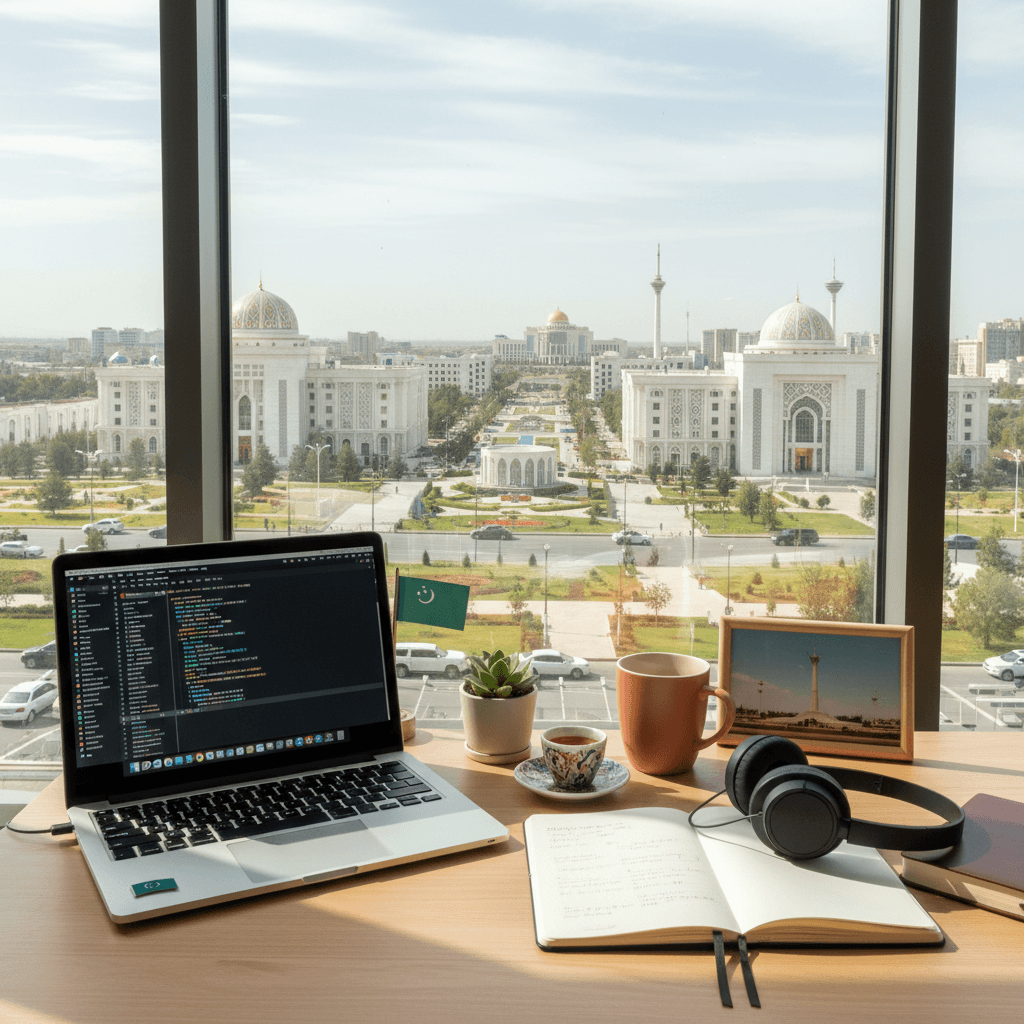
Turkmenistan

Policy Stability
Stamped Nomad ExclusiveHow likely visa and immigration policies are to remain unchanged
Quick Facts
N/A
1 months
No
$1,200/mo
1 Mbps
6/10
Medium
Low
Low
TMT (UTC+5)
Entry Methods Available
Best For
The Reality of Entering Turkmenistan
Turkmenistan has long been one of the most difficult countries to enter, but the gates are finally starting to creak open. For digital nomads, this isn't a place where you just show up and find a co-working space on day one. It requires a bit of forward planning and a decent budget for the paperwork. You will need a visa for almost every scenario, as there is currently no visa-free access for most nationalities.
The standard route is the Tourist Visa. You can get the ball rolling up to 6 months before your trip. If you are planning to dip in and out of the country while exploring Central Asia, look into the new two-entry option. This allows two separate entries within a one-month window, which is perfect if you want to use Ashgabat as a base for regional travel.
Costs and Logistics
Visa fees are a sliding scale based on how long you stay and how fast you need the paperwork processed. It is rarely cheap, so factor these numbers into your initial budget:
- 10-day single entry: $35
- 12-month single entry: $385
- Multiple-entry visas: $75 to $515
Expedited processing is available if you are in a rush, but expect to pay a premium. Once you are in the country, extensions are notoriously hard to get. The State Migration Service usually only grants an extra 3 to 5 days for genuine emergencies like health issues or major travel disruptions.
The Letter of Invitation (LOI)
Until the new digital systems are fully live, the Letter of Invitation is your most important document. You cannot get a visa without one. For a Business Visa, this must be a formal letter on company letterhead, signed by an officer, and certified by the State Migration Service. It needs to clearly state why you are there and how long you plan to stay.
For most travelers, the easiest way to handle this is the Visa on Arrival at Ashgabat International Airport. To make this work, you must have the original or a high-quality photocopy of your certified LOI ready to present. Without that piece of paper, you will likely be on the next flight out.
The Upcoming E-Visa Shift
The biggest news for the nomad community is the move toward an e-visa system. Legislation was signed in April 2025 to modernize the process. This system is designed to live within the State Migration Service's online portal and, most importantly, aims to eliminate the need for a pre-approved Letter of Invitation.
The system is expected to launch fully throughout 2026. Once operational, it will automatically notify consulates and embassies of your application, cutting out the middleman and the wait for physical invitation letters. It is a massive step toward making the country more accessible for independent travelers.
Standard Requirements
Regardless of which visa type you choose, some rules are set in stone. Keep these requirements in mind before you book anything:
- Your passport must be valid for at least 6 months from your planned departure date.
- Most applications require a certified Letter of Invitation from the State Migration Service.
- You will need to provide digital or physical photos that meet specific government standards.
While the paperwork feels heavy compared to Southeast Asia or Europe, the shift toward electronic filing suggests the government is becoming more open to international visitors. Keep a close eye on the official State Migration Service updates, as the transition to the e-visa system will change the entry game entirely.
Source
The Current Reality
If you were hoping for a streamlined, "work from anywhere" visa specifically designed for nomads, Turkmenistan isn't there yet. The government hasn't introduced a dedicated digital nomad visa, and while there are occasional whispers about modernization, the current system remains one of the most rigid in Central Asia. For now, you'll have to fit your remote work lifestyle into one of their existing, traditional visa categories.
Most travelers choose the Tourist Visa (TU). It is the most common path, but it comes with strings attached. Other options like the Entrepreneurship Visa (BS1, BS2) or Work Visa (WP) exist, but these usually require local business ties or a formal invitation from a Turkmen employer, making them impractical for the average freelancer or remote employee.
The Tourist Visa Path
Getting into Turkmenistan is a bit like joining an exclusive club; you need someone on the inside to vouch for you. The traditional route involves securing a Letter of Invitation (LOI). This isn't something you can just write yourself. You have to book a tour through a government-sanctioned operator who then petitions the State Migration Service on your behalf.
The process generally looks like this:
- Book a tour: You must coordinate with a registered agency to handle your itinerary.
- Documentation: Provide a high-quality color scan of your passport, a digital photo, and a completed questionnaire.
- Wait time: Expect to wait 7 to 10 working days for the State Migration Service to review your file.
- Approval: Once you receive the approved LOI, print multiple copies. You will need these for your airline and the immigration officers upon arrival.
There is also a newer electronic visa portal. While it promises a more digital-friendly experience, the scrutiny remains high. You'll upload your details and photos directly to the State Migration Service website and wait 5 to 10 working days for a digital review. If approved, you pay the fee online and receive the e-visa via email.
Bureaucracy and Requirements
Turkmenistan is a country where paperwork matters. To avoid getting turned away at the border, you need to be meticulous with your application. Keep these specific requirements in mind:
- Passport Validity: Your passport must be valid for at least 6 months after your intended date of departure.
- Photo Standards: You need two color photos, 50x60mm, with a white background and a neutral expression.
- The 3-Day Rule: This is the most important step after landing. You must register with the State Migration Service within 3 working days of arrival. Usually, your hotel or tour operator handles this, but you should double-check to ensure it's done.
Which Visa Should You Choose?
Since there isn't a specific remote work category, your choice depends on how long you plan to stay and how much "official" support you have. Here is a quick breakdown of the common options:
Tourist Visa (TU)
- Best for: Short-term stays and those who want to see the sights while clearing their inbox.
- Requirement: A mandatory Letter of Invitation and a pre-booked tour.
- Flexibility: Low; you are generally expected to stick to your itinerary.
Transit Visa (TR1, TR2)
- Best for: Nomads passing through from Uzbekistan to Iran or vice versa.
- Requirement: Proof of onward travel and visas for the next country on your list.
- Duration: Usually only 3 to 7 days, which doesn't leave much time for deep work.
Entrepreneurship Visa (BS1, BS2)
- Best for: Those looking to establish a physical business presence in the country.
- Requirement: Significant documentation regarding your business activities and local partnerships.
- Pros: Allows for longer stays and more formal business conduct.
While the lack of a digital nomad visa makes things more complicated, it isn't impossible. You just have to be comfortable with a high level of government oversight and a process that feels a bit more "old school" than the rest of the world. Always check with the State Migration Service of Turkmenistan or your nearest embassy before booking, as entry requirements can shift without much notice.
Source 1 | Source 2
The Reality of Entry
Turkmenistan remains one of the most closed-off destinations for digital nomads. It is a place where "winging it" simply does not work. Unlike neighboring "Stans" that have opened their doors with wide-reaching visa-free programs, Turkmenistan requires every single foreign visitor to have prior authorization. You cannot simply show up at the border with a passport and a smile.
The traditional gateway is the Letter of Invitation (LOI). This document is the golden ticket, issued by the State Migration Service in Ashgabat. Most travelers obtain this by booking a tour through a registered agency, though the government has recently moved to modernize this gatekeeping process.
The New E-Visa System
The landscape is shifting with the introduction of an official e-visa portal. Authorized by recent law amendments, this system is designed to bypass the old, clunky LOI requirement. When using the portal, you upload your passport scan and a digital photo, pay the fee online, and wait for approval.
- Processing Time: Usually 5 to 10 days for digital approval.
- Requirement: No LOI is needed for the e-visa path, making it the preferred choice for independent-minded nomads.
- Verification: Check the State Migration Service portal regularly, as the full rollout is rolling out in stages throughout 2026.
Visa on Arrival
If you don't have an e-visa, you can still get a visa on arrival at Ashgabat International Airport or major land borders with Uzbekistan and Iran. However, there is a massive catch: you must already have a pre-approved LOI in your hand. Without that paper, the airline won't even let you board the plane. This is not a "buy it when you land" service; it is merely a collection point for a visa that was approved weeks in advance.
Duration and Staying Legal
Standard tourist visas are generally issued for 20 days (single-entry) or 30 days (multiple-entry). For a nomad, this is a tight window. The authorities are strict about your itinerary and your departure date.
If you need more time, extensions are possible but rare. The State Migration Service handles these on a case-by-case basis, usually only for emergencies like health issues or transport breakdowns. You will need to submit an explanation letter and pay a fee equivalent to the original visa cost to get an extra 3 to 5 days. Do not rely on this as a way to stay longer for work.
The Cost of Entry
Budgeting for a trip here requires accounting for several layers of fees. Costs fluctuate based on your nationality, so always double-check the latest reciprocity schedules.
- Standard Visa Fee: Typically starts between $50 and $70 USD.
- LOI Service Fee: If going the traditional route, agencies charge anywhere from $20 to $100 to process your invitation.
- E-Visa Fees: These are paid directly through the government portal and align with standard visa pricing.
A Warning on Overstays
Turkmenistan is not the place to test the limits of your visa. Border runs, the classic nomad strategy of hopping across a border and coming right back, are not officially supported and will likely result in a denied entry. The system is built on pre-approval, not spontaneous travel.
Overstaying your visa is a serious offense. Penalties include heavy fines, potential prosecution, and a long-term ban from the country. If your visa is expiring and you cannot leave, head straight to the State Migration Service at Bitarap Turkmenistan Ave. 18 in Ashgabat to start the extension process before your time runs out.
Source
The Reality of Staying Long-Term
Turkmenistan isn't your typical digital nomad hub where you can just show up and extend a tourist stamp indefinitely. It is one of the most closed societies on the planet, and their immigration policy reflects that. There is no such thing as a "digital nomad visa" or a freelancer permit here. If you want to call Ashgabat home for more than a few weeks, you need a specific, government-approved reason to be there.
Most long-term stays are tied to state-sanctioned work or significant business interests. The State Migration Service (SMS) keeps a tight grip on who enters and stays, and almost every pathway requires an official invitation from a local entity. Without a "host" to vouch for you, the door stays locked.
Work and Business Pathways
The most common route for a multi-year stay is the Work Visa (WP). This isn't something you apply for on your own; a Turkmen employer has to sponsor you. Companies are generally restricted to a 10% foreign workforce quota, so these spots are usually reserved for specialized experts or management. These permits are typically renewable for 1 or 2 years at a time.
If you have capital to deploy, the Investment Visa (IN) is the alternative. While the government doesn't publish a specific price tag for residency, some reports suggest an economic contribution of $500,000 or more might open doors. This requires a mountain of paperwork and an invitation from a Turkmen legal person, followed by a heavy vetting process by the Ministry of Foreign Affairs and the National Security Council.
- Business Visas (BS1/BS2): Best for those setting up trade links, though they require frequent renewals.
- Family Visas (FM): Available if you have immediate relatives who are Turkmen citizens or legal residents.
- Education Visas: For those enrolled in recognized national universities.
Residency Permits
If you manage to stay in the country legally for a few years, you might look into a Temporary Residence Permit. These are valid for up to 5 years and are renewable. You have to be at least 16 years old and prove you have a stable income or someone to guarantee your financial support.
The application process is intense. It involves a formal petition to the President of Turkmenistan. Your file moves through the Interior Ministry and the SMS for a deep dive into your background. Permanent residency is even harder to snag, usually requiring a continuous stay of 2 years for investors or longer for others. After 7 years of legal residency, you can technically apply for citizenship, provided you speak the language and have a clean record.
Requirements and Red Tape
The paperwork for any long-term stay is exhaustive. You will need to provide your passport, dozens of photos, and proof of a clean bill of health. Expect to undergo testing for infectious diseases as part of the process. You also need to show documented proof of funds to support yourself so you don't become a ward of the state.
Fees for these visas and permits aren't listed on a public menu. They vary wildly based on your nationality and the specific nature of your stay. All payments are generally handled through the SMS or Turkmen embassies abroad. Keep in mind that denials are common and often come without a detailed explanation, especially if there are any concerns regarding national security or the accuracy of your application.
Practical Advice for Nomads
Because the rules in Turkmenistan are opaque and subject to change without notice, you shouldn't rely on third-party blogs or old forum posts. Your first move should be contacting the State Migration Service in Ashgabat directly via email or visiting a consulate in person. They are the only ones who can give you a definitive "yes" or "no" on your specific situation.
Most nomads find it easier to treat Turkmenistan as a short-term adventure rather than a long-term base. But if you are determined to stay, start by finding a local business partner or employer. Without that anchor, a long-term stay is virtually impossible.
Source
The Price of Living in the Hermit Kingdom
Turkmenistan is one of the more unique stops on the nomad trail, and its price tag reflects that isolation. Unlike the budget-friendly hubs in neighboring Uzbekistan or Kyrgyzstan, Ashgabat carries a premium. You are paying for a highly controlled, marble-clad environment where costs for high-end amenities like reliable internet and modern apartments can climb quickly.
Living here requires a strategic approach to your budget. While local fuel and public transport are almost unbelievably cheap, anything catering to international standards—like private healthcare or coworking spaces—will be your biggest monthly drains. Most nomads find themselves spending between $1,800 and $2,100 per month to maintain a lifestyle that feels comfortable by Western standards.
Monthly Cost Breakdown
- Housing: A one-bedroom apartment in the center of Ashgabat typically runs between $730 and $1,020. If you head to Turkmenabat, you can find similar setups for $500 to $700.
- Groceries and Dining: Expect to spend about $600 to $780 monthly on food. A budget meal at a local spot costs around $15, while a nice dinner for two at a mid-range restaurant hits closer to $60.
- Connectivity: Home internet is both slow and expensive, costing between $72 and $102 for speeds that rarely hit 50 Mbps.
- Coworking: Because home Wi-Fi is often restricted, many nomads pay for a dedicated desk. These cost between $412 and $486 per month, though day passes are available for about $29.
- Transportation: This is the one area where your wallet gets a break. A monthly transit pass is only $10, and petrol is roughly $0.40 per liter.
City Comparisons
Ashgabat
- Total Monthly Cost: $1,833 to $2,040
- Rent (1BR Center): $730 to $1,020
- Internet: 20 Mbps average with multiple coworking hubs available.
- Vibe: High-end, futuristic, and expensive.
Turkmenabat
- Total Monthly Cost: Approximately $1,620
- Rent (1BR Center): $500 to $700
- Internet: 10 Mbps average with very limited coworking options.
- Vibe: More traditional, significantly cheaper, but harder for remote work.
Budgeting by Lifestyle
The Budget Tier ($1,200–$1,500) is for those willing to live outside the city center or stay in Turkmenabat. You will be cooking most meals at home using local market ingredients and using shared desks rather than private offices. This lifestyle keeps your rent around $550 and food costs near $300.
The Comfortable Tier ($1,800–$2,200) is the sweet spot for most digital nomads in Ashgabat. This covers a central apartment, a mix of eating out and home cooking, and a dedicated desk at a coworking space like Davinci or Spaces. It also allows for the $70 to $100 needed for high-quality international health insurance.
The Premium Tier ($2,500–$3,500) buys you a luxury apartment in the best districts, frequent taxi travel, and dining at upscale international restaurants. At this level, you aren't worried about the cost of imported goods, which can be pricey in local supermarkets.
The Connectivity and Health Tax
There are two non-negotiable costs you have to factor in before arriving. First is the "internet tax." Because the web is highly restricted and slow, you will likely spend more on coworking spaces or specialized data plans than you would in almost any other country. Relying on a standard home connection for Zoom calls is a gamble that rarely pays off.
Second is private health insurance. Public healthcare in Turkmenistan is generally not up to the standards required by expats. You need a plan like SafetyWing or Genki, which cost roughly $56 to $60 per month. Without this, you may be required to pay large cash sums upfront at hospitals. In the event of a serious illness, medical evacuation to Europe is often necessary, a process that can cost six figures if you aren't covered.
Let's be real: Turkmenistan is a tough sell for the digital nomad lifestyle. It’s one of the most closed-off countries in the world, and the infrastructure reflects that. If you’re looking for high-speed fiber and a bustling community of remote workers in every cafe, you’re in the wrong place. However, if you’re a pioneer or someone who needs to be here for specific project work, a few cities offer a semblance of connectivity that makes work possible, if a bit frustrating.
1. Ashgabat
As the capital, Ashgabat is your only realistic option for a long-term stay. It’s a surreal city of white marble and gold statues that feels like a futuristic movie set. It also happens to be where almost all the country's "high-speed" internet is concentrated. While 20 Mbps is technically the peak, you should expect actual speeds to hover between 1 and 5 Mbps on a bad day. It’s the only city where you’ll find a Regus office and a few scattered coliving spaces that understand the needs of an international worker.
The lifestyle here is surprisingly upscale if you have the budget. You can find luxury apartments and a decent nightlife scene at spots like Meltanat or Nusrat. It’s incredibly safe, though the heavy police presence and strict government regulations mean you’ll always feel like someone is watching. If you want to meet other expats, this is the only spot in the country where they gather in any significant numbers.
- Furnished 1-bedroom downtown: $1,128.57 per month
- High-speed internet (50 Mbps plan): $102.86 per month
- Dining out: $15 per meal
- Coworking availability: 40/100
2. Turkmenbashi
Located on the Caspian Sea, Turkmenbashi is the country's primary port and a hub for the oil and gas industry. It’s a bit more relaxed than the capital and offers a coastal vibe with some great seafood. There is a Regus presence here, which is a lifesaver because outside of that office, finding a stable connection is a gamble. It’s a solid secondary choice if you need to be near the water or are involved in the trade sector.
The cost of living is noticeably lower than in Ashgabat, but your entertainment options are much more limited. You’ll have access to the international airport, making it easier to hop out of the country when the isolation starts to set in. Don't expect a "nomad scene" here; you’ll mostly be rubbing shoulders with industrial contractors and port workers.
- Pros: Coastal location, lower rent than the capital, professional office spaces.
- Cons: Highly unreliable internet, very small expat community, remote location.
3. Mary
Mary is the gateway to the ancient ruins of Merv, a UNESCO World Heritage site. It’s a city for those who prioritize culture and history over modern amenities. While there is a Regus office here, the digital infrastructure is thin at best. You’ll find local guesthouses and a much more traditional Turkmen experience, but trying to run a Zoom call from a local cafe will likely end in tears.
This is a "deep dive" location. You come here to see the history and experience the heart of the country, not to crush a forty-hour work week. The cost of living is very low, but the trade-off is a lack of international dining, almost no nightlife, and very slow connection speeds.
- Pros: Incredible historical sites, low cost of living, authentic culture.
- Cons: Extremely limited internet, no nomad community, few modern comforts.
The Hard Truth About Working Here
The internet is the biggest hurdle. Beyond the slow speeds, many global sites and social media platforms are blocked or heavily throttled. You will need to be tech-savvy to stay connected to the outside world. Additionally, the government requires guides for travel in many non-urban areas, which can kill the feeling of freedom most nomads crave.
Safety is high regarding violent crime, but you should be careful in nightclubs and avoid showing off expensive gear or large amounts of cash. If you aren't tied to Turkmenistan for a specific reason, you’ll find a much smoother experience in neighboring Kazakhstan or Uzbekistan. Those countries have embraced the nomad movement with open arms, better WiFi, and much easier visa processes.
The Connectivity Reality Check
Working from Turkmenistan requires a shift in expectations compared to the high-speed hubs of Southeast Asia or Europe. You won't find a high-speed fiber connection on every street corner. While the government is investing in GPON technology to bring speeds up to 100 Mbps in modern areas like Arkadag and Ashgabat, the national average for fixed broadband still hovers around 2.9 Mbps to 4.2 Mbps.
If your workflow involves heavy video editing or constant Zoom calls, you'll need to be strategic. The Telephone Network of Ashgabat is the primary provider for fixed lines, but for most nomads, mobile data is actually the more reliable path to productivity. It's a land of patience, where downloading large files is a task best left for overnight hours.
Coworking in Ashgabat
The coworking scene is almost entirely concentrated in the capital, specifically within the Berkararlyk district. Don't expect a wide variety of boutique spaces; the market is dominated by international brands that offer a predictable, corporate environment. These are your best bets for professional amenities and the most stable power and internet connections in the country.
- Regus (Berkararlyk Building): This is the primary hub for international business travelers. They offer hot-desking and private offices. A dedicated desk starts at roughly $89 USD per month, though this usually requires a long-term commitment.
- Spaces: Located in the same district, Spaces offers a slightly more flexible vibe with day passes and dedicated desks. It’s the go-to for those who need a desk in Ahal Province without a multi-year contract.
- Day Pass Rates: Expect to pay around $15 USD for a day pass, or approximately $8 USD per person if you opt for an All Access plan.
Cafe Culture and Public WiFi
Working from a cafe is a challenge here. While you'll find the occasional "TELECOMWIFI" hotspot in major hotels like the Sofitel Ashgabat or the Grand Turkmen, the speeds are generally capped at 3 Mbps. Reliability is hit or miss, and many local cafes don't provide WiFi to customers as a standard service.
For those determined to work from a cafe, you can purchase a monthly public WiFi pass for 150 TMT (roughly $43 USD). However, given the inconsistent signal, this is often more frustrating than it's worth. Most residents and long-term visitors rely on their own mobile hotspots instead of hunting for public signals.
Mobile Data and SIM Cards
Mobile data is the saving grace for nomads in Turkmenistan. TM Cell (Altyn Asyr) is the dominant carrier and offers surprisingly decent 4G coverage in Ashgabat and Turkmenbashi. Mobile download speeds average around 18.5 Mbps, which easily outperforms the local fixed broadband.
- Prepaid SIM Cost: A basic SIM card costs between 10 and 20 TMT (roughly $3 to $6 USD).
- Data Packages: You can grab 250 MB for as little as 10 TMT, though most nomads opt for larger 20 GB bundles for active daily use.
- eSIM Options: If you prefer to stay digital, MobilityPass provides eSIM services that connect to local networks on a pay-as-you-go basis.
Keep in mind that while 4G is reliable in the cities, speeds will drop significantly once you head into the more remote desert regions. Always check your data balance frequently, as "unlimited" plans are not the norm here. If you're planning a stay longer than a few days, getting a local SIM is the first thing you should do after landing.
The Healthcare Reality for Nomads
Turkmenistan isn’t a place where you can just wing it when it comes to your health. Foreigners are barred from using the public healthcare system, which is free for locals but plagued by shortages and outdated equipment. Even if you could get in, you probably wouldn't want to; reports of corruption and requests for bribes are common in state facilities.
For digital nomads, private healthcare is the only viable path. While the private sector is small, the quality is night and day compared to public clinics. You’ll find modern diagnostic tools, English-speaking doctors, and significantly shorter wait times. Just be prepared for the "expat tax," as foreigners are almost always charged higher rates than locals for the same services.
Top Medical Facilities in Ashgabat
Most reliable medical care is concentrated in the capital. If you need treatment, these are the primary facilities to keep on your radar:
- International Medical Center (Ashgabat): A massive facility with over 200 beds and 120 doctors. They handle everything from general surgery and diagnostics to specialized fertility services.
- Ashgabat Central Hospital: This is the heavy hitter for heart issues. It has 800+ beds and is equipped with modern MRI and CT scanners.
- International Health and Rehabilitation Center: A newer 400-bed facility in the capital that focuses on long-term recovery and wellness.
- Avaza Medical Center (Turkmenbashi): If you are out near the Caspian Sea, this 250-bed center is the best bet for trauma care or orthopedic issues.
Insurance is Non-Negotiable
Don't even think about entering Turkmenistan without a robust international health insurance policy. Local hospitals generally do not accept foreign insurance cards or credit cards for immediate payment. You will need to pay in cash using local currency (TMT) upfront and then file for reimbursement with your provider later.
A solid plan for a family of four typically runs between 3,000 and 8,000 EUR annually. Providers like Cigna Global, Allianz Care, and VUMI are the standard choices here. When picking a plan, make sure it includes emergency medical evacuation. If you face a complex medical crisis, the local infrastructure won't be enough, and an evacuation flight to Western Europe can cost upwards of $250,000.
Typical Medical Costs
While cheaper than the US or UK, private care costs can add up quickly. Here is what you can expect to pay out of pocket:
- Private GP Consultation: 500 to 1,500 TRY (roughly 15 to 45 USD).
- Hospital Stay: 500 to 1,500 TMT (about 120 to 360 EUR) per night in a private room.
- Major Surgeries: Usually start at 3,000 TMT (720 EUR) and go up significantly from there.
Managing Medications and Emergencies
Pharmacies are easy to find in major cities, but the "buyer beware" rule applies. Many locally available drugs are ineffective or don't meet international standards. It is a much better idea to pack a three to six-month supply of your own prescriptions before you fly in.
In a crisis, dialing 03 will get you an ambulance, but don't expect a Western-style paramedic experience. Response times often lag between 30 and 60 minutes. Most ambulance crews only speak Turkmen or Russian and their vehicles are often little more than transport vans without oxygen or emergency meds. If things look serious, your first call should be to your insurance company’s emergency line to start the evacuation process.
Navigating the Local Banking System
Opening a bank account in Turkmenistan is surprisingly straightforward compared to its neighbors. The State Bank for Foreign Economic Affairs is your best bet; they are accustomed to dealing with international clients. While many countries bury you in paperwork, the Central Bank regulations here generally only require a valid passport to get started.
If you plan on staying long-term or need to handle larger international transfers, having a residence permit or a local tax ID helps. These extra documents act as a "fast track" for more complex financial services. Most accounts are state-guaranteed up to 100% of the balance, which provides a layer of security you don't always find in emerging markets.
The Reality of Digital Banks
If you rely on Wise or Revolut, you need to adjust your expectations. These platforms do not issue cards to residents of Turkmenistan. You can use your existing foreign-issued cards for payments at high-end hotels or some supermarkets in Ashgabat, but don't expect them to work at the local bazaar or in smaller towns.
The infrastructure for fintech is still catching up. While your Wise card might work for an occasional TMT payment, the limited ATM support means you shouldn't rely on it as your primary source of funds. Local bank cards or physical cash are the only ways to ensure you aren't left stranded when the bill comes.
Cash is King: ATMs and Currency
The local currency is the Turkmenistan Manat (TMT). It is pegged to the US Dollar at a fixed rate of approximately 3.5 TMT to $1 USD. While this official rate is what you will see in banks, be aware that the economy often operates on different terms in daily life. Always carry crisp, new USD bills for exchange, as older or torn notes are frequently rejected.
ATMs are a bit of a hunt. You will find them mainly in Ashgabat at Halk Bank or Turkmenbashy Bank branches. When you do find one that accepts international Visa or Mastercard, be prepared for the fees. Standard withdrawal fees range from 40,000 to 50,000 TMT (roughly $11 to $14 USD). Daily withdrawal limits are usually capped at the equivalent of $500 USD. Avoid using ATMs at the airport if you can help it, as the surcharges there are significantly higher.
Moving Money In and Out
For moving money across borders, traditional methods still reign supreme. Western Union and MoneyGram are widely available and are often the most reliable way to receive cash quickly. The fees are relatively low, and the pickup locations are easy to find in major hubs.
If you have a foreign currency account at the State Bank, you can perform international transfers with just your ID. It is a simplified process designed for foreigners. While Wise supports sending money into the country, you cannot currently send TMT out through the app. Stick to the state banks for any outward remittances to avoid complications.
The Future of Crypto
Turkmenistan is moving toward a regulated crypto environment, but it is not a "wild west" for digital assets. New laws taking effect in 2026 require all mining and exchange activities to be registered with the Central Bank. Anonymity is not permitted; you will have to comply with strict KYC (Know Your Customer) rules.
Currently, crypto is treated as a digital asset rather than legal tender. Local banks are prohibited from handling it, and the state maintains oversight on digital wallets. If you are a nomad who gets paid in Bitcoin, you should convert your funds to USD or TMT before arriving or use an international gateway. Using unlicensed exchanges within the country is risky and could lead to legal headaches.
Financial Checklist
- Primary Currency: Carry USD in high denominations for the best exchange experience.
- Card Strategy: Use a local account for daily spending and keep your foreign cards as a backup for emergency ATM use.
- Daily Limits: Plan for a $500 daily cap on cash withdrawals.
- Documentation: Keep a digital and physical copy of your passport and visa at all times for bank visits.
Moving the Family: Visas and Paperwork
If you are heading to Turkmenistan on a work permit, your spouse and minor children can join you on dependent visas. You will act as their primary sponsor, which means the State Migration Service will look to you to prove you can financially support the household. The process starts at a Turkmen embassy before you travel, and you will need to provide legalized copies of marriage and birth certificates.
Keep in mind that these visas are strictly for residency. Your spouse cannot legally work on a dependent permit; they would need to secure their own independent job offer and work visa to do so. Once you land in the country, make it a priority to register the whole family with the local authorities immediately to stay compliant with residency laws.
Education Options in Ashgabat
Most nomad families gravitate toward Ashgabat because it is the only city with established international schooling. The Ashgabat International School (AIS) is the most popular choice for expats, offering an American-style curriculum for students from age 2 through 18. The facilities are modern, but the costs are significant and should be factored into your budget early on.
- Early Childhood (Half-Day): Approximately $2,400 per year.
- Full-Day Preschool: Roughly $4,100 per year.
- K-12 Tuition: Can reach up to $23,900 for high school students.
- Additional Fees: Expect a $300 application fee and a $1,600 capital fund contribution.
The Alexander Pushkin Joint Turkmen-Russian School is another alternative, particularly if your children are comfortable in a Russian-speaking environment. While these schools offer great extracurriculars, they operate as day programs, so you will need to handle morning and afternoon transport yourself.
Healthcare and Pediatric Care
The public healthcare system in Turkmenistan often lacks the specialized equipment and Western-standard protocols that expats expect. For children’s health, private international insurance is a non-negotiable requirement. You want a policy that covers private clinics in Ashgabat, specialized pediatric check-ups, and emergency dental work.
For anything more serious than a common cold or minor injury, many expats choose to travel to nearby hubs or arrange for medical evacuation. Ensure your insurance specifically includes medical evacuation coverage, as specialized neonatal or pediatric intensive care can be limited locally.
Where to Live and Play
Ashgabat is the undisputed hub for families. It is filled with white marble buildings, manicured parks, and modern playgrounds that are generally very safe. If you find yourself traveling to other regions, there are pockets of family life to be found, though services will be much more basic.
- Ashgabat: Best for international schools, private clinics, and large public parks.
- Turkmenabat: Home to Dayanch Park, which features playgrounds and local museums.
- Balkanabat: Offers Central Park and various community-focused family activities.
- Turkmenbashi: A coastal option with parks near the Caspian Sea, though expat infrastructure is thinner here.
Childcare and Daily Costs
If your children are not yet school-aged, childcare is surprisingly affordable, though options vary wildly in quality. State-run kindergartens are very cheap, often around $23 a month, but they frequently have long waiting lists and may require local language skills. Private preschools are also available at similar price points, though most expats prefer the early childhood programs at international schools for the English-speaking environment. These programs usually run between $2,400 and $4,100 annually.
Safety and Environment
Turkmenistan is generally a very safe place to raise children in terms of street crime. Violent crime is rare, and the threat of kidnapping for foreigners is considered low. You should still practice normal safety precautions, especially in crowded markets or during local festivals. The environment is quite secure, and the local culture is generally very welcoming toward families and children. Most expats report feeling comfortable letting their children play in public parks, provided they stay aware of their surroundings.
Crime and Physical Safety
Turkmenistan is one of the more unique destinations for a nomad because the streets feel incredibly quiet. Violent crime against foreigners is almost unheard of. The government maintains a heavy police presence and surveillance is everywhere, which acts as a massive deterrent for muggings or physical altercations. Most trouble you might run into is usually alcohol-related, particularly around late-night spots in Ashgabat where locals might get a bit rowdy.
Petty theft isn't a major epidemic, but it pays to keep your wits about you in crowded spots. Keep your phone and wallet secure when you are navigating the Tekke Bazaar or hopping on a public bus. While you aren't likely to be targeted for a robbery, leaving a laptop unattended in a cafe is still a bad move. The "safety" here comes from a high level of state control, so while you won't worry about pickpockets, you should be aware that your movements are often being observed.
Common Scams to Avoid
Most scams here are low-level and focus on your wallet rather than your physical safety. You will encounter the "foreigner tax" almost immediately. Taxis and market vendors often double or triple prices the moment they hear an accent. Always settle on a price before the wheels move or the bag is packed.
- The "Gift" Trap: A vendor might hand you an item as a gesture of friendship. Once you take it, they will demand a "donation" or payment that is far above market value.
- Unofficial Fees: You might encounter officials asking for "processing fees" for paperwork. Unless you get a formal receipt, it is likely a bribe.
- Currency Exchange: Stick to official banks. Street changers might offer better rates, but they often slip in counterfeit notes or shortchange you during the hand-off.
LGBTQ+ Safety Warning
This is a high-risk destination for LGBTQ+ travelers. Male same-sex activity is strictly illegal and carries a prison sentence of up to 2 years. The social climate is deeply conservative and hostile toward the community. There are frequent reports of police raids, extortion, and physical violence, much of which goes unreported because of the intense stigma involved. There is zero public "scene" here, and discretion isn't just a suggestion; it is a survival requirement. For your own safety, avoid any apps or public displays of affection.
Cultural Etiquette
Turkmen culture is built on a foundation of hospitality and deep respect for hierarchy. When you meet someone, a firm handshake and a slight nod are the standard. If you are introduced to an elder, let them lead the conversation and always use polite, formal language. It is a modest society, so keep your shoulders and knees covered when you are out in public.
Hospitality is a point of pride here. If a local offers you food or tea, it is polite to accept. Refusing a first offer can be seen as a slight, so try to take at least a small portion to show respect. Avoid pointing your finger at people and never show the soles of your shoes to others, as both are considered rude. Most importantly, keep your opinions on politics and the government to yourself. These topics are strictly off-limits in public and private conversations.
Language and Communication
Turkmen is the official language, but Russian is still the lingua franca for business and city life in Ashgabat. English is exceptionally rare. You might find a few English speakers in high-end hotels or among the younger elite, but for daily survival, you will need a translation app. Since internet access is notoriously spotty and censored, make sure you download Russian and Turkmen language packs for offline use before you land.
The Expat and Nomad Scene
You won't find a bustling digital nomad hub here. The community is tiny and mostly consists of diplomats, aid workers, and specialists in the oil and gas sector. Because there is no dedicated nomad visa and the internet is heavily restricted, very few remote workers choose to stay long-term. You can find some connections on InterNations, but don't expect weekly meetups or co-working events. It is a lonely post for a nomad, so you will need to be comfortable with your own company.
Tips for Social Integration
Building a social circle takes time and patience. Locals are often wary of outsiders due to the political climate, but they are incredibly warm once a bridge is built. Focus on these steps to settle in:
- Learn the Basics: Even a few words of Turkmen like "Sag bol" (Thank you) will open doors and soften interactions.
- Be a Guest: If you are invited to a home, bring a small gift like sweets or tea. It is the fastest way to build genuine trust.
- Respect the Rules: Always carry your passport or a copy of your visa. Deference to authority is the norm here, so don't argue with police or officials.
- Find a Fixer: Having a local friend or a professional interpreter is invaluable for handling bureaucracy or finding the best spots that aren't listed online.
Understanding Tax Residency
Turkmenistan keeps things relatively straightforward regarding who they consider a taxpayer. You become a tax resident if you spend 183 days or more in the country during a single calendar year. Keep a close eye on your passport stamps; the authorities count partial days as full days, and they use a strict calendar year (January to December) rather than a rolling twelve-month period.
If you cross that 183-day threshold, you are expected to report your worldwide income to the Turkmen tax authorities. If you stay for a shorter period, you are a non-resident, meaning you only owe tax on money actually earned from sources within Turkmenistan. For most remote workers, staying under that half-year mark keeps things simple and keeps your foreign salary off their books.
The Flat Tax Advantage
If you do end up establishing residency, the tax burden is surprisingly manageable compared to Western Europe or North America. Turkmenistan employs a flat Personal Income Tax (PIT) rate of 10%. This rate applies to almost everything: your remote salary, business profits, interest, royalties, and even capital gains.
While the rate is low, the bureaucracy can be a bit rigid. If you are working for a local entity, they will withhold this at the source. However, as a nomad living on foreign income, you will likely need to self-assess and file your own paperwork. Non-residents who happen to earn local income may face higher withholding rates, often between 15% and 20%, depending on the type of work and whether a permanent establishment is involved.
Treaties and Double Taxation
The good news is that Turkmenistan has a broad network of double taxation treaties. They have signed agreements with over 30 countries to ensure you aren't paying twice on the same dollar. These treaties often override local laws and can provide credits or exemptions if you are already paying tax back home. Major treaty partners include:
- Europe: Austria, Belgium, France, Germany, UK, and Czech Republic
- Asia & Middle East: China, India, Japan, Turkey, UAE, and Saudi Arabia
- Americas: The United States
- Regional: Russia, Kazakhstan, and Uzbekistan
Reporting and Deadlines
Staying compliant means marking your calendar for the spring. Residents must file their PIT declarations by April 1 of the year following the tax year. This is when you declare any foreign income that wasn't already taxed at the source. If you need a bit more time, you can usually request an extension of up to 30 days.
You will need to register for a Tax ID once you realize you'll be hitting that residency limit. It is also smart to keep a meticulous log of your entry and exit dates. Since there is no specific "Digital Nomad Visa" with its own tax perks, you are treated like any other foreign resident under the standard tax code.
The Future of Crypto
Turkmenistan is moving toward a more regulated digital asset environment. A new law taking effect on January 1, 2026, will officially recognize mining and virtual asset exchanges. While the law legalizes these activities, it does not make crypto legal tender. All exchanges must be registered and licensed by the Central Bank.
From a tax perspective, crypto gains will likely be folded into the standard 10% flat rate as capital gains or business income. Be aware that the government is taking a hard line on anonymity; strict KYC (Know Your Customer) and AML (Anti-Money Laundering) rules are part of the new framework, and anonymous transactions are strictly prohibited.
Self-Employment Options
If you are looking to set up a more permanent base, you might look into the "Individual Entrepreneur" status. While there is no nomad-specific regime, some individual business structures can access simplified tax systems. These can sometimes offer exemptions from VAT or standard income tax, though they usually require more intensive local registration and accounting than a typical nomad might want to deal with for a short stay.
Connectivity and SIM Cards
Staying online in Turkmenistan requires a bit more effort than in neighboring countries. The primary players are TMCELL and Altyn Asyr. You can pick up a prepaid SIM at their official retail stores for between TMT 10 and TMT 20. While data bundles start as low as TMT 5, don't expect lightning speeds.
Reliable internet is a luxury here. A stable connection for a month will likely run you between $50 and $70. Because speeds often fall below international standards, always have a backup plan. If your work depends on video calls, test the connection at your accommodation before committing to a long-term stay.
Getting Around
If you are used to opening Uber or Yandex Go when you land in a new city, you will need to adjust your habits. Those apps don't operate here. Instead, download TIZ.TAXI (often listed as "Fast taxi"). It is the official local alternative developed by the Ministry of Motor Transport.
The app uses GPS to find your location and provides driver details and route tracking just like the platforms you're used to. For everything else, Ashgabat is quite walkable in the central areas, though the scale of the white marble buildings can make distances deceptive.
Where to Set Up Camp
Ashgabat is a city of distinct vibes. Choosing the right neighborhood depends on how much "local" you want in your daily life.
- Archabil Avenue: This is the nomad hub. It is home to international restaurants, embassies, and the city's few co-working spaces. If you need English-speaking services and high-speed internet cafes, start your search here.
- Bagtyyarlyk District: A great choice for those who want a quieter, more residential feel. You will find community parks and traditional eateries that offer a more authentic Turkmen experience.
- Berzengi: This area is slower and closer to nature. It is peaceful, but keep in mind that amenities like grocery stores and cafes are more spread out.
Ordering Food and Supplies
When you don't feel like heading out to a restaurant, DelivioTM is your best friend. They partner with over 600 establishments in Ashgabat and have no minimum order requirement. Most deliveries arrive within 20 minutes once the food is ready. You can pay online or with cash. FoodChow is another solid backup option for online ordering.
Language and Communication
While Russian is widely understood, having a few Turkmen phrases will go a long way. Download the Turkmen Translator app for its OCR camera feature, which is incredibly helpful for reading menus or signs. For deeper learning, Learn Turkmen For Beginners offers offline modules so you can practice even when the internet acts up.
Emergency Information
In the new city of Arkadag, the unified emergency number is 123. This system can handle calls in foreign languages and routes you to the right department. In other regions, use these specific codes from your mobile:
- Ambulance: 003
- Police: 002
- Fire: 001
Avoiding Common Pitfalls
The biggest hurdle for nomads is the digital environment. Major social media platforms and messaging apps are systematically blocked. While many people use VPNs, be aware that their use is technically restricted. Practice a high level of self-censorship and keep your digital footprint light.
Don't rush your trip. Turkmenistan is a complex place to navigate, and it takes time to find a rhythm. Spend at least a month in Ashgabat to build a routine and find the spots where the WiFi actually works. Finally, always carry physical copies of your passport and visa, as you may be asked to present them by local authorities.
Latest Nomad News
Stay Updated on Turkmenistan
Get notified about visa changes, policy updates, and new information for digital nomads in Turkmenistan.