Herders and digital nomads: what life on the move still shares

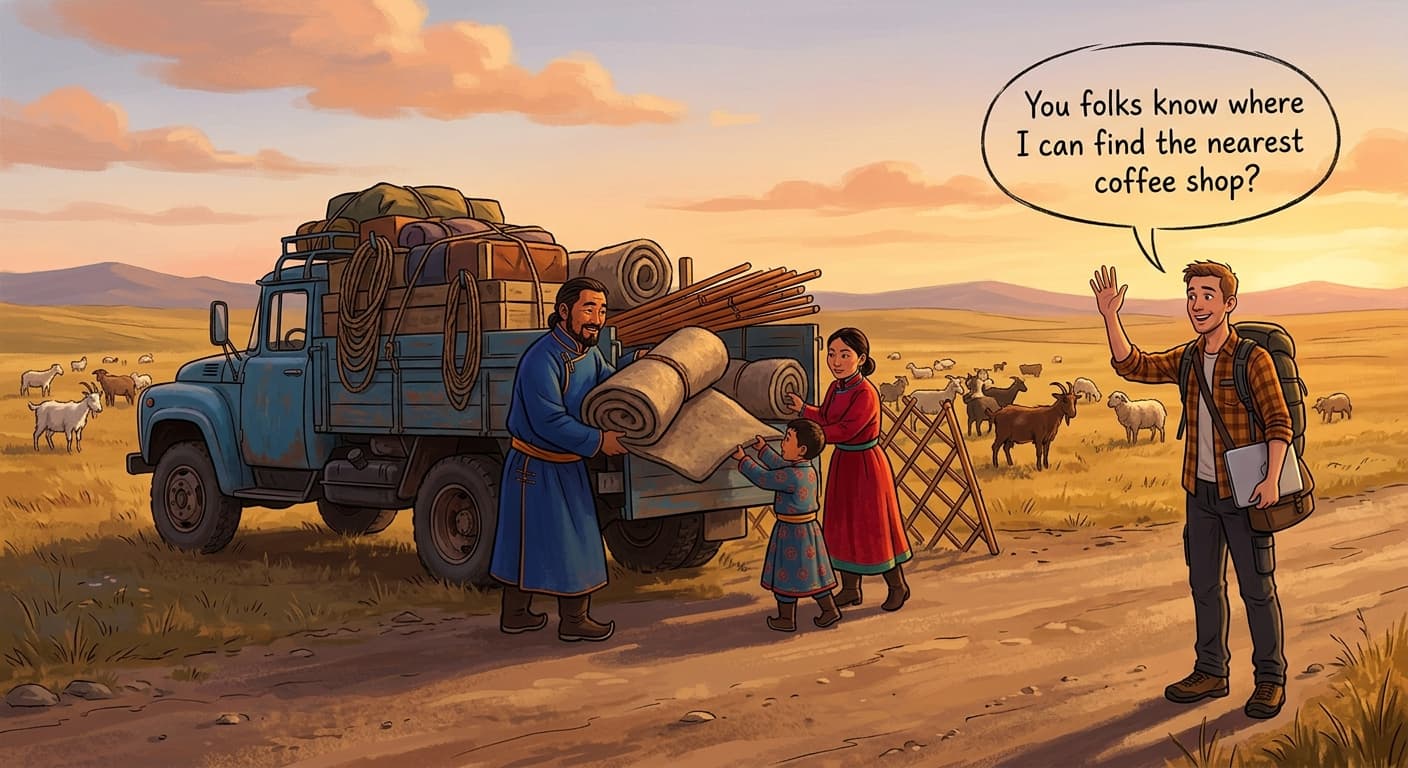
Somewhere in the Dzungarian Gobi, a herding family is loading its ger onto a truck for roughly the ninth time this year. Herders there change seasonal camps about nine times a year, moving 70 to 125 km between their furthest camps. The same week, a remote worker lands in a sixth city with a laptop bag and a booking that runs out in about six weeks. The average US digital nomad visited 6.2 places in 2025 and stayed 6.4 weeks in each.
Both live on the move. Some of what they deal with hasn't changed since Sumer. Some of it couldn't be further apart, and the gap that looks widest, family groups against people setting out alone, closes faster than it seems.
Both follow the resource that keeps them going
Gobi herders stay at a camp as long as the grass holds. Plant biomass and season best explain how long a camp gets used, and in winter, snow is the drinking water for herds and people alike. The pasture, not the date, decides when the family packs.
Nomads read a speed test the same way. In a 2022 survey, the main factors in choosing a destination were the cost of living and fast, accessible internet. Off-the-path places without good wifi rarely make the list. Grass and bandwidth are different things, but the rule is identical: leave before it runs out.
Both plan the route around a few pit stops
Transhumant herders from Senegal, Gambia, Mali and Mauritania travel 800 to 1,000 km a year, heading north as the rains begin. Their herds move along livestock corridors, one of them 110 km long and 100 meters wide, toward villages that offer water and services. In July, hundreds of families pass through Bousra Ndawène in Senegal every day.
Nomads have their own corridor stops. In Chiang Mai, coworking spaces became central infrastructure for the lifestyle, supplying desks, wifi and a ready-made crowd. On some Thai islands, a single coworking space was enough to turn the place into a nomad destination.
Both live in a home that packs down
A large family ger could be dismantled in an hour and carried on two or three horses, camels or yaks. Taking it down and putting it up is a family job, with children learning by watching their elders. Pack animals were the traditional method; today the truck often does the hauling.
The nomad version is lighter and less documented. No survey measures nomad luggage, and "one bag" is a culture, not a statistic. Highly mobile professionals, the closest group anyone has studied, value possessions for use in the moment rather than attachment, and treat them as tools for staying mobile.
Settled neighbors have always had complaints
A Sumerian poem more than 3,500 years old, "The Marriage of Martu," mocks the nomadic Martu as a man who "lives in a tent, exposed to wind and rain." He eats raw meat, has no house while alive and gets no burial when he dies.
In July 2025, hundreds marched through Mexico City's Roma and Condesa neighborhoods against gentrification, with the anger tied partly to efforts to attract digital nomads. One sign read "Gringo: Stop stealing our home." Professional short-term-let landlords are helping price locals out of their homes. How much nomads add on their own hasn't been measured; the evidence is mostly qualitative.
Not every protest is about nomads. In Barcelona in July 2024, about 2,800 protesters turned water pistols on tourists over mass tourism and housing costs. The grievance in Sumer was manners and burial. Now it's rent.
Both are moving less than they used to
That 6.2 is down from 6.6 places in 2024 and 7.2 in 2023. Herders are slowing down too. Many Mongolian families now make at least four camp changes a year, and the ger and belongings go into a truck that slowly follows the herd. Owning livestock no longer means moving camp often.
That's the common ground. The differences start with who travels together, and that one is smaller than it looks.
Herders move as families, nomads rebuild the group
This looks like the widest gap. Mongolian herders work in khot ail, "flexible groups of two to ten families" that share herding, seasonal moves and childcare. Sámi reindeer herders in Norway organize in siida, groups of reindeer owners who do the herding work together. In the Gobi, families even time a move by watching when the neighbors go.
Digital nomads start out differently, though not as differently as the stereotype suggests. Among nomads.com members, a paid community that is 83% men, 67% are single. Among US nomads, 54% are married or living with a partner. Nobody has measured how many set out alone.
The ones who arrive single don't stay alone long. Coworking desks hand them a community, mostly of other nomads rather than locals. Facebook groups, Slack, MeetUp and WhatsApp carry the ties from city to city, and nomads.com alone runs four member meetups a week, 191 a year. Loneliness on the road is possible but not inevitable. A herder is born into a group. A nomad assembles one from desks and chat channels.
Hospitality is owed in the desert, chosen on the road
Bedouin custom gives a guest the right to stay three and a third days. The rule exists because desert travel was impossible without it, and it runs both ways:
"Today's host is tomorrow's guest."
In Mongolia, visitors can turn up at a ger without prior notice and be served milk tea. Nomads have no such duty to one another. Their version is a meetup or a CouchSurfing host, and both are optional.
Eight seasons against a week in a city
Sámi and Yamal reindeer herders recognize eight seasons, each with its own demands. Gobi herders add a climb to the Altai highlands in summer, following fresh grass up the mountain. The calendar comes from the animals and the grass.
Nomads run on a much shorter clock. Nearly half of the city stays logged on nomads.com last less than a week. Nomads trade advice about winter in Southeast Asia and summer in Europe, but nobody has measured whether they actually follow that circuit.
Wealth that walks versus wealth that wires
For many Mongolian herder households, livestock is the main or only income, so a bad winter works like a bank failure. In the 2023 to 2024 dzud, a winter of mass livestock deaths, 4,957 herder households had lost more than 70% of their livestock by April 25, 2024. Most herders no longer raise animals for subsistence; they sell into a market economy, cashmere above all.
A nomad's wealth arrives by bank transfer and stops when a contract ends. How much depends on who's asked. Just over half of respondents in one 2023 survey earned €10,000 to €50,000 ($11,200 to $56,100) a year, while nomads.com members report a median of $85,000, a figure from a paid community that likely runs high.
A livelihood on one side, a lifestyle on the other
The 1925 film "Grass" showed the Bakhtiari of Iran, who migrate twice a year across the Zagros between winter and summer pastures, as people pushed by forces they couldn't control. Historical and anthropological evidence marks that portrait as unrepresentative or untrue. Herders make judgment calls: Gobi families put off the move to winter camp as long as pasture and weather allow.
Nomads picked the life, but the pick comes with rules. Nomad freedom demands heavy self-discipline and isn't always experienced as autonomous or free. One side moves for a living; the other lives to move, and neither is as free or as trapped as the cliché has it.
Children carry the herd forward and slow the road down
On the steppe, children are the next generation of herders. Some Mongolian boys are pulled out of classes to help their families herd, and one 15-year-old ran a 300-animal herd. Schooling now splits many families: mothers move to town with the children while fathers stay with the animals, an arrangement that can double household costs.
On the road, children are barely studied. Research on digital nomads covers almost only young, single, child-free professionals. Nomad families tend to put travel, freedom and self-actualization ahead of work when they uproot. One family in a 2024 case study decided frequent travel didn't suit older children. Family life tends to slow nomads down; whether it ends the life is unmeasured.
Winters push herders out, choice brings nomads home
Bad winters and poverty push Mongolian herders into the ger districts of Ulaanbaatar. In 2002 alone, about 40,000 people moved to the capital. Young herders and families whose herds are too small to live on head for towns too.
Nomads usually leave by choice, and usually early. Between 19% and 22% of US nomads return to a conventional life each year; 73% have been nomads for three years or less, and only 11% for more than five. The reasons follow a pattern covered in why digital nomads quit.
Side by side
Theme | Herders | Digital nomads | Same or different |
|---|---|---|---|
What sets the route | Grass and water | Wifi and cost of living | Same |
Stops along the way | Corridor villages with water | Coworking hubs | Same |
Home | A ger that packs in an hour | Light, though unmeasured | Same |
Settled neighbors | Mocked since Sumer | Rent protests | Same |
Pace | Fewer camp changes than before | Fewer stops each year | Same |
Who travels together | Groups of families | Often single, regroup fast | Smaller gap than it looks |
Hospitality | Owed to any guest | Chosen, at meetups | Different |
Calendar | Seasons set by the animals | Days and weeks per city | Different |
Wealth | The herd | Remote income | Different |
Motive | Livelihood | Lifestyle | Different |
Children | The next herders | Tend to slow the trip | Different |
Why they stop | Bad winters, small herds | Choice, often within a few years | Different |
In "The Marriage of Martu," the princess hears her friend's warning about the tent-dweller who eats raw meat and goes unburied. She marries him anyway.