Vilnius
🇱🇹 Lithuania
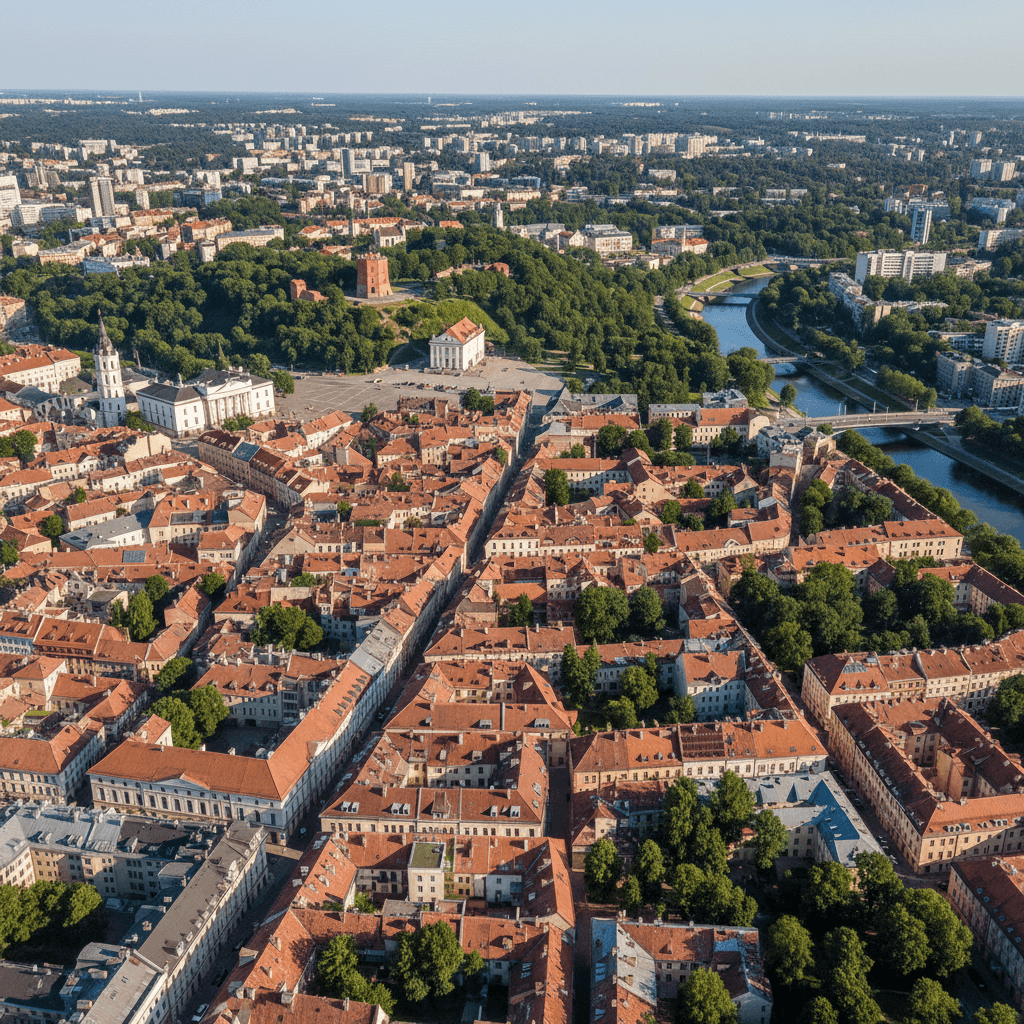
Vilnius is, honestly, a city that takes a little time to read. The Old Town is UNESCO-listed baroque, all amber-lit cobblestones and church spires that catch the late afternoon light, but walk ten minutes north into Šnipiškės and you're suddenly in a glass-and-steel fintech corridor where Revolut has an office and half the café crowd is on a Zoom call. That contrast, medieval and modern sitting right next to each other without much fuss, is what makes this place genuinely different from other European nomad spots.
The pace is slow. Not frustratingly so, just unhurried in a way that Western Europe mostly isn't anymore. Locals are reserved at first, don't mistake that for coldness, but once you're a regular at a place like Caffeine Roasters or you've found your corner in Workland, the city starts to open up.
Winters are brutal. We're talking -10°C, dark by 4pm and a grey that settles in for months, plenty of nomads tap out by January. Summers, though, are genuinely lovely: warm, green and long-eveninged, with Vingis Park filling up and the terraces in Užupis spilling out onto the riverbank. That's when the city earns its reputation.
Užupis deserves its own mention. It's a self-declared "republic" with its own tongue-in-cheek constitution posted on the wall, a bohemian pocket of galleries and independent cafés that smells faintly of coffee and river damp, it's weird and small and completely its own thing. Creative nomads tend to gravitate there instinctively.
Costs are low by EU standards, a comfortable month runs €1,200 to €1,800 all-in and the internet is, turns out, some of the fastest in Europe: fiber at 100 to 500 Mbps for €15 to €25 a month. The startup scene is real, not just marketing, with Vilnius Tech Park and a growing cluster of fintech companies giving the city actual economic momentum.
Four Michelin-starred restaurants, a pagan history that predates most of its neighbors' Christian ones and a quirky local pride that doesn't need outside validation. Vilnius doesn't perform for tourists, it just exists and that's weirdly refreshing.
Vilnius is, honestly, one of the more affordable European capitals you can actually live in comfortably. A single person spending around €1,200 to €1,500 a month gets a decent flat, eats well and doesn't feel like they're cutting corners. Budget harder and you can get by on €900, though that means cooking most meals at home and skipping the coworking spaces.
Rent is the biggest variable. Old Town studios run €650 to €900 and you're paying for the cobblestones and the café downstairs, not extra square footage. Žvėrynas and Naujamiestis are smarter picks for longer stays, where a one-bedroom goes for €500 to €750 and you're still close enough to everything that matters.
Monthly Budget Tiers
- Budget (€900 to €1,000): Žvėrynas or Šnipiškės flat around €500, home cooking keeping food to €220, public transport pass at €38
- Mid-range (€1,400 to €1,650): Old Town or Naujamiestis flat around €700, eating out three times a week, coworking at Workland for €150, Bolt rides adding €40 to €50
- Comfortable (€2,000+): Bigger flat in Šnipiškės around €800, upscale dining, gym membership around €35, a real social life budget
Food is cheap, turns out, even if you eat out regularly. A plate of cepelinai from a local spot costs €4 to €7, mid-range dinners at places like Bistro 18 or Gaspar's land around €12 to €20. Michelin spots like Džiaugsmas will run €50 or more per person, they're genuinely worth it once in a while but not a weekly habit.
Transport is almost laughably affordable. The monthly bus pass is €38, Bolt rides across the center rarely crack €8 and the city is walkable enough that some nomads don't bother with either. Utilities plus fiber internet typically runs €115 to €200 combined, with fiber speeds hitting 100 to 500 Mbps for €15 to €25 a month.
Coworking isn't free, obviously. Workland and Talent Garden charge €100 to €200 monthly, day passes run €10 to €20. Still cheap compared to Lisbon or Berlin, the quality is weirdly good for the price.
Vilnius splits neatly into distinct pockets, each with a different personality and honestly, picking the wrong one for your lifestyle will grind on you fast. Here's where different types of travelers actually land well.
Digital Nomads: Naujamiestis
Naujamiestis is where most nomads end up and for good reason. Rent runs €550-750 for a decent one-bedroom, the café scene is strong (Caffeine Roasters, Mint Vinetu) and you're close enough to Old Town without paying Old Town prices. The vibe is, turns out, closer to a mid-sized European creative district than anything Soviet-era, despite what the architecture suggests in spots.
- Rent (1BR): €550-750/month
- Best for: Coworking access, bar scene, central location
- Watch out for: Some blocks are still rough around the edges
Expats and Tech Workers: Šnipiškės
Šnipiškės sits across the river from Old Town and runs closer to €600-850 for a modern flat. It's sterile in parts, no question, but Revolut and the Vilnius Tech Park crowd gravitate here because the infrastructure is newer and English is, frankly, everywhere. Not charming. Functional and fast.
- Rent (1BR): €600-850/month
- Best for: Tech scene, modern apartments, startup networking
- Watch out for: Lacks neighborhood warmth
Families and Long-Term Expats: Žvėrynas
Žvėrynas is leafy, quiet and sits right on the edge of Vingis Park. Rents are weirdly affordable at €500-700 given the quality of life, you get tree-lined streets and actual calm, the trade-off being you'll Bolt into the center more than you'd like. Families consistently rate it the most livable neighborhood in the city.
- Rent (1BR): €500-700/month
- Best for: Green space, quiet residential feel, families
- Watch out for: Distance from nightlife and coworking hubs
Solo Travelers and Short Stays: Užupis
Užupis is its own thing entirely. It declared itself an independent republic, it has a constitution printed in dozens of languages on a mirrored wall and the galleries and riverside cafés smell like coffee and oil paint on a good afternoon. Rent matches Naujamiestis at €550-750, it's small though and weekend nightlife noise bleeds through thin walls. Skip it for a month-long stay, it's perfect for a week or two.
- Rent (1BR): €550-750/month
- Best for: Creative atmosphere, short stays, solo explorers
- Watch out for: Noise, limited amenities for longer stays
Lithuania ranks in the top five in Europe for internet speeds and you'll feel it. Fiber connections hit 100 to 500 Mbps for €15 to €25 a month, which is, honestly, embarrassingly good compared to most of Western Europe. Public WiFi in cafés is reliable enough that plenty of nomads never bother with a coworking membership at all.
For SIM cards, pick up a Telia, Tele2 or Bite starter pack at the airport or any kiosk for €5 to €20. Data plans run €8 to €15 a month and they work well across the whole city center. If you'd rather not deal with a physical SIM, Airalo and Saily both cover Lithuania without hassle.
The coworking scene, turns out, is more developed than you'd expect for a city this size. A few worth knowing:
- Workland: The most popular with nomads, multiple locations, monthly desks from €100 to €200, day passes around €10 to €20
- Talent Garden: Leans into events and community, good if you want to plug into the local startup crowd
- Spaces Works: Central, professional, better for calls and focused work than socializing
- TechZity and AltSpace: Smaller, scrappier, AltSpace has a weird nightlife-adjacent energy that either works for you or absolutely doesn't
That said, a lot of nomads just end up working from cafés. Mint Vinetu is a bookshop-café hybrid in the Old Town, quiet enough to actually concentrate, the smell of old paper and decent espresso making it easy to spend three hours there without noticing. Caffeine Roasters and Huracán Coffee both have solid WiFi and don't rush you out after one drink.
Naujamiestis is the best neighborhood to base yourself if coworking access matters, it's got the highest density of spaces and the cafés there skew more laptop-friendly than the tourist-heavy Old Town spots. Šnipiškės works too, especially if you're connecting with the fintech or startup crowd near Vilnius Tech Park.
One practical note: café WiFi passwords are usually on the receipt or a small card on the table, don't bother asking the staff in broken Lithuanian, they'll just hand you the card anyway.
Vilnius is, honestly, one of the safer capitals in Europe. Crime is low, the center feels relaxed even late at night and most nomads who've spent time here say they never felt genuinely threatened. That said, it's not entirely without edge: avoid poorly lit side streets after dark and skip unofficial taxis entirely. Use Bolt.
The neighborhoods that expats consistently recommend are Old Town, Naujamiestis and Žvėrynas. Stick to those and you'll rarely have a problem, the issues that do exist tend to cluster further out, away from where most nomads live and work anyway.
For emergencies, dial 112, it's free, works 24/7 and operators speak English. Pharmacies are everywhere; Eurovaistinė is the main chain and you'll spot one on almost every major street. They're well-stocked and staff are generally helpful even if your Lithuanian is nonexistent.
Healthcare quality is EU-standard. Public hospitals are functional, though wait times can be frustrating if it's not an emergency. Most expats and nomads skip the public queue and go private instead, a standard GP consultation runs around €30-50, which is cheap enough that it's barely worth agonizing over.
Insurance coverage breaks down like this:
- EU citizens with EHIC: Covered at public hospitals, no cost for emergency treatment
- Private travel/nomad insurance: Around €50-100 per month depending on your plan and age
- Out-of-pocket private clinic visit: Typically €30-70 for a consultation
If you're staying longer than a few weeks, get proper insurance sorted before you arrive. Turns out most people don't bother until something goes wrong, then they're scrambling.
One thing that catches people off guard: Vilnius winters are dark, genuinely dark and that affects how safe certain areas feel after 4pm. It's not dangerous, it just feels more disorienting than it actually is. Good lighting in the center helps, but venture into quieter residential streets in January at 5pm and you'll understand why locals walk fast.
Overall though, Vilnius doesn't demand the same level of constant alertness that some European capitals do. It's a city where you can, weirdly, actually relax a little.
Vilnius is, honestly, one of the most walkable capitals in Europe. The Old Town is compact enough that you can cross it in 20 minutes on foot and most of what nomads actually need day-to-day sits within a short walk or a cheap Bolt ride.
For longer distances, the bus and trolleybus network covers the city well. A monthly pass runs €38, managed through the Trafi or m.Ticket apps and it's genuinely reliable for a city this size. No metro, though, which surprises people expecting something more elaborate. You adapt fast.
Bolt is the go-to for rides, with most trips across the center landing between €4 and €8. Skip unofficial taxis entirely, they're not worth the hassle or the inflated fares. Uber operates here too, but Bolt dominates and tends to be quicker.
Cycling is a real option in warmer months. Cyclocity bikes offer annual memberships (check app for current pricing) and Bolt scooters are scattered across the center, useful for short hops between neighborhoods when the weather cooperates. In January at -10°C, though, that scooter is staying put.
Getting to and from the airport is straightforward. Bus lines 1, 2, 3G and 88 connect Vilnius Airport (VNO) to the center in around 15 minutes for €1 to €2, Bolt runs about €10 and takes the same time. Most nomads just take the bus on arrival, it drops you close enough to Old Town that it's a non-issue.
For car access without owning one, CityBee is the local carshare option and works well for day trips out to Trakai or Kernavė. It's app-based and turns out to be cheaper than renting for short excursions.
- Monthly bus pass: €38 via Trafi or m.Ticket apps
- Bolt/Uber rides: €4 to €8 across the center
- Cyclocity bike membership: Annual memberships available via app
- Airport bus (1, 2, 3G, 88): €1 to €2, roughly 15 minutes
- Airport by Bolt: around €10
- Carshare: CityBee, app-based, good for day trips
The city doesn't need a car. Most nomads who arrive thinking they'll want one change their minds within a week.
Lithuanian is the official language, one of the oldest living Indo-European languages and locals are genuinely proud of it. Don't stress though, English proficiency in the center is, honestly, high enough that you can live comfortably without learning a single word of Lithuanian. The tech crowd, café staff, coworking receptionists, most people under 40: they'll switch to English without hesitation.
Outside the center it gets patchier. Older residents and outer-neighborhood shop workers sometimes don't speak English at all and you'll occasionally hear Russian as a fallback, a legacy of Soviet-era demographics. It's not a problem so much as a reminder that you're not in a capital city built around tourism.
A few Lithuanian words go a long way, they won't make you fluent but they'll earn you a warmer reception from people who are, weirdly, more reserved than most Europeans until you make the first move.
- Labas , hello
- Ačiū (ah-choo) , thank you
- Taip / Ne , yes / no
- Prašom , please / you're welcome
- Kaip sekasi? , how are you?
- Atsiprašau , excuse me / sorry
The pronunciation trips people up. Lithuanian is phonetic but the sounds are unfamiliar, the "ž" is a soft "zh" sound, the "š" is "sh," and the letter combinations don't behave like anything in English. Give it a shot anyway. Mispronouncing ačiū in a bakery in Naujamiestis will get you a smile, not a grimace.
For apps, Google Translate handles Lithuanian well enough for menus and signs, turns out the camera translation feature is genuinely useful in older shops where nothing's in English. Ling and Simply Learn Lithuanian are solid for picking up basics before you arrive.
One practical note: restaurant menus in Old Town and Naujamiestis are almost always bilingual. Markets and pharmacies like Eurovaistinė usually have at least one English-speaking staff member. The city isn't going to punish you for not speaking Lithuanian, it's just more interesting if you try.
Vilnius has four distinct seasons and they're not equally pleasant. Summers are genuinely lovely, winters are genuinely rough and that's the honest version of the pitch.
June through August is the sweet spot. Temperatures sit around 20-25°C, the Old Town smells like linden blossoms and fresh coffee and the long northern evenings stretch past 10pm. Locals spill out onto terraces in Užupis, parks fill up and the city feels, honestly, like a different place entirely compared to what you'd find in February. Most nomads who've done a Vilnius stint say summer is when the city clicks.
Spring and early autumn are solid second choices. May and September bring mild temperatures, fewer crowds and cheaper short-term rentals, the trade-off is unpredictable rain that can arrive sideways with no warning. Pack a layer regardless of the forecast.
Then there's winter. December through February is cold in a way that gets into your bones, with average highs around -1°C and lows dropping to -7°C or below, sometimes hitting -15°C during bad spells. The days are short and grey, the streets go quiet and the darkness by 4pm is something you either adapt to or don't. That said, snow does make the baroque Old Town look genuinely beautiful, it's just that the novelty wears off around week three.
Here's a quick breakdown by season:
- Summer (Jun-Aug): 20-25°C, long days, best café and park culture, some rain in June (around 10 rainy days)
- Spring (Apr-May): 10-18°C, unpredictable but fresh, good value for accommodation
- Autumn (Sep-Oct): 8-16°C, crisp air, quieter streets, good for focused work
- Winter (Nov-Mar): -1 to -15°C, snow likely, short days, dark by mid-afternoon
Rain, weirdly, is spread fairly evenly across the year, so there's no truly dry season to plan around. Umbrella stays in the bag year-round.
If you're choosing when to visit, June or September hit the balance best: good weather, no peak tourist chaos and the city's coworking spaces and café scene are fully operational without feeling overrun.
Get a local SIM on arrival, it's the first thing experienced nomads do. Telia, Bite and Tele2 all have kiosks at the airport and in the center; starter packs run €5-20 and include solid 4G data. If you're only passing through, an eSIM from Airalo works fine and you can set it up before you land.
Banking is, honestly, almost frictionless here. Vilnius is a fintech hub (Revolut has offices in the city), so SEPA transfers are fast and most places accept cards. Still, carry a little cash for markets and smaller cafés in the Old Town.
For apartments, skip the generic booking platforms and go straight to Aruodas.lt or the Facebook groups for expats in Vilnius. You'll find better prices and more flexibility, studios in Naujamiestis or Žvėrynas typically run €550-750 a month and landlords are generally straightforward to deal with. One thing: most Lithuanians expect you to remove your shoes at the door. Do it without being asked, it goes a long way.
The city charges a tourist tax of €2 per night, which turns out applies to short-term rentals too, not just hotels. Budget for it if you're staying in an Airbnb.
Getting around is easy. The bus and trolleybus network covers most of the city for €38 a month via the m.Ticket or Trafi apps and Bolt rides within the center are usually €4-8. Don't use unmarked taxis; Bolt is cheaper and you won't get stung on the price.
Day trips are genuinely worth building into your schedule. Trakai Castle is 30 minutes by bus or train and costs almost nothing to get to, Kernavė is a UNESCO-listed set of pagan hill forts that most visitors, weirdly, skip entirely.
A few more things worth knowing:
- Emergency number: 112, free from any phone
- Pharmacies: Eurovaistinė is everywhere; no prescription needed for most basics
- English: Strong among younger locals and anyone in tech; don't expect it from older generations
- Winters: Dark and genuinely cold, -5 to -15°C from December through February; plan accordingly or plan to leave
- Nomad meetups: Search "Digital Nomads Vilnius" on Meetup.com and Facebook; the community is small but active
Need visa and immigration info for Lithuania?
🇱🇹 View Lithuania Country GuideNomad Haven
Your home away from home